SP 800-90B Overview* John Kelsey, NIST, May 2016 * Revised to - - PowerPoint PPT Presentation

sp 800 90b overview
SMART_READER_LITE
LIVE PREVIEW

SP 800-90B Overview* John Kelsey, NIST, May 2016 * Revised to - - PowerPoint PPT Presentation

SP 800-90B Overview* John Kelsey, NIST, May 2016 * Revised to correct some errors discovered after the presentation was given. Updated/new slides are starred. Preliminaries SP 800-90 Series, 90B, and RBGs Entropy Sources Min-Entropy


slide-1
SLIDE 1

SP 800-90B Overview*

John Kelsey, NIST, May 2016

* Revised to correct some errors discovered after the presentation was given. Updated/new slides are starred.
slide-2
SLIDE 2

Preliminaries

  • SP 800-90 Series, 90B, and RBGs
  • Entropy Sources
  • Min-Entropy
  • History of the Document

2/40

slide-3
SLIDE 3

What’s SP 800-90? What’s 90B?

An RBG is used as a source of random bits for cryptographic or other purposes.

  • The SP 800-90 series is about how to build random bit generators
  • SP 800-90A describes deterministic mechanisms, called DRBGs
  • SP 800-90B describes entropy sources
  • SP 800-90C describes how to put them together to get RBGs

90B is about how to build, test, and validate entropy sources.

slide-4
SLIDE 4

What is an Entropy Source?

  • SP 800-90B is about how to build an entropy source.
  • Entropy sources are used in SP 800-90 to provide seed material for

DRBG mechanisms, among other things.

  • An entropy source provides:
  • Bits or bitstings of fixed length
  • with a guaranteed minimum entropy per output
  • with continuous health testing to ensure the source keeps working

An entropy source is a black box that provides you entropy (unpredictable bits with a known amount of entropy) on demand.

slide-5
SLIDE 5

So, What’s Entropy Then?

  • Entropy (specifically, min-entropy) is how we quantify

unpredictability.

  • If there’s no way to guess X with more than a 2-h probability of being

right, then X has h bits of entropy.

  • For a distribution with probabilities p1, p2, …, pk:

h = -lg( max(p1, p2, …, pk ) )

  • Sometimes, we use the word “entropy” to mean unpredictability.
  • Sometimes, we use it to mean the amount of unpredictability, in

terms of min-entropy.

slide-6
SLIDE 6

SP800-90B History

  • Previous version published August 2012
  • RNG workshop in 2012
  • Snowden / Dual EC blowup
  • Big changes:
  • Reworked the IID tests
  • Sanity checks  Additional estimates
  • Big improvements of tests of non-iid data
  • Updated and improved health tests
  • Restart Tests
  • Post-processing
  • Vetted conditioning functions moved here from 90C
slide-7
SLIDE 7

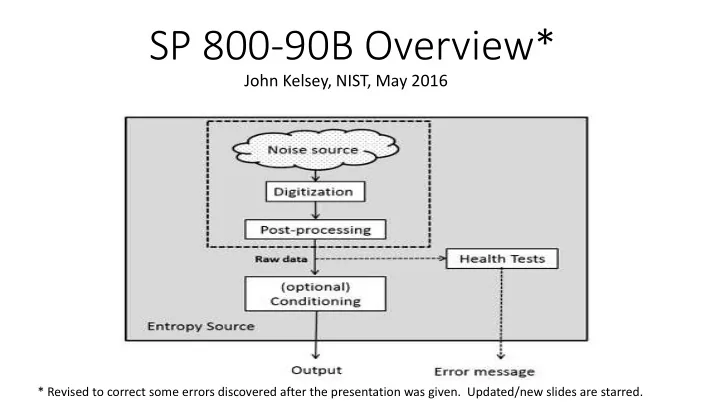
Components of an Entropy Source

 Noise Source

Where the entropy comes from

 Post-processing

Optional minimal processing of noise source outputs before they are used.

 Health tests

Verify the noise source is still working correctly

 Conditioning

Optional processing of noise source outputs before output.

7/40

slide-8
SLIDE 8

Noise Source

  • A noise source provides bitstrings with some inherent

unpredictability.

  • Nondeterministic mechanism + sampling + digitization = noise source.
  • Every entropy source must have a noise source.
  • Common examples: ring oscillators, interrupt timings.
  • The noise source is the core of an entropy source—it’s the thing that

actually provides the unpredictability

slide-9
SLIDE 9

Post-Processing

  • Post-processing is minimal processing done to noise-source outputs

before they are used or tested.

  • Post-processing is optional—not all entropy sources use it.
  • There are a small set of allowed post-processing algorithms:
  • Von Neumann Unbiasing
  • Linear Masking
  • Run Counting
slide-10
SLIDE 10

Health Tests

  • Health tests attempt to detect major failures in the noise source.
  • They are REQUIRED for all entropy sources.
  • Health testing splits into:
  • Startup testing = one-time test done before any outputs are used
  • Continuous testing = testing done in the background during normal operation
  • 90B defines two health tests
  • Designers may use those, or provide their own tests and demonstrate

that their tests detect the same failures.

slide-11
SLIDE 11

Conditioning

  • Conditioning processes the noise source outputs to increase their

entropy/bit before they are output from the entropy source.

  • Conditioning is optional—not all entropy sources incorporate a

conditioning component.

  • 90B specifies a set of six “vetted” conditioning functions based on

cryptographic mechanisms.

  • Vendors may also design or select their own conditioning functions.
  • 90B describes the entropy accounting used for conditioning functions.
slide-12
SLIDE 12

Components Wrapup

 Noise Source

Where the entropy comes from

 Post-processing

Optional minimal processing of noise source outputs before they are used.

 Health tests

Verify the noise source is still working correctly

 Conditioning

Optional processing of noise source outputs before output.

slide-13
SLIDE 13

The Validation Process

  • Documentation
  • Estimating entropy
  • Design requirements

13/40

slide-14
SLIDE 14

Documentation Requirements

  • Full description of how the source works
  • Justification for why noise source has entropy
  • Entropy estimate and whether source might be iid
  • Description of post-processing and conditioning, if used
  • Description of alternative health tests, if used
  • Description of how data collection was done
slide-15
SLIDE 15

Entropy Estimation: Testing the Noise Source

8

439 440

Estimate entropy - Non-IID track (Section 6.2) Validation fails. No entropy estimate awarded. Update entropy estimate (Section 3.1.4) Is conditioning used? Update entropy estimate (Section 3.1.5) Estimate entropy - IID track (Section 6.1) Apply Restart Tests (Section 3.1.4) Pass restart tests? Data collection (Section 3.1.1) Determine the track (Section 3.1.1) Start validation Validation at entropy estimate.

Non-IID track Yes IID track No Yes No

Figure 2 Entropy Estimation Strategy

  • Data collection
  • IID vs non-IID
  • Entropy estimation
  • Restart tests

15/40

slide-16
SLIDE 16

Data Collection

  • Entropy estimation requires lots of data from raw noise source, and

possibly some data from conditioned outputs.

  • Ideally, device has a defined way to get test access to raw noise

source bits.

  • If not, submitter may need to do data collection.
  • Submitter must justify why his method for data collection won’t alter

behavior of source.

  • Must also describe exactly how data collection was done.
slide-17
SLIDE 17

What Data is Collected?

Two datasets from raw noise source samples—always required:

  • Sequential dataset: 1,000,000 successive samples from noise source
  • Restart dataset: 1,000 restarts, 1,000 samples from each restart
  • Restart = power cycle, hard reset, reboot

One dataset from conditioned outputs—sometimes required

  • Conditioner dataset: 1,000,000 successive samples from conditioner
  • Only required if design uses a non-vetted conditioning function.
slide-18
SLIDE 18

Entropy Estimation: Testing the Noise Source

8

439 440

Estimate entropy - Non-IID track (Section 6.2) Validation fails. No entropy estimate awarded. Update entropy estimate (Section 3.1.4) Is conditioning used? Update entropy estimate (Section 3.1.5) Estimate entropy - IID track (Section 6.1) Apply Restart Tests (Section 3.1.4) Pass restart tests? Data collection (Section 3.1.1) Determine the track (Section 3.1.1) Start validation Validation at entropy estimate.

Non-IID track Yes IID track No Yes No

Figure 2 Entropy Estimation Strategy

  • Data collection from noise source

(optionally with post-processing)

  • IID vs non-IID
  • Entropy estimation
  • Restart tests
slide-19
SLIDE 19

Determining the Track (IID or Non-IID)

IID = Independent and Identically Distributed

  • IID means each sample independent of all others, independent of

position in sequence of samples How do we determine if source is iid?

  • If designer says source is NOT iid, then it’s NEVER evaluated as iid
  • Otherwise, run a bunch of statistical tests to try to prove that source

is NOT iid

  • If we can’t disprove it, we assume source is iid for entropy estimation
slide-20
SLIDE 20

Entropy Estimation: Testing the Noise Source

8

439 440

Estimate entropy - Non-IID track (Section 6.2) Validation fails. No entropy estimate awarded. Update entropy estimate (Section 3.1.4) Is conditioning used? Update entropy estimate (Section 3.1.5) Estimate entropy - IID track (Section 6.1) Apply Restart Tests (Section 3.1.4) Pass restart tests? Data collection (Section 3.1.1) Determine the track (Section 3.1.1) Start validation Validation at entropy estimate.

Non-IID track Yes IID track No Yes No

Figure 2 Entropy Estimation Strategy

  • Data collection from noise source

(optionally with post-processing)

  • IID vs non-IID
  • Entropy estimation
  • Restart tests
slide-21
SLIDE 21

Entropy Estimation*

IID Case:

  • Estimate entropy by counting most common value and doing some very

simple statistics.

  • Presentation on this later today.

Non-IID Case:

  • Apply many different entropy estimators against sequential dataset.
  • Take minimum of all resulting estimates.
  • Presentation on this later today.

Sample implementations of entropy estimation can be found at: https://github.com/usnistgov/SP800-90B_EntropyAssessment

slide-22
SLIDE 22

Entropy Estimation—Combining Estimates*:

  • H[original]
  • We do entropy estimation (iid or noniid) on the sequential dataset.
  • H[binary]
  • If the sequential dataset is not binary, we convert it to binary and do a second

estimate on the first 1,000,000 bits that result.

  • H[submitter]
  • The submitter had to estimate the entropy in his documentation package.
  • H[I] = min(H[original,H[binary],H[submitter])
  • Just take the smallest estimate of the three (or two, if it’s binary data)
slide-23
SLIDE 23

Entropy Estimation: Testing the Noise Source

8

439 440

Estimate entropy - Non-IID track (Section 6.2) Validation fails. No entropy estimate awarded. Update entropy estimate (Section 3.1.4) Is conditioning used? Update entropy estimate (Section 3.1.5) Estimate entropy - IID track (Section 6.1) Apply Restart Tests (Section 3.1.4) Pass restart tests? Data collection (Section 3.1.1) Determine the track (Section 3.1.1) Start validation Validation at entropy estimate.

Non-IID track Yes IID track No Yes No

Figure 2 Entropy Estimation Strategy

  • Data collection from noise source

(optionally with post-processing)

  • IID vs non-IID
  • Entropy estimation
  • Restart tests

* This is leaving out some details. See the full

90B draft for the full picture.

slide-24
SLIDE 24

What Are Restart Tests?

  • Some noise sources look a lot worse across restarts.
  • Restart = power cycle, hard reset, reboot
  • Example: Repeated RSA prime factors
  • Restart testing attempts to detect predictability that only becomes

apparent when examining many sequences generated by a source across restarts.

slide-25
SLIDE 25

Restart Datasets

Restart dataset is a 1,000 x 1,000 matrix of samples

  • Each row is 1,000 successive samples, taken after the source restarted
  • Column K is the Kth sample from each restart.

Use the matrix to generate two additional datasets:

  • Row dataset = concatenate the rows together to make a 1,000,000

sample sequence

  • Column dataset = concatenate the columns together to make a

1,000,000 sample sequence

slide-26
SLIDE 26

Restart Testing*

  • We start with entropy estimate H[I] from previous step.
  • Use sequential entropy estimation techniques on row and column dataset:
  • results -> H[r], H[c]
  • Two chances for the source to fail validation:
  • Most Common Value in the Rows and Columns:
  • Use H[I] to compute an upper bound on number of times most common value

should appear in a column or row.

  • If any row or column exceeds upper bound, then the source fails validation.
  • Is H[r] or H[c] *too* low?
  • If min(H[r],H[c]) < H[I]/2, then the source fails validation.
slide-27
SLIDE 27

Entropy Estimation Wrapup*

  • H[original] = original entropy estimate from sequential dataset
  • H[submitter] = submitter’s original entropy estimate
  • H[binary] = estimate from binary version of data (sometimes)
  • H[r] = row dataset entropy estimate
  • H[c] = column dataset entropy estimate
  • All combined to give us the final estimate:

H[final] = min(H[original],H[submitter],H[binary],H[r],H[c])

slide-28
SLIDE 28

Entropy Estimation: Wrapup*

8

439 440

Estimate entropy - Non-IID track (Section 6.2) Validation fails. No entropy estimate awarded. Update entropy estimate (Section 3.1.4) Is conditioning used? Update entropy estimate (Section 3.1.5) Estimate entropy - IID track (Section 6.1) Apply Restart Tests (Section 3.1.4) Pass restart tests? Data collection (Section 3.1.1) Determine the track (Section 3.1.1) Start validation Validation at entropy estimate.

Non-IID track Yes IID track No Yes No

Figure 2 Entropy Estimation Strategy

  • Collect the data
  • IID or non-IID
  • Sequential dataset -> h[sequential]
  • Restart testing
  • May fail the source
  • May lower the estimate
  • h[final] = minimum of all estimates
  • sequential, submitter, binary,

row, column,

  • Either FAIL source, or we have

entropy estimate for noise source.

slide-29
SLIDE 29

So, What’s the Problem With All This?

  • No set of general-purpose statistical tests can measure the entropy per

sample in an arbitrary sequence of values.

  • Right way to build a noise source is:
  • Design your noise source
  • Understand it
  • Model it
  • Use your model to estimate its entropy
  • Run general-purpose tests on outputs as a sanity check.
  • We require design documentation and an entropy estimate from designer to

support this...

  • ...but we’re limited in what resources we can demand for validation testing,

and what expertise we can require from labs. This approach is the best we know how to do given existing constraints.

slide-30
SLIDE 30

Design Requirements

Noise source is validated by examining documentation and entropy estimation. We still need to validate:

  • post-processing
  • health tests
  • conditioning.

29/40

slide-31
SLIDE 31

Post-Processing

  • There are three algorithms for post-processing permitted:
  • Von Neuman’s Method
  • Common method for unbiasing a biased but iid source
  • Note: applying it to a source with some dependencies can make things worse
  • 00 or 11 -> no output; 01 -> 1 bit output, 10 -> 0 bit output
  • Linear Filtering
  • Apply any linear function to w-bit (non-overlapping) blocks to produce output
  • Length of Runs
  • Count the lengths of runs
  • 000001111000110 -> 5,4,3,2,1
  • Documentation specifies which (if any) post-processing function is used.
slide-32
SLIDE 32

Conditioning

  • There are six vetted conditioning functions based on cryptographic

functions

  • HMAC, CMAC, CBC-MAC, any approved hash function, hash-df, bc-df
  • These are all algorithms, so the implementation can be validated.
  • Designers may also use any conditioning function they like.
  • Documentation must specify the conditioning function.
  • Additional data collection and testing used for these functions.
  • Validation has to verify the entropy accounting.
  • See presentation later today on conditioning functions.
slide-33
SLIDE 33

Health Tests: Big Picture

Noise sources can be fragile. Thus, all entropy sources MUST have health tests.

  • Health tests examine the raw noise source outputs, NOT conditioned
  • utputs.
  • Tests must have minimal performance impact.
  • False positive rate is important
  • 90B has two recommended health tests
  • Designers can use ours or make up their own
  • with some extra requirements
slide-34
SLIDE 34

Why is False Positive Rate Important?

  • Health tests run continuously
  • They process every raw noise source output.
  • Many sources can produce millions of outputs per hour
  • A 10-6 false positive rate means > one failure per hour!
  • False positive rate needs to be tuned to make sure expected number
  • f failures of healthy noise sources is acceptably small!
  • This is a tradeoff—the lower the false positive rate, the larger the

failure of the noise source that won’t be detected!

  • We think values between 2-40 and 2-50 are usually reasonable.
slide-35
SLIDE 35

Health Tests: Continuous vs Startup

  • Continuous Tests
  • Going on all the time behind the scenes—noise source outputs continue to be

used unless the test detects a problem

  • If the tests detect a problem, this is signaled somehow to the device or calling
  • application. Normally, you’d expect to see an error message or a device

failure here.

  • Startup Tests
  • Run on a sequence of noise source samples at startup, before those samples

may be used for anything.

  • If the tests detect a problem, then the device refuses to function.
slide-36
SLIDE 36

Our Health Tests

  • Repetition Count Test – Detect when the source gets “stuck” on one
  • utput for much longer than expected.
  • Adaptive Proportion Test – Detect when one value becomes much

more common in output than expected.

  • Note that tests:
  • Require minimal resources
  • Outputs can be used as they are produced
  • Allow tunable false-positive rates
slide-37
SLIDE 37

Repetition Count

The repetition count test is an updated version of the “stuck test.”

  • Let H = entropy estimate for noise source
  • P[max] = 2^{-H} is maximum probability for any value.
  • Probability of seeing T identical values in a row <= P[max](T-1)
  • Choose T so that P[max](T-1) is small enough that false positives aren’t

important (for example, 2-50).

  • Memory requirements = previous sample value, counter of how many

repetitions were seen

slide-38
SLIDE 38

Adaptive Proportion Test

The Adaptive Proportion Test tries to detect when one particular value has become much more common than expected.

  • Choose window size (W): 512 for nonbinary sources, 1024 for binary
  • Based on entropy/sample (H), W, and acceptable false positive rate,

choose cutoff value C.

  • Every W samples, the test restarts.
  • We take the first sample in the window, and count how many times it

appears in the whole window.

  • If it appears C or more times, then we detect an error condition.
slide-39
SLIDE 39

Alternative Tests

  • Designers should understand their sources much better than we can,

when writing this document.

  • So we allow designers to specify their own continuous health tests, if

they meet the requirements: (H = entropy/sample of noise source)

  • If a single value appears more than 100/H times in a row, the tests must

detect this with high probability.

  • If a single value begins to appear with probability P >= 2-H/2, the tests must

detect this with acceptable probability.

  • Designers can provide statistical simulations or some other proof that

their tests meet these requirements.

slide-40
SLIDE 40

Startup Testing

  • Startup testing happens when the module starts up.
  • The noise source generates a pool of at least 4096 samples, with the

continuous health tests running. The samples CANNOT be used until the testing is complete.

  • If no error is detected, then the module MAY use or discard those

samples.

  • The designers MAY include additional tests at startup.
slide-41
SLIDE 41

Wrapup

41/40

slide-42
SLIDE 42

Wrapup: Lots of New Stuff in SP 800-90B

  • Documentation requirements
  • Data collection requirements
  • Entropy estimation
  • Restart testing
  • Post-processing
  • Conditioning
  • Health Tests
slide-43
SLIDE 43

Wrapup: Open Questions

  • Post-processing functions
  • Are they necessary?
  • What else should be included?
  • What should be removed?
  • Testing strategy
  • How can we improve this, given constraints on cost of evaluation and lab

resources?

  • Health tests