Sparse matrix partitioning, ordering, and visualisation by Mondriaan - - PowerPoint PPT Presentation

sparse matrix partitioning ordering and visualisation by
SMART_READER_LITE
LIVE PREVIEW

Sparse matrix partitioning, ordering, and visualisation by Mondriaan - - PowerPoint PPT Presentation

Sparse matrix partitioning, ordering, and visualisation by Mondriaan 3.0 Outline Partitioning Matrix-vector Rob H. Bisseling, Albert-Jan Yzelman, Bas Fagginger Auer Movies Hypergraphs Ordering Mathematical Institute, Utrecht University SBD


slide-1
SLIDE 1

Outline Partitioning

Matrix-vector Movies Hypergraphs

Ordering

SBD

Conclusions

1
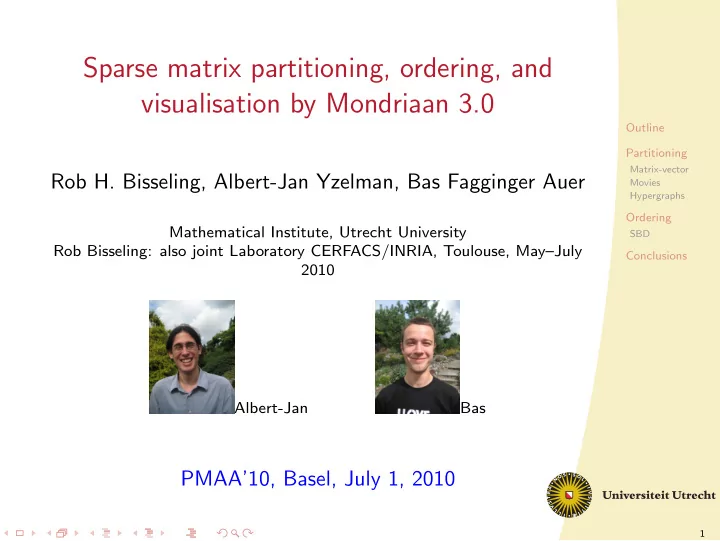
Sparse matrix partitioning, ordering, and visualisation by Mondriaan 3.0

Rob H. Bisseling, Albert-Jan Yzelman, Bas Fagginger Auer

Mathematical Institute, Utrecht University Rob Bisseling: also joint Laboratory CERFACS/INRIA, Toulouse, May–July 2010 Albert-Jan Bas

PMAA’10, Basel, July 1, 2010

slide-2
SLIDE 2

Outline Partitioning

Matrix-vector Movies Hypergraphs

Ordering

SBD

Conclusions

2

Motivation: supercomputer 109/500 (June 2010)

◮ National supercomputer Huygens named after Christiaan

  • Huygens. Wikipedia: . . . Ausserdem konnte er durch die

bessere Aufl¨

  • sung seines Teleskops erkennen, dass das, was

Galilei als Ohren des Saturns bezeichnet hatte, in Wirklichkeit die Saturnringe waren.”

◮ Huygens, the machine, has 104 nodes ◮ Each node has 16 processors ◮ Each processor has 2 cores and a a shared L3 cache ◮ Each core has a local L1 and L2 cache

slide-3
SLIDE 3

Outline Partitioning

Matrix-vector Movies Hypergraphs

Ordering

SBD

Conclusions

3

Parallel sparse matrix–vector multiplication u := Av

A sparse m × n matrix, u dense m-vector, v dense n-vector ui :=

n−1

  • j=0

aijvj

1 22 2 3 5 5 9 1 3 4 6 5 8 4 6 41 3 1 9 2 64 9 1

u v A

p = 2 4 supersteps: communicate, compute, communicate, compute

slide-4
SLIDE 4

Outline Partitioning

Matrix-vector Movies Hypergraphs

Ordering

SBD

Conclusions

4

Divide evenly over 4 processors

slide-5
SLIDE 5

Outline Partitioning

Matrix-vector Movies Hypergraphs

Ordering

SBD

Conclusions

5

Avoid communication completely, if you can

All nonzeros in a row or column have the same colour.

slide-6
SLIDE 6

Outline Partitioning

Matrix-vector Movies Hypergraphs

Ordering

SBD

Conclusions

6

Permute the matrix rows/columns

First the green rows/columns, then the blue ones.

slide-7
SLIDE 7

Outline Partitioning

Matrix-vector Movies Hypergraphs

Ordering

SBD

Conclusions

7

Combinatorial problem: sparse matrix partitioning

Problem: Split the set of nonzeros A of the matrix into p subsets, A0, A1, . . . , Ap−1, minimising the communication volume V (A0, A1, . . . , Ap−1) under the load imbalance constraint nz(Ai) ≤ nz(A) p (1 + ǫ), 0 ≤ i < p.

slide-8
SLIDE 8

Outline Partitioning

Matrix-vector Movies Hypergraphs

Ordering

SBD

Conclusions

8

The hypergraph connection

4 2 1 3 6 8 5 7

Hypergraph with 9 vertices and 6 hyperedges (nets), partitioned over 2 processors, black and white

slide-9
SLIDE 9

Outline Partitioning

Matrix-vector Movies Hypergraphs

Ordering

SBD

Conclusions

9

1D matrix partitioning using hypergraphs

1 2 3 4 5 0 1 2 3 4 5 6

vertices nets ◮ Hypergraph H = (V, N) ⇒ exact communication volume

in sparse matrix–vector multiplication.

◮ Columns ≡ Vertices: 0, 1, 2, 3, 4, 5, 6.

Rows ≡ Hyperedges (nets, subsets of V): n0 = {1, 4, 6}, n1 = {0, 3, 6}, n2 = {4, 5, 6}, n3 = {0, 2, 3}, n4 = {2, 3, 5}, n5 = {1, 4, 6}.

slide-10
SLIDE 10

Outline Partitioning

Matrix-vector Movies Hypergraphs

Ordering

SBD

Conclusions

10

(λ − 1)-metric for hypergraph partitioning

◮ 138 × 138 symmetric matrix bcsstk22, nz = 696, p = 8 ◮ Reordered to Bordered Block Diagonal (BBD) form ◮ Split of row i over λi processors causes

a communication volume of λi − 1 data words

slide-11
SLIDE 11

Outline Partitioning

Matrix-vector Movies Hypergraphs

Ordering

SBD

Conclusions

11

Cut-net metric for hypergraph partitioning

◮ Row split has unit cost, irrespective of λi

slide-12
SLIDE 12

Outline Partitioning

Matrix-vector Movies Hypergraphs

Ordering

SBD

Conclusions

12

Mondriaan 2D matrix partitioning

◮ p = 4, ǫ = 0.2, global non-permuted view

slide-13
SLIDE 13

Outline Partitioning

Matrix-vector Movies Hypergraphs

Ordering

SBD

Conclusions

13

Fine-grain 2D matrix partitioning

◮ Each individual nonzero is a vertex in the hypergraph,

C ¸ataly¨ urek and Aykanat, 2001.

slide-14
SLIDE 14

Outline Partitioning

Matrix-vector Movies Hypergraphs

Ordering

SBD

Conclusions

14

Mondriaan 2.0, Released July 14, 2008

◮ New algorithms for vector partitioning. ◮ Much faster, by a factor of 10 compared to version 1.0. ◮ 10% better quality of the matrix partitioning. ◮ Inclusion of fine-grain partitioning method ◮ Inclusion of hybrid between original Mondriaan and

fine-grain methods.

◮ Can also handle p = 2q.

slide-15
SLIDE 15

Outline Partitioning

Matrix-vector Movies Hypergraphs

Ordering

SBD

Conclusions

15

Matrix lns3937 (Navier–Stokes, fluid flow)

Splitting the sparse matrix lns3937 into 5 parts.

slide-16
SLIDE 16

Outline Partitioning

Matrix-vector Movies Hypergraphs

Ordering

SBD

Conclusions

16

Recursive, adaptive bipartitioning algorithm

MatrixPartition(A, p, ǫ) input: p = number of processors, p = 2q ǫ = allowed load imbalance, ǫ > 0.

  • utput:p-way partitioning of A with imbalance ≤ ǫ.

if p > 1 then q := log2 p; (Ar

0, Ar 1) := h(A, row, ǫ/q); hypergraph splitting

(Ac

0, Ac 1) := h(A, col, ǫ/q);

(Af

0, Af 1) := h(A, fine, ǫ/q);

(A0, A1) := best of (Ar

0, Ar 1), (Ac 0, Ac 1), (Af 0, Af 1);

maxnz := nz(A)

p

(1 + ǫ); ǫ0 := maxnz

nz(A0) · p 2 − 1; MatrixPartition(A0, p/2, ǫ0);

ǫ1 := maxnz

nz(A1) · p 2 − 1; MatrixPartition(A1, p/2, ǫ1);

else output A;

slide-17
SLIDE 17

Outline Partitioning

Matrix-vector Movies Hypergraphs

Ordering

SBD

Conclusions

17

Mondriaan version 1 vs. 3 (Preliminary)

Name p v1.0 v3.0 dfl001 4 1484 1404 16 3713 3631 64 6224 6071 cre b 4 1872 1437 16 4698 4144 64 9214 9011 tbdmatlab 4 10857 10041 16 28041 25117 64 52467 50116 nug30 4 55924 47984 16 126255 110433 64 212303 194083 tbdlinux 4 30667 29764 16 73240 68132 64 146771 139720 Mondriaan split strategy: v1 localbest, v3 hybrid, ǫ = 0.03.

slide-18
SLIDE 18

Outline Partitioning

Matrix-vector Movies Hypergraphs

Ordering

SBD

Conclusions

18

Mondriaan 3.0 coming soon

◮ Ordering to SBD and BBD structure: cut rows are placed

in the middle, and at the end, respectively.

◮ Visualisation through Matlab interface, MondriaanPlot,

and MondriaanMovie

◮ Metrics: λ − 1 for parallelism, and cut-net for other

applications

◮ Library-callable, so you can link it to your own program ◮ Interface to PaToH hypergraph partitioner

slide-19
SLIDE 19

Outline Partitioning

Matrix-vector Movies Hypergraphs

Ordering

SBD

Conclusions

19

Ordering a sparse matrix to improve cache use

◮ Compressed Row Storage (CRS, left) and

zig-zag CRS (right) orderings.

◮ Zig-zag CRS avoids unnecessary end-of-row jumps in

cache, thus improving access to the input vector in a matrix–vector multiplication.

◮ Yzelman and Bisseling, SIAM Journal on Scientific

Computing 2009.

slide-20
SLIDE 20

Outline Partitioning

Matrix-vector Movies Hypergraphs

Ordering

SBD

Conclusions

20

Separated block-diagonal (SBD) structure

◮ SBD structure is obtained by recursively partitioning the

columns of a sparse matrix, each time moving the cut (mixed) rows to the middle. Columns are permuted accordingly.

◮ Mondriaan is used in one-dimensional mode, splitting only

in the column direction.

◮ The cut rows are sparse and serve as a gentle transition

between accesses to two different vector parts.

slide-21
SLIDE 21

Outline Partitioning

Matrix-vector Movies Hypergraphs

Ordering

SBD

Conclusions

21

Partition the columns till the end, p = n = 59

◮ The recursive, fractal-like nature makes the ordering

method work, irrespective of the actual cache characteristics (e.g. sizes of L1, L2, L3 cache).

◮ The ordering is cache-oblivious.

slide-22
SLIDE 22

Outline Partitioning

Matrix-vector Movies Hypergraphs

Ordering

SBD

Conclusions

22

Try to forget it all

◮ Ordering the matrix in SBD format makes the

matrix-vector multiplication cache-oblivious. Forget about the exact cache hierarchy. It will always work.

◮ We also like to forget about the cores: core-oblivious. And

then processor-oblivious, node-oblivious.

◮ All that is needed is a good ordering of the rows and

columns of the matrix, and subsequently of its nonzeros.

slide-23
SLIDE 23

Outline Partitioning

Matrix-vector Movies Hypergraphs

Ordering

SBD

Conclusions

23

Wall clock timings of SpMV on Huygens

! " # $ % %&" %&$ %&' %&( ! !&" !&$ )*+,-./01234, 510!+-24/6*-0 / / 758 ! " # $ 9 !% !9 "%

Splitting into 1–20 parts

◮ Experiments on 1 core of the dual-core 4.7 GHz Power6+

processor of the Dutch national supercomputer Huygens.

◮ 64 kB L1 cache, 4 MB L2, 32 MB L3. ◮ Test matrices: 1. stanford; 2. stanford berkeley;

  • 3. wikipedia-20051105; 4. cage14
slide-24
SLIDE 24

Outline Partitioning

Matrix-vector Movies Hypergraphs

Ordering

SBD

Conclusions

24

Doubly Separated Block-Diagonal structure

◮ 9 × 9 chess-arrowhead matrix, nz = 49, p = 2, ǫ = 0.2. ◮ DSBD structure is obtained by recursively partitioning the

sparse matrix, each time moving the cut rows and columns to the middle.

◮ The nonzeros must also be reordered by a Z-like ordering. ◮ Mondriaan is used in two-dimensional mode.

slide-25
SLIDE 25

Outline Partitioning

Matrix-vector Movies Hypergraphs

Ordering

SBD

Conclusions

25

Screenshot of Matlab interface

◮ Matrix rhpentium, split over 30 processors

slide-26
SLIDE 26

Outline Partitioning

Matrix-vector Movies Hypergraphs

Ordering

SBD

Conclusions

26

Conclusions

◮ We have presented two combinatorial problems:

partitioning and ordering. Solution of these is an enabling technology for high-performance computing.

◮ Reordering is a promising method for oblivious computing.

We have shown its utility in enhancing cache performance.

◮ Mondriaan 3.0, to be released soon, provides new

reordering methods, based on hypergraph partitioning.

◮ Visualisation can help in designing new algorithms!