SLIDE 1 1
Speech Nico Roozen - India International Tea convention
Held during the India International Tea convention, The Nilgiris, 22 to 24 September 2016 Thank you mister chairman, ladies and gentlemen. It is an honour and pleasure for me to address this high level convention on the future of the tea sector and to make a humble contribution on behalf of Solidaridad. First a few words about Solidaridad. Sometimes people ask me: why is Solidaridad doing so well? How come the organization is growing so fast? And how does Solidaridad manage to engage with so many partners on so many issues, with real impact in the programmes? I think there are two main reasons: First the proposition of Solidaridad is inspired by the concept of a 21-st century civil society
- rganization. In essence, this means having a
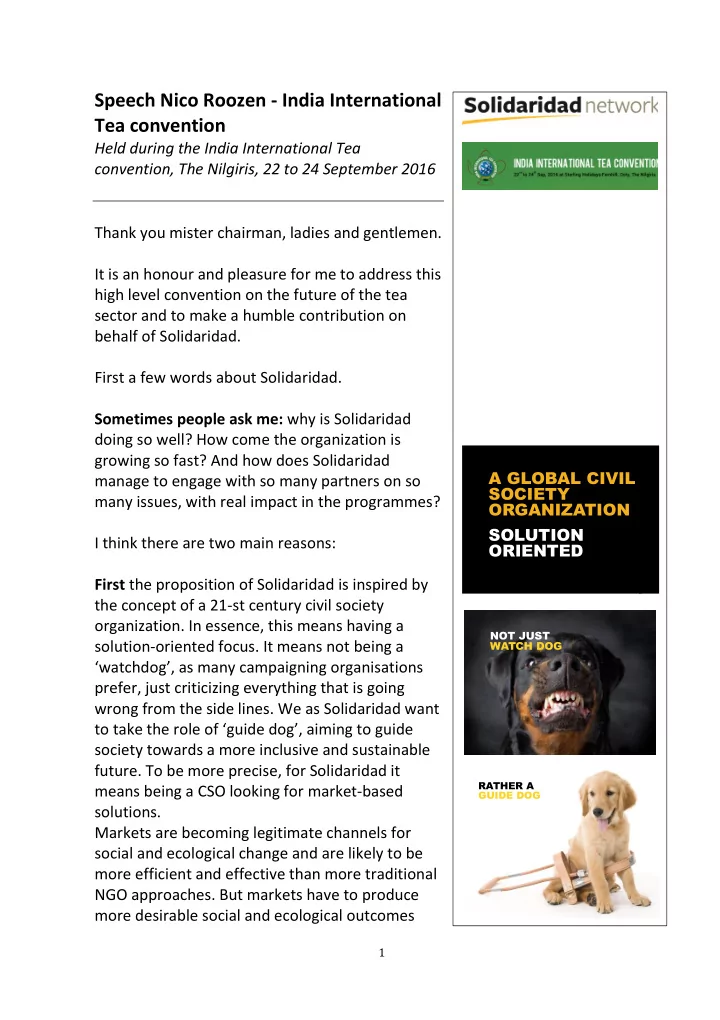
solution-oriented focus. It means not being a ‘watchdog’, as many campaigning organisations prefer, just criticizing everything that is going wrong from the side lines. We as Solidaridad want to take the role of ‘guide dog’, aiming to guide society towards a more inclusive and sustainable
- future. To be more precise, for Solidaridad it
means being a CSO looking for market-based solutions. Markets are becoming legitimate channels for social and ecological change and are likely to be more efficient and effective than more traditional NGO approaches. But markets have to produce more desirable social and ecological outcomes
2
A GLOBAL CIVIL SOCIETY ORGANIZATION SOLUTION ORIENTED
3
NOT JUST WATCH DOG
5
RATHER A GUIDE DOG
SLIDE 2 2
through the interaction between good governance, corporate social en ecological responsibility and innovative civil society contributions. Public-private partnerships will be increasingly important for leveraging the change we seek: market transformation. Secondly our success is related to our new organizational structures. The process
- f transition from a more traditional, Western organization for development
cooperation, into a network organization based on local vision, knowledge and expertise in all continents of the world. Building local capacity to supervise our programmes, to design, to manage and to execute the programmes with local staff – our boots on the ground – has added so much quality to our organization. Local ownership creates accountability for decentralized programming in nine regional teams all over the world. Our world is changing into a multi-polar world, thus ending a long period of Western dominance. Our interconnected network has created an exciting dynamic
- f cooperation between people from different backgrounds serving the same
- cause. Walking the talk is our spirit. Achieving results and impact is our goal.
Sometimes people ask me: Why are you so passionate about sustainability, for such a long time? Even from times – some forty years ago - when the word sustainability did not even exist? The growing strength of a global movement towards a more inclusive and sustainable economy inspires me and motivates me to continuously look for
- innovations. Urgently needed innovations to make this world a better place for
more people.
SLIDE 3
3
What I see is that the world is gradually shifting into a place where sustainability interventions are voluntarily tested by first movers and proven to be possible. Then followers, who view the improvements as relevant to their businesses, scale up the proven concepts. This process of crowding-in will in the end create the critical mass for changes that will in time become the dominant characteristic of markets. The new rules of the game will become mandatory by governmental action, forcing the laggards to follow as well. The track record of Solidaridad can be described from the ‘pyramid of change’, reflecting four generations of sustainability labels, over forty years time. The first generation, developed in the 80s, are consumer labels like ‘organic’ and ‘fair trade’. Solidaridad launched the first fair trade labelling system for coffee in Europe in 1988, and for bananas in 1996. The drivers behind these markets are conscious consumers, who unfortunately turned out to represent a niche market. Highly relevant as catalyser, but not creating the required scale and speed. The second generation are so called Corporate Social Responsibility concepts. The drivers behind this second step of innovation are first mover companies, mainly end-consumer companies. The big brands who are vulnerable to public criticism.
SLIDE 4 4
The third generation, the so-called sector initiatives - like the commodity Round Tables - are meant to be adopted as a license to operate in the sector. The fourth and most recent generation are the so-called domestic standards in producing countries like Brazil, India and Indonesia that create local ownership for sustainability in their upcoming consumer markets. In my understanding, the underlying dynamic in this ‘pyramid of change’ are two fundamental shifts, paradigm shifts: The first shift is a motivational shift. Initially – until the first decade of this new century – sustainability efforts of companies were mainly motivated by reputational management. Companies would react to issues in the supply chain
- nly when raised by civil society. Issues like child labour, environmental concerns,
working conditions and low wages that could possibly damage their reputation. Addressing sustainability was therefore often seen as a task of the public relations department managing the reputation of the brand. However, nowadays sustainability is more and more perceived as a pre-condition for the continuity and profitability of businesses. It is linked to the security of supply in the future. Doubling production to feed a more demanding world population by 2050 requires a sharp reduction of our ecological footprint, the transformation to climate-smart, resilient agriculture and to a more inclusive and bio-based economy. This is the true business case of sustainably, driving the change we are witnessing today. The second shift is related to the fact that we are moving from a Western agenda to a global agenda. The first three generations of certification were more or less dominated by preferences of Western consumers and companies. As a consequence, governments from the global South were often suspicious, fearing ‘non-tariff barriers’ to Western markets. There was no common agenda, no shared
- wnership. At least this is how certification was perceived. However, the fourth
generation of certification has created a new dynamic, of local ownership and design: Trustea in India and Lestari in Indonesia are the most exciting examples of this innovation. Tea sector took the lead.
SLIDE 5
5
Sometimes people aske me: What will be the future of certification? No one can predict the future. But I will share my intuition with you. I think that if we want to be truly successful, we need a more integrated approach, aiming for the integration of five levels of intervention: First, good agricultural practices starting from the best interest of farmers, addressing all relevant economic, social and ecological issues at farm level. Second, a robust agricultural infrastructure, addressing issues of scale of production, development of a service industry, access to finance and the development of adequate logistics and a modern processing industry. Third, embedding of these strategies in a sustainable landscape approach, allowing to address issues like water quality and management, reclaiming of degraded areas, payment for eco-services and avoided deforestation. The fourth element is an intervention strategy aimed at creating an enabling environment, by addressing policies that are based on old thinking and that stand in the way of the change we seek.
SLIDE 6 6
And finally, the fifth element, market development, aimed at linking farmers to local, regional and international markets. By creating food security for local rural communities, feeding the people in the megacities in the regional markets and strengthening the linkages with international markets. This agenda is a much broader agenda than just certification. Solidaridad is now looking for an interconnected agenda addressing all these success factors of structural innovation. Self-motivation, a solid business case and inspiring best practices from neighbouring farmers are the real incentives for systemic change. The third industrial revolution of information technology of these days will prove itself to be a major game changer. It will offer new perspectives for continual improvement at farm level and smart use of big data will boost innovation in
- markets. Such IT-based systems would replace the need for certification and
expensive third party auditing. I want to elaborate a little more on the consequences of this strategy for
- certification. My intuition is that the society is looking for other kind of assurance.
This slide would clarify this. The top priority for the next decade is creating speed and scale.
SLIDE 7 7
It is doubtful if certification could bring that. It doesn’t offer the right incentives and its very costly. Moreover, the benefits to the farmers are not always clear. Society prefers clear proof of concepts at four levels. Good practices validated through evidence based scientific methods will replace the debatable audit
- reports. Transformative knowledge and technology will enable us to scale up.
Good practices have to show the business case contributing to market transformation and have to generate investible propositions which mobilise credits and equity creating continuity beyond grant based pilots. Tested new policy frameworks can be scaled up and contribute to good governance and strategic public investment. For sure it is a new thinking. Let’s discuss it. Sometimes people ask me: What could be the future strategy for sustainable development of the tea sector? I am happy to discuss this issue with you during this congress. Because you are the real experts, people from different segments of the tea industry. I am just the son
- f a Dutch bulb grower. The famous Dutch tulip.
In relation to tea, there are some priority issues to discuss. From my perspective of being a Western European consumer of tea it is amazing to see that for one litre of tea I only have to pay five euro cents, while for one litre of coke I have to pay € 1.69. This means 32 times more! This is ironic considering tea is a much healthier and precious product than coke. In the end it is all about
- marketing. The prices for tea in real terms have actually gone down continuously
from 1957. The introduction of the tea bag has been a decisive factor in the process of degrading the taste of tea in markets. Perhaps the coffee sector is already showing the way forward. The coffee sector has transformed from a ‘bulk’ market into a market that is increasingly characterised by claims concerning quality and sustainability. The quality experience is fuelled by a revolution in how I prepare my coffee: by the cup, with expensive capsules for only one cup of coffee, thus creating a new coffee culture. And by highlighting the importance of origin of production and professionality of the farmer. Together we can change the game, by upgrading the taste of tea instead of continuously degrading its taste and turning tea into a ‘poor man’s drink’.
SLIDE 8
8
Another crucial aspect that needs to be addressed is the low income of tea farmers and workers. Yes indeed, there is a social issue to solve. A difficult issue. But what we see is that in the end this issue is decisive for the future of the tea sector. The tea workers do not want their children to become tea workers anymore. Parents wish their children a better future. We are facing a next generation issue. Who will pick the tea leaves in 2050? There is a very popular Dutch television programme called “Farmer wants a wife”. This programme helps farmers to find a partner to get married. This is a popular programme but at the same time quite ironic. Obviously, a farmer has a low marriageable status. The other major challenge is the climate change that is affecting tea industry in multiple ways. It impacts yield, revenue and livelihood security. As per FAO it can contribute to soil erosion, increased use of agro-chemicals and irrigation, which will mean higher costs of production. Climate adaptive farming would be crucial apart from reorganising the way tea is grown to ensure that yields are not negatively affected.
SLIDE 9 9
My personal experience could be promising. My friends from Asia taught me on how to appreciate quality of tea. The gifted me the best of green and black tea of
- Asia. And tea has replaced soft drinks, juices and I have reduced my consumption
- f alcoholic drink. Each evening we enjoy 2 cups of tea. If the world would follow
this example, the prices for producers would double. Nico Roozen Executive Director Solidaridad Network