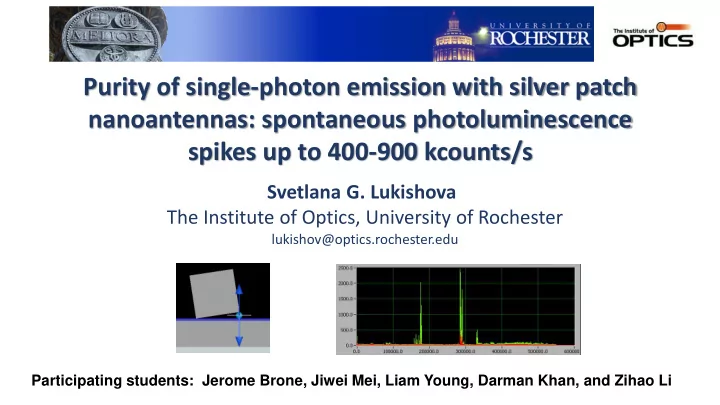
spikes up to 400-900 kcounts/s Svetlana G. Lukishova The Institute - - PowerPoint PPT Presentation
Purity of single-photon emission with silver patch nanoantennas: spontaneous photoluminescence spikes up to 400-900 kcounts/s Svetlana G. Lukishova The Institute of Optics, University of Rochester lukishov@optics.rochester.edu Participating
1. S.G. Lukishova and L.J. Bissell, ““Nanophotonic advances for room-temperature single-photon sources”, pp. 103-178, in Quantum Photonics: Pioneering Advances and Emerging Applications, R.W. Boyd, S.G. Lukishova, V.N. Zadkov (Eds.), Springer (2019). 2. T.B. Hoang, G.M. Akselrod, C. Argyropoulos, J. Huang, D.R. Smith, M.H. Mikkelsen, “Ultrafast spontaneous emission source using plasmonic nanoantennas”, Nat. Commun. 6, Article number 7788 (2015). 3. G.M. Akselrod, C. Argyropoulos, T.B. Hoang, C. Ciracì, C. Fang, J. Huang, D.R. Smith, M.H. Mikkelsen, “Probing the mechanisms of large Purcell enhancement in plasmonic nanoantennas”, Nat. Photonics 8, 835–840 (2014). 4. S.I. Bogdanov, M.Y. Shalaginov, A.S. Lagutchev, C.-C. Chiang, D. Shah, A.S. Baburin, et al., “Ultrabright room-temperature sub-nanosecond emission from single nitrogen-vacancy centers coupled to nanopatch antennas”, Nano Lett. 18, 4837–4844 (2018).
APPLICATION: Room-temperature single-photon sources
From all known nanostructures, plasmonic nanoantennas provide both the highest reported emission rate enhancements and the highest photon flux increase from single emitters [1-4]. From all types of plasmonic nanoantennas the highest Purcell factor with increasing emitter radiative decay rate (~1,000 times), see, e.g., [2], and 2,300-fold enhancement in the total fluorescence intensity [3] were obtained with metal plasmonic patch (gap) nanoantennas. Up to 35 million photon counts per seconds from NV center nanodiamonds coupled to silver patch nanoantennas was reported in [4]
Most of reported patch nanoantennas consist of emitters situated in a dielectric nanogap between a metal nanoparticle of a given shape (cube, triangle, etc.) and a metal film. For emitters in visible spectral range usually silver nanoparticles (e.g. silver nanocubes [2-4]) are used as the part of patch nanoantennas.
1 mg/mL in ethanol
Our goal: fluorescence enhancement from 20 nm diameter NV-nanodiamonds in patch nanoantenna with a gold mirror and silver nanocubes 100 nm silver nanocubes (NanoXast from nanoComposix) coated by a few nanometers of polyvinylpyrrolidone (PVP) were used
cw, 532 or 633 nm laser excitation, incident power at the microscope input is ~ 100 µW, 1.3 N.A.,
- il
immersion microscope
- bjective (less than 100 kW/cm2)
Confocal fluorescence microscopy of 100 nm silver nanocubes on a glass cover slip
User interface showing confocal fluorescence microscope raster scan images from two APD detectors (right) and time traces of count rate (counts/5ms) in the point marked by the cross on a top image
Spikes appear in time traces under 633 nm laser irradiation of 100 nm silver nanocubes
, sometimes after few minutes of irradiation. from less than 0.1 s up to few seconds. Single-emitter like photoluminescence from 100 nm silver nanocubes (semicircles and stripes in a raster scan of a confocal fluorescent microscopy)
Time traces (counts/pixel) under 532 nm or 633 nm irradiation of 100 nm silver nanocubes
Raw data from user interface (100,000 units = 100 s, 1 pixel corresponds 5 ms) Some of processed data
Spectra of PVP-coated silver nanocubes with SERS lines
PVP SERS lines 1023-1490 cm-1, 1685-1730 cm-1 , and 3017 cm-1 are seen clearly on a background of silver photoluminescence Cooled EM-CCD camera, 10 s exposure time 633 nm excitation 532 nm excitation
Two possible mechanisms:
- SERS instability. In Ref. [1] blinking in time was observed in SERS spectra of the PVP-
coated ~150-nm edge colloidal gold triangular nanoprisms, although time scale was much longer and count rate values were significantly lower in [1] than in our experiments.
- Photoinduced creation of small silver nanoclusters on possibly oxidized silver surface
reported in [2-4]. There is the whole direction of research with interesting applications
- f authors [2-4] of very bright metal nanoclusters that behave as single emitters with
- bservation of photon antibunching from some of these nanoclusters.
[1] A. Mezni, T. Dammak, A. Fkiri, A. Mlayah, Y. Abid, and L.S. Smiriet, “Photochemistry at the surface of gold nanoprisms from surface-enhanced Raman scattering blinking”, J. Phys. Chem. C, 118, 17956−17967 (2014). [2] L.A. Peyser, A.E. Vinson, A.P. Bartko, R.M. Dickson, “Photoactivated fluorescence from individual silver nanoclusters”, Science, 291, 103, 5 January (2001). [3] L.A. Peyser, T.-H. Lee, R.M. Dickson, “Mechanism of Agn nanocluster photoproduction from silver oxide films”, J. Phys.
- Chem. B, 106, 7725-7728 (2002).
[4] C.D. Geddes, A. Parfenov, I. Gryczynski, J.R. Lakowicz, “Luminescent blinking from silver nanostructures”, J. Phys. Chem. B, 107, 9589-9993 (2003).
[1] A. Mezni, T. Dammak, A. Fkiri, A. Mlayah, Y. Abid, and L.S. Smiriet, “Photochemistry at the surface of gold nanoprisms from surface-enhanced Raman scattering blinking”, J. Phys.
- Chem. C, 118, 17956−17967 (2014).
SERS spectra instability of the PVP-coated ~150-nm edge colloidal gold triangular nanoprisms was observed in Ref. [1] although count rate variation was significantly lower in [1] than in our experiments
Similar silver clusters (20 nm) were observed in
- Ref. [1] under 15 mins irradiation of AgI
nanocrystals by 540 nm laser light:
[1] S.V. Vinogradov, M.A. Kononov, B.M. Kononov, V.V. Savransky, Lebedev Institute Reports, N 1, 21-25 (2015).
Atomic force microscopy of silver nanocubes topography after laser irradiation: cluster appearance
Two effects were observed that may influence performance of single-photon sources with modern patch plasmonic nanoantennas based on colloidal metal nanoparticles:
- spontaneous intensity spikes up to 400─900 kcounts/s in photoluminescence of
silver nanocubes coated with few nanometers of PVP (either 532 nm or 633 nm laser irradiation was used).
- under identical conditions, a step-wise spontaneous photoluminescence increase
- f up to several times
These spikes and step-wise photoluminescence effects should be taken into account working with silver or other metal plasmonic nanostructures: spontaneous spikes may influence purity of single-photon emission with silver nanoantennas and even damage of the single-photon counting detectors.
Summary
Questions: lukishov@optics.rochester.edu