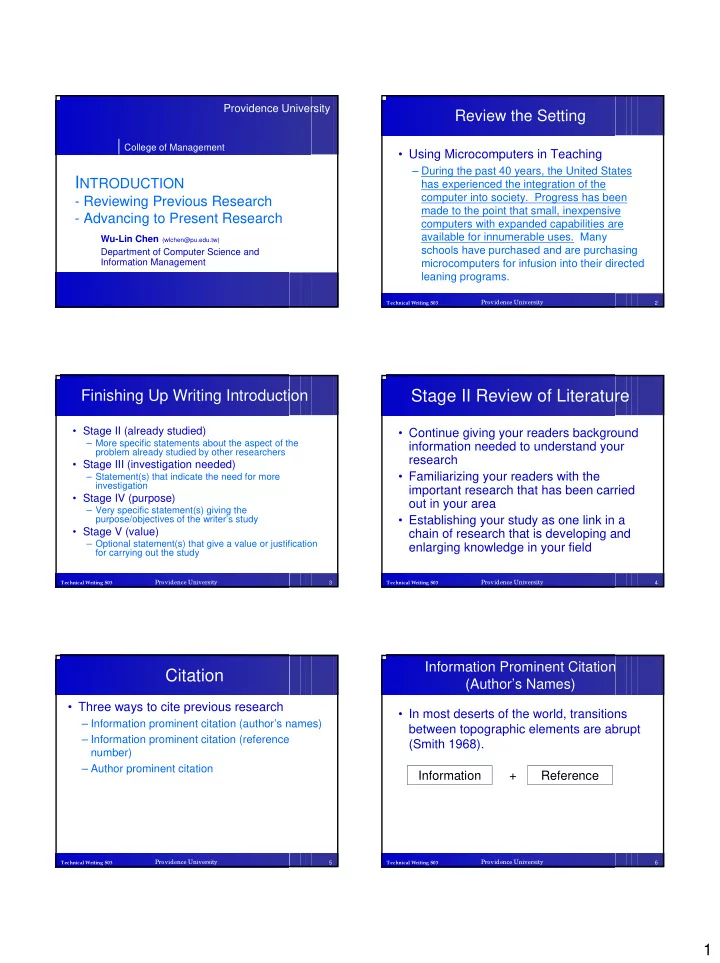
Stage II Review of Literature Finishing Up Writing Introduction - - PDF document

stage ii review of literature
SMART_READER_LITE
LIVE PREVIEW

Stage II Review of Literature Finishing Up Writing Introduction - - PDF document

Providence University Review the Setting College of Management Using Microcomputers in Teaching During the past 40 years, the United States I NTRODUCTION has experienced the integration of the computer into society. Progress has been


slide-1
SLIDE 1

1

Providence University

College of Management

INTRODUCTION

  • Reviewing Previous Research
  • Advancing to Present Research

Wu-Lin Chen (wlchen@pu.edu.tw) Department of Computer Science and Information Management

Technical Writing S03

Providence University 2

Review the Setting

  • Using Microcomputers in Teaching

– During the past 40 years, the United States has experienced the integration of the computer into society. Progress has been made to the point that small, inexpensive computers with expanded capabilities are available for innumerable uses. Many schools have purchased and are purchasing microcomputers for infusion into their directed leaning programs.

Technical Writing S03

Providence University 3

Finishing Up Writing Introduction

  • Stage II (already studied)

– More specific statements about the aspect of the problem already studied by other researchers

  • Stage III (investigation needed)

– Statement(s) that indicate the need for more investigation

  • Stage IV (purpose)

– Very specific statement(s) giving the purpose/objectives of the writer’s study

  • Stage V (value)

– Optional statement(s) that give a value or justification for carrying out the study

Technical Writing S03

Providence University 4

Stage II Review of Literature

  • Continue giving your readers background

information needed to understand your research

  • Familiarizing your readers with the

important research that has been carried

  • ut in your area
  • Establishing your study as one link in a

chain of research that is developing and enlarging knowledge in your field

Technical Writing S03

Providence University 5

Citation

  • Three ways to cite previous research

– Information prominent citation (author’s names) – Information prominent citation (reference number) – Author prominent citation

Technical Writing S03

Providence University 6

Information Prominent Citation (Author’s Names)

  • In most deserts of the world, transitions

between topographic elements are abrupt (Smith 1968). Information + Reference

slide-2
SLIDE 2

2

Technical Writing S03

Providence University 7

Information Prominent Citation (Reference Number)

  • In most deserts of the world, transitions

between topographic elements are abrupt (1,2,8,9). Information + Reference number

Technical Writing S03

Providence University 8

Author Prominent Citation

  • Leopold (1921) listed foods, but gave no

quantitative data.

  • Allen and Reiner [1] described graphically

the differences between the various vibration scales. Last name of author + Date or reference number + Information

Technical Writing S03

Providence University 9

Order of Citations

  • From most distantly related to your study to

those most closely related

  • In chronological order

– If you are describing the history of research in an area

  • According to different approaches

– If you are dealing with a large amount of citations as in a thesis or dissertation – Each group can be ordered

  • chronologically or
  • from general to specific

Technical Writing S03

Providence University 10

Order of Citations

Citations grouped by approach One approach Another approach Still another approach + + Citations

  • rdered from

distant to close Citations ordered chronologically earliest latest OR OR

Technical Writing S03

Providence University 11

Citation Focus and Verb Tense

  • When you decide using information or

author prominent citations, you also determine the verb tense you will use in each citation

Technical Writing S03

Providence University 12

Tense in Information Prominent Citations

  • The present tense is used when the

information you are citing is generally accepted as a scientific fact

  • For example: Reporting Facts

Topic Verb (present) Fact (Reference) + + + Nutrient resorption is a common phenomenon in forest trees (Kramer 1979). The factors that control the connection of aluminum in seawater are poorly known [1].

slide-3
SLIDE 3

3

Technical Writing S03

Providence University 13

Tense in Weak Author Prominent Citations

  • The present perfect tense is used in

citations where the focus is on research area of several authors

  • For example: Several Authors I

Authors Verb (present perfect) Topic (Reference) + + + Several researchers the relationship between classroom adjustment and mobility (Madsen 1980; Biggs 1983; Randall 1985) have studied

Technical Writing S03

Providence University 14

Tense in Weak Author Prominent Citations

  • For example: Several Authors II

Topic Verb (present perfect) Author (Reference) + + + The physiology of annual plants by several authors has been studied [3,7,13].

Technical Writing S03

Providence University 15

General Statements about the Research

  • The present perfect tense is also used in

general statements that describes the level of research activity in an area. These statements are often written without reference

  • For example: Level of Research Activity

Level Verb (present perfect) Topic + + Little research

  • n topic development
  • n ESL students’

composition. has been done

Technical Writing S03

Providence University 16

Tense in Author Prominent Citations

  • The simple past tense is used if you use author

prominent citations to report the finding of individual studies closely related to your own

  • For example: Finding from Specific Studies

Authors THAT Findings + + + Allington found showed reported noted

  • bserved

(1983) Reference Verb (past) + that teachers allocated equal time to all groups.

Technical Writing S03

Providence University 17

Progression of Literature Review

Citation from Beginning citations: Information prominent Weak author prominent General statements Latest citations: Author prominent Tense Simple present and present perfect Simple past

Technical Writing S03

Providence University 18

Attitude and Tense in Research Findings

  • In author prominent citations your attitude

towards the findings of the researchers also affects the complement verb forms.

– When you believe the findings you are citing are fact, use the present tense in the complement verb. – When you believe the findings are restricted to the specific study you are citing, use the past tense in the complement verb. – When the finding you are citing were seen by the

  • riginal authors as tentative, or were only suggestions
  • r proposals rather than findings, use tentative verbs

for the verb of report, and a modal auxiliary with the complement verb.

slide-4
SLIDE 4

4

Technical Writing S03

Providence University 19

Attitude Towards Findings: Accepted as a Fact

Author THAT Findings (present) + + + Sillen showed [1] Reference number or date Verb of report + that Aluminum in seawater is regulated by a thermodynamic balance.

Technical Writing S03

Providence University 20

Attitude Towards Findings: Results Limited to One Study

Author (s) Findings (past) + + Reference number or date Verb of report + Abramson reported (1974) that mobile students had lower academic performance. Henderson and Harris found [7] that 34.6kg of nitrogen were cycled internally by trees.

Technical Writing S03

Providence University 21

Attitude Towards Findings: Tentative Findings

Van Bennekom proposed suggested hypothesized [5] Author THAT Tentative findings (modal auxiliary + verb) + + + Reference number or date Verb of report + that aluminum may be common in diatom residues.

Technical Writing S03

Providence University 22

Advancing to Present Research

  • Stages III, IV, and V of the introduction

focus your readers’ attention on the specific research problem

  • Stage III indicates an area that is not

treated in the previous literature

  • Stage IV announces the purpose of your

research

  • Stage V indicates possible benefits or

application of your work

Technical Writing S03

Providence University 23

Writing Stage III: Missing Information

  • Summing up previous literature review by

pointing out a gap

  • Pointing out this gap is an important

research area that is not investigated by

  • ther researchers
  • Accomplishing Stage III in only one or two

sentence

Technical Writing S03

Providence University 24

Stage III: Missing Information

Gap Research topic + However, the effects of computer assisted instruction. few studies have reported on But, the air flow rates on simple flat plate solar collectors. there is little information available on

slide-5
SLIDE 5

5

Technical Writing S03

Providence University 25

Stage III: Signal Words

  • Signal words are used for helping

transition from Stage II to Stage III.

  • The connector (signal word) is followed

immediately by a gap statement in the present or present perfect tense, which

  • ften contains modifiers such as few, little,
  • r no.

Technical Writing S03

Providence University 26

Stage III: Signaling Missing Information

Gap (present or present perfect tense) Research topic + However, But the effects of air flow rates on simple flat plate solar collectors. few studies have been done on little literature is available on very little is known about no work has been done on Signal word +

Technical Writing S03

Providence University 27

Stage III: Signaling Missing Information

Previous work (present or present perfect tense) Gap + Topic + Although While little information is available on Y. some literature is available on X, many studies have been done on X, much research has been devoted to X, Signal word + X = Previous work Y = Research topic

Technical Writing S03

Providence University 28

Writing Stage IV: The Statement of Purpose

  • State as concisely as possible the specific
  • bjective(s) of your research report
  • The statement of purpose answers the

need expressed in Stage III for additional research in your area of study

Technical Writing S03

Providence University 29

Statement of Purpose

  • The orientation of the statement of

purpose may be

– towards the report itself – towards the research activity

Technical Writing S03

Providence University 30

Statement of Purpose: Report Orientation

Report orientation Research question + is to determine whether an automatic measurement system can be applied to educational settings. The purpose of this thesis The aim of the present paper The objective of this report

slide-6
SLIDE 6

6

Technical Writing S03

Providence University 31

Statement of Purpose: Research Orientation

Report orientation Research question + was to determine whether

  • r not genetic differences in

germination exist at low temperatures in pepper species. The purpose of this study this investigation this research the research reported here

Technical Writing S03

Providence University 32

Stage IV: Orientation and Tense

  • If you choose the research orientation you

should use the past tense, because the research activity has already been done.

  • If you choose to use the report orientation,

use the present or future tense.

Technical Writing S03

Providence University 33

Stage IV: Verb Tenses Research Orientation

Main verb (past) Research question + The purpose of this study to investigate the effect of computer-assisted instruction

  • n the computer literacy of fifth

grade children. was Research orientation +

Technical Writing S03

Providence University 34

Stage IV: Verb Tenses Report Orientation

Main verb (present or future) Research question + This paper the results of surveys conducted in Honduras to determine the distribution of manatees in that country. describes presents Report orientation + This thesis the implementation and

  • peration of an automatic

measurement system appropriate for classroom and laboratory demonstrations. will deal with will discuss

Technical Writing S03

Providence University 35

Stage IV and Your Research Question

  • Stage IV should be directly related to the

research question upon which you based your study.

  • The statement of purpose should be written so

that your reader can infer the research question behind your study.

  • If the implied research question is a yes or no

question, the connecting words whether or if are used in Stage IV, and a modal auxiliary like would or could accompanies the verb.

Technical Writing S03

Providence University 36

Stage IV: Questions in the Statement of Purpose Yes or No Questions

Research question Purpose (implied question) The purpose of this thesis is to determine if an automatic measurement system would be suitable for classroom and laboratory demonstration. Is an automatic measurement system suitable for classroom and laboratory demonstrations?

slide-7
SLIDE 7

7

Technical Writing S03

Providence University 37

Stage IV: Questions in the Statement of Purpose Information Questions

Research question Purpose (implied question) What is the distribution and status of manatees in Honduras? This paper reports the results of surveys and interviews conducted in

  • rder to determine the distribution

and status of manatees on Honduras. This paper reports on the distribution and status of manatees in Honduras.

Technical Writing S03

Providence University 38

Writing Stage V: The Statement of Value

  • Stage V is not included in every introduction.
  • It should be included in your introduction when

you write a thesis, dissertation, or a thesis proposal.

  • It is also commonly included in research reports

written to describe a project conducted with money from outside sources.

  • It is often omitted in report written up as journal

articles.

Technical Writing S03

Providence University 39

Points of View of the Statement of Value

  • Practical orientation

– This research may provide an alternative to the problem of manually demonstrating instrumentation principles in classroom environments. – The results of this study could be useful to educators responsible for planning course work in consumer education.

  • Theoretical orientation

– Both of the factors under investigation in this study may be of importance in explaining the irregular occurrence of this disease. – Results of this study may suggest a broader hypothesis for further research into the effects of atmospheric chemical on rubber.

Technical Writing S03

Providence University 40

Stage V – Modal Auxiliaries and Tentativeness

  • Stage V is usually written in a way that

suggests an attitude of tentativeness or modesty on the part of the author.

  • You should not sound too sure of the

benefits, either practical or theoretical, of your work.

  • It is conventional to sound more cautions.
  • Modal auxiliaries, principally may, are

used for this purpose.

Technical Writing S03

Providence University 41

Stage V: Statement of Value Using Modal Auxiliaries

Modal auxiliary Value + The application of the strategies described here increase the proportion of drug abusers who can be identified. may should Your research + The system described here serve as the basis for a study of automatic measurement systems in an instrumentation course. could This study lead to a better understanding

  • f phosphorus in natural

systems. may

Technical Writing S03

Providence University 42

Selecting the Best Modal Auxiliaries for Use in Stages IV

Stage IV: no doubt about the future no doubt about the future, assuming certain conditions (SURE) WILL WOULD (TENTATIVE) Stage IV: The data contained in this report will supplement that presented in our earlier publication. The purpose of this study was to determine if the use

  • f home computers would

improve the math scores of third grade children.

slide-8
SLIDE 8

8

Technical Writing S03

Providence University 43

Selecting the Best Modal Auxiliaries for Use in Stages V

Stage V: reasonable expectation about the future some doubt about the future more doubt about the future (SURE) SHOULD COULD (TENTATIVE) Stage V: This alternative method should simplify the analysis procedure. Both of the factors studied here may be of importance in explaining the occurrence

  • f this disease.

Results of this study could have considerable impact on estimates of land values. MAY