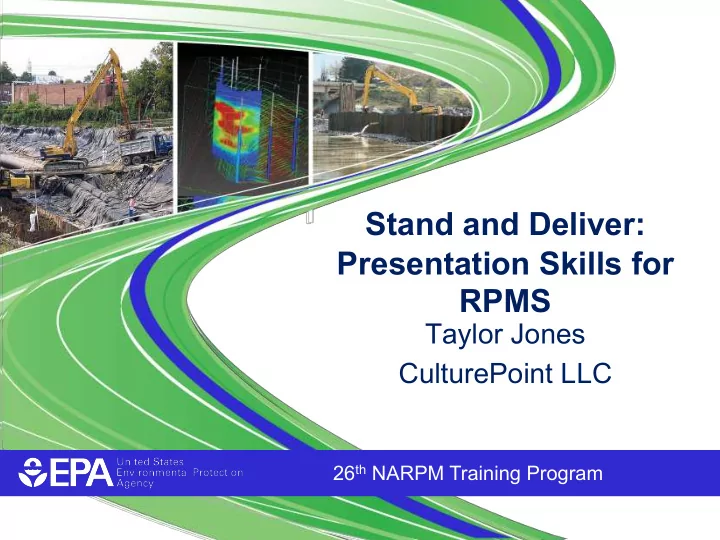
Stand and Deliver: Presentation Skills for RPMS Taylor Jones - - PowerPoint PPT Presentation

stand and deliver presentation skills for rpms
SMART_READER_LITE
LIVE PREVIEW

Stand and Deliver: Presentation Skills for RPMS Taylor Jones - - PowerPoint PPT Presentation

Stand and Deliver: Presentation Skills for RPMS Taylor Jones CulturePoint LLC 26 th NARPM Training Program Course Objectives To understand how people evaluate presentations To review best practices for presentations To develop a


slide-1
SLIDE 1

Stand and Deliver: Presentation Skills for RPMS

Taylor Jones CulturePoint LLC

26th NARPM Training Program

slide-2
SLIDE 2

Course Objectives

  • To understand how people evaluate presentations
  • To review best practices for presentations
  • To develop a game plan for presentations

26th NARPM Training Program 1

slide-3
SLIDE 3

Agenda

  • Introduction
  • Overview of the research
  • Overview of presentation skills
  • Putting it all together

26th NARPM Training Program 2

slide-4
SLIDE 4

INTRODUCTION

26th NARPM Training Program 3

slide-5
SLIDE 5

Who Am I?

  • Facilitator with a decade of experience teaching

difficult topics around Diversity and Inclusion

  • Quantitative social scientist with teaching

experience across a variety of classes and over 50 conference talks, invited lectures, and academic talks for the general public

  • Performer with background playing music

professionally

26th NARPM Training Program 4

slide-6
SLIDE 6

Who am I?

  • My career consists of communicating scientific

ideas to the general public through presentations, relying on the platform skills we will discuss shortly

26th NARPM Training Program 5

slide-7
SLIDE 7

OVERVIEW OF THE RESEARCH

26th NARPM Training Program 6

slide-8
SLIDE 8

Why bother?

  • There is a wealth of research that indicates that

platform skills affect perceived credibility

  • You are public-facing
  • Your work is important, and it is important that it is

communicated effectively

  • Platform skills are skills, not inherent – you can

learn, practice, and improve

26th NARPM Training Program 7

slide-9
SLIDE 9

The research

  • We can tell when people believe what they are

saying, and when they are confident in it.

  • Verbal vs. nonverbal (Tenney et al 2019)
  • Sounds of confidence and doubt (Jiang & Pell 2017)
  • Professionals lower vocal frequency when giving

expert advice (Sorokowski et al 2019)

26th NARPM Training Program 8

slide-10
SLIDE 10

The research

  • The clues to confidence are measurable
  • Pitch, intonation, and speed influence perceptions of

speaker confidence (Guyer & Vaughn-Johnston 2019)

  • We are more likely to believe and cooperate with

people who send signals of confidence

  • Even when we later think it wasn’t about presentation

skills (Clark 2008)

26th NARPM Training Program 9

slide-11
SLIDE 11

The research

  • Not only can we measure, we can improve with

training

  • Communication training improves presentation skills

(Siebold & Rude 1993)

26th NARPM Training Program 10

slide-12
SLIDE 12

The takeaway

  • Presentation skills matter
  • Presentation skills and confidence affect speaker

believability, and audience confidence

  • The better your presentation skills, the easier your

presentations will go!

  • We can improve communication skills with training

and practice

  • You have an important message

26th NARPM Training Program 11

slide-13
SLIDE 13

OVERVIEW OF PRESENTATION SKILLS

26th NARPM Training Program 12

slide-14
SLIDE 14

Presentation Competencies

  • Content management
  • Visual aids
  • Platform skills
  • Participant management

26th NARPM Training Program 13

slide-15
SLIDE 15

Content Management

  • Effective speakers:
  • Connect subject matter with objectives
  • Analyze participants’ needs, current level of expertise,

and expectations

  • Identify and organize key points that support the
  • bjectives and meet participant needs
  • Identify potential problem areas and strategies

26th NARPM Training Program 14

slide-16
SLIDE 16

Content Management

  • What is the key point of your talk?
  • What do people need to know to understand that

point?

  • Where can they go astray?

26th NARPM Training Program 15

slide-17
SLIDE 17

Content Management

  • Basic organization:
  • Introduce the topic
  • Provide a motivation
  • Describe the necessary context
  • Explain the research question or point yo uwant to

make

  • Lay out the data and analysis strategy

26th NARPM Training Program 16

slide-18
SLIDE 18

Content Management

  • Basic organization (continued):
  • Document the findings
  • Point by point, or,
  • Laying out the necessary pieces to make your argument
  • Provide comments to explain findings or implications of

the argument

  • Wrap up

26th NARPM Training Program 17

slide-19
SLIDE 19

Visual Aids

  • Effective speakers prepare visuals that are:
  • Legible/Readable
  • Clearly related to content being presented
  • Organized
  • Consistently formatted

26th NARPM Training Program 18

slide-20
SLIDE 20

Visual Aids

  • Effective speakers manage the visual aids by:
  • Testing equipment/having contingency plans
  • Positioning the body to avoid blocking participants’

view

  • Speaking to participants rather than to the visual aid

26th NARPM Training Program 19

slide-21
SLIDE 21

Visual Aids

  • What makes a slide bad?

26th NARPM Training Program 20

slide-22
SLIDE 22

A Bad Slide

26th NARPM Training Program 21

slide-23
SLIDE 23

Another Bad Slide

26th NARPM Training Program 22

slide-24
SLIDE 24

Other Technology

  • Arrive early and find your point of contact for tech,

if any

  • Test microphone setup, if present
  • If it is present, use it. Do not assume everyone can

hear you!

26th NARPM Training Program 23

slide-25
SLIDE 25

Basics on Platform Skills

  • Prior preparation
  • Posture and movement
  • Breathing
  • Speed and pacing
  • Asking questions
  • Answering questions

26th NARPM Training Program 24

slide-26
SLIDE 26

Prior Preparation

  • Is there a preferred format?
  • What is your timeframe for providing secondary

materials (e.g., slides, poster)?

26th NARPM Training Program 25

slide-27
SLIDE 27

Prior Preparation

  • Decide if you want or need a script
  • Practice
  • Decide if you need to time yourself
  • Nobody likes going over time
  • Brainstorm possible questions
  • Don’t focus only on the smart questions; how might

people “not get it”?

26th NARPM Training Program 26

slide-28
SLIDE 28

Platform Skills

  • Effective speakers will manage:
  • Nerves: transformation into positive energy
  • Voice: volume, pace, and intonation
  • Eye contact: range and focus
  • Body: posture, stance, and movement

26th NARPM Training Program 27

slide-29
SLIDE 29

Platform Skills

  • Effective speakers will manage:
  • Gestures: hand and facial
  • Language: inclusive and technical
  • Transitions and segues

26th NARPM Training Program 28

slide-30
SLIDE 30

Soliciting Questions

  • Assume that there will be questions
  • Ask: “What questions do you have?”
  • Avoid: “Any questions?”
  • After you ask for questions, STOP TALKING, wait

several moments for them to think

  • Perfect time to take a drink of water

26th NARPM Training Program 29

slide-31
SLIDE 31

Answering Questions

  • Let the questioner finish
  • Rephrase the question
  • Respond to everyone
  • Refer to the central theme of the speech
  • Feel free to postpone an answer or throw the

question back to the group

  • Respect the questioner

26th NARPM Training Program 30

slide-32
SLIDE 32

Answering Questions

  • Sometimes, you can let the audience answer for

you

26th NARPM Training Program 31

slide-33
SLIDE 33

Participant Management

  • Effective speakers:
  • Use participants’ names (where possible)
  • Reinforce desired and appropriate participant

behaviors

  • Refer to previous contributions made by participants

26th NARPM Training Program 32

slide-34
SLIDE 34

Participant Management

  • Effective speakers:
  • Respond appropriately to questions
  • Manage “challenging” participant behavior
  • Make the experience enjoyable

26th NARPM Training Program 33

slide-35
SLIDE 35

Participant Management

  • Contentious participants:
  • Attempt to take their question in the best, most

charitable light

  • Thank them for their feedback
  • If they are wrong, thank them for bringing up the topic

and allowing you the chance to clarify

  • Do not get stuck repeating or clarifying – cut it and
  • ffer to discuss offline later
  • If their comment is not relevant, thank them for

participating and refocus (with the option of discussing more after the presentation)

26th NARPM Training Program 34

slide-36
SLIDE 36

The Gift of Feedback

  • Effective feedback is:
  • A GIFT – given to be helpful
  • Specific rather than general
  • Focused on behavior, not on the person
  • Descriptive rather than evaluative
  • Concise
  • Well-timed
  • Checked

26th NARPM Training Program 35

slide-37
SLIDE 37

Wrap-up

  • What have you learned?
  • About presentations?
  • About yourself?
  • What will you do differently?

26th NARPM Training Program 36

slide-38
SLIDE 38

Thank you!

26th NARPM Training Program 37