State Machine for GPRS MM READY timer expiry or GPRS Attach Force - - PowerPoint PPT Presentation

state machine for gprs mm
SMART_READER_LITE
LIVE PREVIEW

State Machine for GPRS MM READY timer expiry or GPRS Attach Force - - PowerPoint PPT Presentation

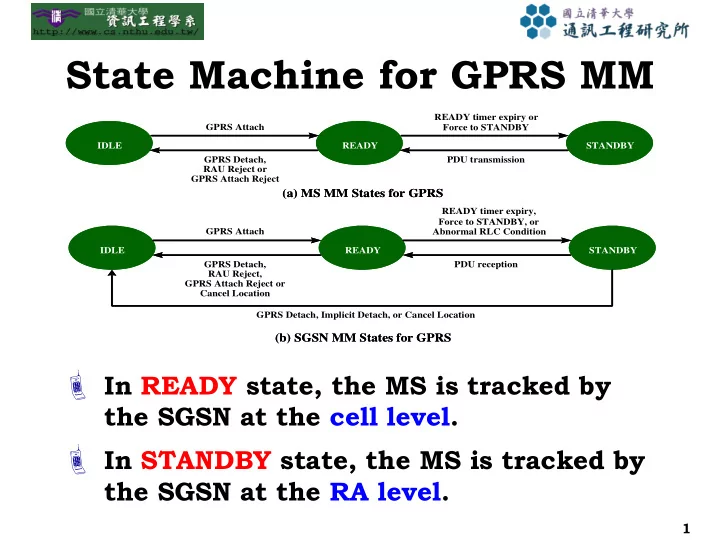
State Machine for GPRS MM READY timer expiry or GPRS Attach Force to STANDBY IDLE IDLE READY READY STANDBY STANDBY GPRS Detach, PDU transmission RAU Reject or GPRS Attach Reject (a) MS MM States for GPRS (a) MS MM States for GPRS


slide-1
SLIDE 1

1

State Machine for GPRS MM

 In READY state, the MS is tracked by

the SGSN at the cell level.

 In STANDBY state, the MS is tracked by

the SGSN at the RA level.

IDLE READY STANDBY GPRS Attach READY timer expiry or Force to STANDBY PDU transmission IDLE READY STANDBY GPRS Attach GPRS Attach Reject or Cancel Location READY timer expiry, Force to STANDBY, or Abnormal RLC Condition PDU reception GPRS Detach, Implicit Detach, or Cancel Location IDLE READY STANDBY IDLE READY STANDBY GPRS Detach, RAU Reject, GPRS Detach, RAU Reject or GPRS Attach Reject

(b) SGSN MM States for GPRS (b) SGSN MM States for GPRS (a) MS MM States for GPRS (a) MS MM States for GPRS

slide-2
SLIDE 2

2

SGSN

Location update

RA Tracking

RA changed

Low paging cost High location update cost High paging cost Low location update cost

Location Update vs. Paging

SGSN

Location update

Cell Tracking

RA

Cell changed

Transitions between cell and RA trackings determine the location update and paging signaling costs.

slide-3
SLIDE 3

3

READY Timer Mechanism

 3GPP TS 23.060 proposed the READY Timer (RT)

approach, where an RT threshold T is defined.

t4 tp time the end of the previous packet transmission t0 t1 the beginning of the next packet transmission

. . . . .

t1 t2 t3 ti ti+1 ti+2 ti+3

. . . .

ti+4 ti+5

Cell Updates RA Updates ... ...

tNc

Ready timer T expiration

 Drawbacks of the RT approach

 The RT approach has a major fallacy that the RT

timers in both the MS and the SGSN are independent and thus may lose synchronization.

 When the MS mobility rate changes from time to

time, the RT timer can not adapt to the change.

slide-4
SLIDE 4

4

READY Counter Mechanism

 To resolve the drawbacks of the RT approach,

we propose the READY Counter (RC) approach.

 In the RC approach, an RC counter counts the

number of cell movements in the packet idle period.

 If the number of movements reaches a threshold

K, then the MS is switched from cell tracking to RA tracking.

tm,4 tp time the end of the previous packet transmission t0 t1 the beginning of the next packet transmission

. . . . .

tm,1 tm,2 tm,3 tm,K tm,K+1 tm,K+2 tm,K+3

. . . .

tm,K+4 tm,K+5

K Cell Updates Nu-K RA Updates ... ... Threshold K

tm,Nc

slide-5
SLIDE 5

5

Comparison of RC and RT (1)

Mix two types of user mobility patterns

 Type I pattern: mobility rate λm’ = 1/500min  Type II pattern: mobility rate λm’’ = 1/5min

Consider 1,000,000 packet idle periods

with mean 100min, in which

 Type I pattern is exercised with probability 0.5, and  Type II pattern is exercised with probability 0.5.

Let the expected signaling cost of

location update and paging in a packet idle period be

 CT’ for Type I pattern, and CT’’ for Type II pattern.

slide-6
SLIDE 6

6

Comparison of RC and RT (2)

In RC (E[tp] = 100min, E[tm’] = 500min, E[tm’’] = 5min)

 the lowest CT’ is expected when K ≥ 2  the lowest CT’’ is expected when K = 0  good performance can be expected when K = 1 or 2

In RT (E[tp] = 100min, E[tm’] = 500min, E[tm’’] = 5min)

 the best threshold value for CT’ occurs when T > 100min  the best threshold value for CT’’ occurs when T < 5min  no T value will satisfy both patterns

slide-7
SLIDE 7

7

Optimal Threshold K Calculation

3 tp time the end of the previous packet transmission t0 t1 the beginning of the next packet transmission

. . . . .

1 2 i-1 i i+1 i+2

. . . .

i+3 i+4

...

Nc

RA Crossings

 The net cost in tp includes location update cost

during tp and paging cost (if needed) on t1.

slide-8
SLIDE 8

8

Proof for Theorem 1

3 tp time the end of the previous packet transmission t0 t1 the beginning of the next packet transmission

. . . . .

1 2 i-1 i i+1 i+2

. . . .

i+3 i+4

...

Nc

RA Crossings

 If K > Nc, CT(K) = CT(Nc+1) = … = CT(∞) = UNc  If K ≤ Nc, CT(K) = U[K+Nr(K)]+SV

 Nr(0) - Nr(K) ≤ K ↔ Nr(0) ≤ K + Nr(K)  CT(K) = U[K+Nr(K)]+SV ≥ U[0+ Nr(0)] + SV = CT(0)

 K* = 0 or K* = Nc+1.

.

slide-9
SLIDE 9

9

Dynamic READY Counter (DRC) Algorithm

time

. . . . .

tp(1)

. . . .

tp(2) tp(3) tp(4) tp(i-3) tp(i-2) tp(i-1) tp(i) tp(i+1) tp(i+2)

K(1) K(2) K(3) K(4) K(i-3) K(i-2) K(i-1) K Average of the previous M optimal K values

slide-10
SLIDE 10

10

Performance of DRC

Case 1 (randomness): consider 1,000,000 periods,

 mean 9 cell crossings in a packet idle period with prob. 0.5  mean 20 cell crossings with prob. 0.5

Case 2 (locality):

 mean 9 cell crossings for the first 500,000 periods  mean 20 cell crossings for the last 500,000 periods

(RA size = 37 cells; 1 location update cost : 1 paging cost = 4:1)

Case 1 Case 2

slide-11
SLIDE 11

11

Summary

We proposed READY Counter (RC) to

resolve the fallacies of READY Timer (RT).

We devised an adaptive algorithm

dynamic RC (DRC) to reduce the net cost

  • f location update and paging.

We proposed analytic and simulation

models to investigate RT, RC and DRC.

We provided numerical examples to show

how to select appropriate operation parameters.