Statistical Geometry Processing Winter Semester 2011/2012 n r u - - PowerPoint PPT Presentation

statistical geometry processing
SMART_READER_LITE
LIVE PREVIEW

Statistical Geometry Processing Winter Semester 2011/2012 n r u - - PowerPoint PPT Presentation

Statistical Geometry Processing Winter Semester 2011/2012 n r u v Differential Geometry Multi-Dimensional Derivatives Derivative of a Function Reminder: The derivative of a function is defined as d f ( t h ) f ( t )


slide-1
SLIDE 1

Statistical Geometry Processing

Winter Semester 2011/2012

Differential Geometry

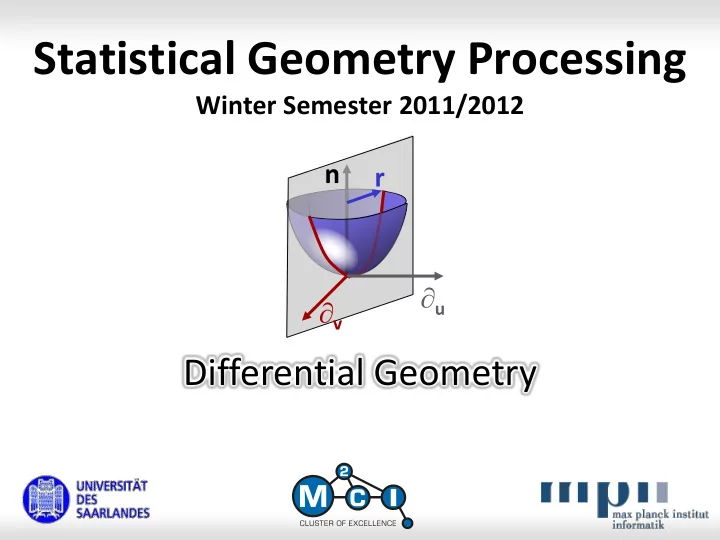
u r v n

slide-2
SLIDE 2

Multi-Dimensional Derivatives

slide-3
SLIDE 3

3

Derivative of a Function

Reminder: The derivative of a function is defined as If limit exists: function is called differentiable. Other notation:

h t f h t f t f dt d

h

) ( ) ( lim : ) (   

variables time context from variable

) ( ) ( ' ) ( t f t f t f dt d    ) ( ) (

) (

t f t f dt d

k k k

repeated differentiation (higher order derivatives)

slide-4
SLIDE 4

4

Taylor Approximation

Smooth functions can be approximated locally:

  • Convergence: holomorphic functions
  • Local approximation for smooth functions

     

) ( ) ( ! 1 ... ... ) ( 2 1 ) ( ) ( ) (

1 2 2 2 

        

k k k k

x O x x x f dx d k x x x f dx d x x x f dx d x f x f

slide-5
SLIDE 5

5

Rule of Thumb

Derivatives and Polynomials

  • Polynomial: 𝑔 𝑦 = 𝑑0 + 𝑑1𝑦 + 𝑑2𝑦2 + 𝑑3𝑦3 …
  • 0th-order derivative: 𝑔 0 = 𝑑0
  • 1st-order derivative: 𝑔′ 0 = 𝑑1
  • 2nd-order derivative: 𝑔′′ 0 = 2𝑑2
  • 3rd-order derivative: 𝑔′′′ 0 = 6𝑑3
  • ...

Rule of Thumb:

  • Derivatives correspond to polynomial coefficients
  • Estimate derivates  polynomial fitting
slide-6
SLIDE 6

6

Differentiation is Ill-posed!

Regularization

  • Numerical differentiation needs regularization
  • Higher order is more problematic
  • Finite differences (larger h)
  • Averaging (polynomial fitting) over finite domain

h

slide-7
SLIDE 7

7

Partial Derivative

Multivariate functions:

  • Notation changes:
  • Alternative notation:

h x x x x x f x x h x x x f x x x x x f x

n k k k n k k k h n k k k k

) ,..., , , ,..., ( ) ,..., , , ,..., ( lim : ) ,..., , , ,..., (

1 1 1 1 1 1 1 1 1       

    

use curly-d

) ( ) ( ) ( x x x

k

x k k

f f f x     

slide-8
SLIDE 8

8

Special Cases

Derivatives for:

  • Functions f: n   (“heightfield”)
  • Functions f:   n (“curves”)
  • Functions f: n  m (general case)
slide-9
SLIDE 9

9

Special Cases

Derivatives for:

  • Functions f: n   (“heightfield”)
  • Functions f:   n (“curves”)
  • Functions f: n  m (general case)
slide-10
SLIDE 10

10

Gradient

Gradient:

  • Given a function f: n   (“heightfield”)
  • The vector of all partial derivatives of f is called the

gradient:

                                           ) ( ) ( ) ( ) (

1 1

x x x x f x f x f x x f

n n

 

slide-11
SLIDE 11

11

Gradient

Gradient:

  • gradient: vector pointing in direction of steepest ascent.
  • Local linear approximation (Taylor):

f(x) x1 x2 x f(x) f(x) x1 x2

) ( ) ( ) ( ) ( x x x x x      f f f

x0

) ( ) ( ) ( x x x x     f f

slide-12
SLIDE 12

12

Higher Order Derivatives

Higher order Derivatives:

  • Can do all combinations:
  • Order does not matter for f  Ck

f x x x

k

i i i

              ...

2 1

slide-13
SLIDE 13

13

Hessian Matrix

Higher order Derivatives:

  • Important special case: Second order derivative
  • “Hessian” matrix (symmetric for f  C2)
  • Orthogonal Eigenbasis, full Eigenspectrum

) ( : ) (

2 2 2 1 2 2 1 2 2 1 1 1 2 2 1 2

x x

f n n n n n

H f x x x x x x x x x x x x x x x                                                          

slide-14
SLIDE 14

14

Taylor Approximation

Second order Taylor approximation:

  • Fit a paraboloid to a general function

) ( ) ( ) ( 2 1 ) ( ) ( ) ( ) (

T

x x x x x x x x x x          

f

H f f f

2nd order approximation (schematic) f(x) x1 x2 x

slide-15
SLIDE 15

15

Special Cases

Derivatives for:

  • Functions f: n   (“heightfield”)
  • Functions f:   n (“curves”)
  • Functions f: n  m (general case)
slide-16
SLIDE 16

16

Derivatives of Curves

Derivatives of vector valued functions:

  • Given a function f:   n (“curve”)
  • We can compute derivatives for every output dimension:

           ) ( ) ( ) (

1

t f t f t f

n

 ) ( : ) ( ' : ) ( ) ( : ) (

1

t f t f t f dt d t f dt d t f dt d

n

                  

slide-17
SLIDE 17

17

Geometric Meaning

Tangent Vector:

  • f ’: tangent vector
  • Motion of physical particle: f = velocity.
  • Higher order derivatives: Again vector functions
  • Second derivative f = acceleration

f ’(t0) f(t) t0 . ..

slide-18
SLIDE 18

18 18 / 76

Special Cases

Derivatives for:

  • Functions f: n   (“heightfield”)
  • Functions f:   n (“curves”)
  • Functions f: n  m (general case)
slide-19
SLIDE 19

19

You can combine it...

General case:

  • Given a function f: n  m (“space warp”)
  • Maps points in space to other points in space
  • First derivative: Derivatives of all output components of f

w.r.t. all input directions.

  • “Jacobian matrix”: denoted by f or Jf

 

            ) ,..., ( ) ,..., ( ) ,..., ( ) (

1 1 1 1 n m n n

x x f x x f x x f f  x

slide-20
SLIDE 20

20

Jacobian Matrix

Jacobian Matrix: Use in a first-order Taylor approximation:

                                    ) ( ) ( ) ( ) ( ) ,..., ( ) ,..., ( ) ,..., ( ) ( ) (

1 1

1 1 T 1 T 1 1 1

x x x x x x

m x m x x x n m n n f

f f f f x x f x x f x x f J f

n n

    

 

) ( ) ( ) ( x x x x x   

f

J f f

matrix / vector product

slide-21
SLIDE 21

21

Coordinate Systems

Problem:

  • What happens, if the coordinate system changes?
  • Partial derivatives go into different directions then.
  • Do we get the same result?
slide-22
SLIDE 22

22

Total Derivative

First order Taylor approx.:

  • Converges for C1 functions

f: n  m (“totally differentiable”)

f(x) x1 x2 x0

) ( ) ( ) ( x x x x     f f ) ( ) ( ) ( ) ( x x x x x

x

R f f      , ) ( lim  

x x x

x x x

R

slide-23
SLIDE 23

23

Partial Derivatives

Consequences:

  • A linear function: fully determined by image of a basis
  • Hence: Directions of partial derivatives do not matter –

this is just a basis transform.

  • We can use any linear independent set of directions T
  • Transform to standard basis by multiplying with T-1
  • Similar argument for higher order derivatives
slide-24
SLIDE 24

24

Directional Derivative

The directional derivative is defined as:

  • Given f: n  m and v  n, ||v|| = 1.
  • Directional derivative:
  • Compute from Jacobian matrix

(requires total differentiability)

) ( : ) ( ) ( v x x v x

v

t f dt d f f       v v x x

v

) ( ) ( f f   

slide-25
SLIDE 25

Multi-Dimensional Optimization

slide-26
SLIDE 26

26

Optimization Problems

Optimization Problem:

  • Given a C1 function f: n   (general heightfield)
  • We are looking for a local extremum (minimum /

maximum) of this function

Theorem:

  • x is a local extremum  f (x) = 0

Sketch of a proof: If f (x)  0, we can walk a small step in gradient direction to improve the score further (in case of a maximum, minimum similar).

slide-27
SLIDE 27

27

Critical Points

Critical points:

  • f (x) = 0 does not guarantee

an extremum (saddle points)

  • Points with f (x) = 0 are called

critical points.

  • Final decision via Hessian matrix:
  • All eigenvalues > 0: local minimum
  • All eigenvalues < 0: local maximum
  • Mixed eigenvalues: saddle point
  • Some zero eigenvalues: critical line

i > 0 0 > 0, 1 < 0 0 = 0, 1 > 0

slide-28
SLIDE 28

28

Quadratic Optimization

Quadratic Case:

  • f: n  
  • Objective function: f (x) = xTA x + bTx + c
  • symmetric n  n matrix A
  • n-dim. vector b
  • constant c
  • Gradient: f (x) = 2A x + b
  • Critical points: solution to 2A x = -b
  • Solution: Solve system of linear equations
slide-29
SLIDE 29

29

Example

Gradient computation example:

   

                                                           y x cy bx by ax cy bxy ax y x c b b a y x b a by ax b a y x

y x

A 2 2 2 2 2 2 , ,

2 2

slide-30
SLIDE 30

30 30 / 24

Global Extrema of Quadratic Funcs.

Three cases:

  • Eigenvalues of A  0: critical points are global minima
  • Eigenvalues of A  0: critical points are global maxima
  • Mixed eigenvalues: no global minimum/maximum exists

(minimum and maximum at infinity)

Structure:

  • Critical points form an affine subspace of n.
  • I.e.: Point, line, plane...
slide-31
SLIDE 31

Non-Linear Optimization Algorithms

slide-32
SLIDE 32

32

Non-Quadratic Optimization

Optimization Problems:

  • Find (local/global) minimum of E: n    .
  • E for “energy” (motivated from physics)
  • What to do if E is non-quadratic?
slide-33
SLIDE 33

33

Gradient Descent

Gradient Descent:

  • Gradient E points into direction of steepest ascent.
  • Walking a small step in direction -E will decrease the

energy.

  • When E = 0, a critical point is found.

Properties:

  • For sufficiently small steps, this algorithm is guaranteed to

converge

  • Generally slow convergence
  • Does not work in practice for ill-conditioned problems
slide-34
SLIDE 34

34

Newton Optimization

Newton Optimization

  • Basic idea: Local quadratic approximation of E:
  • Solve for vertex (critical point) of the fitted parabola
  • Iterate until a minimum is found (E = 0)

Properties:

  • Typically much faster convergence,

more stable

  • No convergence guarantee

) ( ) ( ) ( 2 1 ) ( ) ( ) ( ) (

T

x x x x x x x x x x          

E

H E E E

x0

slide-35
SLIDE 35

35

Newton Optimization - Divergence

Regularization:

  • Hessian matrix: for negative eigenvalues, steps might

point uphill

  • (Near-) zero eigenvalues make problem ill-conditioned.
  • Simple solution: Add  I to the Hessian for a small .
  • Sum of two quadrics:  I keeps solution at x0.
  • This is an example of regularization
slide-36
SLIDE 36

36 36 / 24

Handling Indefinite Situations

minimum x0 minimum new solution new solution x0 minimum minimum

...

Initial state: First Iteration: Second Iteration: New state:

 I  I HE HE HE HE HE +  I HE +  I

slide-37
SLIDE 37

37 37 / 24

Further Algorithms

Gradient descent line search:

  • Optimize step size for gradient descent
  • Fit 1D parabola to E in gradient direction
  • Perform 1D Newton search
  • If E does not decrease at the new

position:

– Try to half step width (say up to 10-

20 times).

– If this still does not decrease E, stop

and output local minimum.

slide-38
SLIDE 38

38

Further Algorithms

Line search for Newton-optimization:

  • Following the quadratic fit might
  • vershoot
  • Line search:
  • Test value of E at new position
  • Half step width until error decreases

(say 10-20 iterations)

  • Switch to gradient descent, if this does not

work

slide-39
SLIDE 39

39

Convex Problems

General Classification:

  • Non-linear optimization problems can be hard to solve.
  • What is definitely “easy”?

Convex Problems:

  • Convex functions on a convex domain can be optimized

“easily” using a generic algorithm.

  • Other problems might be hard to solve.
slide-40
SLIDE 40

40

Convex Problems

Convex Function:

  • A C2 function E is convex, if HE > 0 (all eigenvalues of the

Hessian are strictly positive everywhere)

  • A set  is convex if every line connecting two points from

 is also contained in .

  • A convex function has at most one local minimum

Problem Properties:

  • Assume a global minimum exists
  • Will be the only local minimum
  • Can be reached on a straight line from any point in 
slide-41
SLIDE 41

41

Convex Problems

Generic Optimization Algorithm (Sketch):

  • Gradient descent
  • Start at any point p  
  • Perform gradient descent in “small enough” steps
  • In case of hitting the domain boundary, project on

boundary surface (follow the wall)

  • When the gradient becomes zero, the minimum is found

There are more efficient algorithms...

slide-42
SLIDE 42

Multi-Dimensional Integrals

slide-43
SLIDE 43

43

Integral

Integral of a function

  • Function f:   
  • Integral measures signed area under curve:

b a

dt t f ) (

+ + + + + +

slide-44
SLIDE 44

44

Integral

Numerical Approximation

  • Sum up a series of approximate shapes
  • (Riemannian) Definition: limit for baseline  zero
slide-45
SLIDE 45

45

Multi-Dimensional Integral

Integration in higher dimensions

  • Functions f: n  
  • Tessellate domain and sum up volume of cuboids

0,1 0,2 0,3 0,4 0,5 0,6 0,7 0,8 0,9 1 0,2 0,4 0,6 0,8 1 0,2 0,4 0,6 0,8 1 1,2 1,4 0,1 0,2 0,3 0,4 0,5 0,6 0,7 0,8 0,9 1 0,2 0,4 0,6 0,8 1 0,2 0,4 0,6 0,8 1 1,2 1,4

slide-46
SLIDE 46

46

Integral Transformations

Integration by substitution:

Need to compensate for speed of movement that shrinks the measured area.

 

 

) ( ) (

1 1

) ( ' )) ( ( ) (

b g a g b a

dt t g t g f dx x f

f(x) f(x) g(x) g(x)

slide-47
SLIDE 47

47

Multi-Dimensional Substitution

Transformation of Integrals:

  • g  C1, invertible
  • Jacobian approximates

local behavior of g()

  • Determinant: local area/volume change
  • In particular: means g() is area/volume

conserving.

   

 

 

 

) (

1

) ( det ) ( ) (

g

d g g f d f y y y x x

x2 x1 2g(x) 1g(x)

( ) 1

) ( det   y g

slide-48
SLIDE 48

Topology

  • a very short primer -
slide-49
SLIDE 49

49

A Few Concepts from Topology

Homeomorphism:

  • 𝑔: 𝑌 → 𝑍
  • 𝑔 is bijective
  • 𝑔 is continuous
  • 𝑔−1 exists and is continuous
  • Basically, a continuous deformation

Topological equivalence

  • Objects are topologically equivalence if there exists a

homeomorphism that maps between them

  • “Can be deformed into each other”
slide-50
SLIDE 50

50

Surfaces

Boundaries of volumes in 3D

  • Topological Equivalence classes
  • Sphere
  • Torus
  • n-fold Torus
  • Genus = number of tunnels

g = 0 g = 1 g = 2

...

slide-51
SLIDE 51

51

Manifold

Definition: Manifold

  • A d-manifold M:

At every 𝑦 ∈ 𝑁 there exists an 𝜗-environment homeomorphic to a d-dimensional disc

  • With boundary: disc or half-disc

𝑦1 homeomorphism 𝑦2

slide-52
SLIDE 52

52

Further concepts

Connected Set

  • There exists a continuous

curve within the set between all pairs of points

Simply Connected

  • Every closed loop can be

continuously shrunken until it disappears

slide-53
SLIDE 53

Differential Geometry

  • f Curves & Surfaces
slide-54
SLIDE 54

Part I: Curves

slide-55
SLIDE 55

55

f

Parametric Curves

Parametric Curves:

  • A differentiable function

f: (a, b)  n describes a parametric curve C = f ((a, b)), C  n.

  • The parametrization is called regular if f ’(t)  0 for all t.
  • If | f ’(t)|  1 for all t, f is called a unit-speed

parametrization of the curve C.

a b C = f ((a, b)) f

| |

slide-56
SLIDE 56

56

Length of a Curve

The length of a curve:

  • The length of a regular curve C is defined as:
  • Independent of the parametrization

(integral transformation theorem).

  • Alternative: length(C) = |b – a| for a unit-speed

parametrization

b a

dt t f C ) ( ' ) length(

slide-57
SLIDE 57

57

Reparametrization

Enforcing unit-speed parametrization:

  • Assume:| f ’(t)|  0 for all t.
  • We have:
  • Concatenating yields a unit-speed

parametrization of the curve

b a

dt t f C ) ( ' ) length( ) ( length

1 C

f

length(t) length-1(t)

(invertible, because f ’(t) > 0) | |

slide-58
SLIDE 58

58

Tangents

Unit Tangents:

  • The unit tangent vector at x  (a, b) is given by:
  • For curves C  2, the unit normal vector of the curve is

defined as:

) ( ' ) ( ' ) tangent( t f t f t  ) ( ' ) ( ' ) normal(

1 1

t f t f t       

slide-59
SLIDE 59

59

Curvature

Curvature:

  • First derivatives show curve direction / speed of

movement.

  • Curvature is encoded in 2nd order information.
  • Why not just use f ’’?
  • Problem: Depends on parametrization
  • Different velocity yields different results
  • Need to distinguish between acceleration

in tangential and non-tangential directions.

slide-60
SLIDE 60

60

Curvature & 2nd Derivatives

Definition of curvature

  • We want only the non-tangential component of f ’’.
  • Accelerating/slowing down does not matter for curvature
  • f the traced out curve C.
  • Need to normalize speed.

C = f ((a, b))

tangent(t) normal(t) f’’(t)

slide-61
SLIDE 61

61

Curvature

Curvature of a Curve C  2:

  • Normalization factor:
  • Divide by |f ’| to obtain unit tangent vector
  • Divide again twice to normalize f ’’

– Taylor expansion / chain rule: – Second derivative scales quadratically with speed

3

) ( ' ) ( ' ), ( ' ' ) (

1 1

t f t f t f t       

κ2

| |

) ( ) )( ( ' ' 2 1 ) )( ( ' ) ( ) (

3 2 2

t O t t t f t t t f t f t f         

slide-62
SLIDE 62

62

Unit-speed parametrization

Unit-speed parametrization:

  • Assume a unit-speed parametrization, i.e. .
  • Then, 2 simplifies to:

) ( ' ' ) ( t f t  κ2 1 '  f

slide-63
SLIDE 63

63

Radius of Curvature

Easy to see:

  • Curvature of a circle is constant,2   1/r (r = radius).

(see problem sets)

  • Accordingly: Define radius of curvature as 1/2.
  • Osculating circle:
  • Radius:
  • Center:

κ2 / 1 ) ( 1 ) ( t normal t f κ2 

.

slide-64
SLIDE 64

64

Theorems

Definition:

  • Rigid motion: x  Ax+b with orthogonal A
  • Orientation preserving (no mirroring) if det(A) = +1
  • Mirroring leads to det(A) = -1

Theorems for plane curves:

  • Curvature is invariant under rigid motion
  • Absolute value is invariant
  • Signed value is invariant for orientation preserving rigid motion
  • Two unit speed parameterized curves with identical

signed curvature function differ only in a orientation preserving rigid motion.

slide-65
SLIDE 65

65

Space Curves

General case: Curvature of a Curve C  n

  • W.l.o.g.: Assume we are given a unit-speed

parametrization f of C

  • The curvature of C at parameter value t is defined as:
  • For a general, regular curve C  3 (any regular

parametrization):

  • General curvature is unsigned

) ( ' ' ) ( t f t  κ

3

) ( ' ) ( ' ' ) ( ' ) ( t f t f t f t   κ

C f ’(t) f’’(t)

slide-66
SLIDE 66

66

Torsion

Characteristics of Space Curves in 3:

  • Curvature not sufficient
  • Curve may “bend” in space
  • Curvature is a 2nd order property
  • 2nd order curves are always flat
  • Quadratic curves are specified by 3 points in space,

which always lie in a plane

  • Cannot capture out-of-plane bends
  • Missing property: Torsion
slide-67
SLIDE 67

67

Torsion

Definition:

  • Let f be a regular parametrization of a curve C  3 with

non-zero curvature

  • The torsion of f at t is defined as

 

2 2

) ( ' ' ) ( ' ) ( ' ' ' ), ( ' ' ), ( ' det ) ( ' ' ) ( ' ) ( ' ' ' ) ( ' ' ) ( ' ) ( t f t f t f t f t f t f t f t f t f t f t       τ

slide-68
SLIDE 68

68

Illustration

 

2

) ( ' ' ) ( ' ) ( ' ' ' ), ( ' ' ), ( ' det ) ( t f t f t f t f t f t   τ

C f ’(t) f ’’(t) f ’’’(t)

slide-69
SLIDE 69

69

Theorem

Fundamental Theorem of Space Curves

  • Two unit speed parameterized curves C  3 with

identical, positive curvature and identical torsion are identical up to a rigid motion.

slide-70
SLIDE 70

Part II: Surfaces

slide-71
SLIDE 71

71

Parametric Patches

Parametric Surface Patches:

A smoothly differentiable function f: 2   n describes a parametric surface patch P = f (), P  n.

slide-72
SLIDE 72

72

Parametric Patches

Function f 𝐲 = 𝑔 𝑣, 𝑤 → ℝ3

  • Tangents:

𝑒 𝑒𝑢 𝑔 𝐲0 + 𝑢𝐬 = 𝛼 𝐬𝑔(𝐲0)

  • Canonical tangents:
  • Normal:

𝐨 𝐲0 =

𝜖𝑣𝑔 𝑣,𝑤 ×𝜖𝑤𝑔(𝑣,𝑤) 𝜖𝑣𝑔 𝑣,𝑤 ×𝜖𝑤𝑔(𝑣,𝑤)

) , ( ), , ( v u f v u f

v u

 

slide-73
SLIDE 73

73

Illustration

u v (u, v) f (u, v) f

  2 P  3 v f (u, v) u f (u, v) normal (u, v)

slide-74
SLIDE 74

74

Surface Area

Surface Area:

  • Patch 𝑄: 𝑔: Ω → ℝ3
  • Computation is simple
  • Integrate over constant function f  1 over surface
  • Then apply integral transformation theorem:

    x x x d f f P

u u

) ( ) ( ) area(

slide-75
SLIDE 75

75

Fundamental Forms

Fundamental Forms:

  • Describe the local parametrized surface
  • Measure...
  • ...distortion of length (first fundamental form)
  • ...surface curvature (second fundamental form)
  • Parametrization independent surface curvature

measures will be derived from this

slide-76
SLIDE 76

76

First Fundamental Form

First Fundamental Form

  • Also known as metric tensor.
  • Given a regular parametric patch f: 2   3.
  • f will distort angles and distances
  • We will look at a local first order Taylor approximation to

measure the effect:

  • Length changes become visible

in the scalar product...

 

) ( ) ( ) ( x x x x x     f f f

v u v f (x0) u f (x0) x0 f(x0)

slide-77
SLIDE 77

77

First Fundamental Form

First Fundamental Form

  • First order Taylor approximation:
  • Scalar product of vectors a, b  2:

 

) ( ) ( ) ( x x x x x     f f f

v u v f (x0) u f (x0) x0 f(x0)

 b

x x a b x a x x b x x a x       

form l fundamenta first T T

) ( ) ( ) ( , ) ( ) ( ) ( ), ( ) ( f f f f f f f f          

a u x0 f(x0) f(a+x0) b f(b+x0)

slide-78
SLIDE 78

78

First Fundamental Form

First Fundamental Form

  • The first fundamental form can be written as a

2  2 matrix:

  • The matrix is symmetric and positive definite

(regular parametrization, semi-definte otherwise)

  • Defines a generalized scalar product that measures

lengths and angles on the surface.

 

                            G F F E f f f f f f f f f f :

T v v v u v u u u

 y

x y x I f f   

T T

: ) , (

slide-79
SLIDE 79

79

Second Fundamental Form

Problems:

  • The first fundamental form measures length changes only.
  • A cylinder looks like a flat sheet in this view.
  • We need a tool to measure curvature of a surface as well.
  • This requires second order information.
  • Any first order approximation is inherently “flat”.
slide-80
SLIDE 80

80

Second Fundamental Form

Definition:

  • Given: regular parametric patch f: 2   3.
  • Second fundamental form:

(a.k.a. shape operator, curvature tensor)

  • Notation:

                 n x n x n x n x x

vv uv uv uu

) ( ) ( ) ( ) ( ) ( f f f f S y n x n x n x n x x y x II

vv uv uv uu

                 ) ( ) ( ) ( ) ( ) , (

T

f f f f

slide-81
SLIDE 81

81

Second Fundamental Form

Basic Idea:

  • Compute second derivative vectors
  • Project in normal direction (remove tangential

acceleration)

slide-82
SLIDE 82

82

Alternative Computation

Alternative Formulation (Gauss):

  • Local height field parameterization f(x,y) = z
  • Orthonormal x,y coordinates tangential to surface,

z in normal direction, origin at zero

  • 2nd order Taylor representation:
  • Second fundamental form: Matrix of second derivatives

           

T

) ( ) ( ' 2 2 2 ) ( ' ' 2 1 ) ( f f gy fxy ex f f       x x x x x x

                     g f f e f f f f

yy xy xy xx

:

x y z

slide-83
SLIDE 83

83

Basic Idea

In other words:

  • First fundamental form: I

Linear part (squared) of local Taylor approximation.

  • Second fundamental form: II

Quadratic part of heightfield approximation

  • Both matrices are symmetric.
  • Next: eigenanalysis, of course...
slide-84
SLIDE 84

84

i > 0 0 > 0, 1 < 0 0 = 0, 1 > 0

Principal Curvature

Eigenanalysis:

  • Eigenvalues of second fundamental form

for an orthonormal tangent basis are called principal curvatures 1, 2.

  • Corresponding orthogonal eigenvectors are called

principal directions of curvature.

0 = 0, 1 = 0

...

slide-85
SLIDE 85

85

Normal Curvature

Definition:

  • The normal curvature k(r) in direction r for a unit length

direction vector r at parameter position x0 is given by:

Relation to Curvature of Plane Curves:

  • Intersect the surface locally with plane

spanned by normal and r through point x0.

  • Identical curvatures (up to sign).

u r v normal normal normal

r x S r r r II r

x

) ( ) , ( ) (

T x0

  k

slide-86
SLIDE 86

86

Principal Curvatures

Relation to principal curvature:

  • The maximum principal cuvature 1 is the maximum of

the normal curvature

  • The minimum principal cuvature 2 is the minimum of the

normal curvature

slide-87
SLIDE 87

87

More Definitions:

  • The Gaussian curvature K is the product of the principal

curvatures: K = 12

  • The mean curvature H is the average: H = 0.5·(1 + 2)

Theorems:

2 2

) ( det ) ( F EG f eg x S K     x

Gaussian & Mean Curvature

 

 

2

2 2 ) ( tr 2 1 ) ( F EG gE fF eG x S H      x

slide-88
SLIDE 88

88

Global Properties

Definition:

  • An isometry is a mapping between surfaces that preserves

distances on the surface (geodesics)

  • A developable surface is a surface with Gaussian curvature

zero everywhere (i.e. no curvature in at least one direction)

  • Examples: Cylinder, Cone, Plane
  • A developable surface can be locally mapped to a plane

isometrically (flattening out, unroll).

slide-89
SLIDE 89

89

Theorema Egregium

Theorema egregium (Gauss):

  • Any isometric mapping preservers Gaussian curvature, i.e.

Gaussian curvature is invariant under isometric maps (“intrinsic surface property”)

  • Consequence: The earth ( sphere) cannot be mapped to

a plane in an exactly length preserving way.

slide-90
SLIDE 90

90

Gauss Bonnet Theorem

Gauss Bonnet Theorem:

For a compact, orientable surface without boundary in 3, the area integral of the Gauss curvature is related to the genus g

  • f the surface:

 

g dx x K

S

 

1 π 4 ) (

g = 0 g = 1 g = 2

...

slide-91
SLIDE 91

91

Fundamental Theorem of Surfaces

Theorem:

  • Given two parametric patches in 3 defined on the same

domain .

  • Assume that the first and second fundamental form are

identical.

  • Then there exists a rigid motion that maps on surface to

the other.

slide-92
SLIDE 92

92

Summary

Objects are the same up to a rigid motion, if...:

  • Curves   2: Same speed, same curvature
  • Curves   3: Same speed, same curvature, torsion
  • Surfaces 2  3: Same first & second fundamental form
  • Volumetric Objects 3  3: Same first fundamental form

plane curve space curve surface space warp

= = = =

slide-93
SLIDE 93

93

Deformation Models

What if this does not hold?

  • Deviation in fundamental forms is a measure of

deformation

  • Example: Surfaces
  • Diagonals of I1 - I2: scaling (stretching)
  • Off-diagonals of I1 - I2: sheering
  • Elements of II1 - II2: bending
  • This is the basis of deformation models.

Reference: D. Terzopoulos, J. Platt, A. Barr, K. Fleischer: Elastically Deformable Models. In: Siggraph '87 Conference Proceedings (Computer Graphics 21(4)), 1987.