Statistical markers of pathologies from the brain at rest Ga el - - PowerPoint PPT Presentation

statistical markers of pathologies from the brain at rest
SMART_READER_LITE
LIVE PREVIEW

Statistical markers of pathologies from the brain at rest Ga el - - PowerPoint PPT Presentation

Statistical markers of pathologies from the brain at rest Ga el Varoquaux Probing variations of the mind Psychiatry is defined by symptoms Diagnostic and Statistical Manual of Mental Disorders No known physio-pathology; Autism = ?


slide-1
SLIDE 1

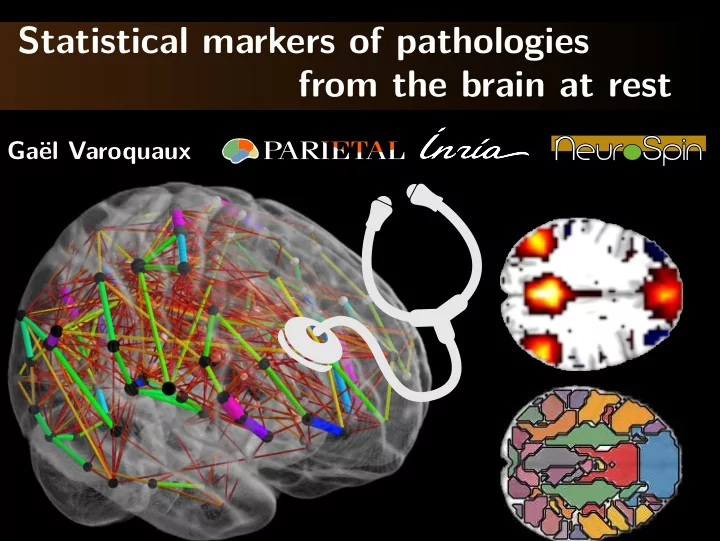
Statistical markers of pathologies from the brain at rest

Ga¨ el Varoquaux
slide-2
SLIDE 2

Probing variations of the mind Psychiatry is defined by symptoms Diagnostic and Statistical Manual of Mental Disorders No known physio-pathology; Autism = ? Asperger Need quantitative phenotypes of brain function

G Varoquaux 2

slide-3
SLIDE 3

Probing variations of the mind Psychiatry is defined by symptoms Diagnostic and Statistical Manual of Mental Disorders No known physio-pathology; Autism = ? Asperger Need quantitative phenotypes of brain function Population imaging with rest fMRI

UK Biobank [Miller... 2016]

Easy to set up reproducibly Suitable for diminished patients Connectivity captures traits

G Varoquaux 2

slide-4
SLIDE 4

Functional connectomes: brain graphs No salient features in rest fMRI

G Varoquaux 3

slide-5
SLIDE 5

Functional connectomes: brain graphs Define functional regions

[Varoquaux and Craddock 2013]

G Varoquaux 3

slide-6
SLIDE 6

Functional connectomes: brain graphs Define functional regions Learn interactions

[Varoquaux and Craddock 2013]

G Varoquaux 3

slide-7
SLIDE 7

Functional connectomes: brain graphs Define functional regions Learn interactions Detect differences

[Varoquaux and Craddock 2013]

G Varoquaux 3

slide-8
SLIDE 8

Outline

1 Functional regions 2 The connectome matrix 3 Biomarkers of autism

G Varoquaux 4

slide-9
SLIDE 9

1 Functional regions

Need functional regions for nodes Bad choice of regions gives wrong graph properties

[Smith... 2011]

⇒ Spatial analysis

G Varoquaux 5

slide-10
SLIDE 10

1 Functional regions

Available “on the market”

anatomical atlases, functional atlases, region-extraction methods

G Varoquaux 5

slide-11
SLIDE 11

1 Functional regions

Atlases based on anatomy Clustering tools Models based on linear decompositions

G Varoquaux 5

slide-12
SLIDE 12

1 Anatomical atlases Anatomical atlases do not resolve functional structures

Harvard Oxford AAL

Default mode network: most stable network at rest

G Varoquaux 6

slide-13
SLIDE 13

1 Clustering approaches Group together voxels with similar time courses

... ... ...

... ...

G Varoquaux 7

slide-14
SLIDE 14

1 Clustering approaches K-Means Fast No spatial constraint

(smooth the data) Related to [Yeo... 2011]

Normalized cuts Slow

[Craddock... 2012]

Spatial constraints Very geometrical Ward clustering Very fast

(even with many clusters)

Spatial constraints

G Varoquaux 8

slide-15
SLIDE 15

1 Clustering approaches

[Thirion... 2014]

K-Means Fast No spatial constraint

(smooth the data) Related to [Yeo... 2011]

Normalized cuts Slow

[Craddock... 2012]

Spatial constraints Very geometrical Ward clustering Very fast

(even with many clusters)

Spatial constraints Model selection: empirical results Based on cluster stability and fit to data Large number of clusters: Ward Small number of clusters: Kmeans [Thirion... 2014]

G Varoquaux 8

slide-16
SLIDE 16

1 Mixture models: linear decompositions Working hypothesis / model: Observing linear mixtures of networks at rest

Time courses G Varoquaux 9

slide-17
SLIDE 17

1 Mixture models: linear decompositions Working hypothesis / model: Observing linear mixtures of networks at rest

Time courses Language G Varoquaux 9

slide-18
SLIDE 18

1 Mixture models: linear decompositions Working hypothesis / model: Observing linear mixtures of networks at rest

Time courses Audio G Varoquaux 9

slide-19
SLIDE 19

1 Mixture models: linear decompositions Working hypothesis / model: Observing linear mixtures of networks at rest

Time courses Visual G Varoquaux 9

slide-20
SLIDE 20

1 Mixture models: linear decompositions Working hypothesis / model: Observing linear mixtures of networks at rest

Time courses Dorsal Att. G Varoquaux 9

slide-21
SLIDE 21

1 Mixture models: linear decompositions Working hypothesis / model: Observing linear mixtures of networks at rest

Time courses Motor G Varoquaux 9

slide-22
SLIDE 22

1 Mixture models: linear decompositions Working hypothesis / model: Observing linear mixtures of networks at rest

Time courses Salience G Varoquaux 9

slide-23
SLIDE 23

1 Mixture models: linear decompositions Working hypothesis / model: Observing linear mixtures of networks at rest

Time courses Ventral Att. G Varoquaux 9

slide-24
SLIDE 24

1 Mixture models: linear decompositions Working hypothesis / model: Observing linear mixtures of networks at rest

Time courses Parietal G Varoquaux 9

slide-25
SLIDE 25

1 Mixture models: linear decompositions Working hypothesis / model: Observing linear mixtures of networks at rest

Time courses

Observe a mixture

How to unmix networks?

G Varoquaux 9

slide-26
SLIDE 26

1 Spatial modes: ICA decomposition

time voxels time voxels time voxels

Y

+

E · S

=

25

N

Decomposing time series into: covarying spatial maps, S uncorrelated residuals, N p ICA: minimize mutual information across S

[Kiviniemi 2003, Beckmann 2005, Varoquaux 2010]

G Varoquaux 10

slide-27
SLIDE 27

1 Spatial modes: ICA decomposition

time voxels time voxels time voxels

Y

+

E · S

=

25

N

Decomposing time series into: covarying spatial maps, S uncorrelated residuals, N p ICA: minimize mutual information across S

[Kiviniemi 2003, Beckmann 2005, Varoquaux 2010]

G Varoquaux 10

slide-28
SLIDE 28

1 Spatial modes: ICA decomposition

time voxels time voxels time voxels

Y

+

E · S

=

25

N

Decomposing time series into: covarying spatial maps, S uncorrelated residuals, N Sparse decompositions: sparse penalty on maps

[Kiviniemi 2003, Beckmann 2005, Varoquaux 2010]

G Varoquaux 10

slide-29
SLIDE 29

1 ICA versus sparse decompositions ICA

  • 1. Select signal of interest
  • 2. Select “maximaly independent” ICs

Sparse decomposition

ˆ E, ˆ S = argmin

S, E

  • Y − E S
  • 2

2 + λ

  • S
  • 1

Data fit Penalization: sparse maps Joint estimation of signal space + components

G Varoquaux 11

slide-30
SLIDE 30

1 From group to subject networks MSDL

[Varoquaux... 2011, Abraham... 2013]

Multi-Subject Dictionary Learning

argmin

Es,Ss,S

  • subjects
  • Ys − EsSsT2

Fro + µSs − S2 Fro

  • + λ Ω(S)

Data fit Subject variability Penalization: inject structure

G Varoquaux 12

slide-31
SLIDE 31

1 From group to subject networks MSDL

[Varoquaux... 2011, Abraham... 2013]

Multi-Subject Dictionary Learning

argmin

Es,Ss,S

  • subjects
  • Ys − EsSsT2

Fro + µSs − S2 Fro

  • + λ Ω(S)

Data fit Subject variability Penalization: inject structure Create a region-forming penalty: Original Clustering Total-variationg

G Varoquaux 12

slide-32
SLIDE 32

1 From group to subject networks MSDL

[Varoquaux... 2011, Abraham... 2013]

Multi-Subject Dictionary Learning

argmin

Es,Ss,S

  • subjects
  • Ys − EsSsT2

Fro + µSs − S2 Fro

  • + λ Ω(S)

Data fit Subject variability Penalization: inject structure Create a region-forming penalty: Original Clustering Total-variationg TV-ℓ1 penalty: w1 + TV (w) sparse and smooth regions TV = “piecewise constant”

[Gramfort... 2013]

Gain in TV and l1 No gain in TV G Varoquaux 12

slide-33
SLIDE 33

Downloadable from Parietal webpage http://team.inria.fr/parietal

White matter Vascular system Inner nuclei Functional network Visual and motor system

slide-34
SLIDE 34

[Abraham... 2013]

Brain parcellations

MSDL Group ICA Ward K-Means

slide-35
SLIDE 35

[Abraham... 2013]

Brain parcellations

MSDL Group ICA Ward K-Means

slide-36
SLIDE 36

[Abraham... 2013]

Brain parcellations

MSDL Group ICA Ward K-Means

slide-37
SLIDE 37

Functional regions

AAL Smith 2009 ICAs Craddock 2011 Ncuts Abraham 2013 TV-MSDL Ward Harvard- Oxford High model

  • rder ICA

K-Means Varoquaux 2011 Smooth- MSDL Yeo 2011 G Varoquaux 15

slide-38
SLIDE 38

Functional regions

AAL Smith 2009 ICAs Craddock 2011 Ncuts Abraham 2013 TV-MSDL Ward Harvard- Oxford High model

  • rder ICA

K-Means Varoquaux 2011 Smooth- MSDL Yeo 2011 G Varoquaux 15

slide-39
SLIDE 39

2 The connectome matrix

How to capture and represent interactions?

G Varoquaux 16

slide-40
SLIDE 40

2 Data processing induces structure Small-world: “The friends of my friends are my friends” Correlation: If A and B are very correlated, and C is correlated with A, C is also correlated with B ⇒ Thresholded correlations are small-world

[Zalesky... 2012]

Need careful statistics

G Varoquaux 17

slide-41
SLIDE 41

2 From correlations to connectomes Threshold? How to check that we are not throwing out the baby with the bath water

G Varoquaux 18

slide-42
SLIDE 42

2 From correlations to connectomes Threshold? How to check that we are not throwing out the baby with the bath water No models without controlling goodness of fit Descriptive statistics are hard to compare

G Varoquaux 18

slide-43
SLIDE 43

2 Probabilistic model for interactions Simplest data generating process = multivariate normal:

P(X) ∝

  • |Σ−1|e−1

2XT Σ−1X

Model parametrized by inverse covariance matrix, K = Σ−1: conditional covariances Goodness of fit: likelihood of observed covariance ˆ Σ in model Σ

L( ˆ Σ|K) = log |K| − trace( ˆ Σ K)

G Varoquaux 19

slide-44
SLIDE 44

2 Correlations: observations and indirect effects

Observations

Correlation

1 2 3 4

Covariance: scaled by variance

Direct connections

Partial correlation

1 2 3 4

Inverse covariance: scaled by partial variance

G Varoquaux 20

slide-45
SLIDE 45

2 Correlations: observations and indirect effects

Observations

Correlation

Direct connections

Partial correlation

G Varoquaux 20

slide-46
SLIDE 46

2 Estimating a graphical model Gaussian graphical models Zeros in inverse covariance give conditional independence Σ−1

i,j = 0

⇔ xi, xj independent conditionally on {xk, k = i, j} Sparse inverse covariance Estimator imposes zeros

[Smith... 2011, Varoquaux... 2010b]

Shrunk estimator Estimates closer to 0

[Varoquaux and Craddock 2013] G Varoquaux 21

slide-47
SLIDE 47

2 Differences in correlations across subjects

5 10 15 20 25 5 10 15 20 25 5 10 15 20 25 5 10 15 20 25 5 10 15 20 25 5 10 15 20 25 5 10 15 20 25 5 10 15 20 25

Correlation matrices

5 10 15 20 25 5 10 15 20 25 5 10 15 20 25 5 10 15 20 25 5 10 15 20 25 5 10 15 20 25 5 10 15 20 25 5 10 15 20 25

Partial correlation matrices 3 controls, 1 severe stroke patient Which is which?

G Varoquaux 22

slide-48
SLIDE 48

2 Differences in correlations across subjects

5 10 15 20 25 5 10 15 20 25Control 5 10 15 20 25 5 10 15 20 25Control 5 10 15 20 25 5 10 15 20 25Control 5 10 15 20 25 5 10 15 20 25Large lesion

Correlation matrices

5 10 15 20 25 5 10 15 20 25Control 5 10 15 20 25 5 10 15 20 25Control 5 10 15 20 25 5 10 15 20 25Control 5 10 15 20 25 5 10 15 20 25Large lesion

Partial correlation matrices Spread-out variability in correlation matrices Noise in partial-correlations Strong dependence between coefficients

[Varoquaux... 2010a] G Varoquaux 22

slide-49
SLIDE 49

2 A toy model of differences in connectivity Two processes with different partial correlations K1: K1 − K2: Σ1: Σ1 − Σ2:

+ jitter in observed covariance

MSE(K1 − K2): MSE(Σ1 − Σ2): Non-local effects and non homogeneous noise

G Varoquaux 23

slide-50
SLIDE 50

2 Error geometry Disentangle parameters (edge-level connectivities) Connectivity matrices form a manifold ⇒ project to tangent space

θ¹ θ²

( ) θ¹

I

  • 1

( ) θ²

I

  • 1

Estimation error of covariances Assymptotics given by Fisher matrix

[Rao 1945]

Cramer-Rao bounds

G Varoquaux 24

slide-51
SLIDE 51

2 Error geometry Disentangle parameters (edge-level connectivities) Connectivity matrices form a manifold ⇒ project to tangent space

Manifold

Estimation error of covariances Assymptotics given by Fisher matrix

[Rao 1945]

Defines a metric on a manifold of models With covariances: Lie-algebra structure

G Varoquaux 24

slide-52
SLIDE 52

2 Reparametrization for uniform error geometry Disentangle parameters (edge-level connectivities) Connectivity matrices form a manifold ⇒ project to tangent space

Controls Patient

Manifold T a n g e n t

dΣ = Σ− 1/

2

Ctrl ΣPatientΣ− 1/

2

Ctrl

G Varoquaux 24

slide-53
SLIDE 53

2 Reparametrization for uniform error geometry The simulations K1 − K2: Σ1 − Σ2: dΣ: MSE(dΣ): Semi-local effects and homogeneous noise

G Varoquaux 25

slide-54
SLIDE 54

2 Which parametrization capture differences

5 10 15 20 25 5 10 15 20 25Control 5 10 15 20 25 5 10 15 20 25Control 5 10 15 20 25 5 10 15 20 25Control 5 10 15 20 25 5 10 15 20 25Large lesion

Correlation matrices

5 10 15 20 25 5 10 15 20 25Control 5 10 15 20 25 5 10 15 20 25Control 5 10 15 20 25 5 10 15 20 25Control 5 10 15 20 25 5 10 15 20 25Large lesion

Partial correlation matrices

5 10 15 20 25 5 10 15 20 25Control 5 10 15 20 25 5 10 15 20 25Control 5 10 15 20 25 5 10 15 20 25Control 5 10 15 20 25 5 10 15 20 25Large lesion

Tangent-space embedding

[varoquaux 2010] G Varoquaux 26

slide-55
SLIDE 55

3 Biomarkers of autism

from connectomes

G Varoquaux 27

slide-56
SLIDE 56

3 Intersite autism neurophenotypes Predicting diagnostic status a good success metric Multi-site large autism dataset: ABIDE Autism Spectrum Disorder

[Di Martino... 2014]

⇒ Patient/Control classification 16 sites ∼ 1000 subjects Biomarkers robust to inter-site variations Cross-validation predicting to new sites

Training set T esting set

G Varoquaux 28

slide-57
SLIDE 57

A connectome classification pipeline

RS-fMRI

Functional connectivity Time series

2 4 3 1

Diagnosis

ROIs

1 ROI definition 2 Time-series extraction 3 Connectivity matrices 4 Supervised learning

[Abraham... 2016]

G Varoquaux 29

slide-58
SLIDE 58

A connectome classification pipeline

RS-fMRI

Functional connectivity Time series

2 4 3 1

Diagnosis

ROIs

1 ROI definition 2 Time-series extraction 3 Connectivity matrices 4 Supervised learning

[Abraham... 2016]

Prediction accuracy (%)

Seen sites 67±3 Unseen sites 67±5

What is important to predict?

G Varoquaux 29

slide-59
SLIDE 59

A connectome classification pipeline

RS-fMRI

Functional connectivity Time series

2 4 3 1

Diagnosis

ROIs

1 ROI definition 2 Time-series extraction 3 Connectivity matrices 4 Supervised learning

[Abraham... 2016]

Prediction accuracy (%)

Seen sites 67±3 Unseen sites 67±5

What is important to predict?

G Varoquaux 29

slide-60
SLIDE 60

3 ROI definition: impact of choice

RS-fMRI

Functional connectivity Time series

2 4 3 1

Diagnosis

ROIs

1 ROI definition 2 Time-series extraction 3 Connectivity matrices 4 Supervised learning

G Varoquaux 30

slide-61
SLIDE 61

3 ROI definition: impact of choice

RS-fMRI

Functional connectivity Time series

2 4 3 1

Diagnosis

ROIs

1 ROI definition 2 Time-series extraction 3 Connectivity matrices 4 Supervised learning

G Varoquaux 30

slide-62
SLIDE 62

3 Time-series extraction

Time series

2

RS-fMRI

Functional connectivity

4 3 1

Diagnosis

ROIs

1 ROI definition 2 Time-series extraction 3 Connectivity matrices 4 Supervised learning

G Varoquaux 31

slide-63
SLIDE 63

3 Functional-connectivity matrix

Time series

2

RS-fMRI

4 1

Diagnosis

ROIs Functional connectivity

3 1 ROI definition 2 Time-series extraction 3 Connectivity matrices 4 Supervised learning

G Varoquaux 32

slide-64
SLIDE 64

3 Functional-connectivity matrix

Time series

2

RS-fMRI

4 1

Diagnosis

ROIs Functional connectivity

3 1 ROI definition 2 Time-series extraction 3 Connectivity matrices 4 Supervised learning Correlation matrix? Partial correlation matrix? Tangent-space embedding?

[Varoquaux... 2010a]

G Varoquaux 32

slide-65
SLIDE 65

3 Functional-connectivity matrix

Time series

2

RS-fMRI

4 1

Diagnosis

ROIs Functional connectivity

3 1 ROI definition 2 Time-series extraction 3 Connectivity matrices 4 Supervised learning

G Varoquaux 33

slide-66
SLIDE 66

3 Supervised learning method

Functional connectivity Time series

3 4

Diagnosis

2

RS-fMRI

1

ROIs

1 ROI definition 2 Time-series extraction 3 Connectivity matrices 4 Supervised learning Ridge classifier SVC ℓ2 penalized SVC ℓ1 penalized

G Varoquaux 34

slide-67
SLIDE 67

3 Supervised learning method: impact of choice

Functional connectivity Time series

3 4

Diagnosis

2

RS-fMRI

1

ROIs

1 ROI definition 2 Time-series extraction 3 Connectivity matrices 4 Supervised learning

G Varoquaux 35

slide-68
SLIDE 68

Importance of pipeline steps

RS-fMRI

Functional connectivity Time series

2 4 3 1

Diagnosis

ROIs

1 ROI definition 2 Time-series extraction 3 Connectivity matrices 4 Supervised learning

G Varoquaux 36

slide-69
SLIDE 69

Importance of pipeline steps

RS-fMRI

Functional connectivity Time series

2 4 3 1

Diagnosis

ROIs

1 ROI definition 2 Time-series extraction 3 Connectivity matrices 4 Supervised learning

G Varoquaux 36

slide-70
SLIDE 70

MSDL atlas

slide-71
SLIDE 71

More data is better

Accuracy Fraction of subjects used

Multivariate processing of a 1Tb of heterogeneous data is worth the trouble

slide-72
SLIDE 72

3 Results carry over (1)

[Dadi... 2016]

3 more cohorts and brain disorders Schizophrenia, Alzheimer’s, addiction

slide-73
SLIDE 73

3 Results carry over (2)

[Liem... 2016]

Brain aging Combines brain connectivity and morphology Predicts age with a mean absolute error of 4.3 years Prediction error correlates with cognitive impairment

slide-74
SLIDE 74

3 Psychiatric neurophenotypes from rest-fMRI Viable from data accumulation ABIDE is a post-hoc aggregate Prediction across sites

slide-75
SLIDE 75

3 Psychiatric neurophenotypes from rest-fMRI Viable from data accumulation ABIDE is a post-hoc aggregate Prediction across sites Not (yet) for clinical diagnostic Capture neural signatures of disorders ⇒ Towards a redefinition of disorders Requires huge data accumulation

slide-76
SLIDE 76

nilearn: machine learning for neuroimaging

ni

Make it easy for Neuroscientists to use machine learning Machine learning research to do neuroimaging Design goal: runs out of the box Strong points Fast and versatile High-quality brain plotting Simple syntax Meaningful neuroimaging analysis in examples. Try it – http://nilearn.github.io

[Abraham... 2014]

slide-77
SLIDE 77

@GaelVaroquaux

Statistical markers of pathologies Markers from brain graphs Choice of regions critical (learn them) Valued graphs and estimation error Tangent-space embedding Standard SVM ni

slide-78
SLIDE 78

@GaelVaroquaux

Statistical markers of pathologies Markers from brain graphs Choice of regions critical (learn them) Valued graphs and estimation error Tangent-space embedding Standard SVM ni Dictionary learning MSDL Good definitions of regions Validation is very hard

slide-79
SLIDE 79

@GaelVaroquaux

Statistical markers of pathologies Markers from brain graphs Choice of regions critical (learn them) Valued graphs and estimation error Tangent-space embedding Standard SVM ni Dictionary learning MSDL Good definitions of regions Validation is very hard Prediction of autism across sites

[Abraham... 2016]

slide-80
SLIDE 80

References I

  • A. Abraham, E. Dohmatob, B. Thirion, D. Samaras, and
  • G. Varoquaux. Extracting brain regions from rest fMRI with

total-variation constrained dictionary learning. In MICCAI, page

  • 607. 2013.
  • A. Abraham, F. Pedregosa, M. Eickenberg, P. Gervais, A. Mueller,
  • J. Kossaifi, A. Gramfort, B. Thirion, and G. Varoquaux.

Machine learning for neuroimaging with scikit-learn. Frontiers in neuroinformatics, 8, 2014.

  • A. Abraham, M. Milham, A. Di Martino, R. C. Craddock,
  • D. Samaras, B. Thirion, and G. Varoquaux. Deriving robust

biomarkers from multi-site resting-state data: An autism-based

  • example. bioRxiv, page 075853, 2016.
  • R. C. Craddock, G. A. James, P. E. Holtzheimer, X. P. Hu, and
  • H. S. Mayberg. A whole brain fMRI atlas generated via spatially

constrained spectral clustering. Human brain mapping, 33(8): 1914–1928, 2012.

slide-81
SLIDE 81

References II

  • K. Dadi, A. Abraham, M. Rahim, B. Thirion, and G. Varoquaux.

Comparing functional connectivity based predictive models across datasets. In PRNI 2016: 6th International Workshop on Pattern Recognition in Neuroimaging, 2016.

  • A. Di Martino, C.-G. Yan, Q. Li, E. Denio, F. X. Castellanos,
  • K. Alaerts, J. S. Anderson, M. Assaf, S. Y. Bookheimer,
  • M. Dapretto, ... The autism brain imaging data exchange:

towards a large-scale evaluation of the intrinsic brain architecture in autism. Molecular psychiatry, 19:659, 2014.

  • A. Gramfort, B. Thirion, and G. Varoquaux. Identifying predictive

regions from fMRI with TV-L1 prior. In PRNI, pages 17–20, 2013.

  • F. Liem, G. Varoquaux, J. Kynast, F. Beyer, S. K. Masouleh, J. M.

Huntenburg, L. Lampe, M. Rahim, A. Abraham, R. C. Craddock, ... Predicting brain-age from multimodal imaging data captures cognitive impairment. NeuroImage, 2016.

slide-82
SLIDE 82

References III

  • K. L. Miller, F. Alfaro-Almagro, N. K. Bangerter, D. L. Thomas,
  • E. Yacoub, J. Xu, A. J. Bartsch, S. Jbabdi, S. N. Sotiropoulos,
  • J. L. Andersson, ... Multimodal population brain imaging in the

uk biobank prospective epidemiological study. Nature Neuroscience, 2016.

  • C. Rao. Information and accuracy attainable in the estimation of

statistical parameters. Bull. Calcutta Math. Soc., 37:81, 1945.

  • S. Smith, K. Miller, G. Salimi-Khorshidi, M. Webster,
  • C. Beckmann, T. Nichols, J. Ramsey, and M. Woolrich. Network

modelling methods for fMRI. Neuroimage, 54:875, 2011.

  • B. Thirion, G. Varoquaux, E. Dohmatob, and J. Poline. Which

fMRI clustering gives good brain parcellations? Name: Frontiers in Neuroscience, 8:167, 2014.

  • G. Varoquaux and R. C. Craddock. Learning and comparing

functional connectomes across subjects. NeuroImage, 80:405, 2013.

slide-83
SLIDE 83

References IV

  • G. Varoquaux, F. Baronnet, A. Kleinschmidt, P. Fillard, and
  • B. Thirion. Detection of brain functional-connectivity difference

in post-stroke patients using group-level covariance modeling. In MICCAI, pages 200–208. 2010a.

  • G. Varoquaux, A. Gramfort, J. B. Poline, and B. Thirion. Brain

covariance selection: better individual functional connectivity models using population prior. In NIPS. 2010b.

  • G. Varoquaux, A. Gramfort, F. Pedregosa, V. Michel, and
  • B. Thirion. Multi-subject dictionary learning to segment an atlas
  • f brain spontaneous activity. In Inf Proc Med Imag, pages

562–573, 2011.

  • B. Yeo, F. Krienen, J. Sepulcre, M. Sabuncu, ... The organization
  • f the human cerebral cortex estimated by intrinsic functional
  • connectivity. J Neurophysio, 106:1125, 2011.
  • A. Zalesky, A. Fornito, and E. Bullmore. On the use of correlation

as a measure of network connectivity. NeuroImage, 2012.