Statistical Mechanics of Money, Income, Debt, and Energy Consumption - - PowerPoint PPT Presentation

statistical mechanics of money income debt and energy
SMART_READER_LITE
LIVE PREVIEW

Statistical Mechanics of Money, Income, Debt, and Energy Consumption - - PowerPoint PPT Presentation

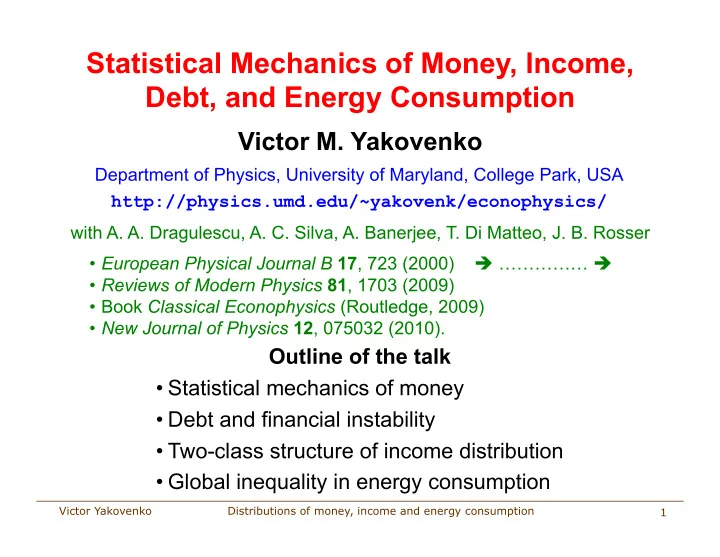
Statistical Mechanics of Money, Income, Debt, and Energy Consumption Victor M. Yakovenko Department of Physics, University of Maryland, College Park, USA http://physics.umd.edu/~yakovenk/econophysics/ with A. A. Dragulescu, A. C. Silva, A.


slide-1
SLIDE 1

Distributions of money, income and energy consumption Victor Yakovenko 1

Statistical Mechanics of Money, Income, Debt, and Energy Consumption

Victor M. Yakovenko

Department of Physics, University of Maryland, College Park, USA http://physics.umd.edu/~yakovenk/econophysics/

  • European Physical Journal B 17, 723 (2000)  …………… 
  • Reviews of Modern Physics 81, 1703 (2009)
  • Book Classical Econophysics (Routledge, 2009)
  • New Journal of Physics 12, 075032 (2010).

with A. A. Dragulescu, A. C. Silva, A. Banerjee, T. Di Matteo, J. B. Rosser

Outline of the talk

  • Statistical mechanics of money
  • Debt and financial instability
  • Two-class structure of income distribution
  • Global inequality in energy consumption
slide-2
SLIDE 2

Distributions of money, income and energy consumption Victor Yakovenko 2

Boltzmann-Gibbs versus Pareto distribution

Ludwig Boltzmann (1844-1906) Vilfredo Pareto (1848-1923) Boltzmann-Gibbs probability distribution P(ε)∝exp(-ε/T), where ε is energy, and T=〈ε〉 is temperature. Pareto probability distribution P(r)∝1/r(α+1) of income r. An analogy between the distributions of energy ε and money m or income r

slide-3
SLIDE 3

Distributions of money, income and energy consumption Victor Yakovenko 3

Boltzmann-Gibbs probability distribution of energy

Boltzmann-Gibbs probability distribution P(ε) ∝ exp(−ε/T) of energy ε, where T = 〈ε〉 is temperature. It is universal – independent of model rules, provided the model belongs to the time-reversal symmetry class. Detailed balance: w12→1’2’P(ε1) P(ε2) = w1’2’→12P(ε1′) P(ε2′) Collisions between atoms ε1 ε2 ε1′ = ε1 + Δε ε2′ = ε2 − Δε Conservation of energy: ε1 + ε2 = ε1′ + ε2′ Boltzmann-Gibbs distribution maximizes entropy S = −Σε P(ε) lnP(ε) under the constraint of conservation law Σε P(ε) ε = const. Boltzmann-Gibbs probability distribution P(m) ∝ exp(−m/T) of money m, where T = 〈m〉 is the money temperature. Detailed balance: w12→1’2’P(m1) P(m2) = w1’2’→12P(m1′) P(m2′) Economic transactions between agents m1 m2 m1′ = m1 + Δm m2′ = m2 − Δm Conservation of money: m1 + m2 = m1′+ m2′

money

slide-4
SLIDE 4

Distributions of money, income and energy consumption Victor Yakovenko 4

Computer simulation of money redistribution

The stationary distribution of money m is exponential: P(m) ∝ e−m/T

slide-5
SLIDE 5

Distributions of money, income and energy consumption Victor Yakovenko 5

Money distribution with debt

Debt per person is limited to 800 units. Total debt in the system is limited via the Required Reserve Ratio (RRR): Xi, Ding, Wang, Physica A 357, 543 (2005)

  • In practice, RRR is enforced inconsistently and does not limit total debt.
  • Without a constraint on debt, the system does not have a stationary

equilibrium.

  • Free market itself does not have an intrinsic mechanism for limiting

debt, and there is no such thing as the equilibrium debt.

slide-6
SLIDE 6

Distributions of money, income and energy consumption Victor Yakovenko 6

Probability distribution of individual income

US Census data 1996 – histogram and points A PSID: Panel Study of Income Dynamics, 1992 (U. Michigan) – points B Distribution

  • f income r

is exponential: P(r) ∝ e−r/T

slide-7
SLIDE 7

Distributions of money, income and energy consumption Victor Yakovenko 7

Income distribution in the USA, 1997

Two-class society

Upper Class

  • Pareto power law
  • 3% of population
  • 16% of income
  • Income > 120 k$:

investments, capital Lower Class

  • Boltzmann-Gibbs

exponential law

  • 97% of population
  • 84% of income
  • Income < 120 k$:

wages, salaries

“Thermal” bulk and “super-thermal” tail distribution r*

slide-8
SLIDE 8

Distributions of money, income and energy consumption Victor Yakovenko 8

Income distribution in the USA, 1983-2001

The rescaled exponential part does not change, but the power-law part changes significantly.

(income / average income T)

slide-9
SLIDE 9

Distributions of money, income and energy consumption Victor Yakovenko 9

A measure of inequality, the Gini coefficient is G =

Area(diagonal line - Lorenz curve) Area(Triangle beneath diagonal)

Lorenz curves and income inequality

Lorenz curve (0<r<∞): With a tail, the Lorenz curve is where f is the tail income, and Gini coefficient is G=(1+f)/2. For exponential distribution, G=1/2 and the Lorenz curve is

slide-10
SLIDE 10

Distributions of money, income and energy consumption Victor Yakovenko

f - fraction of income in the tail <r> − average income in the whole system T − average income in the exponential part Income inequality peaks during speculative bubbles in financial markets

10

Time evolution of income inequality in USA

Gini coefficient G=(1+f)/2

slide-11
SLIDE 11

Distributions of money, income and energy consumption Victor Yakovenko 11

The origin of two classes

  • Different sources of income: salaries and wages for the lower

class, and capital gains and investments for the upper class.

  • Their income dynamics can be described by additive and

multiplicative diffusion, correspondingly.

  • From the social point of view, these can be the classes of

employees and employers, as described by Karl Marx.

  • Emergence of classes from the initially equal agents was

simulated by Ian Wright “The Social Architecture of Capitalism” Physica A 346, 589 (2005), see also the new book “Classical Econophysics” (2009)

slide-12
SLIDE 12

Distributions of money, income and energy consumption Victor Yakovenko 12

Income distribution in Sweden

The data plot from Fredrik Liljeros and Martin Hällsten, Stockholm University

slide-13
SLIDE 13

Distributions of money, income and energy consumption Victor Yakovenko 13

Diffusion model for income kinetics

Suppose income changes by small amounts Δr over time Δt. Then P(r,t) satisfies the Fokker-Planck equation for 0<r<∞: For a stationary distribution, ∂tP = 0 and For the lower class, Δr are independent of r – additive diffusion, so A and B are

  • constants. Then, P(r) ∝ exp(-r/T), where T = B/A, – an exponential distribution.

For the upper class, Δr ∝ r – multiplicative diffusion, so A = ar and B = br2. Then, P(r) ∝ 1/rα+1, where α = 1+a/b, – a power-law distribution. For the upper class, income does change in percentages, as shown by Fujiwara, Souma, Aoyama, Kaizoji, and Aoki (2003) for the tax data in Japan. For the lower class, the data is not known yet.

slide-14
SLIDE 14

Distributions of money, income and energy consumption Victor Yakovenko 14

Additive and multiplicative income diffusion

If the additive and multiplicative diffusion processes are present simultaneously, then A= A0+ar and B= B0+br2 = b(r0

2+r2). The

stationary solution of the FP equation is It interpolates between the exponential and the power-law distributions and has 3 parameters:

  • T = B0/A0 – the temperature of the exponential

part

  • α = 1+a/b – the power-law exponent of the

upper tail

  • r0 – the crossover income between the lower

and upper parts.

slide-15
SLIDE 15

Distributions of money, income and energy consumption Victor Yakovenko 15

“The next great depression will be from 2008 to 2023” Harry S. Dent, book “The Great Boom Ahead”, page 16, published in 1993 His forecast was based on demographic data: The post-war ”baby boomers” generation to invest retirement savings in the stock market massively in the 1990s. His new book “The Great Depression Ahead”, January 2009

slide-16
SLIDE 16

Distributions of money, income and energy consumption Victor Yakovenko 16

Global inequality in energy consumption

Global distribution of energy consumption per person is roughly exponential. Division of a limited resource + entropy maximization produce exponential distribution. Physiological energy consumption

  • f a human at rest

is about 100 W

slide-17
SLIDE 17

Distributions of money, income and energy consumption Victor Yakovenko 17

Global inequality in energy consumption

The distribution is getting smoother with time. The gap in energy consumption between developed and developing countries shrinks. The global inequality of energy consumption decreased from 1990 to 2005. The energy consumption distribution is getting closer to the exponential.

slide-18
SLIDE 18

Distributions of money, income and energy consumption Victor Yakovenko 18

Conclusions

  • The probability distribution of money is stable and has an equilibrium only

when a boundary condition, such as m>0, is imposed.

  • When debt is permitted, the distribution of money becomes unstable,

unless some sort of a limit on maximal debt is imposed.

  • Income distribution in the USA has a two-class structure: exponential

(“thermal”) for the great majority (97-99%) of population and power-law (“superthermal”) for the top 1-3% of population.

  • The exponential part of the distribution is very stable and does not change

in time, except for a slow increase of temperature T (the average income).

  • The power-law tail is not universal and was increasing significantly for the

last 20 years. It peaked and crashed in 2000 and 2007 with the speculative bubbles in financial markets.

  • The global distribution of energy consumption per person is highly

unequal and roughly exponential. This inequality is important in dealing with the global energy problems.

slide-19
SLIDE 19

Distributions of money, income and energy consumption Victor Yakovenko 19

Time evolution of the tail parameters

  • Pareto tail changes in time

non-monotonously, in line with the stock market.

  • The tail income swelled 5-

fold from 4% in 1983 to 20% in 2000.

  • It decreased in 2001 with

the crash of the U.S. stock market. The Pareto index α in C(r)∝1/ rα is non-universal. It changed from 1.7 in 1983 to 1.3 in 2000.

slide-20
SLIDE 20

Distributions of money, income and energy consumption Victor Yakovenko 20

Time evolution of income temperature

The nominal average income T doubled: 20 k$ 1983 40 k$ 2001, but it is mostly inflation.

slide-21
SLIDE 21

Distributions of money, income and energy consumption Victor Yakovenko 21

Wealth distribution in the United Kingdom

For UK in 1996, T = 60 k£ Pareto index α = 1.9 Fraction

  • f wealth

in the tail f = 16%

slide-22
SLIDE 22

Distributions of money, income and energy consumption Victor Yakovenko 22

Income distribution for two-earner families

The average family income is 2T. The most probable family income is T.

slide-23
SLIDE 23

Distributions of money, income and energy consumption Victor Yakovenko 23

No correlation in the incomes of spouses

Every family is represented by two points (r1, r2) and (r2, r1). The absence of significant clustering of points (along the diagonal) indicates that the incomes r1 and r2 are approximately uncorrelated.

slide-24
SLIDE 24

Distributions of money, income and energy consumption Victor Yakovenko 24

Lorenz curve and Gini coefficient for families

Lorenz curve is calculated for families P2(r)∝r exp(-r/T). The calculated Gini coefficient for families is G=3/8=37.5% Maximum entropy (the 2nd law of thermodynamics) ⇒ equilibrium inequality: G=1/2 for individuals, G=3/8 for families. No significant changes in Gini and Lorenz for the last 50 years. The exponential (“thermal”) Boltzmann-Gibbs distribution is very stable, since it maximizes entropy.

slide-25
SLIDE 25

Distributions of money, income and energy consumption Victor Yakovenko 25

World distribution of Gini coefficient

A sharp increase of G is observed in

  • E. Europe and

former Soviet Union (FSU) after the collapse of communism – no equilibrium yet. In W. Europe and

  • N. America, G is

close to 3/8=37.5%, in agreement with

  • ur theory.

Other regions have higher G, i.e. higher inequality. The data from the World Bank (B. Milanović)

slide-26
SLIDE 26

Distributions of money, income and energy consumption Victor Yakovenko 26

Income distribution in Australia

The coarse-grained PDF (probability density function) is consistent with a simple exponential fit. The fine-resolution PDF shows a sharp peak around 7.3 kAU$, probably related to a welfare threshold set by the government.

slide-27
SLIDE 27

Distributions of money, income and energy consumption Victor Yakovenko 27

Thermal machine in the world economy

In general, different countries have different temperatures T, which makes possible to construct a thermal machine: High T2, developed countries Low T1, developing countries Money (energy) Products T1 < T2 Prices are commensurate with the income temperature T (the average income) in a country. Products can be manufactured in a low-temperature country at a low price T1 and sold to a high-temperature country at a high price T2. The temperature difference T2–T1 is the profit of an intermediary. In full equilibrium, T2=T1 ⇔ No profit ⇔ “Thermal death” of economy Money (energy) flows from high T2 to low T1 (the 2nd law of thermodynamics – entropy always increases) ⇔ Trade deficit