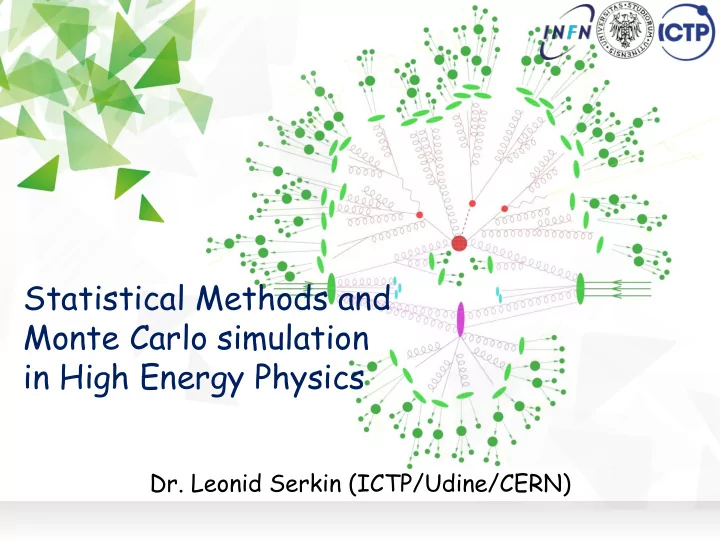
SLIDE 1 Statistical Methods and Monte Carlo simulation in High Energy Physics
- Dr. Leonid Serkin (ICTP/Udine/CERN)
SLIDE 2 The Concept of Probability
- Many processes in nature have uncertain outcomes.
- A random process is a process that can be reproduced, to some
extent, within some given boundary and initial conditions, but whose
- utcome is uncertain.
- For example, quantum mechanics phenomena have intrinsic
randomness.
- Probability is a measurement of how favored one of the possible
- utcomes of such a random process is compared with any of the
- ther possible outcomes.
SLIDE 3 The Meaning of Probability: 2 approaches
- Frequentist probability is defined as the fraction of the number of
- ccurrences of an event of interest over the total number of possible
events in a repeatable experiment, in the limit of very large number
- f experiments.
- Bayesian probability measures someone’s degree of belief that a
statement, and it makes use of an extension of the Bayes theorem: the probability of an event A given the condition that the event B has
- ccurred is given by:
- The conditional probability is equal to the
area of the intersection divided by the area if B
SLIDE 4 A Word on Simulation
- What a (computer) simulation does:
- Applies mathematical methods to the analysis of complex,
real-world problems
- Predicts what might happen depending on various
actions/scenarios
- Use simulations when
- Doing the actual experiments is not possible
- The cost in money, time, or danger of the actual experiment is
prohibitive (e.g. nuclear reactors)
- The system does not exist yet (e.g. an airplane)
- Various alternatives are examined (e.g. hurricane predictions)
SLIDE 5
Why we need and have so much data at LHC?
Correct dice every number has probability 1/6 Manipulated dice numbers 1..5 probability <1/6 number 6 probability > 1/6
An example for illustration
SLIDE 6
Role the dice and record the number in a bar chart
… 10 times … 1000 times Just random fluctuations Still nothing can be concluded
Why we need and have so much data at LHC?
SLIDE 7
… 10000 times … 100000 times
The more data you take the smaller your error gets (Gauss)
Evidence is rising … For sure there is something wrong with the dice
Why we need and have so much data at LHC?
SLIDE 8 Monte Carlo Method
- A numerical simulation method which
uses sequences of random numbers to solve complex problems
SLIDE 9 What Monte Carlo does?
- MC assumes the system is described by probability
density functions (PDF) which can be modeled with no need to write down equations
- These PDF are sampled randomly, many simulations are
performed and the result is the average over the number
SLIDE 10 Monte Carlo in High Energy Physics
- In HEP (in particular in hadron collider physics) MC are
very useful:
- To generate simulated collision events:
- Quantum Field Theory obey probability laws
- Proton PDF's have to be taken into account
- Final state kinematical distributions with many alternatives
(correlation of observables might be a problem...)
- Complex soft and non-perturbative QCD
(parton shower and hadronization)
- To simulate the response of the detector:
- Particle interaction with matter can be complicated
- Huge number of different detector components
SLIDE 11 What to do with Monte Carlo events?
- To test performances:
- Perform feasibility studies before looking at Data
- Predict the performances of the detector
- To compare with real collision Data to extract physics
results:
- Background modeling
- Signal selection efficiency (acceptance) determination
SLIDE 12
Example: Higgs discovery at ATLAS
Real Data Monte Carlo Simulation
SLIDE 13 Collision Event Simulation
- Different steps are required:
Start by determining the hard process: 1) Choice of the interesting process to generate (start from a generic pp collision would be inefficient...) 2) Randomly generate kinematics of initial and final states (using PDF's for initial state) Evolve the final state: 3) Decays of heavy particles according to BR's 4) Parton shower evolution 5) Hadronization of partons to form particles
SLIDE 14
Practical example: estimating the value of π using the Monte Carlo method
SLIDE 15 Practical example: estimating the value of π using the Monte Carlo method
- Q: How to estimate a value of π using the Monte Carlo
method?
SLIDE 16 Practical example: estimating the value of π using the Monte Carlo method
- Q: How to estimate a value of π using the Monte Carlo
method?
- A: Generate a large number of random points and see
how many fall in the circle enclosed by the unit square.
SLIDE 17 Practical example: estimating the value of π using the Monte Carlo method
- A: Generate a large number of random points and see
how many fall in the circle enclosed by the unit square
- Build a circle of radius 0.5, enclosed by a 1 × 1 square.
The area of the circle is: πR2 = π/4
- The area of the square is 1.
- If we divide the area of the circle,
by the area of the square we get: π/4
SLIDE 18 Practical example: estimating the value of π using the Monte Carlo method
- Generate a large number of uniformly distributed random
points and plot them on the graph. These points can be in any position within the square i.e. between (0,0) and (1,1).
- If they fall within the circle, they are coloured red,
- therwise they are coloured blue.
SLIDE 19 Practical example: estimating the value of π using the Monte Carlo method
- We keep track of the total number of points, and the
number of points that are inside the circle.
- If we divide the number of points within the
circle, Ninner, by the total number of points, Ntotal, we should get a value that is an approximation of the ratio of the areas we calculated above, π/4
- With a small number of points, the
estimation is not very accurate, but with thousands of points, we get closer to the actual value
SLIDE 20
A word on statistics
SLIDE 21
A word on statistics
SLIDE 22
Counting events
SLIDE 23
Counting events
SLIDE 24
Rare processes at the LHC
SLIDE 25 Probability to find something new In one year, the LHC provides ~1014 pp collisions
Searching for a needle in a haystack?
- typical needle: 5 mm3
- typical haystack: 50 m3
needle : haystack = 1 : 1010
Looking for new physics at the LHC is like looking for a needle in thousands of haystacks …
An observation of ~ 10 events could be a discovery of new physics.
SLIDE 26
QUESTIONS