Status of Analyses & Publications of Previous and Active - - PowerPoint PPT Presentation

status of analyses amp publications of previous and
SMART_READER_LITE
LIVE PREVIEW

Status of Analyses & Publications of Previous and Active - - PowerPoint PPT Presentation

Status of Analyses & Publications of Previous and Active Virology WG Collaborative Studies Published: International Survey on NAT Testing of Blood Donations: Expanding Implementation and Yield from 1999 to 2009. Vox Sang International


slide-1
SLIDE 1

1

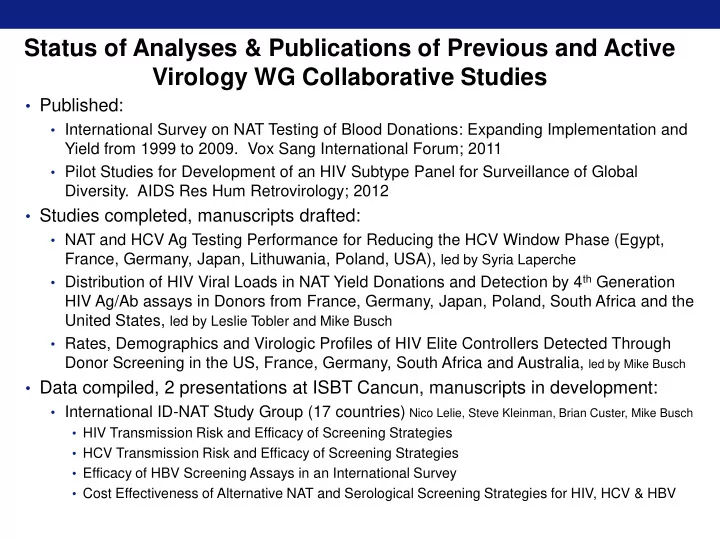
Status of Analyses & Publications of Previous and Active Virology WG Collaborative Studies

  • Published:
  • International Survey on NAT Testing of Blood Donations: Expanding Implementation and

Yield from 1999 to 2009. Vox Sang International Forum; 2011

  • Pilot Studies for Development of an HIV Subtype Panel for Surveillance of Global
  • Diversity. AIDS Res Hum Retrovirology; 2012
  • Studies completed, manuscripts drafted:
  • NAT and HCV Ag Testing Performance for Reducing the HCV Window Phase (Egypt,

France, Germany, Japan, Lithuwania, Poland, USA), led by Syria Laperche

  • Distribution of HIV Viral Loads in NAT Yield Donations and Detection by 4th Generation

HIV Ag/Ab assays in Donors from France, Germany, Japan, Poland, South Africa and the United States, led by Leslie Tobler and Mike Busch

  • Rates, Demographics and Virologic Profiles of HIV Elite Controllers Detected Through

Donor Screening in the US, France, Germany, South Africa and Australia, led by Mike Busch

  • Data compiled, 2 presentations at ISBT Cancun, manuscripts in development:
  • International ID-NAT Study Group (17 countries) Nico Lelie, Steve Kleinman, Brian Custer, Mike Busch
  • HIV Transmission Risk and Efficacy of Screening Strategies
  • HCV Transmission Risk and Efficacy of Screening Strategies
  • Efficacy of HBV Screening Assays in an International Survey
  • Cost Effectiveness of Alternative NAT and Serological Screening Strategies for HIV, HCV & HBV
slide-2
SLIDE 2
slide-3
SLIDE 3

Global Distribution of HIV-1 Genotypes

slide-4
SLIDE 4

HIV Viral Panels Project Requirements

  • Well characterized HIV reference panels encompassing

epidemic

  • Full length single genome sequencing
  • Verified RNA concentration
  • Fiebig staging and serological profiles for current

assays/platforms including rapid POC assays

  • Comparisons of VL from different FDA approved

commercially available platforms

  • Panels with larger volumes for use on newer diagnostic

platforms

  • Pilot study completed and published in 2010; Duke

awarded 7 year contract for full scale study

slide-5
SLIDE 5

5

slide-6
SLIDE 6

Overview of EQAPOL Viral Diversity Program

  • EQAPOL (External Quality Assurance Oversight

Laboratory)

  • Seven year NIAID contract
  • Encompasses multiple EQA programs (ELISpot, Flow Cytometry

Luminex) and the Viral Diversity Program

  • Viral Diversity Program Goals
  • Create HIV panels of plasma and viral isolates representative of

worldwide viral diversity

  • Grow 50 high-titer/high-volume cultures per year
  • Characterize viruses
  • Conduct work in a GCLP environment
  • Make viruses available for order through a web-based system

6

slide-7
SLIDE 7

Viral Diversity Program Workflow

7

Collect viral specimens

  • Sources include National Blood Collection origanization

(BSRI), FDA, Instituto de Salud Carlos III and First Affiliated Hospital of China Medical University

Perform Initial Characterization

  • Fiebig staging, VL, p24, pre-culture sequencing, sterility

testing

Culture to High-titer, High-volume

  • Two step culture process
  • Results in culture supernatant and HIV-spiked plasma

Characterize Virus

  • TCID50, Final VL testing (multiple platforms), sequencing,

coreceptor usage, sterility testing

Distribute HIV to Research Laboratories

  • Inventory available through EQAPOL web-based system
slide-8
SLIDE 8

Two-step culture process

8

Source Viral Specimen

Plasma, PBMCs, previously-cultured supernatant

Feeder Cells

Pooled cryopreserved PBMCs

Master Lot

  • ≈40mL
  • average titer >4.90e+09 cp/mL
  • average culture time is 8.2 days

Aliquot of master lot

Culture

Step 1:Small-Scale Culture Step 2:Large-Scale Culture

Feeder Cells

Pooled cryopreserved PBMCs

Culture

High Titer Culture Supernatant

  • ≈250 1mL aliquots
  • average titer >4.48e+09 cp/mL
  • Culture time generally 4-7 days

HIV Spiked-plasma

  • ≈100 1mL aliquots at 1e+07 cp/mL
  • ≈20 1mL aliquots at 5e+07 cp/mL
slide-9
SLIDE 9

Characterization Performed on All Final Viral Products

9

Viral Products (Culture supernatant and spiked plasma)

Sterility Testing

  • Endotoxin
  • Mycoplamsa
  • Bacterial

Inoculation

TCID50

  • TZM-bl cell-based

assay

Viral Load

  • Roche 2.0
  • Abbott (FDA)
  • Future: bDNA

Sequencing

  • Data uploaded to

GenBank

Coreceptor Usage

  • Phenotype
  • NP-2 Cell Assay

Pre-culture Testing

  • Fiebig staging
  • VL and p24
  • Sterility
  • Pre-culture

sequencing

slide-10
SLIDE 10

10

Sample Certificate of Analysis (COA)

CERTIFICATE OF ANALYSIS

Product Information Virus Name: DEMB94ZA001.01 Product Type (HIV-spiked Serum or Cell Culture Supernatant): Cell Culture Supernatant Clade: B Final Harvest Date: 08/30/2011 Viral Load of Product: 1.5 *1010 copies/mL Co-receptor Usage (determined using cell culture supernatant): CCR5 TCID50 of Product (cell culture supernatants only): 2.5 * 104 TCID50/mL Sterility Information Mycoplasma Testing: PASS Endotoxin Testing: Concentration: 0.05 EU/mL PASS Bacterial Testing: Soybean Casein Digest Medium PASS Fluid Thioglycolate Medium PASS Source Specimen Information Fiebig Stage of Source Plasma (if available): II Country of Origin for Source Specimen: South Africa Year of Donation for Source Specimen: 1994 Additional Information about Source Specimen: ______________________________ ______________ Quality Assurance Signature Date

  • All viral products

generated for EQAPOL will have a COA

  • COA will be signed by

EQAPOL Central Quality Assurance Unit

  • COA will be available for

download on EQAPOL web-based system

slide-11
SLIDE 11

11

0.02 A1.AU.03.PS1044_Day0 DEMF210CM007 DEMB10CN002 F2.CM.02.02CM_0016BBY F2.CM.97.CM53657 D.TZ.A280 DE04708ES004 DEMB99DE001 DEMG10CM008 C.IN.95.95IN21068 01_AE.AF.07.569M H.GB.00.00GBAC4001 DEMB09BO001 DEMC06ES003 F2.CM.95.95CM_MP257 02_AG.CM.99.pBD6_15 DEMC09ZA008 47_BF.ES.08.P1942 DEMA105TZ001 A1.RW.92.92RW008 B.TH.90.BK132 05_DF.BE.93.VI961 DEURF10DZ001 DEMC08NG001 DEMB08ES001 DE01405BR001 A3.DDJ360 06_cpx.EE.EE0359 F1.BR.93.93BR020_1 A2.CY.94.94CY017_41 A1.UG.92.92UG037 DEURF07ES002 DEMG09ES002 A3.DDI579 DEMB05FR001 F1.BE.93.VI850 D.CD.83.ELI.K03454 24_BG.ES.08.X2456_2 DEMBF09ES003 K.CM.96.96CM_MP535 05_DF.ES.99.X492 02_AG.NG.x.IBNG 04_cpx.GR.97.GR84_97PVMY DEMB08UY001 DEMC10ZA001 14_BG.ES.00.X605 G.NG.92.92NG083 D.CMCM_4412HAL A2.CD.97.97CDKTB48 01_AE.CN.05.05GX001 47_BF.ES.08.X2457_2 G.PT.x.PT2695 N.CM.95.YBF30 DEMC09ZA009 05_DF.BE.x.VI1310 DEMB99PL001 01_AE.TH.90.CM240 DEMF110ES001 G.KE.93.HH8793_12_1 DEURF09ES005 DEURF10US008 DE00109CN004 DE00110CN001 J.CD.97.J_97DC_KTB147 N.CM.97.YBF106 F1.FR.96.96FR_MP411 24_BG.CU.03.CB378 C.ET.86.ETH2220 DE00109CN003 DE00400GR002 04_cpx.GR.91.GR11_97PVCH C.BR.92.BR025_d 04_cpx.CY.94.94CY032_3 A2.CMCM_1445MV D.UG.94.94UG114 DE02408ES002 DE00711CN003 DEMC07BR003 DE00206AO001 DEMC07AO001 DEMB10VE001 DEMA106ES002 06_cpx.AU.96.BFP90 F1.FI.93.FIN9363 DEMC08ZA011 G.BE.96.DRCBL J.SE.93.SE9280_7887 DEMG05ES001 K.CD.97.97ZR_EQTB11 F2.CM.95.95CM_MP255 H.CF.90.056 24_BG.CU.03.CB471 06_cpx.GH.03.03GH173_06 14_BG.PT.00.00PTHDE10 B.FR.83.HXB2_LAI_IIIB_BRU 02_AG.LR.x.POC44951 C.ZA.04.04ZASK146 J.CM.04.04CMU11421 DE00208CM001 DE00208CM004 A3.DDJ369 DEMF210CM001 DEMBF09ES006 N.CM.02.DJO0131 DEMD10CM009 B.US.98.1058_11 B.NL.00.671_00T36 DEMB08FR002 DEMC07ZA011 DEMB09US002 14_BG.ES.00.X623

B

A1/B

D F1

C CRF01_A E

A1

CRF02_AG/A3

CRF02_A G

CRF14_BG

G

CRF04_cpx

CRF02_AG/CRF06_cpx

F2

CRF24_BG CRF47_BF

B/F B/F A1/B

B B B B, C, BF, 14 B C A C C D, G, 02, F2 B, BF, C, G, F1, 02 B, 01, 07 04 B 02, 02/06 B, C

  • Algeria
  • Angola
  • Bolivia
  • Brazil
  • Cameroon
  • China
  • France
  • Germany
  • Greece
  • Nigeria
  • Poland
  • South Africa
  • Spain
  • Tanzania
  • Uruguay
  • US
  • Venezuela

Current Diversity of Panel

slide-12
SLIDE 12

EQAPOL Web-based Application

  • Web-based application developed for EQAPOL Viral

Diversity:

  • Data regarding culture process
  • Viral characterization results
  • Inventory of viral products
  • Allows external users to order viral products
  • Tracks shipping and receipt of viral products
  • Track sites participating in the program
  • To use the system, users must request access via email:

EQAPOL@duke.edu

12

slide-13
SLIDE 13

13

slide-14
SLIDE 14

14

slide-15
SLIDE 15

15

slide-16
SLIDE 16
slide-17
SLIDE 17

17

Objectives of REDS-III HIV Diversity Project

  • Comparison, training and adoption of improved sequencing methods for

pol gene and/or full genome to enable high yield of sequence data and better drug resistance classification and subtype assignment than in REDS-II

  • Perform detailed env diversity analysis targeting NAT yield and recent

SC incident cases to characterize T/F viruses, and to provide data for validation of deep sequencing study (using 454 deep sequencing platform)

  • Demonstrate evolution of T/F viruses in blood donations with incident

HIV infections by performing deep sequencing study on 300 acutely infected blood donor samples, 100 from the US, 100 from Brazil and 100 from SA, with 50 from 15-20 years ago and 50 recent NAT yields or very recent SCs per country