Stereotactic Involving (being, utilizing, or used) a surgical - - PDF document

stereotactic
SMART_READER_LITE
LIVE PREVIEW

Stereotactic Involving (being, utilizing, or used) a surgical - - PDF document

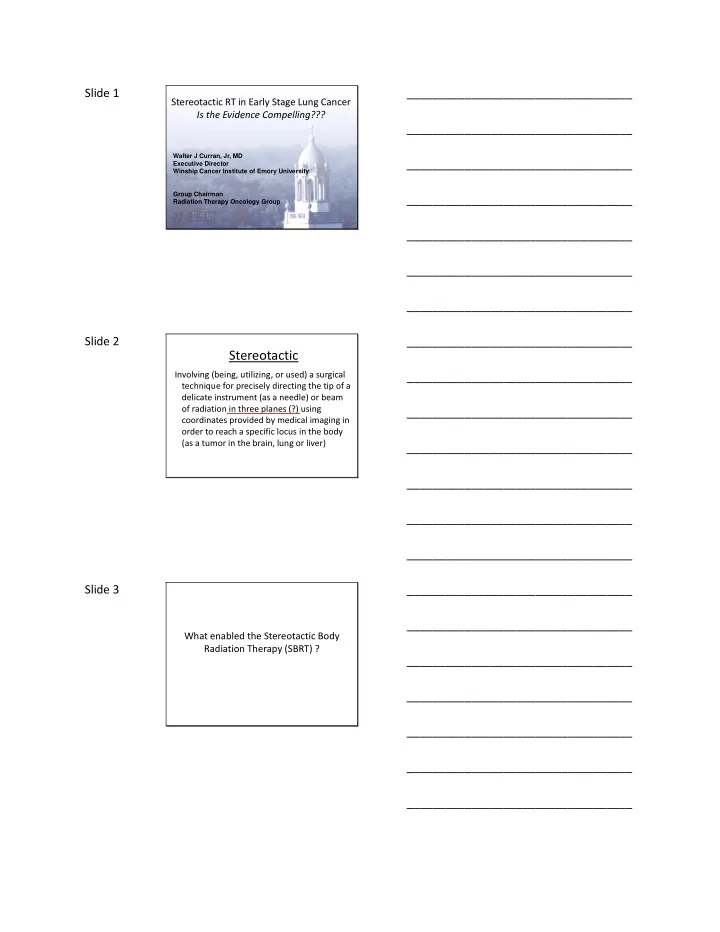
Slide 1 ___________________________________ Stereotactic RT in Early Stage Lung Cancer Is the Evidence Compelling??? ___________________________________ Walter J Curran, Jr, MD ___________________________________ Executive Director Winship


slide-1
SLIDE 1

Slide 1

Walter J Curran, Jr, MD Executive Director Winship Cancer Institute of Emory University Group Chairman Radiation Therapy Oncology Group

Stereotactic RT in Early Stage Lung Cancer Is the Evidence Compelling???

___________________________________ ___________________________________ ___________________________________ ___________________________________ ___________________________________ ___________________________________ ___________________________________ Slide 2

Stereotactic

Involving (being, utilizing, or used) a surgical technique for precisely directing the tip of a delicate instrument (as a needle) or beam

  • f radiation in three planes (?) using

coordinates provided by medical imaging in

  • rder to reach a specific locus in the body

(as a tumor in the brain, lung or liver)

___________________________________ ___________________________________ ___________________________________ ___________________________________ ___________________________________ ___________________________________ ___________________________________ Slide 3

What enabled the Stereotactic Body Radiation Therapy (SBRT) ?

___________________________________ ___________________________________ ___________________________________ ___________________________________ ___________________________________ ___________________________________ ___________________________________
slide-2
SLIDE 2

Slide 4

David Jablons’ Mentors in Thoracic Surgery

___________________________________ ___________________________________ ___________________________________ ___________________________________ ___________________________________ ___________________________________ ___________________________________ Slide 5

David Jablons’ Mentors in Thoracic Surgery

___________________________________ ___________________________________ ___________________________________ ___________________________________ ___________________________________ ___________________________________ ___________________________________ Slide 6

David Jablons’ Mentors in Thoracic Surgery

___________________________________ ___________________________________ ___________________________________ ___________________________________ ___________________________________ ___________________________________ ___________________________________

slide-3
SLIDE 3

Slide 7 ___________________________________ ___________________________________ ___________________________________ ___________________________________ ___________________________________ ___________________________________ ___________________________________ Slide 8

Technology Enabling SBRT

___________________________________ ___________________________________ ___________________________________ ___________________________________ ___________________________________ ___________________________________ ___________________________________ Slide 9

What is SBRT?

  • Potentially highly effective
  • Potentially extremely dangerous

___________________________________ ___________________________________ ___________________________________ ___________________________________ ___________________________________ ___________________________________ ___________________________________

slide-4
SLIDE 4

Slide 10

RT Fractionation Options

  • Conventionally Fractionated RT
  • small daily doses
  • go to very high cumulative doses
  • tolerable for most normal tissues
  • Hypofractionated RT
  • larger daily doses (3-8 Gy)
  • used mostly for palliation
  • Ablative RT (Stereotactic)
  • very high daily doses (8-20 Gy)
  • overwhelm tumor repair
  • causes “late” effects that may be intolerable

___________________________________ ___________________________________ ___________________________________ ___________________________________ ___________________________________ ___________________________________ ___________________________________ Slide 11

Hypofractionation Benefits

  • Reduce number of trips

– Increases convenience for patients – Decreased costs to system

  • Hospital staffing and equipment Payors
  • Biological

– Radiation at a specified dose is more tumorcidal if given in fewer “fractions”/High Dose

___________________________________ ___________________________________ ___________________________________ ___________________________________ ___________________________________ ___________________________________ ___________________________________ Slide 12

Survey: 9 out of 10 Tumor Cells Prefer Conventional Fractionation

100 2 4 6 8 Survival Dose (Gy) 10-1 10-2

single fraction multiple 2 Gy fractions

___________________________________ ___________________________________ ___________________________________ ___________________________________ ___________________________________ ___________________________________ ___________________________________

slide-5
SLIDE 5

Slide 13

Ablative Treatments (Stereotactic) Must Exclude Normal Tissue

  • Requirements for ablative hypofractionation:

–Abandon prophylactic treatment –Account for organ motion –Achieve sharper dose fall-off gradients to normal tissue (mimic radiosurgery)

  • These requirements need advanced technology

___________________________________ ___________________________________ ___________________________________ ___________________________________ ___________________________________ ___________________________________ ___________________________________ Slide 14

Ablative Treatments (Stereotactic) Must Exclude Normal Tissue

  • Requirements for ablative hypofractionation:

–Abandon prophylactic treatment –Account for organ motion –Achieve sharper dose fall-off gradients to normal tissue (mimic radiosurgery)

  • These requirements need advanced technology

___________________________________ ___________________________________ ___________________________________ ___________________________________ ___________________________________ ___________________________________ ___________________________________ Slide 15

Phase I Dose Response for Local Control

20 40 60 80 100 20 40 60 80 Total Dose (Gy) in 3 Fractions 17 Month Local Control (%)

___________________________________ ___________________________________ ___________________________________ ___________________________________ ___________________________________ ___________________________________ ___________________________________

slide-6
SLIDE 6

Slide 16

  • First North American cooperative group trial

testing SBRT

  • Non-small cell lung cancer - biopsy proven
  • T1, T2 ( 5 cm) and T3 (chest wall only,  5 cm), N0,

M0

  • Medical problems precluding surgery

(e.g. emphysema, heart disease, diabetes)

  • No other planned therapy

Robert Timmerman, MD; Rebecca Paulus, BS; James Galvin, PhD; Jeffrey Michalski, MD; William Straube, PhD; Jeffrey Bradley, MD; Achilles Fakiris, MD; Andrea Bezjak, MD; Gregory Videtic, MD;David Johnstone, MD; Jack Fowler, PhD; Elizabeth Gore, MD; Hak Choy, MD

:RTOG 0236

___________________________________ ___________________________________ ___________________________________ ___________________________________ ___________________________________ ___________________________________ ___________________________________ Slide 17

Stereotactic Body Radiation Therapy

Pulmonary Vein Bronchus Esophagus Cord Skin Chestwall Lu ng

Stereotactic Body Radiation Therapy

RTOG 0236: 20 Gy X 3 60 Gy in 3 Treatments

___________________________________ ___________________________________ ___________________________________ ___________________________________ ___________________________________ ___________________________________ ___________________________________ Slide 18

Local Control (%) 25 50 75 100 Months after Start of SBRT 6 12 18 24 30 36 25 50 75 100 6 12 18 24 30 36 Patients at Risk 55 54 47 46 39 34 23 Fail: 1 Total: 55

/ / / / // / / / / // / / / // / / / / // / / /// / / /

RTOG 0236: Local Control (JAMA 2010)

36 month local control = 98% (CI: 84-100%) 1 failure within PTV, 0 within 1 cm of PTV

___________________________________ ___________________________________ ___________________________________ ___________________________________ ___________________________________ ___________________________________ ___________________________________

slide-7
SLIDE 7

Slide 19

Disseminated Recurrence (%) 25 50 75 100 Months after Start of SBRT 6 12 18 24 30 36 25 50 75 100 6 12 18 24 30 36 Patients at Risk 55 51 44 43 38 33 21 Fail: 11 Total: 55

/ / / / / / / / / / / / / / / // / / // / / /

RTOG: 0236 Disseminated Recurrence

36 month disseminated recurrence = 22% (CI: 12-38%)

  • 6 patients (11%) disseminated within 1 year of Rx

Timmerman: JAMA 2010

___________________________________ ___________________________________ ___________________________________ ___________________________________ ___________________________________ ___________________________________ ___________________________________ Slide 20

n=55 Complete Response 23 (42%) Partial Response 22 (40%) Stable 9 (16%) Not evaluated 1 (2%)

RTOG 0236 : Best Observed Response

___________________________________ ___________________________________ ___________________________________ ___________________________________ ___________________________________ ___________________________________ ___________________________________ Slide 21

Post-SBRT Treatment Lung Reaction

___________________________________ ___________________________________ ___________________________________ ___________________________________ ___________________________________ ___________________________________ ___________________________________

slide-8
SLIDE 8

Slide 22

Grade 3-5 Toxicity: Location, Location

p = 0.003

___________________________________ ___________________________________ ___________________________________ ___________________________________ ___________________________________ ___________________________________ ___________________________________ Slide 23

  • RTOG 0618: SBRT for Operable Stage I NSCLC: Accrual complete
  • RTOG 0813: SBRT for Central Early Stage NSCLC: Nearly done

Other RTOG Phase I/II Trials SBRT

20 40 60 80 100 20 40 60 80 Total Dose (Gy) in 3 Fractions

Future Plans

___________________________________ ___________________________________ ___________________________________ ___________________________________ ___________________________________ ___________________________________ ___________________________________ Slide 24

Japanese Pooled Retrospective Experience with SBRT in OPERABLE Patients

stage IA (n=63) 5y OS 75% (95% C.I. 63-87%) stage IB (n=24) 5y OS 70% (95% C.I. 49-90%) Overall Survival Time (years) Slide Courtesy of H. Onishi

___________________________________ ___________________________________ ___________________________________ ___________________________________ ___________________________________ ___________________________________ ___________________________________

slide-9
SLIDE 9

Slide 25

Legitimate Alternative to Lobectomy for Stage I NSCLC??????

  • Requirements:
  • Local control 90% or more at 5 years (acturarial)
  • Survival 60-80% at 5 years (acturarial)
  • Grade III or higher toxicity <15-20%
  • Ideally less invasive than thoracotomy
  • Ideally more convenient
  • Ideally less costly
  • All proven by prospective testing

___________________________________ ___________________________________ ___________________________________ ___________________________________ ___________________________________ ___________________________________ ___________________________________ Slide 26

Phase III Study of Sublobar Resection (SR) versus SBRT in High Risk Patients with Stage I NSCLC Z4099 / R1021

  • Joint Trial between ACOSOG and RTOG
  • To ascertain whether patients treated by SBRT

have 3-year overall survival (OS) rate that is no more than 10% less than patients treated with Surgery.

___________________________________ ___________________________________ ___________________________________ ___________________________________ ___________________________________ ___________________________________ ___________________________________ Slide 27

Phase III Study of Sublobar Resection versus SBRT in High Risk Patients with Stage I NSCLC Z4099 / R1021

___________________________________ ___________________________________ ___________________________________ ___________________________________ ___________________________________ ___________________________________ ___________________________________

slide-10
SLIDE 10

Slide 28

Phase III Study of Surgery vs SBRT in High Risk Pts with Stage I NSCLC: Z4099 / R1021

  • Non-Inferiority Survival Design: 80% +/-10%
  • 420 Pts to be Enrolled
  • Activated 3/11
  • Brachytherapy with Sublobar Resection

___________________________________ ___________________________________ ___________________________________ ___________________________________ ___________________________________ ___________________________________ ___________________________________ Slide 29

What is the Real Debate Question?

  • Are American Docs Disciplined Enough to Enroll

and Randomize Patients into this Surgery vs SBRT Trial?

  • Historic Record is Spotty
  • Likely Possible at Lower Velocity than Projected
  • NCI Early Stopping Rules will be an Issue!

___________________________________ ___________________________________ ___________________________________ ___________________________________ ___________________________________ ___________________________________ ___________________________________ Slide 30

Development of rat orthotopic model for SBRT treatment

BIOLUMINIESCENCE IMAGING + Micro CT

___________________________________ ___________________________________ ___________________________________ ___________________________________ ___________________________________ ___________________________________ ___________________________________

slide-11
SLIDE 11

Slide 31

Image guided stereotactic radiotherapy

  • f orthotopic lung tumor

8/19/2011 31

Center of beam

  • A. Reference

Tumor

  • B. Verification

Tumor/center of beam

  • C. Overlaid

Size of beam

___________________________________ ___________________________________ ___________________________________ ___________________________________ ___________________________________ ___________________________________ ___________________________________ Slide 32 Summary

  • SBRT is a new Standard for Medically

Inoperable Stage I NSCLC

  • Operable Patients: Data from Phase II and

Phase III Trials Necessary

  • Central Lesions: Data on RT Dose Pending

___________________________________ ___________________________________ ___________________________________ ___________________________________ ___________________________________ ___________________________________ ___________________________________ Slide 33 ___________________________________ ___________________________________ ___________________________________ ___________________________________ ___________________________________ ___________________________________ ___________________________________