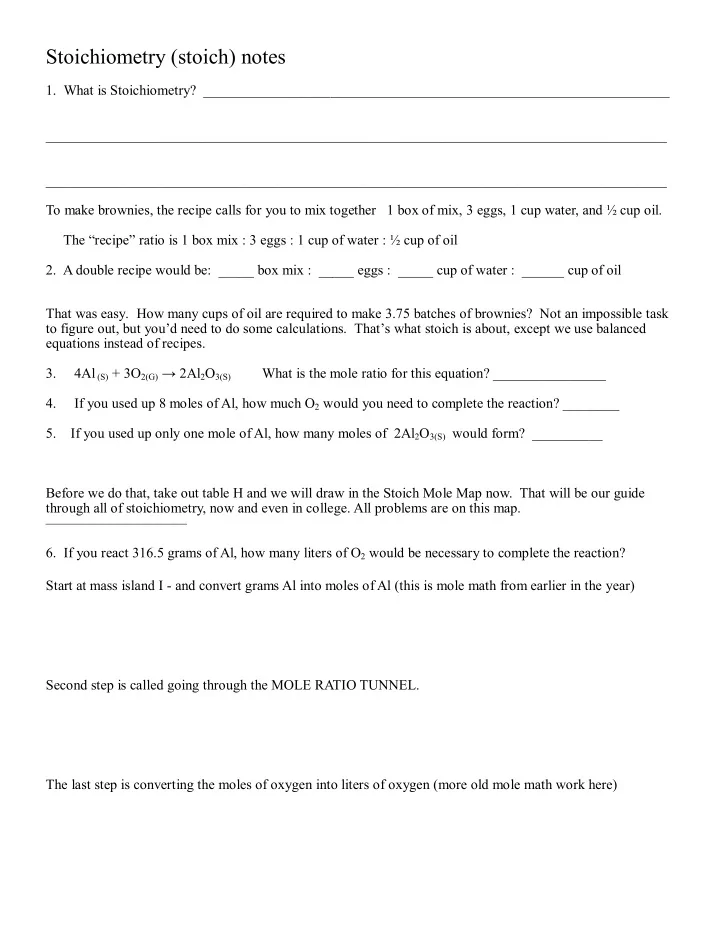
Stoichiometry (stoich) notes 1. What is Stoichiometry? - - PDF document

stoichiometry stoich notes
SMART_READER_LITE
LIVE PREVIEW

Stoichiometry (stoich) notes 1. What is Stoichiometry? - - PDF document

Stoichiometry (stoich) notes 1. What is Stoichiometry? __________________________________________________________________ ________________________________________________________________________________________


slide-1
SLIDE 1

Stoichiometry (stoich) notes

  • 1. What is Stoichiometry? __________________________________________________________________

________________________________________________________________________________________ ________________________________________________________________________________________ To make brownies, the recipe calls for you to mix together 1 box of mix, 3 eggs, 1 cup water, and ½ cup oil. The “recipe” ratio is 1 box mix : 3 eggs : 1 cup of water : ½ cup of oil

  • 2. A double recipe would be: _____ box mix : _____ eggs : _____ cup of water : ______ cup of oil

That was easy. How many cups of oil are required to make 3.75 batches of brownies? Not an impossible task to figure out, but you’d need to do some calculations. That’s what stoich is about, except we use balanced equations instead of recipes.

  • 3. 4Al (S) + 3O2(G) → 2Al2O3(S) What is the mole ratio for this equation? ________________
  • 4. If you used up 8 moles of Al, how much O2 would you need to complete the reaction? ________
  • 5. If you used up only one mole of Al, how many moles of 2Al2O3(S) would form? __________

Before we do that, take out table H and we will draw in the Stoich Mole Map now. That will be our guide through all of stoichiometry, now and even in college. All problems are on this map. ——————————

  • 6. If you react 316.5 grams of Al, how many liters of O2 would be necessary to complete the reaction?

Start at mass island I - and convert grams Al into moles of Al (this is mole math from earlier in the year) Second step is called going through the MOLE RATIO TUNNEL. The last step is converting the moles of oxygen into liters of oxygen (more old mole math work here)

slide-2
SLIDE 2
  • 7. There are 3 “levels” of questions in stoich. Not harder, just longer or shorter.

The longest are called 3 step stoich problems. Examples include The medium long ones are called 2 step stoich problems. Examples include The shortest problems are called one-step—or moles to moles problems. The only example is —————————————————————

New Reaction now…

  • 8. Propane (C3H8) gas burns with oxygen and forms carbon dioxide and water gases.

If 56.8 grams of C3H8(G) is used up, how many liters of CO2 form? (3 steps) Start with a balanced equation: _________________________________________________________________________________

slide-3
SLIDE 3
  • 9. If you use up 23.1 moles HCl, how many formula units of aluminum chloride form?

Use this reaction: 2Al(S) + 6HCl(AQ) → 2AlCl3(AQ) + 3H2(G)

  • 10. If 371.5 grams of candle wax (C21H44) combusts. Assume STP; how many liters of CO2 gas form?

Write the balanced equation first. ___________________________________________________________________________________

slide-4
SLIDE 4
  • 11. Using the same combustion reaction, if you consume 23.9 moles of O2, how many moles of H2O form?

C21H44 + 32O2(G) → 21CO2(G) + 22H2O(G)

  • 12. You have 4.56 x 1025 atoms of Zn that you put into H3PO4(AQ) to make them fizz away.

How many grams of hydrogen gas form? ________________________________________________________________________________________

  • 14. How many liters of nitrogen gas are required to combine with 809 liters of hydrogen when ammonia

forms? Balance the equation. Write the balanced equation first. _____________________________________________________________________________________

slide-5
SLIDE 5
  • 15. If exactly 15.6 moles of ethane gas combusts like this, how many moles of oxygen are used?

2C2H6(G) + 7O2(G) → 4CO2(G) + 6H2O(L)

  • 16. If exactly 649.6 L of NO(G) form like this, how many liters of O2 are used?

4NH3(G) + 5O2(G) → 4NO(G) + 6H2O(L)

slide-6
SLIDE 6
  • 17. During this combustion, 125 g of oxygen are used up. How many g of H2O are produced?

2C8H18(L) + 25O2(G) → 16CO2(G) +18H2O(G)

  • 18. 105 g of N2 react with oxygen to form dinitrogen pentoxide. How many molecules of O2 are required

in this reaction? 2N2(G) + 5O2(G) → 2N2O5(G)

slide-7
SLIDE 7
  • 19. In an odd chemical reaction shown below, if 0.135 moles of H2 reacts,

how many grams of NH3 are produced? 2NO2(G) + 7H2(G) → 2NH3(G) + 4H2O(L) This is hardest stoich problem I could ever imagine, and the last one you have to do:

  • 20. When 9.42 x 1029 atoms of phosphorous react with sufficient chlorine to make phosphorous pentachloride,

how many molecules of chlorine gas are necessary?