Storage and Retrieval Cycle A storage and retrieval (S/R) cycle is - - PowerPoint PPT Presentation

storage and retrieval cycle
SMART_READER_LITE
LIVE PREVIEW

Storage and Retrieval Cycle A storage and retrieval (S/R) cycle is - - PowerPoint PPT Presentation

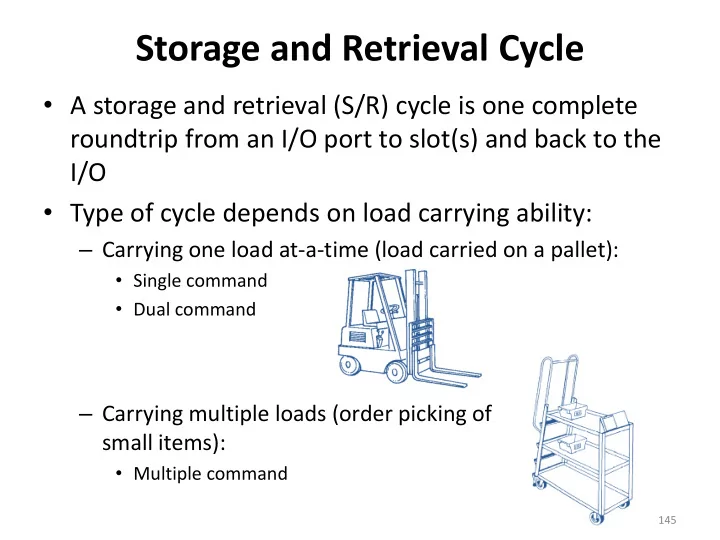
Storage and Retrieval Cycle A storage and retrieval (S/R) cycle is one complete roundtrip from an I/O port to slot(s) and back to the I/O Type of cycle depends on load carrying ability: Carrying one load at-a-time (load carried on a


slide-1
SLIDE 1

Storage and Retrieval Cycle

  • A storage and retrieval (S/R) cycle is one complete

roundtrip from an I/O port to slot(s) and back to the I/O

  • Type of cycle depends on load carrying ability:

– Carrying one load at-a-time (load carried on a pallet):

  • Single command
  • Dual command

– Carrying multiple loads (order picking of small items):

  • Multiple command

145

slide-2
SLIDE 2

Single-Command S/R Cycle

store empty empty retrieve I/O slot

146

  • Single-command (SC)

cycles:

– Storage: carry one load to slot for storage and return empty back to I/O port, or – Retrieval: travel empty to slot to retrieve load and return with it back to I/O port

/

2

SC SC SC L U L U

d d t t t t v v = + + = +

Expected time for each SC S/R cycle:

slide-3
SLIDE 3

Industrial Trucks: Walk vs. Ride

Walk (2 mph = 176 fpm) Ride (7 mph = 616 fpm)

Pallet Jack Pallet Truck Walkie Stacker Sit-down Counterbalanced Lift Truck

147

slide-4
SLIDE 4

Dual-Command S/R Cycle

store empty retrieve I/O slot1 slot2

148

  • Dual-command (DC):
  • Combine storage with a

retrieval:

– store load in slot 1, travel empty to slot 2 to retrieve load

  • Can reduce travel

distance by a third, on average

  • Also termed task

“interleaving”

/

2 2 4

DC DC DC L U L U

d d t t t t v v = + + = +

Expected time for each SC S/R cycle:

slide-5
SLIDE 5

Multi-Command S/R Cycle

empty retrieve I/O

149

  • Multi-command:

multiple loads can be carried at the same time

  • Used in case and piece
  • rder picking
  • Picker routed to slots

– Simple VRP procedures can be used

slide-6
SLIDE 6

1-D Expected Distance

( ) ( )

1 1 1 1 1

1 2 2 ( 1) 2 2 2 2 2

L L way i i way way

X X X X TD i i L L L L X L L X L L L XL X X XL TD X ED L

− = = − −

  = − = −     +   = −     + − = = = =

∑ ∑

150

  • Assumptions:

– All single-command cycles – Rectilinear distances – Each slot is region used with equal frequency (i.e., randomized storage)

  • Expected distance is the

average distance from I/O port to midpoint of each slot

– e.g., [2(1.5) + 2(4.5) + 2(6.5) + 2(10.5)]/4 = 12

I/O 3 6 9 X = 12 X X L 2L x =

1-D Storage Region

1

2( )

SC way

d ED X

= =

slide-7
SLIDE 7

Off-set I/O Port

I/O 3 6 9 X = 12

  • ffset

151

  • If the I/O port is off-set

from the storage region, then 2 times the distance

  • f the offset is added the

expected distance within the slots

  • ffset

2( )

SC

d d X = +

slide-8
SLIDE 8

2-D Expected Distances

  • Since dimensions X and Y are independent of each other for

rectilinear distances, the expected distance for a 2-D rectangular region with the I/O port in a corner is just the sum

  • f the distance in X and in Y:
  • For a triangular region with the I/O port in the corner:

152

rect SC

d X Y = +

( )

( )

1 1-way 1 1 2 1-way 1-way

2 2 2 3 1 6 2 2 , as ( 1) 3 3 3 2 2 2 1 1 2 2 3 3 3 3

L L i i j tri SC

X X X X TD i j L L L L X L L TD X ED X X L L L L d X X Y X Y

− + = =

      = − + − =             = + + = = + = → ∞ +     = = = + +        

∑ ∑

I/O

X X x L = Y Y y D =

slide-9
SLIDE 9

I/O-to-Side Configurations

Rectangular Triangular

153

2

1 2 2 2 4 2 1.886 3

SC

TA X X TA TA d TA TA = ⇒ = = ⇒ = =

2

2

SC

TA X X TA d TA = ⇒ = ⇒ =

TA I/O X X TA I/O X X

slide-10
SLIDE 10

I/O-at-Middle Configurations

Rectangular Triangular

154

2

1 2 2 4 1.333 3

SC

TA X X TA d TA TA = ⇒ = ⇒ = =

2

2 2 2 2 1.414

SC

TA X TA TA X d TA TA = ⇒ = = ⇒ = =

TA/2 I/O X X TA/2 TA/2 TA/2 I/O X X

slide-11
SLIDE 11

Example 3: Handling Requirements

Pallet loads will be unloaded at the receiving dock of a warehouse and placed on the floor. From there, they will be transported 500 feet using a dedicated pallet truck to the in-floor induction conveyor of an AS/RS. Given

  • a. It takes 30 sec to load each pallet at the dock
  • b. 30 sec to unload it at the induction conveyor

c. There will be 80,000 loads per year on average

  • d. Operator rides on the truck (because a pallet truck)
  • e. Facility will operate 50 weeks per year, 40 hours per week

155

transport load empty Receiving Dock AS/RS 500 ft

slide-12
SLIDE 12

Example 3: Handling Requirements

1. Assuming that it will take 30 seconds to load each pallet at the dock and 30 seconds to unload it at the induction conveyor, what is the expected time required for each single- command S/R cycle?

156

/

2(500) 1000 ft/mov 1000 ft/mov 30 2 2 min/mov 616 ft/min 60 2.62 2.62 min/mov hr/mov 60

SC SC SC L U

d d t t v = =   = + = +     = =

(616 fpm because operator rides on a pallet truck)

slide-13
SLIDE 13

Example 3: Handling Requirements

2. Assuming that there will be 80,000 loads per year on average and that the facility will operate for 50 weeks per year, 40 hours per week, what is the minimum number of trucks needed?

157

80,000 mov/yr 40 mov/hr 50(40) hr/yr 1 2.62 40 1 1.75 1 60 2 trucks

avg avg SC

r m r t = = = +         = + = +             =

slide-14
SLIDE 14

Example 3: Handling Requirements

3. How many trucks are needed to handle a peak expected demand of 80 moves per hour?

158

80 mov/hr 1 2.62 80 1 3.50 1 60 4 trucks

peak peak SC

r m r t = = +         = + = +             =

slide-15
SLIDE 15

Example 3: Handling Requirements

4. If, instead of unloading at the conveyor, the 3-foot-wide loads are placed side-by-side in a staging area along one side

  • f 90-foot aisle that begins 30 feet from the dock, what is

the expected time required for each single-command S/R cycle?

159

Receiving Dock 3 6 X = 90

  • ffset = 30 ft

87 84

. . .

  • ffset

/

2( ) 2(30) 90 150 ft 150 ft/mov 30 2 2 min/mov 616 ft/min 60 1.24 1.24 min/mov hr/mov 60

SC SC SC L U

d d X d t t v = + = + =   = + = +     = =

slide-16
SLIDE 16

Estimating Handling Costs

  • Warehouse design involves the trade-off between building

and handling cost.

  • Maximizing the cube utilization of a storage region will help

minimize building costs.

  • Handling costs can be estimated by determining:

1. Expected time required for each move based on an average of the time required to reach each slot in the region. 2. Number of vehicles needed to handle a target peak demand for moves, e.g., moves per hour. 3. Operating costs per hour of vehicle operation, e.g., labor, fuel

(assuming the operators can perform other productive tasks when not

  • perating a truck)

4. Annual operating costs based on annual demand for moves. 5. Total handling costs as the sum of the annual capital recovery costs for the vehicles and the annual operating costs.

160

slide-17
SLIDE 17

Example 4: Estimating Handing Cost

161

I/O

TA = 20,000

/ peak year

Expected Distance: 2 2 20,000 200 ft Expected Time: 2 200 ft 2(0.5 min) 2 min per move 200 fpm Peak Demand: 75 moves per hour Annual Demand: 100,000 moves per year Number of T

SC SC SC L U

d TA d t t v r r = = = = + = + = = =

peak hand truck year labor

rucks: 1 3.5 3 trucks 60 Handling Cost: 60 2 3($2,500 / tr-yr) 100,000 ($10 / hr) 60 $7,500 $33,333 $40,833 per year

SC SC

t m r t TC mK r C   = + = =         = + = + = + =

2 * *

Add 20% Cross aisle: 1.2 20,000 ft Total Storage Area: ( ) TA TA D L D TA ⇑ ′ = × = ⇑ ′ ⇒ ⇒