Stormwater Discharge Permits and Clean Water Act Compliance - - PowerPoint PPT Presentation

stormwater discharge permits and clean water act
SMART_READER_LITE
LIVE PREVIEW

Stormwater Discharge Permits and Clean Water Act Compliance - - PowerPoint PPT Presentation

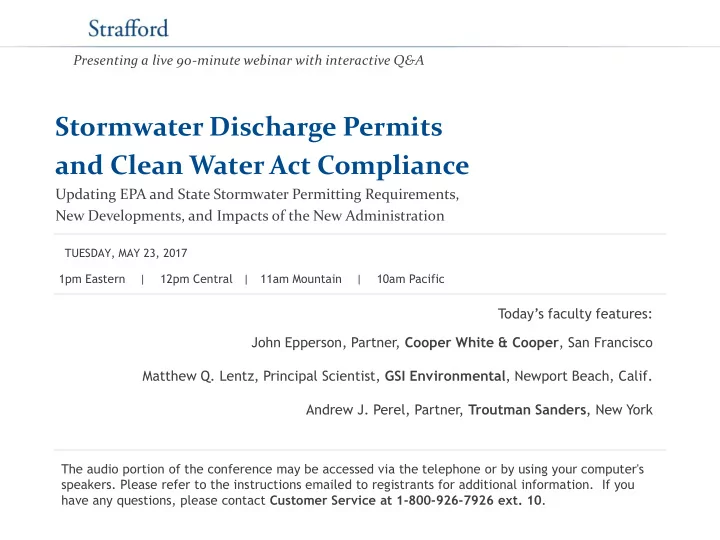
Presenting a live 90-minute webinar with interactive Q&A Stormwater Discharge Permits and Clean Water Act Compliance Updating EPA and State Stormwater Permitting Requirements, New Developments, and Impacts of the New Administration TUESDAY,


slide-1
SLIDE 1

The audio portion of the conference may be accessed via the telephone or by using your computer's

  • speakers. Please refer to the instructions emailed to registrants for additional information. If you

have any questions, please contact Customer Service at 1-800-926-7926 ext. 10.

Presenting a live 90-minute webinar with interactive Q&A

Stormwater Discharge Permits and Clean Water Act Compliance

Updating EPA and State Stormwater Permitting Requirements, New Developments, and Impacts of the New Administration

Today’s faculty features:

1pm Eastern | 12pm Central | 11am Mountain | 10am Pacific TUESDAY, MAY 23, 2017

John Epperson, Partner, Cooper White & Cooper, San Francisco Matthew Q. Lentz, Principal Scientist, GSI Environmental, Newport Beach, Calif. Andrew J. Perel, Partner, Troutman Sanders, New York

slide-2
SLIDE 2

Tips for Optimal Quality

Sound Quality If you are listening via your computer speakers, please note that the quality

  • f your sound will vary depending on the speed and quality of your internet

connection. If the sound quality is not satisfactory, you may listen via the phone: dial 1-866-755-4350 and enter your PIN when prompted. Otherwise, please send us a chat or e-mail sound@straffordpub.com immediately so we can address the problem. If you dialed in and have any difficulties during the call, press *0 for assistance. Viewing Quality To maximize your screen, press the F11 key on your keyboard. To exit full screen, press the F11 key again.

FOR LIVE EVENT ONLY

slide-3
SLIDE 3

Continuing Education Credits

In order for us to process your continuing education credit, you must confirm your participation in this webinar by completing and submitting the Attendance Affirmation/Evaluation after the webinar. A link to the Attendance Affirmation/Evaluation will be in the thank you email that you will receive immediately following the program. For additional information about continuing education, call us at 1-800-926-7926

  • ext. 35.

FOR LIVE EVENT ONLY

slide-4
SLIDE 4

Program Materials

If you have not printed the conference materials for this program, please complete the following steps:

  • Click on the ^ symbol next to “Conference Materials” in the middle of the left-

hand column on your screen.

  • Click on the tab labeled “Handouts” that appears, and there you will see a

PDF of the slides for today's program.

  • Double click on the PDF and a separate page will open.
  • Print the slides by clicking on the printer icon.

FOR LIVE EVENT ONLY

slide-5
SLIDE 5

Overview of Storm Water Permitting

 1987 Amendments to Clean Water Act added

storm water to NPDES program

 States, not EPA, regulate storm water

programs in 45 out of 50 states

– EPA important as standard-setter more than enforcer

 CWA citizen suit enforcement

5

slide-6
SLIDE 6

Clean Water Act Citizen Suits

What are the legal remedies to address these conditions?

6

slide-7
SLIDE 7

Clean Water Act Citizen Suits

Legal Approaches to Protect Water Quality: Keeping it all Straight

U.S. EPA or State Actions

  • Issue administrative orders

to stop regulatory violations

  • File lawsuits to enforce laws

and require action

  • File criminal environmental

action Private Party Lawsuits

  • File “tort” lawsuits (e.g., trespass,

nuisance, negligence, etc.)

  • Stand-alone case/Class Actions
  • File “Citizen Suit” under Clean

Water Act

7

slide-8
SLIDE 8

Clean Water Act Citizen Suits

What is a CWA Citizen Suit?

Any citizen may commence a civil action against any person who is alleged to be in violation of an effluent standard or limitation under the CWA. 33 USC 1365 Translation: Discharging a pollutant without a permit or discharging a pollutant in violation of a permit Uncertain to what extent it can to enforce Section 404 Dredge & Fill Permits (Wetlands).

8

slide-9
SLIDE 9

Clean Water Act Citizen Suits

CWA Citizen Suit Notice Procedures

  • Plaintiff must give 60-days prior notice to the EPA,

the state where alleged violation occurred and to the alleged violator. 33 USC 1365(b)

  • 33 USC 1365(b) provides that “No action may be

commenced … prior to sixty days after the plaintiff has given notice of the alleged violation (i) to the Administrator, (ii) the State in which the alleged violation occurs, and (iii) to any alleged violator...”

9

slide-10
SLIDE 10

Clean Water Act Citizen Suits

Specific Notice Requirements

Notice must include “sufficient information to permit the recipient” to identify:  the specific standard, limitation, or order allegedly violated;  the activity constituting a violation;  the person(s) responsible for the violation;  the location of the violation;  the date(s) of such violation;  the full name, address and phone number of the person giving notice. 40 CFR 135.3(a)

10

slide-11
SLIDE 11

Clean Water Act Citizen Suits

Requirements to Properly Serve Notice

  • For an individual or corporation: by

certified mail to or personal service upon, the owner or managing agent of the building, plant, installation, or facility.

  • Copies mailed to:

– Corporation’s registered agent – EPA Administrator – EPA Regional Administrator – Chief Administrative Officer of state water pollution control agency

  • Different requirements if violator is state or

federal agency

40 CFR 135.2

11

slide-12
SLIDE 12

Clean Water Act Citizen Suits

Purpose of the Notice Requirement

  • The purpose of the notice requirement is to allow permittees to

come into CWA compliance without there being a suit.

  • The 60 day notice period also allows the government to begin

prosecution (triggering the “diligent prosecution” defense discussed by the next speaker) which also precludes the suit.

12

slide-13
SLIDE 13

Clean Water Act Citizen Suits

Common Defenses to CWA Citizen Suits

  • 1. “Diligent prosecution”—has the government

stepped up?

  • 2. “On going violations”—is the problem

continuing?

  • 3. “Permit shield”—were the “pollutants”

disclosed and considered by agency?

  • 4. “Not a navigable water”—is “discharge” to

“groundwater” covered by CWA?

  • 5. “Time limits”—how long do you have?

13

slide-14
SLIDE 14

Clean Water Act Citizen Suits

Common Defenses to CWA Citizen Suits

Diligent Prosecution

  • 1. Has agency taken the specific

action set forth in the Clean Water Act?

  • 2. Is the State program for “consent

decrees” legally “comparable” to the CWA requirements?

14

slide-15
SLIDE 15

Clean Water Act Citizen Suits

Common Defenses to CWA Citizen Suits

Ongoing Violation?

  • 1. Is the violation still ongoing?
  • 2. Do the effects of the violation still exist?

City of Mountain Park, Ga. V. Lakeside at Ansley, LLC, 560 F. Supp. 2d 1288 (N.D. Ga. 2008) 15

slide-16
SLIDE 16

Clean Water Act Citizen Suits

Common Defenses to CWA Citizen Suits

Permit Shield?

  • 1. What information disclosed in the

NPDES permit application?

  • 2. Was it available to the Agency?
  • 3. Does permit shield apply to

“individual,” “general” and “nationwide” permits?

16

slide-17
SLIDE 17

Clean Water Act Citizen Suits

Common Defenses to CWA Citizen Suits

“Discharges from point sources” to “navigable waters” or “waters

  • f the United States”?
  • 1. Direct discharges to WOUS?
  • 2. Groundwater discharges?
  • 3. “Isolated groundwater” v. “hydrologically connected”

groundwater

  • 4. Majority rule

17

slide-18
SLIDE 18

Clean Water Act Citizen Suits

Common Defenses to CWA Citizen Suits

Did you wait too long?

  • 1. No statute of limitation in CWA
  • 2. Presumed 5-years

18

slide-19
SLIDE 19

Clean Water Act Citizen Suits

Attorney Fees

  • Awarded to the “prevailing or substantially prevailing

party, whenever the court deems such an award appropriate”

  • Must advanced the goals of the CWA

Civil Penalties

  • Currently $37,500 per day per violation

Injunctive Relief

  • An order by the court to take action or not take action
  • Research project (at UGA, Georgia Southern, etc.)
  • Discretion of Court

Remedies Under CWA Citizen Suits

19

slide-20
SLIDE 20

General Permit elements

 General Permit rather than facility-specific

Industrial Activities (based on SIC)

Construction (size)

Municipal Separate Storm Sewer System (MS4)

 Notice of Intent (NOI)

No-Exposure Certification (NEC)

Notice of Non-Applicability (NONA)

 Storm Water Pollution Prevention Plan (SWPPP)  Best Management Practices (BMP)  Training  Sampling  Reporting

20

slide-21
SLIDE 21

Current Developments

 State developments

– California Industrial General Permit experience

 2017 Construction General Permit (EPA)  Numerical limits vs. benchmarks  Citizen suit trends  Electronic submittals/online availability of

records

 Significant recent litigation

21

slide-22
SLIDE 22

State Developments

 California’s Industrial General Permit

– Numeric Action Levels – Tiered Exceedance Response Action (ERA)

Program

– Public Availability of Documents – Minimum and Advanced BMPs

 Design Storm Criteria

– TMDL Incorporation Process…

 Washington State Program

– Similar Tiered Corrective Action Program

22

slide-23
SLIDE 23

California – ERA Process

 The ERA Process is Driven by

Numeric Action Levels

 Two types of NAL exceedances

  • Instantaneous Maximum NAL Exceedance

(TSS, O&G, pH)

 Based on CA Industrial site data (2 or more in a

reporting year)

  • Annual NAL Exceedance

 Based on USEPA Benchmarks (average for

monitoring year)

ACTION NO ACTION

23

slide-24
SLIDE 24

Basis for USEPA Benchmarks

TSS, N+N – National Urban Runoff Program Median Concentrations

pH, BOD - Secondary Treatment Regulations (40 CFR 133)

COD - Factor 4 times BOD5 Concentration – North Carolina Benchmark

Metals, VOCs - AMBIENT Freshwater Aquatic Life Criteria

Magnesium - Laboratory MDL x 3.18

24

slide-25
SLIDE 25
  • Evolved over time
  • Results > NAL = Trigger
  • Reports must be

uploaded to SMARTS

ERA Process

25

Baseline Status (all facilities start here) Level 2 Status Sampling Trigger NALs Trigger

Industrial Activity BMP Demonstrations with NO Future NAL Exceedances Return to Baseline Status

Sampling NALs Level 1 Status NALs Trigger Sampling

Designate a QISP

25

slide-26
SLIDE 26

How is Industry Doing?

Parameter 2015-2016 Number of Samples 2015-2016 % Above Annual NAL 2016-2017 Number of Samples 2016-2017 % Above Annual NAL

TSS 25,690 18% 13,381 11% O&G 25,257 3% 13,384 2% pH 25,326 6%* 13,340 3%* Total Al 6,140 44% 3,191 33% Total Fe 7,912 50% 4,050 40% Total Cu 3,852 41% 2,075 31% Total Pb 4,861 2% 2,282 1% Total Zn 7,681 41% 3,967 32% Total Mg 363 95% 200 93% COD 3,531 28% 1,598 25% N+N 3,135 37% 1,747 32%

26

slide-27
SLIDE 27

ERA Level 1 Review

 Sites Entering ERA Level 1: Over 2800  Several Hundred Still Outstanding (due 1/1/17)  RWQCBs and SWRCB have been reviewing…  ~Cost for Industry… $7,000,000 – $12,500,000

– Basis: $2,500 – $4,500/ report

27

slide-28
SLIDE 28

What’$ Ahead - ERA Level 2

 Site Exceeding NAL During Year 2

– Officially enter ERA Level 2 on July 1, 2017

 Level 2 ERA Action Plan

– What’s Different? – “Dischargers must further evaluate

BMP options and may have to implement additional BMPs, which may include physical, structural, or mechanical devices…”

 Level 2 ERA Technical Report (several options…)

– Industrial Activity BMP Demonstration (BAT/BCT) – Non-Industrial Pollutant Source ID – Natural Background Pollutant Source ID

28

slide-29
SLIDE 29

The Conundrum – BAT/BCT

Are BMPs sufficient, how do You know if You are meeting BAT/BCT?

 Technology-Based Effluent Limits

What is BAT/BCT and who defines it?

How is it being applied?

Numeric or non-numeric?

 What BMPs meet BAT/BCT?

Regulatory enforcement

NPDES Permits

Citizen Group Consent Decrees

 Case Studies - What is realistically achievable?

29

slide-30
SLIDE 30

Technology-Based Effluent Limits (TBELs)

 Industrial NPDES Permits must contain TBELs or more

stringent site-specific Water Quality Based Effluent Limits (WQBELs) when necessary

 USEPA develops technology-based effluent limitation

guidelines (ELGs) within industry point source categories (subchapter N)

 BAT/BCT

Best Available Technology economically achievable (“BAT”) for toxic pollutants and non-conventional pollutants

Best conventional pollutant Control Technology (“BCT”) for conventional pollutants (BOD, TSS, coliform, pH, oil and grease)

30

slide-31
SLIDE 31

BAT/BCT

 Many Factors must be considered:

 Age of facilities/equipment  Process employed  Engineering aspects of control technologies  Process changes  Cost of achieving effluent reductions  Non-water quality environmental impacts (including energy)

 Where no ELGs exist, use specific, formal process to

apply best professional judgment for that facility

Generally follow factors used when developing ELGs

BAT/BCT can be expressed through narrative BMPs rather than numeric effluent limits

31

slide-32
SLIDE 32

Compliance Approaches

 Possible Approaches:

– Claim Existing BMPs are “Good Enough”

 Meet effluent limitations in IGP (BAT/BCT)  Still Need to Evaluate Alternatives NOT selected

– Infiltration – Discharge to the POTW – Treatment – Other measures to reduce or eliminate

exposure

32

slide-33
SLIDE 33

Public Process – Becoming SMARTS

 SMARTS…Storm Water Multi-Application

Reporting and Tracking System

– All program documents uploaded for Public Access – Analytical Data Reporting System

 Easily searchable  Even easier to make mistakes…

– Document Repository for Regulators – Increase in Citizen Suits

33

slide-34
SLIDE 34

Minimum and Advanced BMPs

 Standard Suite of BMPs for all Permittees  To the extent feasible, implement the following

– Good Housekeeping – Preventative Maintenance – Spill and Leak Prevention/Response – Material Handling/Waste Management – Erosion/Sediment Controls – Employee Training Program – Quality Assurance and Record Keeping

 Includes a Design Storm!!

%Treatment vs. Design Storm Magnitude

0.0 0.2 0.4 0.6 0.8 1.0 0.0 1.0 2.0 3.0 4.0 Design Storm (inches) % Treatment

34

slide-35
SLIDE 35

Changes on the Horizon: TMDLs

 Permit will be Re-Opened and New TMDL Specific

Requirements Incorporated

 All TMDLs identified in Attachment E will be affected  TMDL requirement will likely follow one of three

  • ptions

– Defer to requirement in IGP – Have more stringent TMDL Action Levels – Incorporate Effluent Limits

 Many of the action levels or effluent limits will be

much lower than NALs currently in Permit

35

slide-36
SLIDE 36

Los Angeles River Metals

 Metals TMDL Address Wet- and Dry- Weather Discharges  Likely will Establish TMDL Action Levels (TALs) or effluent limits for

wet-weather discharges:

 TALs/ELs based on acute California Toxics Rule (CTR) criteria  The Lower Number Makes a Difference!

Cadmium (µg/l) Copper (µg/l) Lead (µg/l) Zinc (µg/l)

TAL/EL 3.1 17 62 159 IGP NAL 5.3 33.2 262 260 Parameter % Above TAL/EL % Above NAL Total Cu 62% 39% Total Pb 10% 2% Total Zn 58% 42% 36

slide-37
SLIDE 37

Current Developments

 State developments

– California Industrial General Permit experience

 2017 Construction General Permit (EPA)  Numerical limits vs. benchmarks  Citizen suit trends  Electronic submittals/online availability of

records

 Significant recent litigation

37

slide-38
SLIDE 38

Typical Claims

 Exceedance of USEPA Benchmarks/NALs  Receiving Water Standards violations

Exceedance of California Toxics Rule (CTR) concentrations

Basin Plan Exceedances

 Failure to develop and implement BMPs that achieve

compliance with BAT/BCT

 Failure to develop/implement an accurate SWPPP  Failure to collect and analyze samples  Failure to analyze for all materials potentially exposed

to storm water SWRCB Citizen Suit Claims Report-

http://www.swrcb.ca.gov/water_issues/programs/enforcement/rpts_citizensuits.shtm l 38

slide-39
SLIDE 39

Post-Settlement BMP Requirements

 Achieve NALs  “Action Plans” if NALs are not achieved  Installation of Treatment Controls

Advanced Media Filtration Systems

 Implement Measures to Reduce/Eliminate Discharges

Infiltration

Storage/Re-use

Discharge to POTW

 Other BMP Improvements

Berms and containment areas

Coating of “polluting” surfaces

Covering materials storage/outdoor activity areas

Additional sweeping

 Expen$ive automated sweepers

Increased documentation/ training

39

slide-40
SLIDE 40

USEPA Settlement Agreement (August 2016)

 Multi-Sector Industrial General Permit  Environmental Groups (petitioners) against

USEPA (signed August 2016)

– Intervenors (Federal Strom Water Quality

Coalition and Federal Storm Water Association)

 Several Key Requirement

– National Research Council Study

– Benchmarks/Monitoring – Feasibility of Numeric Retention Standards

– Lays out Corrective Action Approach

40

slide-41
SLIDE 41

Impacts of Trump Administration

 Executive Orders

– “Two-for-one” EO – Waters Of The United States EO

 Pruitt as EPA Administrator

– “Back to Basics” campaign

 Budget

– Trump budget proposal: 30% EPA cut – 2017 Stop-gap Funding Bill: 1% EPA cut

41

slide-42
SLIDE 42

Impacts of Trump Administration

 Amending or withdrawing regulations

– APA rulemaking process – Determined opposition – Congressional Review Act (CRA) – Priorities on other areas (climate change)

 Amending statutes

– Republican-controlled Congress and White

House

– Priorities on other areas

42

slide-43
SLIDE 43

Take-aways

Compliance, compliance, compliance! Storm water permit requirements can be complex but nothing good comes from ignoring them.

CWA Citizen Suits are an important and effective legal tool in storm water enforcement and may become even more common due to online records and if new administration is perceived as soft on enforcement.

Don’t expect numeric limits - but the alternatives (benchmarks, numeric action levels) are getting more bite.

Storm water issues are unlikely to get much attention in Trump administration efforts to roll back regulations, despite compliance costs for business.

43

slide-44
SLIDE 44

Thank You

John Epperson Cooper White & Cooper jepperson@cwclaw.com Matthew Q. Lentz GSI Environmental mqlentz@gsi-net.com Andrew J. Perel Troutman Sanders andrew.perel@troutmansanders.com

44