
SLIDE 1
ASCE Oregon EWRG
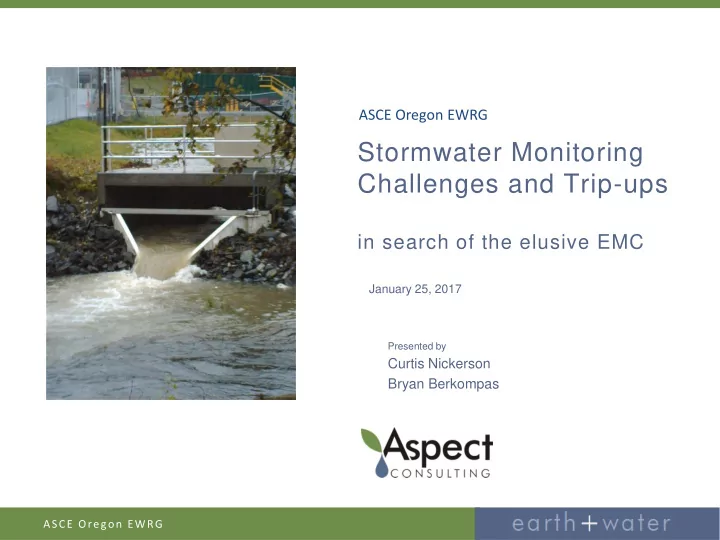
Stormwater Monitoring Challenges and Trip-ups
in search of the elusive EMC
ASCE Oregon EWRG
Presented by
Curtis Nickerson Bryan Berkompas
January 25, 2017
Stormwater Monitoring Challenges and Trip-ups in search of the - - PowerPoint PPT Presentation
ASCE Oregon EWRG Stormwater Monitoring Challenges and Trip-ups in search of the elusive EMC January 25, 2017 Presented by Curtis Nickerson Bryan Berkompas ASCE Oregon EWRG Its a challenge! Targeting an ephemeral event Challenge
ASCE Oregon EWRG
in search of the elusive EMC
ASCE Oregon EWRG
Presented by
Curtis Nickerson Bryan Berkompas
January 25, 2017
ASCE Oregon EWRG
Targeting an ephemeral event Challenge to get representative data Difficult working conditions
ASCE Oregon EWRG
Stormwater monitoring basics Planning a monitoring project Site selection consideration Instrument selection and installation Pointers for project implementation
ASCE Oregon EWRG
Water quality sampling In-situ WQ measurements Flow metering Rain gauging Stormwater sediment sampling
ASCE Oregon EWRG
Manual grab sampling
instantaneous measurement
Time-paced composite sampling
time-averaged concentration
Flow-weighted composite sampling
event-mean concentration can calculate loading
ASCE Oregon EWRG
Monitoring infrastructure has typically
Get in on the facility design process More difficult to retrofit for monitoring
ASCE Oregon EWRG
Prepare planning documents Select site(s) Procure equipment and materials Install and test equipment Train staff
ASCE Oregon EWRG
ASCE Oregon EWRG
ASCE Oregon EWRG
Locations driven by project objectives
Characterization Pollutant source tracing Permit compliance BMP effectiveness evaluation
ASCE Oregon EWRG
ASCE Oregon EWRG
Access Security Future changes to
Confined space Traffic control Vandalism Power source Cell phone access Flooding Flow conditions Pipe characteristics Tidal influence Backwater Permanent site for
Off-site, co-mingled
Freezing conditions
ASCE Oregon EWRG
ASCE Oregon EWRG
flume weir bubbler flow meter pressure transducer look-down sensor area-velocity meter Venturi tube meter mag meter
ASCE Oregon EWRG
Channel or pipe slope too steep Water depth too shallow No defined channel Backwater conditions, including tidal effects Large range of flows Straight reaches/ pipe sections too short
ASCE Oregon EWRG
ASCE Oregon EWRG
ASCE Oregon EWRG
ASCE Oregon EWRG
ASCE Oregon EWRG
ASCE Oregon EWRG
primary orifice secondary orifice measure water level then calculate flow from orifice and weir equations bypass
ASCE Oregon EWRG
3-in. magmeter
medium to high flows (max. 160 gpm)
tipping bucket
trickle and low flows (<1.8 gpm)
ASCE Oregon EWRG
secondary drain primary drain
ASCE Oregon EWRG
ASCE Oregon EWRG
ASCE Oregon EWRG
suction from pump
sealed canister
sample bottle sample tubing extension pole
ASCE Oregon EWRG
ASCE Oregon EWRG
ASCE Oregon EWRG
ASCE Oregon EWRG
ASCE Oregon EWRG
low flow strainer
ASCE Oregon EWRG
ASCE Oregon EWRG
ASCE Oregon EWRG
ASCE Oregon EWRG
ASCE Oregon EWRG
Onsite rage gauge or nearby if accessible real-
Need open area Security a concern
ASCE Oregon EWRG
ASCE Oregon EWRG
ASCE Oregon EWRG
Don’t believe design plans – always measure
Orifice sizes/ condition Weir position Incorrect construction
ASCE Oregon EWRG
ASCE Oregon EWRG
ASCE Oregon EWRG
ASCE Oregon EWRG
ASCE Oregon EWRG
Sturdy housing Concrete pad or wooden platform Conduit for electrical cable and suction line (below
Anchor housing if security a concern Seal gaps to exclude rodents and insects Stainless steel fasteners if zinc a concern Use “quick connects” for sampler suction line Use zip-ties to organize cables “in the hole” Keep suction line and electrical cables out of flow
ASCE Oregon EWRG
ASCE Oregon EWRG
ASCE Oregon EWRG
ASCE Oregon EWRG
ASCE Oregon EWRG
ASCE Oregon EWRG
ASCE Oregon EWRG
Provides remote control of samplers and flow
Frequent automatic downloading of data on a
We use Campbell Scientific data
Communicate via cellular, radio, and even
ASCE Oregon EWRG
Reduced labor to arm samplers prior to storm
Ability to modify instrument settings remotely
One person (Storm Controller) can monitor
Automatic notifications based on alarm
Field staff deployed only as-needed
ASCE Oregon EWRG
Insert screen shot of logger net Loggernet connect screen
ASCE Oregon EWRG
1 .8 1 .9 2 .0 .0 00 .0 05 .0 10 2 4 3 PM 6 Sa t O ct 2 07 6 PM 9 PM 7 Su n 3 AM 6 AM 9 AM
sdn1-tele
Flowlink 4 for Windows ft in m 1 0/6/20 7 2:00 :0 0 PM - 1 0/7/20 7 11 :0 :00 AM L eve l (1.90 6 ft) Ra in fa ll (0 .0 8 in) Sa mp le (1 .4 54 7 m)
ASCE Oregon EWRG
Make sure you have sufficient, well trained
Train for confined space entry, instrument
Rotate storm response assignments – make
Be ready to improvise!
Storms rarely occur as advertised Equipment malfunctions People make mistakes
ASCE Oregon EWRG
Develop and use SOPs for everything Detailed field sheets –completely filled out! Double check equipment Ice samples immediately and thoroughly Be safe! – often dark, wet, cold and windy
ASCE Oregon EWRG
ASCE Oregon EWRG
Decaport sample splitter for sample compositing/ splitting
ASCE Oregon EWRG
Churn sample splitter to fill bottles for laboratory analysis
ASCE Oregon EWRG
Conduct routine maintenance and calibration Download and check flow and rainfall data
Is it believable? If not, investigate Check instrument performance Check site for potential causes of strange data
ASCE Oregon EWRG
Rain gauge calibration check
ASCE Oregon EWRG
Secondary flow measurement
ASCE Oregon EWRG
Collect field and trip blanks routinely Backflush sampler tubing thoroughly Replace sampler tubing periodically Adjust laboratory decon procedures if
Raise sampler strainer out of baseflow/sump
ASCE Oregon EWRG
Curtis Nickerson
cnickerson@aspectconsulting.com 206.838.8595 www.aspectconsulting.com