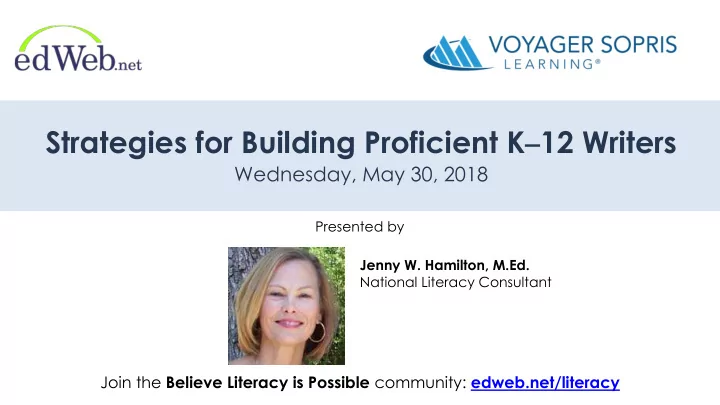
SLIDE 1 Strategies for Building Proficient K–12 Writers
Wednesday, May 30, 2018
Join the Believe Literacy is Possible community: edweb.net/literacy
Jenny W. Hamilton, M.Ed. National Literacy Consultant Presented by
SLIDE 2
- Close other applications that use bandwidth or resources on
your device.
- For audio issues you can switch to phone by clicking the
telephone icon at the top of your screen.
- Ask a question by clicking the question mark at the top of
your screen.
- Post in the chat. You can display or hide the chat panel by
clicking the arrow at the top left of your screen.
- For a larger view of the slides click the full screen icon on the
upper right of your screen.
- If you’re on Twitter tweet using #edWebinar
Here are some edWebinar tips …
SLIDE 3
- If you’re an edWeb member your personalized certificate will be posted
to your homepage by the end of the next business day.
- If you logged in with your email address we’ll email you links to a CE
certificate form, the recording, and how to get added resources.
- You ONLY need to take the CE quiz if you dialed in by phone, are
watching as a group, or are viewing this as a recording.
Get your CE Certificate for this edWebinar
Join edWeb to get personalized CE certificates and to access the edWebinar archives with recordings, slides, chat log, and CE quizzes. edweb.net/literacy
SLIDE 4 Believe Literacy is Possible: Unlock Reading Potential
ü edWebinar recordings ü Slides and chat logs ü Quizzes for CE Certificates ü Online discussions ü Free resources
Join the community, then click on this image for the edWebinar recordings, slides, chat logs and CE quizzes
Join the community – it’s free! edweb.net/literacy
SLIDE 5 Jenny W. Hamilton, M.Ed., has been a tireless advocate for students who struggle to achieve academic success. Her training and background in behavior management enables her to share practical solutions for classroom management issues. She also works with teachers to raise awareness about the emotional damage that accompanies academic failure. Jenny’s depth of experience in teaching elementary, middle, and high school students lends authenticity to her delivery when she trains and coaches teachers. A deep interest in the research behind best practices and the science of learning allows her to share with teachers and administrators current and relevant data about how the brain works and what can be done to change the trajectory of struggling readers and writers. She is currently an independent consultant focusing on literacy.
SLIDE 6 SPOTLIGHT ON RESEARCH What does research tell us about effective writing instruction and student
SLIDE 7 SPOTLIGHT ON RESEARCH
effective writing instruction
- Identifies 11 strategies that
improve writing of students in grades 4–12
https://webcache.googleusercontent.com/search?q=cache:xrvmb5wJ4l0J:https://www.carnegie.org/media/filer_p ublic/3c/f5/3cf58727-34f4-4140-a014-723a00ac56f7/ccny_report_2007_writing.pdf+&cd=1&hl=en&ct=clnk&gl=us
SLIDE 8
ELEVEN RESEARCH-DRIVEN STRATEGIES
1. Writing Strategies 2. Summarization 3. Collaborative Writing 4. Specific Product Goals 5. Word Processing 6. Sentence Combining 7. Prewriting 8. Inquiry Activities 9. Process Writing Approach (teach the writing process) 10. Study of Models 11. Writing for Content Learning
SLIDE 9 SPOTLIGHT ON RESEARCH
effective writing instruction
- Identifies four research-
driven instructional recommendations to improve elementary school students’ writing
SLIDE 10
FOUR INSTRUCTIONAL RECOMMENDATIONS
1. Provide daily time for students to write * 2. Teach students to use the writing process for a variety of purposes *** 3. Teach students to become fluent with handwriting, spelling, sentence construction, typing, and word processing ** 4. Create an engaged community of writers *
SLIDE 11 SPOTLIGHT ON RESEARCH
Writing Practices That Enhance Students’ Reading Skills
- Have students write about texts
they read
- Teach students the writing skills
and processes for creating text
- Increase how much students write.
SLIDE 12 WHEN STUDENTS WRITE ABOUT WHAT THEY READ:
- Knowledge deepens
- Reading comprehension improves
SLIDE 13 TO WRITE ABOUT THE TEXTS BEING READ:
- Respond to a text in writing
- Personal reactions
- Analyze and interpret text
- Write summaries of text
- Write notes about a text
- Create and answer questions in writing
SLIDE 14 RESPONDING TO TEXT
- What are you thinking?
- Do you agree or disagree?
- Does this remind you of something that happened to you?
- Do you think this is important?
- What do you already know about this subject or topic?
- Does this remind you of something else you have read?
- Would you have done the same thing as the character in this
situation?
- Why is the author giving us this detail?
SLIDE 15 RESPONDING TO TEXT
- Sticky notes
- One word or phrase vs. complete sentences
- Draw or sketch response
- Turn and talk
- Wipe off boards
- Summary sentences in reading journal
SLIDE 16 WRITING SUMMARIES: Summary Sentences
I Identify the item V Select a verb F Finish the thought Chapter Five, “Computers,” in my science book explains how a computer makes pictures on the screen Chapter Five, “Computers,” in my science book explains how a computer makes pictures on the screen. Emily Dickinson’s poem, “I’m Nobody! Who Are You? compares life in the public eye with life as an
Emily Dickinson's poem, “I’m Nobody! Who Are You?,” compares life in the public eye to life as an ordinary person.
SLIDE 17 WRITING SUMMARIES: Summary Sentences
I Identify the item V Select a verb F Finish the thought Chapter Five, “Computers,” in my science book explains how a computer makes pictures on the screen Chapter Five, “Computers,” in my science book explains how a computer makes pictures on the screen. Emily Dickinson’s poem, “I’m Nobody! Who Are You? compares life in the public eye with life as an
Emily Dickinson's poem, “I’m Nobody! Who Are You?,” compares life in the public eye to life as an ordinary person. Writing summaries enhances student learning
SLIDE 18 WHEN STUDENTS LEARN SKILLS AND PROCESSES TO CREATE TEXT:
- Reading comprehension improves
- Reading fluency improves
- Word reading skills improve
SLIDE 19 TO LEARN THE SKILLS AND PROCESSES TO CREATE TEXTS:
- Employ the writing process
- Analyze text structures for writing
- Practice sentence and paragraph construction
skills
SLIDE 20 Brainstorm, discuss, or research the topic Write one draft Add, delete, or rearrange text to improve wording,
- rganization and flow, interest, or level of detail
Polish by fixing CUPS errors: Capitalization, Usage, Punctuation, and Spelling Create clean final copy–type or best handwriting Correct minor errors, like typos Make corrections as needed
Celebrate and share!
Organize your thoughts and ideas–outline
THE WRITING PROCESS
SLIDE 21
PROMPT Write a paragraph about two important documents in American history. Explain what each document accomplished or established.
SLIDE 22 Questions for Analyzing the Prompt
- What am I writing?
- What is the topic?
- What am I to do (verb)?
- How am I to develop my ideas?
RESPONDING TO A PROMPT
SLIDE 23 Write a paragraph about two important documents in American history. Explain what made each document important. Analyze the Prompt
- Underline words that show
- What they are writing
- What the topic is
- What they are to do
- Circle how to develop the composition
RESPONDING TO A PROMPT
SLIDE 24 Important Documents in American History THE WRITING PROCESS: PREWRITING
Bill of Rights Declaration of Independence Constitution Emancipation Proclamation Mayflower Compact
SLIDE 25
Title = Topic = C=
THE WRITING PROCESS: PLAN
SLIDE 26 (One) Bill of Rights Title= Documents that Shaped America T = Important Documents in American History
- Ensured individual freedoms
- Guarded against an
- verreaching government
C = important documents that protect freedoms
PLAN
- Abolished slavery
- Ensured the rights in the
Constitution for everyone (Another) Emancipation Proclamation
SLIDE 27 SENTENCE STRUCTURES
Topic Sentence Variety
- Action Verb
- Power (Number) Sentence
- When/Where + What’s Happening
- And, But, Or, and So Statements
SLIDE 28
Action Verb Topic Sentence Power(Number) Statements When/Where + What’s Happening And, But, Or, and So Statements
Throughout the history of this country, some documents have spoken more loudly than others about citizens’ rights and freedoms. The Bill of Rights and the Emancipation Proclamation are two important documents in American history. The need to be free of tyrannical governments fostered the creation of America’s democracy and important documents have been used to ensure and maintain this freedom. Important historical documents cement the freedoms cherished in this country.
SLIDE 29 SENTENCE STRUCTURES
- Use questions to expand sentences and vary syntax
- Who/What?
- Action?
- How?
- When?
- Where?
SLIDE 30
SLIDE 31
Who What Action How When Where where who action when when what action where how
SLIDE 32 WHEN STUDENTS INCREASE HOW MUCH THEY WRITE:
- Reading comprehension improves
How can you put this research to work in your classroom?
SLIDE 33 REFLECTION
- What was shared today that resonated with you?
- Write an IVF statement to summarize one key piece of learning
I Identify the item V Select a verb F Finish the thought
SLIDE 34
Question and Answer Session
Jenny W. Hamilton, M.Ed. National Literacy Consultant Email: jhamteach@bellsouth.net Join the Believe Literacy is Possible community: edweb.net/literacy
SLIDE 35
Inspiring Lifelong Learners
Learn more at voyagersopris.com
SLIDE 36
Visit www.voyagersopris.com/literacy/step-up-to-writing/try-it for free sample materials for grade bands: K– 2, 3– 5, 6– 8, and 9– 12.
SLIDE 37
Thank you to our presenter!
Jenny W. Hamilton, M.Ed. National Literacy Consultant Email: jhamteach@bellsouth.net Learn more about Voyager Sopris Learning at voyagersopris.com Give us feedback about this edWebinar! Click on this link in the Chat: http://tinyurl.com/edWebinarEval
SLIDE 38
- If you’re an edWeb member your personalized certificate will be posted
to your homepage by the end of the next business day.
- If you logged in with your email address we’ll email you links to a CE
certificate form, the recording, and how to get added resources.
- You ONLY need to take the CE quiz if you dialed in by phone, are
watching as a group, or are viewing this as a recording.
Get your CE Certificate for this edWebinar
Join edWeb to get personalized CE certificates and to access the edWebinar archives with recordings, slides, chat log, and CE quizzes. edweb.net/literacy
SLIDE 39 Believe Literacy is Possible: Unlock Reading Potential
ü edWebinar recordings ü Slides and chat logs ü Quizzes for CE Certificates ü Online discussions ü Free resources
Join the community, then click on this image for the edWebinar recordings, slides, chat logs and CE quizzes
Join the community – it’s free! edweb.net/literacy