
SLIDE 1
18TH INTERNATIONAL CONFERENCE ON COMPOSITE MATERIALS
1 Introduction Multi material design in lightweight applications is most probable the challenging task in the future. Only the right material in the right place can exploit full use from the positive properties of each material. Under many environmental and economical points
- f view hybrid structures moved into the centre of
the interest in different branches [1]. Joining technologies are essential for practical applications
- f hybrid materials and structures [2]. In particular,
the automotive industry is looking for alternative materials and appropriate joining techniques [3–5]. Thereby, self-pierce riveting (SPR) offers a long list
- f advantages compared to more traditional methods
- f sheet material joining [6]. It is a fast and clean
technique to join dissimilar materials with no need for pre-drilled holes. Although, SPR is inappropriate for brittle substrates, Fratini and Ruisi have shown that SPR can be used to join fibreglass composite panels and aluminium blanks if the composite laminates are placed at the top of the joint [7]. In this study, semi-tubular self-pierce riveting joints between carbon fibre reinforced laminates (T700SC/RIM935) and aluminium alloy sheets (AlMgSi0,5 T6) were investigated experimentally to study the mechanical behaviour in dependence of the fibre orientation. For a better understanding of the inward phenomena, finite element simulations have been carried out and have been verified by the experiments. 2 Self-piercing riveting process SPR is being used more to join metal sheets and not to join brittle materials like composites with epoxy resin matrix. Nevertheless, the joining of CFRP laminates with aluminium sheets was obtained in this study by using a flat and round head rivet with an optimal yield strength and hardness by Böllhoff
- GmbH. When the yield strength of the self-piercing
rivet material was too low, the self-piercing rivet was deformed before it could pierce the top CFRP
- laminate. If the yield strength of the self-piercing
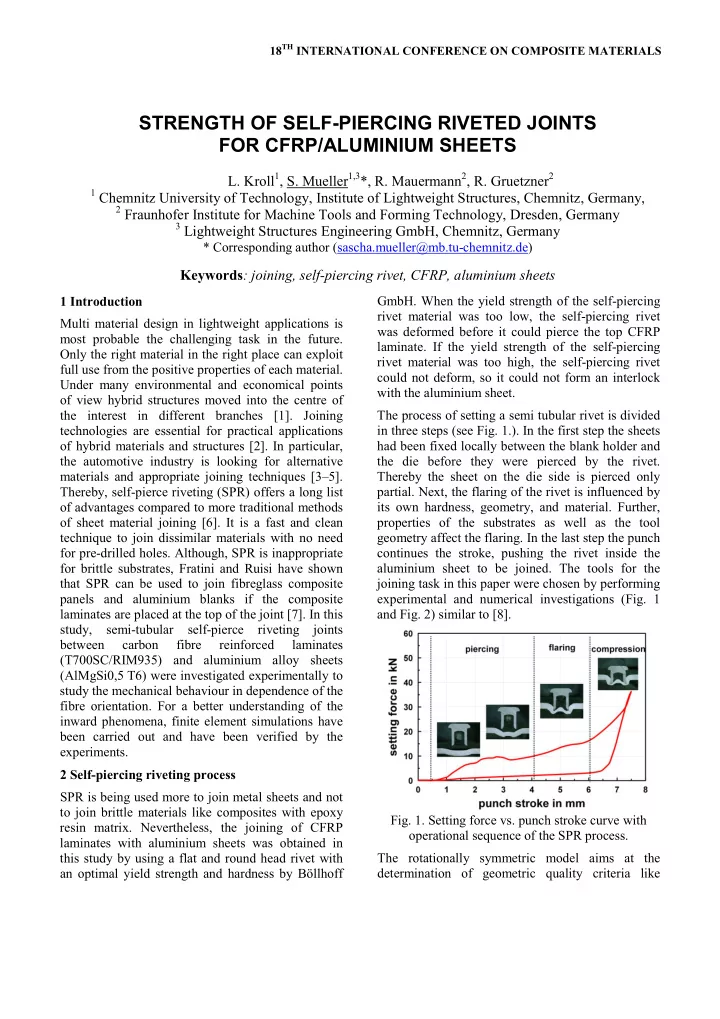
rivet material was too high, the self-piercing rivet could not deform, so it could not form an interlock with the aluminium sheet. The process of setting a semi tubular rivet is divided in three steps (see Fig. 1.). In the first step the sheets had been fixed locally between the blank holder and the die before they were pierced by the rivet. Thereby the sheet on the die side is pierced only
- partial. Next, the flaring of the rivet is influenced by
its own hardness, geometry, and material. Further, properties of the substrates as well as the tool geometry affect the flaring. In the last step the punch continues the stroke, pushing the rivet inside the aluminium sheet to be joined. The tools for the joining task in this paper were chosen by performing experimental and numerical investigations (Fig. 1 and Fig. 2) similar to [8].
- Fig. 1. Setting force vs. punch stroke curve with
- perational sequence of the SPR process.
The rotationally symmetric model aims at the determination of geometric quality criteria like
STRENGTH OF SELF-PIERCING RIVETED JOINTS FOR CFRP/ALUMINIUM SHEETS
- L. Kroll1, S. Mueller1,3*, R. Mauermann2, R. Gruetzner2