Strengthening Higher Agricultural Education for Agri-Food System - - PowerPoint PPT Presentation

strengthening higher agricultural education for agri food
SMART_READER_LITE
LIVE PREVIEW

Strengthening Higher Agricultural Education for Agri-Food System - - PowerPoint PPT Presentation

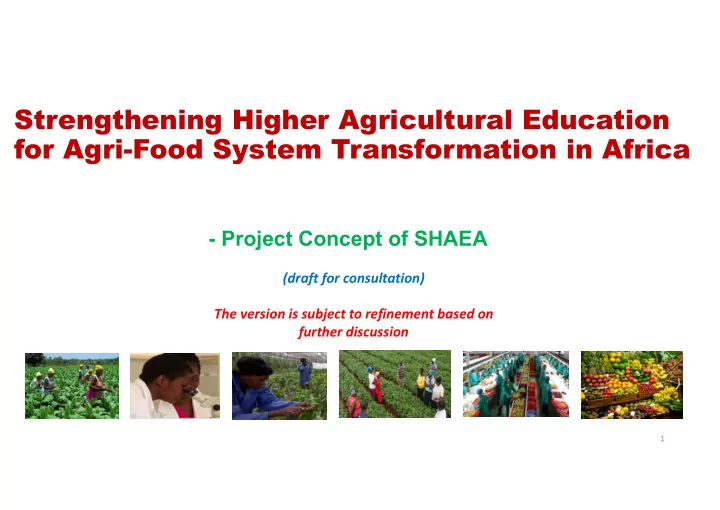
Strengthening Higher Agricultural Education for Agri-Food System Transformation in Africa - Project Concept of SHAEA (draft for consultation) The version is subject to refinement based on further discussion 1 Africa-wide regional agenda to


slide-1
SLIDE 1

Strengthening Higher Agricultural Education for Agri-Food System Transformation in Africa

1

  • Project Concept of SHAEA

(draft for consultation) The version is subject to refinement based on further discussion

slide-2
SLIDE 2

Africa-wide regional agenda to strengthen Agricultural Education, Science, Technology and skills for the youth

  • African governments called for coordinated regional initiative to

strengthen university capacity especially targeting agricultural faculties

  • The meeting of African Ministers of Education, Science and

Technology held 21 October 2016 in Cape Town called for a Marshal Plan to:

  • Establish a vibrant academic mobility programmes to increase

access to quality academic programmes and foster regional cooperation and integration.

  • Establish lead anchor universities to serve the wider continent in

specific skill gap areas especially in Agriculture related fields,

  • Strengthen staff capacities in African Universities and TAE

institutions,

  • RUFORUM was tasked to work with partners to develop a

programme to strengthen Higher Agricultural Education on the continent

Provide youth with the skills for Africa’s future Food System Provide youth with the skills for Africa’s future Food System

slide-3
SLIDE 3

“Regional Anchor University”

  • 1. Capacity to provide national and regional leadership for agri-food system

transformation

  • demonstrate functional links with government policy-makers, private sector,

agriculture extension and show how it will fill the gap between academia and industry

  • demonstrate current and proposed impact on rural communities and agricultural

transformation and the role of the university in a knowledge-based economy

  • 2. Recognised academic leader able to demonstrate commitment to reform

for transformative impact

  • 3. Support to internationalize higher agricultural education services
  • 4. Potential to evolve into a vibrant and transformative Anchor university

3

slide-4
SLIDE 4

Consultations suggest a regional project through ‘regional anchor universities’ to:

4

Develop competent and relevant human resources (esp. the highly-skilled) required to accelerate agri-food systems transformation in Africa through strengthening (i) agri-food related education and training enhanced with transdisciplinary approaches and applied research at selected African regional anchor universities; (ii) university linkages to the regional agricultural sector – its priorities, needs and stakeholders; and (iii) university partnerships with public and private entities related to agri-food both within and outside the region. And, address 6 regional Key Gap Areas identified through a multi-year consultative process with government representatives, agricultural university leaders and other stakeholders in Africa:

1. Agribusiness and Entrepreneurship 2. Agri-food Systems and Nutrition 3. Rural Innovations and Agricultural Extension 4. Agricultural Risk Management and Climate Change Proofing 5. Agricultural Policy Analysis 6. Statistical Analysis, Foresight and Data Management

SHAEA focuses on system change rather than on individual institutional benefits. It employs a results-based financing modality to ensure the achievement of results and impact!

slide-5
SLIDE 5

Project Development Objective:

To strengthen linkages between selected African universities and regional agricultural sector needs for developing required human resources to accelerate agri-food systems transformation in Africa

Key Beneficiaries

Individuals:

  • Faculty, students and administrators in selected RAUs and

partner institutions

  • Agricultural advisory service personnel
  • Agricultural policymakers and researchers

Institutions:

  • Agricultural education institutions
  • Agricultural research institutes and think-tanks
  • Agricultural advisory service organizations
  • Agribusiness firms
  • Government agencies, development partners and NGOs

working in agriculture

Key Results Indicators

 % increase of sector actors acknowledgement of RAUs’ leadership and management capabilities for agri-food system transformation  % of agri-food sector actors satisfied with knowledge, competence and skills of RAU graduates  No. of academic programs benchmarked or accredited with regional and international standards

(will be adjusted after consultations)

SHAEA’s proposed overall design is outlined as follows:

5

All will be modified after consultations as necessary.

slide-6
SLIDE 6

Proposed Activity Focus Areas

Subcomponent 1.1: Developing Sustainable Institutional Leadership and Management Capacity for Agri-Food Systems Transformation

  • Leadership and management capacity development for RAUs
  • Application of a proven institutional change model to each self-identified challenge issue

linked to regional key gap areas

Possible Tools for Using

  • Applying the Adaptive Leadership Framework for capacity building in RAUs (cross-RAUs

training workshops will be handled by RFU under Subcomponent 2.1)

  • Study visits and mentoring programs with appropriate institutions within and outside the

region

  • Immersion and application of institutional change models (e.g., iAGRI change model

experiment in Tanzania, Atlantic Fellows for Health Equity in South Africa program, etc)

  • Partnership with appropriate regional and international organizations/associations

Component 1: Strengthening Regional Anchor Universities (RAUs) in Regional Key Gap Areas with Specialization(s)

6

slide-7
SLIDE 7

Proposed Activity Focus Areas

Subcomponent 1.2: Delivering High Quality and Relevant Research-based Training to Produce a New Generation of Transdisciplinary Problem Solvers for Agri-food Development

  • Curriculum development – reviewing/improving content relevance of existing programs, developing transdisciplinary

courses/ programs, including online offerings, to address skill shortage in the identified regional key gap areas

  • Program benchmarking/accreditation – more academic programs meeting international standards, esp. those critical

to addressing regional key gap areas

  • Upgrading faculty’s professional qualifications, including modern pedagogies and transdisciplinary approaches
  • Entrepreneurship training –skills for agri-food job-market, institutionalizing such training
  • Increased access with cross-regional mobility – cultivating a new generation of critical mass of agri-food

scientists/technicians with an inclusive admission policy for degree students and short-term trainees (see Component 2 for targeting, on specific topic areas that are pre-defined by RSC, based on regional/national demand and priorities) Possible Tools for Using

  • Curriculum Review Committees with the participation of agricultural advisory services, the private sector and

international experts

  • Partnerships with other academic/research institutions, advisory services and the private sector within and outside the

region

  • Joint or twinning programs with other academic institutions within and outside the region
  • A visiting scholar program for faculty exchange among RAUs (see Component 2 for its linkage and facilitation)
  • Internship/apprenticeship programs with agribusiness firms, advisory services, and agri-food related organizations
  • A differentiated fee scheme to incentivize admission of more regional, female and rural students (e.g., through DLIs)

Component 1: Strengthening Regional Anchor Universities (RAUs) in Regional Key Gap Areas with Specialization(s)

7

slide-8
SLIDE 8

Proposed Activity Focus Areas

Subcomponent 1.3: Fostering University’s Field-based Research and Outreach to Agriculture Sector Stakeholders

  • Strengthening research collaborations (while developing an experiential learning program for students) with agri-

food relevant public and private entities such as research institutes, think-tanks, agribusiness firms, advisory services, farmers and public agencies

  • Upgrading knowledge and skills of agricultural advisory service personnel with latest research findings and

technologies relevant to their services

  • Contributing to or leading national and regional agricultural policy dialogue and debate
  • Disseminating agri-food related general knowledge/info to agricultural sector stakeholders

Possible Tools for Using

  • Competitive Grants to support Community Action Research Projects (CARPs) with engaging agricultural TVET

institutions on specific topics defined by agri-food development priorities either regional or national (based on the CARP+ model in Kenya)

  • Contractual or twining arrangements with agricultural advisory service organizations and private sector to provide

targeted training with short-term courses for extension service personnel

  • Establishment of an agri-food policy center on strategic planning and policy analysis for the agricultural sector
  • Leading the formulation of a 10-year strategic plan to transform a Regional Key Gap Area (chosen based on a

RAU’s specialization) with key stakeholders both regional and national, contributing to CAADP*

  • Creating an effective media platform (e.g., online, TV or radio) for agri-food knowledge dissemination

Component 1: Strengthening Regional Anchor Universities (RAUs) in Regional Key Gap Areas with Specialization(s)

8

slide-9
SLIDE 9

Proposed Activity Focus Areas

Subcomponent 2.1: Capacity-building Support to RAUs through Regional Interventions

  • Addressing common inadequacies of institutional capacity facing RAUs – e.g. leadership, entrepreneurship, PS

partnership development, outreach to AAS and farmers, M&E, grant management/revenue mobilization

  • Mobility– faculty/students exchange among RAUs and sharing good practices
  • Partnership activity facilitation - between RAUs and relevant regional agri-food organizations and networks in

quality assurance, research, agribusiness, and agricultural policy (see Component 3). Possible Tools for Using

  • Workshops, conferences, e.g. on capacity-building needs/topics identified by RAUs
  • Annual Vice-Chancellors/Deans Round Table between RAUs and global leading agricultural

universities

9

Subcomponent 2.2: Capacity-building Support of RAUs to Associated Agricultural Tertiary Education Institutions and the Agriculture Sector

  • Leadership and management offerings by RAUs to AATEI
  • Faculty development – upgrading faculty’s professional qualifications e.g. modern pedagogies and

research skills, of AATEIs

  • Improving and upgrading academic programs and standards of AATEIs

Proposed Activity Focus Areas

  • Training modules (including online ones), internships, mentoring programs through twining

arrangement between a RAU and its AATEIs

  • Visiting scholar programs; A shared online platform for providing high quality online courses

Component 2: Developing a Network of Agricultural Tertiary Education Institutions to Support Regional Agri-Food Transformation Needs

slide-10
SLIDE 10

10

SHAEA Results Chain Framework

slide-11
SLIDE 11

Component 3: Project Facilitation, Coordination and Management

This component will be implemented by the RFU in collaboration with SHAEA implementation entities in each participating country.

  • Implementation oversight – with RSC and NSC, effective communications
  • Results assurance – results framework implementation and disbursement-

linked indicators (DLIs) verification

  • M&E, fiduciary and safeguards – support RAUs and facilitate their

reporting in these areas

  • Knowledge-sharing – among RAUs on SHAEA implementation

11

slide-12
SLIDE 12

A result based approach- Disbursement based indicators (DLIs)

Disbursement linked indicator Action to be completed Maximum disbursement amounts available (TBD) DLI #2 Strengthened University Leadership and Management DLI#2.4 Leadership role in knowledge generation for Agri-food systems transformation DLI#2.4 (year 5) DLI #3 Strengthened education capacity in key gap areas DLI#3.5 International accreditation

  • f transdisciplinary post graduate

programs within the key agri-food knowledge gap areas DLI#3.5 (year 2, 3, 4) DLI#4 Strengthening linkages between RAU and Regional agricultural sector needs in key gap areas DLI#4.1 Strategic national or Regional Partnerships sector actor X DLI#4.4 10-year strategic plan to transform key gap area of knowledge X

12

slide-13
SLIDE 13

13

The project will use results-based financing to achieve these results:

  • The results-based financing modality with disbursement-linked indicators (DLIs) to finance the agreed activities
  • Funds disbursed against the independently-verified achievement of the agreed results.

Financing modality summary of the proposed activities under SHAEA: Financing Modality Component 1 Component 2 Component 3 Implementing Agency

Subcomponent 1.1 Subcomponent 1.2 Subcomponent 1.3 Subcomponent 2.1 Subcomponent 2.1

− − DLI-based √ √ √ − √ − RAUs SoE-based* − − − √ − √ RUFORUM

* Traditional financing modality and its disbursement is based on statement of expenses.

  • Proportion of project funding accessible to the agriculture sector for “purchasing” services from the RAUs to meet sector

demands.

  • “purchasing” list presented by the Ministry of Agriculture annually, approved by the NSC, and incorporated into the RAU

annual work program.

  • Funding for such “purchasing” disbursed when the agreed services are delivered and the results independently verified.
slide-14
SLIDE 14

For effective and efficient implementation, SHAEA proposes the following governance structure:

Regional National Institutional Regional Steering Committee (RSC) (representatives from regional bodies, governments of the participating countries, agriculture experts, private sector) Project Steering (/Advisory) Committee (NSC) (representatives from MoA, MoE, MoF/MoNP, Vice Chancellor(s) of the selected RAU, relevant higher education and agriculture agencies) ~ 17-19 members ~ 7-9 members SHAEA Implementation Committee/Unit

(will invite the government representatives from the existing RSCs of ACE/WAAPP/ECAAT projects for better integration and synergy) (will use the existing NSCs of ACE/WAAPP/ECAAT projects, which could be expanded with required subject-matter experts as necessary, for better integration and synergy) (in case where the selected RAU also hosts ACE(s), the same governance structure / implementation arrangement the University set up for its ACE(s) implementation will be use for SHAEA and could be expanded with required subject-matter experts as necessary)

as appropriate

14

Implementation arrangement detail will be discussed with each government for meeting the country’s specific needs.

slide-15
SLIDE 15

SHAEA preparation has a tight timetable:

15

SHAEA preparation WB team is comprised of a small regional core team with country teams resided in WB country

  • ffices of the participating countries which are led jointly by the country TTLs for agriculture and education.

No. Milestone Responsible Party Anticipated Timeframe 1

First RSC and RFU meeting RSC/RFU/WB (organized by RFU) July 2018

2

In-country stakeholder consultations Gov/RFU/WB (organized by the gov, facilitated

by RFU)

July-August 2018

3

Issuing the Call for Proposals for RAUs RSC/RFU July 31, 2018

4

RAU proposal submission Gov submits to RFU (by deadline) November 30, 2018

5

RAU proposal evaluation and selection IEC conducts evaluations and submit

recommendations to RSC who makes the selection

By mid-January, 2019

6

SHAEA appraisal WB By Feb 2018

7

SHAEA negotiations MoFs/WB March-April 2019

8

SHAEA submission to the WBG Board WB End May 2019

9

SHAEA approval by the WBG Board WB End June 2019
slide-16
SLIDE 16

16

Thank You!

Comments and suggestions are welcome! Please send them to:

  • Dr. Irina Klytchnikova
  • Sr. Economist

+1 202 458 0292 iklytchnikova@worldbank.org

  • Dr. Xiaonan Cao
  • Sr. Education Specialist

+1 202 473 8917 xcao@worldbank.org

  • Dr. Joanne Gaskell

Agriculture Economist +1 202 458 1088 jgaskell@workbank.org

  • Dr. Moses Osiru

Deputy Executive Secretary +256 759 988723 m.osiru@ruforum.org

  • Dr. Sylvanus Mensah

Training Officer +256 778089687 m.Sylvanus@ruforum.org

slide-17
SLIDE 17

Discussion and Consultations with Stakeholders

  • 1. What major agricultural development challenges does your country

face in the area of required human resources?

  • 2. Does SHAEA’s design help to address some of them?
  • 3. Which part of the project design should be customized further in
  • rder to better address those challenges?
  • 4. Given the challenges and relative competitive strength of your

universities in agri-food related subject areas, which regional gap area(s) identified by SHAEA should be the focus of your country’s participation?

17