Strongly Coupled Plasma: Properties and Critical Point Search - - PowerPoint PPT Presentation
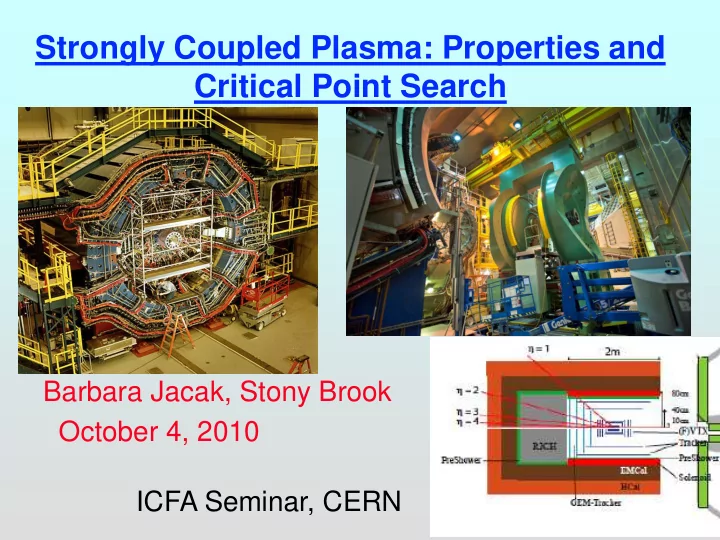
Strongly Coupled Plasma: Properties and Critical Point Search Barbara Jacak, Stony Brook October 4, 2010 ICFA Seminar, CERN Why Quark Gluon Plasma? QCD predicts: @ high T color screening reduces confining potential T c ~ 155 MeV
Why Quark Gluon Plasma?
QCD predicts: @ high T
color screening reduces confining potential
Tc ~ 155 MeV Asymptotic freedom in the
medium?
2
23,32,n2…
pQCD (particles) AdS/CFT (fields)
PRD75:054504(2007)
Explore the region near Tc
3
Relativistic Heavy Ion Collider at Brookhaven SPS at CERN
4 4
Exponential fit pT spectrum slope = 221 ±23 ±18 MeV Hydrodynamics reproduces g’s; vary thermalization time Tinit ≥ 300 MeV, t < 1 fm/c
gdir shows Tinitial > Tc at RHIC
PRL104, 132301, PRC81, 034911 (2010)
5
Bulk matter flows collectively
Hydrodynamic flow of hadrons @ pT < 2 GeV/c
Nearly ideal hydro flow! h/s near quantum bound 1/(4)
Thermalization in < 1 fm/c Low h/s good momentum transport strong coupling
Flow scales with # of valence quarks
How can equilibration be achieved so rapidly? What are the initial conditions? Are there quasiparticles in the quark gluon plasma?
If so, when and what are they?
arXiv:1109.6289 h/s=0.08
Fourier analyze particle emission pattern STAR
PRL98, 162301 (2007)
6
Plasma is very opaque
A challenge for pQCD (g radiation dominated) Radiation + collisional energy loss?
At what scales (distance, E, M) is coupling strong? What mechanisms for parton-plasma interactions?
For plasma response?
Colored particles
suffer large energy loss
opaque up to high pT
AA/Ncoll*pp
7
NeB /(NeB+NeD) At what scales (distance, E, M) is the
coupling strong?
What is the parton-plasma interaction?
Is there a plasma response?
Are there quasiparticles?
Even heavy quarks lose energy & flow!
added evidence for strong coupling!
arXiv:1109.5738 arXiv:1005.1627 Quenched lQCD pQCD x 25% heavy quark diffusion 2DT
J/y: color screening in QGP?
8
No obvious suppression
pattern with e, T!
Final state recombination
plays a √s dependent role
To understand color
screening: study as a function of √s, pT, ronium
NB: need d+Au data to
disentangle cold matter effects in initial state
arXiv:1103.6269 SPS J/y suppression AA/Ncoll*pp
Effect of final state cc coalescence?
9
Open charm flows but J/y does not
c-cbar coalescence
@ RHIC is not large Correlations remain in QGP due to strong coupling? Need ϒ 1S, 2S, 3S
Is there a relevant color
screening length?
New questions from RHIC & LHC data!
- 1. At what scales is the coupling strong?
- 2. What is the mechanism for quark/gluon-
plasma interactions? Plasma response? Is collisional energy loss significant?
- 3. Are there quasiparticles in the quark gluon
plasma? If so, when and what are they?
- 4. Is there a relevant (color) screening length?
- 5. How is thermalization achieved so rapidly?
- 6. Are there novel symmetry properties?
- 7. Nature of QCD matter at low T but high ?
(i.e. what is the initial state?)
10
To answer these questions
11
Upgrade PHENIX to answer the questions
12
Compact, hermetic, EM + hadron calorimetry
Use RHIC’s key capabilities*
Coupling scale & quasiparticle search
charm hard(not thermal) probe @ RHIC c vs. b in QGP
parton-plasma interaction
Jets ≤ 50 GeV, g-jet Ejet, l, qmass, angle dep. of dE/dx Jet virtuality ~ medium scale
Screening length
study as function of √s, pT, ronium
Thermalization mechanism
gdir yield, spectra & flow
QCD in cold, dense (initial) state
y dependence in d+Au Gluon saturation scale? EIC
13
*In the era of Pb+Pb at the LHC rare probe scan: 50<√s <200 GeV & asymmetric systems Luminosity x10 at RHIC Large acceptance in both STAR & PHENIX Au+Au Cu+Au U+U
- S. Gupta, QM2011
Can we locate the QCD critical point?
14
Fluctuations as Critical Point Signature
Event-by-event net-baryon fluctuation ratios from STAR are so far consistent with the Hadron Resonance Gas Hadron freezeout not (yet) near critical point Calculations of higher moments from LQCD deviate from HRG calculations and may provide conclusive evidence for critical point if observed in data
15
Karsch, et al. PLB695 2010.10046
Beam Energy Scan Plans
16 √sNN (GeV) Status Experiment
5.0 TBD STAR 7.7 analyzed STAR PHENIX (limited statistics) 11.5 analyzed STAR 19.6 Collected in 2011 STAR, PHENIX 27 Collected in 2011 STAR, PHENIX 39 analyzed STAR, PHENIX 62 analyzed STAR, PHENIX 130 collected in Run-1, analyzed limited statistics STAR, PHENIX
RHIC (Au+Au)
species Status year
p+p done 2009-2011 Be + Be Next for NA61 2011-2012 Ar + Ca NA61 2014 Xe + La NA61 2015 Pb + Pb NA49 did 1996-2002 p+Pb 2012/2014
SPS
SPS scan: 13, 20, 30, 40, 80, 158 GeV/A Search also for onset of deconfinement
Rapid thermalization?
Parton cascade is simply not fast enough A number of cool, inventive ideas
Plasma instabilities?
- v. strong coupling (holographic)
- > hydro valid after 3 sheet
thicknesses! Shatter a color glass condensate?
A paucity of predicted
experimental observables Needs more theory work
Understanding the initial state
(cold gluonic matter) is key
17
arXiv:1011.3562
Electron-ion collider; e-p collider
18
Existing e+p range Existing p+p range Current fit uncertainty Uncertainty w/ EIC Current best fit
0.2 0.4 105 104 103 102 101 1
Inferred momentum fraction of sampled gluons Gluon momentum fraction helicity distribution
10x100
RHIC’s future - hot and exciting
Near-term (2011-2016) Stochastic cooling 4 x 1027; Cu+Au
New microvertex detectors for heavy quark probes Quantify properties of near-perfect fluid QGP (vn) Quantify features of the QCD phase diagram Study novel symmetries, exotic particles
Medium-term (2017-2022) Upgraded detectors
Upgrade PHENIX: compact, large acceptance jet, quarkonia, photon detector Add forward spectrometer, muon telescope to STAR Attack the list of new QGP questions Study parton transverse spin in polarized p+p
Long-term (≥ 2023) Electron-Ion Collider
Add ~5 GeV (upgradable to 30 GeV) electron Energy Recovery Linac inside RHIC tunnel e+A, e+p (3He) for GPDs, Dg, gluonic cold matter
19
20
Backup
21
Many types of strongly coupled matter
Quark gluon plasma is like other systems with strong coupling - all flow and exhibit phase transitions Cold atoms: coldest & hottest matter on earth are alike! Dusty plasmas & warm, dense plasmas have liquid and even crystalline phases Strongly correlated condensed matter: liquid crystal phases and superconductors In all these cases have a competition: Attractive forces repulsive force or kinetic energy Result: many-body interactions; quasiparticles exist?
22
Properties of hot QCD matter?
thermodynamic (equilibrium) T, P, Equation Of State (relation btwn T, P, V, energy density) vsound, static screening length transport properties (non-equilibrium)* particle number, energy, momentum, charge diffusion sound viscosity conductivity
In plasma: interactions among charges of multiple particles charge is spread, screened in characteristic (Debye) length, lD also the case for strong, rather than EM force *measuring these is new for nuclear/particle physics!
Nature is nasty to us: does a time integral…
23
Measuring collective flow: start with v2
dN/df ~ 1 + 2 v2(pT) cos (2f) + … “elliptic flow”
Almond shape
- verlap region
in coordinate space
x y z
momentum space
24
Quantify the viscosity
Viscosity/entropy ratio near
quantum bound 1/(4)
At what scales is the coupling strong? What are the initial conditions?
vn(h/s=0.16)/vn(ideal) vn(h/s=0.08)/vn(ideal)
arXiv:1109.6289
Low viscosity/entropy very good momentum transport strong coupling
h
- S. Gupta,
QM2011
Can we locate the QCD critical point?
25
+ deconfinement onset
Early hard probe insights from LHC
Quarkonia energy dependence not understood!
Need charmonium and bottonium states at >1 √s at RHIC + guidance from lattice QCD!
Jet results from LHC very surprising!
Steep path length dependence of energy loss also suggested by PHENIX high pT v2; AdS/CFT is right? Unmodified fragmentation function of reconstructed jets looks different at RHIC, depends on “jet” definition? Lost energy goes to low pT particles at large angle is dissipation slower at RHIC? Due to medium or probe? Little modification of di-jet angular correlation appears to be similar at RHIC
Need full, calorimetric reconstruction of jets in wide y
range at RHIC to disentangle probe effects/medium effects/initial state
26
27
Is there a relevant screening length?
running coupling coupling drops off for r > 0.3 fm Karsch, et al. Lattice: Strongly coupled
matter: few particles in Debye sphere - decreases screening!
Ding, et al. arXiV: 1107.0311
LQCD spectral functions show correlation remaining at T>Tc Partial screening?
Need to understand quantitatively!
Coalescence could be important at LHC
More c-cbar pairs produced. Use b-bar to probe…
Does partial screening preserve correlations,
enhancing likelihood of final state coalescence?
arXiV:1010.2735 (Aarts, et al):
unchanged to 2.09Tc cb modified @ 1-1.5Tc, then free. Need states at RHIC!
28
ϒ (2S,3S) suppressed
Suppression pattern ingredients
Color screening Initial state effects
Shadowing or saturation of incoming gluon distribution Initial state energy loss (calibrate with p+A or d+A)
Final state effects
Breakup of quarkonia due to co-moving hadrons Coalescence of q and qbar at hadronization (calibrate with A, centrality dependence)
29
arXiv:1010.1246
30
Evidence of chiral symmetry restoration?
Excess low mass e+e- New data at 200 GeV
+ 62.4 and 39 GeV
Hadron Blind Detector
to improves S/B!
Are chiral and deconfinement transitions at same T? Spectral function modification? Source of the low mass excess? Pre-equilibrium??
PRC81, 034911 (2010)
Cost estimate
31
Staging
32
( )
33
Upgrades schedule
Exciting new physics opportunities in the coming decade!
34
Thermal radiation
PRL104, 132301 (2010)
Low mass, high pT e+e- nearly real photons Large enhancement above p+p in the thermal region pQCD g spectrum (Compton scattering @ NLO) agrees with p+p data g g
e+ e-
35
p+p Au+Au (MB)
Gluon Compton
q
g
g q e+ e-
Dileptons at low mass and high pT
- m<2 only Dalitz contributions
- p+p: no enhancement
- Au+Au: large enhancement at low pT
- A real g source
virtual g with v. low mass
- We assume internal conversion of direct
photon extract the fraction of direct photon
PHENIX Preliminary PHENIX Preliminary
1 < pT < 2 GeV 2 < pT < 3 GeV 3 < pT < 4 GeV 4 < pT < 5 GeV
r : direct g*/inclusive g* Direct g*/Inclusive g* determined by fitting each pT bin
36
Pre-equilibrium flow prior to t0?
Do the direct photons flow? First step: compare to hydro after equilibration
Experiment homework: smaller errors 2<pT<4 GeV/c Theory homework - pre-equilibrium v2 magnitude?
Chatterjee, Srivastava & Heinz PhysRevC79, 021901,’09
37
low mass di-electron excess
Run-4 PRC81, 034911 (2010) In central collisions and low pT
R=(data−cocktail)/fdir(mee)
38