Studies of High Risk Infants: Implications for Cerebral Palsy and - - PowerPoint PPT Presentation

studies of high risk infants implications for cerebral
SMART_READER_LITE
LIVE PREVIEW

Studies of High Risk Infants: Implications for Cerebral Palsy and - - PowerPoint PPT Presentation

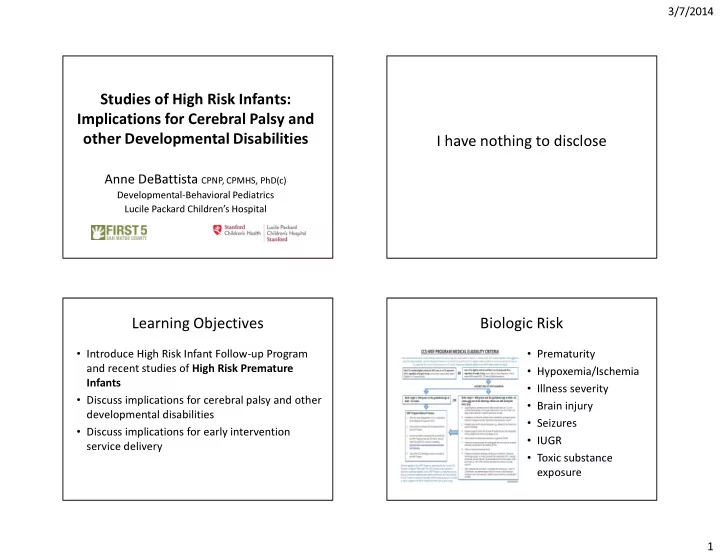
3/7/2014 Studies of High Risk Infants: Implications for Cerebral Palsy and other Developmental Disabilities I have nothing to disclose Anne DeBattista CPNP, CPMHS, PhD(c) Developmental-Behavioral Pediatrics Lucile Packard Childrens Hospital


slide-1
SLIDE 1

3/7/2014 1

Studies of High Risk Infants: Implications for Cerebral Palsy and

  • ther Developmental Disabilities

Anne DeBattista CPNP, CPMHS, PhD(c)

Developmental-Behavioral Pediatrics Lucile Packard Children’s Hospital

I have nothing to disclose Learning Objectives

  • Introduce High Risk Infant Follow-up Program

and recent studies of High Risk Premature Infants

  • Discuss implications for cerebral palsy and other

developmental disabilities

  • Discuss implications for early intervention

service delivery

Biologic Risk

  • Prematurity
  • Hypoxemia/Ischemia
  • Illness severity
  • Brain injury
  • Seizures
  • IUGR
  • Toxic substance

exposure

slide-2
SLIDE 2

3/7/2014 2

Biologic Risk – Etiology of Brain Injury

  • Advances in Neuroimaging -Multifactorial etiology

– Hypoxia-ischemia (cv instability) – Excess release of glutamate – Genetic susceptibility – Growth factor deficiency – Oxidative stress – Maternal infections->cytokines, inflammation – Toxins – Maternal stress or malnutrition

Social and Environmental Risk

  • Significant relationship between poverty & poor

developmental outcomes

  • Pre and postnatal inadequate nutrition can lead to

poor brain development

  • Stressful events-> lasting adverse effects

– mediated by:

  • genetic predispositions
  • supportive relationships

Epigenetic Risk

Epigenetics: Experience Changes Genes Positive and negative experience leave chemical signals on genes that may be temporary or permanent and change how the gene supports learning.

http://developingchild.harvard.edu/index.php/resource s/multimedia/interactive_features/gene-expression/

Epigenetics and Environmental Experience

  • Most studies in animal models
  • Early life experiences in preemies alters the stress

response and creates different stress response pathways from term babies.

  • These altered response pathways disrupt normal brain

growth and development.

  • Animal studies suggest these changes can be passed to

future generations

  • Clapper (2012) Advances in Neonatal Care vol 12, 5.
slide-3
SLIDE 3

3/7/2014 3

Science-Early Intervention Beginning in the NICU Recent Studies of NICU Environmental Interventions

  • Feldman (2014) RCT-14 daily skin to skin
  • 10 year better Executive Function measures
  • Scher (2009) –RCT 8 weeks of skin to skin

holding

– better brain maturation by EEG

  • Procainoy (2009) – RCT skin to skin and

massage

– Better developmental scores at age 2

Recent Studies of NICU Environmental Interventions

  • Guzetta (2011) – RCT massage 12 days

– EEG worse in controls, intervention like term

  • Milgrom (2010) – RCT parent training

– DTI MRI -Better brain maturation

  • Nordhov (2010) - RCT -7 sessions inpatient, 4
  • utpatient

– Reading/supporting stress cues to promote self regulation and quiet alert state for social interaction – Better cognitive development at 3 and 5 years

Why Do We Need HRIF?

  • Outcome studies

–Risk –Odds –Percentages

slide-4
SLIDE 4

3/7/2014 4

High Risk Infant Follow-up

  • California Children’s Services

– Mandated Title 5 – Regional CCS approved NICUs must refer eligible babies to CCS approved HRIF program (3 visits to age 3yrs) – Unfunded – use their medical insurance – Some managed care systems not authorizing HRIF

  • r authorize just the 1st visit

High Risk Infant Follow-up

  • Medical follow-up of

neonatal issues

  • Growth
  • Neurological Exam
  • Developmental Assessment
  • Psychosocial Assessment
  • Guidance & connection to

EarIy Intervention services

Neurologic Exam Movement & Posture

  • Targeted to look for signs
  • f cerebral palsy
  • Amiel Tison exam
  • GMFM levels
  • Refer to CCS medical

Therapy for PT & OT for:

– children at risk for CP – < age 3 years – 2 Neurological physical exam findings

Cerebral Palsy

  • Injury in the developing fetal or infant brain that

results in abnormal development of movement and posture, and causes activity limitations

  • Motor disorders of CP are often accompanied by

disturbances of sensation, cognition, communication, perception, behavior, and/or by a seizure disorder Bax et al. 2005

slide-5
SLIDE 5

3/7/2014 5

Prevalence of Cerebral Palsy

9 Europe Countries 88, 371 live births Overall 1.9/1000 live births <28 weeks 77/1,000 28-31 weeks 40/1,000 32-36 weeks 7/1,000 > 36 weeks 1.1/1,000

  • Himmelmann 2005

Cerebral Palsy

Cerebral Palsy

There is a range of severity

Diagnostic Imaging

  • Preemies <1500 grams with grade I or II IVH

– 3D MRIs near term age

  • Cortical Gray Matter Volume was significantly

reduced (Vasileiadis, PEDIATIRICS 9/2004)

  • Normal HUS/MRI adolescents born

premature – Abnormal brain volumes & white matter abnormalities without distinctive injuries

(Arthur, Pediatric Radiology,2006)

  • VLBW preemies at age 15 years >PWMI compared to Term and SGA

controls (Vangerg, Neuroimaging, 11/2006, Norway)

  • Grade I-II IVH – higher risk and rates of CP, DD, vision & hearing

impairments (Lui, Pediatrics 2014;133:55–62)

White Matter Injury

Encephalopathy Of Prematurity (Volpe, 2009)

  • PWMI and accompanying neuronal/axonal deficits -leads to

deficit of mature oligodendrocytes, impaired myelination and decreased brain volume – Focal injury (<5%)

  • Deep in white matter

– Diffuse

  • Noncystic and evolves over

several weeks to form glial scars

  • Focal or diffuse noncystic injury is emerging as the

predominant lesion (Back, 2007, Stroke)

  • Clinical MRI not able to detect diffuse micro-lesions that impair

myelination – Dysmaturation

(2014, Back, Clin Perinatology)

slide-6
SLIDE 6

3/7/2014 6

Normalizing MRI Reports

  • Diffuse PWMI not seen readily on

MRI

  • Correlates reported as signal and

diffusion abnormalities

– increased T2 signal intensity in periventricular white matter can be injury or undermyelination associated with prematurity – NICU DC Summary reports Normal MRI

  • What is Common in Preemies is

Not Always Normal

Huppi, 2010

T2 Weighted MRI Scans

None Mild Moderate Severe n=47 (28%) n=85 (51%) n= 6 (4%) n=29 (17%)

Woodward, NEJM 2006 Total preemies < 32 weeks gestation n = 167

Development of Immature Brains

Developmental skills are delayed at birth compared to term born peers

25weeks GA-39 Weeks GA 34 week brain is 60% of a term brain (Vohr, 2013)

Developmental Assessment

  • Adjusted Age Scores

(subtract # weeks early from age e.g. 8 month old born 16 weeks early = 4m AA)

  • Chronologic Age Scores

(score for age) Are they catching up to chronologic same age peers?

slide-7
SLIDE 7

3/7/2014 7

Outcome Specific Impairment All LBW 2500-1500 g VLBW 1499-1000 g ELBW <1000 g Neurosensory Vision Impairment <1% 2% 4-24% 2-20% Hearing Loss <1% <1% 1-3% 7-11% Developmental Cerebral Palsy <1% <1% 6-20% 9-30% Speech Language Delay 6% 3-5% 8-45% 25-45% Learning/ Academic Learning Disabilities 5- 20% 17% 30-38% 34-45% Special Education 8% 8% 60-70% 24-80% Behavioral ADHD 5-7% 7-30% 9-30% 5-40%

Vanderbilt 2007

Developmental Outcomes Preemie Graduate Services

Long Term Morbidities

Cerebral palsy Memory deficits Cognitive deficits Mental Health Disorders ADHD, Autism, Schizophrenia Speech/Language deficits Learning differences Coordination/balance Executive Function- Attention,

  • rganization difficulties

Visual-motor perception Processing problems Social/ emotional

Preemie Project: Medical-Legal- Community Collaborative Preemie Project

  • Longitudinal study of preterm children as part of a

community-based collaborative that promoted early access to intervention services.

  • Prospective cohort of preterm infants born between

2001-2007.

  • All children born <37 weeks gestational age (GA) and

<2500 grams and met one California Children Services risk factor for developmental delay.

slide-8
SLIDE 8

3/7/2014 8

Characteristic (n) n % Annual Family Income >50k 111 57 <50k 85 43 Maternal Education less than College degree 84 47 College or graduate degree 112 54 Maternal Race/Ethnicity (218) Caucasian 92 42 Hispanic 73 34

  • ther

53 24 Gender Male (218) 109 50 Gestational Age weeks (218) (Mean=31 weeks, SD=2.99) 23-29 72 33 30-32 82 37 33-36 64 30

When do Preemies Catch-up to Term Peers in Development?

  • Historically – Gessell

– Automatic Sequential Catch up

  • Web MD 2009
  • AAP 2013
  • Parent Blogs

23 lb. pumpkin (weight) 1½ lb. pumpkin (birth weight)

Developmental Catch-Up Average Range 85-115

Percent Of Preemies With Standard Scores > 85

PLS (n=93) BSID-II/ WPSSI-III (n=92)

Vineland Adaptive Behavior Scales

(n=97)

AGE Language Cognitive Comp

Communication

Daily Living Social Motor ~2 yr

43% 22% 45% 50% 56% 61% 75%

~3yr

58% 58% 57% 66% 63% 55% 66% DeBattista, 2008

Individual Trajectories 4m-36m

slide-9
SLIDE 9

3/7/2014 9

Development in Adaptive Behavior to Age 3

4 months 16 28 40

DeBattista, 2013

Trajectory Categories

Developmental Categories (%) Categories Catch-up (8) Sustained Normal (49) No Catch-up (16) False Catch-up (27)

Vineland Trends by Domain

Motor Communication Social Composite Activities of Daily Living

Adaptive Behavior by GA Group

slide-10
SLIDE 10

3/7/2014 10

Adaptive Behavior by Gender Adaptive Behavior by Income Preemie Catch Up

  • Extensive systematic review of medical and

psychological literature

  • Promoting that preemies “catch up by age 2

years” is not evidence based practice (Wilson & Cradock, 2004. Journal of Pediatric Psychology)

With Mean Score 90 instead of 100

90

Shift To the Left

Greater Percentage Falling In The Borderline Range May Not Be Eligible for Special Education

slide-11
SLIDE 11

3/7/2014 11

Guidance & Early Intervention (EI)

  • California Early Start Program

–Federal Extension of IDEA legislation for children birth to 3 years

–Therapies and Infant Programs for children with Developmental Delays & Disabilities

Early Start Program

  • California budget cuts 2009

–NICU grads no longer eligible at discharge based on risk –Families must use private insurance up - before Early Start will provide service

Early Start Program

Eligibility Categories:

  • Developmental Delay

– Percent delay – < 2 years adjusted age score: 33% delay in 1 domain

  • 22m/18m function < 12m in one area

– > 2 years chron age: 50% delay in 1, or 33% in 2 domains

  • 22m/18m function < 9m in one area
  • Established Risk
  • Solely Low Incidence

National EI Trends

  • Nationally, only 17% of children who are

younger than 5 years and whose development was classified as delayed actually received services for those delays (Rosenberg, 2008)

  • NICHD Neonatal Network (Hintz, 2008) <1000

gm preemies born 1997-2000 (n= 2,315) up to 44% had not received any EI services by the 18-22month visit.

slide-12
SLIDE 12

3/7/2014 12

Preemie Project EI Dosage

  • Hours of early intervention data collected

(ESP nurse, teacher, PT, OT, SLP) targeting development

  • Entered into Mixed Multilevel Model

# hours for each child between clinic assessment visits (time varying covariate)

  • EI was associated with lower adaptive

behavior scores at baseline (more delayed got EI)

  • Every hour of EI service resulted in a positive

increase in scores over time

Summary

  • Developmental outcomes are impacted by

biologic, social and epigenetic risk

  • We can’t predict exact outcomes for individual

babies

  • There is nothing magical about age 2 for preemie

catch-up

Summary

  • Children born prematurely:

– have immature brains subject to injuries – lower group mean scores- persist into adulthood – greater numbers requiring special education – limited access to EI – are expected to automatically catch up – NICU Early interventions are not considered in Federal Part C service provision and are not consistently provided

Summary

  • Research knowledge -> increased:

– understanding of neuropathology & genes – understanding of the importance of environmental experiences on brain development beginning in the NICU and continuing through childhood

  • Decreased investment in resources to promote

development with early and sustained environmental experiences and therapies

slide-13
SLIDE 13

3/7/2014 13

Summary

  • We need a renewed investment

in Early Intervention for High Risk Infants!

  • Development is shaped by a

dynamic and continuous interaction between biology and experience

(National Council on the Science of Early Intervention 2001)

Thank you