STUDY OF DYNAMIC AND PERMANENT INDENTATION OF LAMINATES SUBJECTED TO - - PDF document

study of dynamic and permanent indentation of laminates
SMART_READER_LITE
LIVE PREVIEW

STUDY OF DYNAMIC AND PERMANENT INDENTATION OF LAMINATES SUBJECTED TO - - PDF document

18 TH INTERNATIONAL CONFERENCE ON COMPOSITE MATERIALS STUDY OF DYNAMIC AND PERMANENT INDENTATION OF LAMINATES SUBJECTED TO LOW-VELOCITY IMPACT U Debo Liu UP * P , U Zhidong Guan U ,Wei He, Jun Wang School of Aeronautics Science and Engineering,


slide-1
SLIDE 1

18TH INTERNATIONAL CONFERENCE ON COMPOSITE MATERIALS

1 Introduction Composite materials are now being used in primary aircraft structures, particularly in helicopters, light aircrafts, commercial planes and sailplanes, because

  • f their numerous advantages including low weight,

high modulus and strengths and the possibility of manufacturing large integral shell structures. However, a well-known problem with composite laminates is their poor resistance to accidental impact by foreign objects. The resulting damage due to impacts, often in the form of delamination, matrix cracking and fiber failures, may severely reduce the structural strength and stability[1]. Therefore, considerable amount of research has been done in the area of impact of composite structures. The relationship between the indentation and impact energy has been studied by many investigators[2]. It is proved to be an effective method to evaluate the internal damage by observing the indentation. Laminated composite panels with BVID (Barely Visible Impact Damage) are required to endure the full DUL (Design Ultimate Load) in the strength criteria usually adopted in composite wing structure design in civil aviation. BVID primarily considers the depth of the permanent indentation. More exactly the depth of indentation after impact is measured, more accurate evaluation of composite can be made, which provides a reference to the design of composite structure. With the development

  • f

computer, many calculative methods were raised to study the formation of the indentation, which made it possible to gain an insight into the damage theory of

  • composites. In the simulation of the impact, Hertzian

contact law has been widely used to calculate the contact force between the impactor and the

  • laminates. In 1977, C.T. Sun proposed a modified

Hertzian contact law [3]. In 1981, Yang and Sun experimentally investigated indentation phenomena through static indentation tests on composite laminated specimens and they presented the experimental static indentation law[4]. In order to follow the approach, researchers needed to develop their own finite element method (FEM) program. Many new damage theories and analytical methods were established to simulate the damage evolution process during the impact. At present, the dynamic process of the indentation growth has been studied a lot by the simulation but rarely by experiment, because it was impossible to

  • bserve the details between the impactor and the

laminates during impact test. Most contact laws are based on Hertzian/modified Hertzian contact law, which was generalized from the static indentation

  • test. It is necessary to measure the dynamic changes
  • f the indentation during the impact test to

understand the damage evolution process better. In the present study, firstly, a simplified method was introduced to measure the thickness changes of the laminates at the impact point during the experiment. Secondly, a modified Hertzian contact law was raised based on the dynamic indentation. Thirdly, a calculative method was developed to predict the permanent indentation. 2 Experiment The dynamic indentation is defined as the changes

  • f the thickness where the specimen is impacted. In
  • rder to acquire the dynamic indentation, the

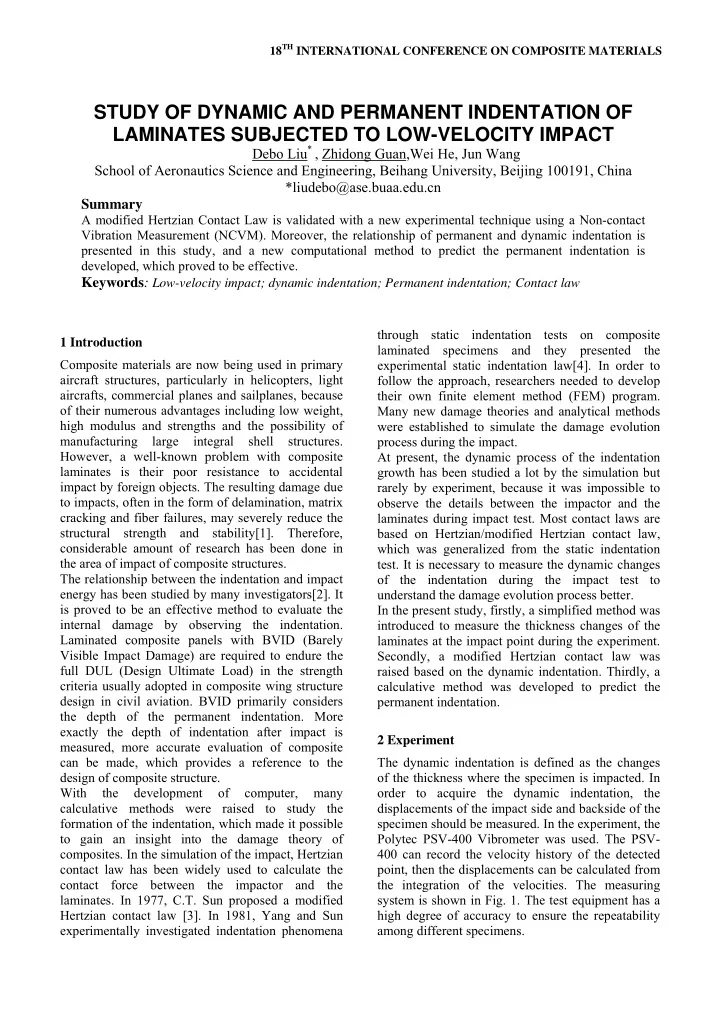
displacements of the impact side and backside of the specimen should be measured. In the experiment, the Polytec PSV-400 Vibrometer was used. The PSV- 400 can record the velocity history of the detected point, then the displacements can be calculated from the integration of the velocities. The measuring system is shown in Fig. 1. The test equipment has a high degree of accuracy to ensure the repeatability among different specimens.

STUDY OF DYNAMIC AND PERMANENT INDENTATION OF LAMINATES SUBJECTED TO LOW-VELOCITY IMPACT

UDebo LiuUP* P, UZhidong GuanU,Wei He, Jun Wang

School of Aeronautics Science and Engineering, Beihang University, Beijing 100191, China *liudebo@ase.buaa.edu.cn Summary

A modified Hertzian Contact Law is validated with a new experimental technique using a Non-contact Vibration Measurement (NCVM). Moreover, the relationship of permanent and dynamic indentation is presented in this study, and a new computational method to predict the permanent indentation is developed, which proved to be effective.

Keywords: Low-velocity impact; dynamic indentation; Permanent indentation; Contact law

slide-2
SLIDE 2
  • Fig. 1 Schematic illustration of velocity measurement

system

The specimens were T700/5428A laminates with the stacking sequence [45/0/-45/90]R4S

  • R. Several of them

were used to detect the velocity of the impact side and the others were used to detect that of the

  • backside. The velocity of impactor before contact

was detected by the flag (shown in Fig.1) using a high speed data acquisition system. A comparison of the impactor’s velocity between the experimental result and the integration of the contact force was made which showed the correctness of the method. The velocities of the impactor and backside of the specimen are shown in Fig.2 and Fig.3. From the Figures, the velocities of both sides have a high accordance except that the backside has some vibrations in the earlier stage of impact.

0.000 0.001 0.002 0.003 0.004 0.005 0.006

  • 3
  • 2
  • 1

1 2 3 4 Velocity(m/s) Time(s)

Backside of specimen Impactor

Fig.2 Velocities of impactor and specimen’s backside under 17J impact

0.000 0.001 0.002 0.003 0.004 0.005 0.006

  • 3
  • 2
  • 1

1 2 3 4 Velocity(m/s) Time(s)

Backside of specimen Impactor

Fig.3 Velocities of impactor and specimen’s backside under 26J impact

The histories of dynamic indentation with different impact energies were obtained by the displacements

  • f both sides, which were calculated by integration
  • f the velocities recorded by the PSV-400. The

relationship of the dynamic indentation and contact force are shown in Fig.4 and Fig.5. As we can see, the dynamic indentation histories are similar to the contact force before large damage occurred.

0.000 0.001 0.002 0.003 0.004 0.005 0.006 0.007 0.0 0.1 0.2 0.3 0.4 Depth of Indentation(mm) Time(s) Dynamic Indentation Contact Force 2000 4000 6000 8000 Contact Force(N)

  • Fig. 4 Contact force and dynamic indentation with the

impact energy of 17J

0.000 0.001 0.002 0.003 0.004 0.005 0.006 0.007 0.0 0.1 0.2 0.3 0.4 0.5 Depth of Indentation(mm) Time(s) Dynamic Indentation Contact Force 2000 4000 6000 8000 10000 Contact Force(N)

  • Fig. 5 Contact force and dynamic indentation with the

impact energy of 26J Guide Rail Specimen Impactor Laser Beam Laser Beam Flag

slide-3
SLIDE 3

3 STUDY OF DYNAMIC AND PERMANENT INDENTATION OF LAMINATES SUBJECTED TO LOW-VELOCITY IMPACT

3 Computation In the computation, a modified Hertzian contact law has been used to analyze the relationship of the contact force and dynamic indentation: Loading [5]

n

f k 

(1) Where f is contact force,  is indentation shown in Fig.6, k is the contact coefficient, obtained from experiments, but can also be approximately calculated as

2

4 1 3 (1 ) / 1/

i i i t

k R E E        

(2) Where

i

R is the radius of the impactor,

i

 and

i

E

are respectively the Poisson's ratio and the Young's modulus of the impactor, and

t

E is the transverse

  • ut-of-plane Young's modulus of the laminated

composite.

  • Fig. 6 Quasi-static indentation with the bottom clamped

Modified unloading [6]

n m m

f f             

(3) Where n equals 2.5 during the unloading period and equals 1.5 during the loading period,

m

f and

m

 are

respectively the max contact force and the max indentation during one loading-unloading cycle,

is the depth of the permanent indentation caused by the max contact force

m

f .  is given by

2 5

1

m cr cr m m cr m

                                

(4) Where

m

 is the maximum indentation, and

cr

is the critical indentation and it can be estimated by the following equation [7].

c cr t

Z h E  

(5) In order to acquire the relationship between the contact force and dynamic indentation, a new contact law was introduced from eq. (1), in which n equals 1.4, k is 0.9×10P9

PN/mP1.5 P calculated by eq. (2).

The test and fitting curves are shown in Fig.7 and Fig.8.

0.000 0.001 0.002 0.003 0.004 0.005 0.006 0.007 2000 4000 6000 8000

Force(N) Time(s)

Imapct test Fitting

Fig.7 Fitting curve with the impact energy of 17J

0.000 0.001 0.002 0.003 0.004 0.005 0.006 0.007 2000 4000 6000 8000 10000 Force(N) Time(s) Impact test Fitting

Fig.8 Fitting curve with the impact energy of 26J

The fitting curves are similar with the test results in the vibration mode and maximum force. Therefore it could be used in the dynamic analysis of laminates subjected to low-velocity impact. A simple computational method was summarized to estimate the permanent indentation through the maximum contact force which could be obtained from a finite element analysis, in which the modified Hertzian contact law was incorporated in the FEM program CIMPACT written in FORTRAN. The permanent indentation can be obtained from eq. (4), in which the maximum indentation and critical

slide-4
SLIDE 4

indentation can be calculated by eq. (1) and eq. (5),

  • respectively. The examples are shown as follows.

4 Calculation examples Carbon/epoxy composite T700/5428 is used in this

  • study. The laminates is a 150mm×100mm×4mm

plate, with stacking sequence [45/90/-45/0]R4S

  • R. Two

common energy levels, 4.45J/mm and 6.67J/mm, are applied in the calculation and impact tests. The detailed properties of the material are shown in the table 1.

Table 1 Material Properties of T700/5428 carbon/epoxy

Properties Symbol (unit) Value In-plane longitudinal modulus ER1

R (GPa)

125 In-plane transverse modulus ER2

R (GPa)

7.8 Out-of-plane transverse modulus ER3

R (GPa)

7.8 In-plane shear modulus GR12

R (GPa)

5.6 In-plane Poisson’s ratio VR12 0.28 Density ρ(kg/mP3

P)

1540 Longitudinal tension Xt(MPa) 2150 Longitudinal compression Xc(MPa) 1200 Transverse tension Yt(MPa) 65 Transverse compression Yc(MPa) 220 Ply longitudinal shear SR12

R(MPa)

110 First, the finite element model is built, and the simulation is carried out by the program CIMPACT. The program uses the Hertzian contact law, adopting

  • eq. (1) during loading period and eq. (3) during local

unloading and reloading period. The contact force histories are shown in Fig.9 and Fig.10. Second, calculate the depth of the permanent indentation as follows: (1) Calculate the contact coefficient k According to eq. (2) and the material properties in the table 1, the contact coefficient can be calculated, and its value is 0.9×10P9

PN/mP1.5 P.

1 2 3 4 5 6 1 2 3 4 5 6 7 8

Contact Force(KN) Time History(ms)

Impact Test Calculation

  • Fig. 9 Comparison of calculation and test results with

4.45J/mm impact energy

1 2 3 4 5 6 2 4 6 8 10

Contact Force(KN) Time History(ms)

Impact Test Calculation

  • TFig. 10 Comparison of calculation and test results with

6.67J/mm impact energy

(2) By eq. (1), the max indentation

m

can be calculated from the max contact force

m

f produced

from the finite element simulation. The values with the two impact energy levels can be seen in Table 2. (3) Calculate the depth of the permanent indentation

 using eq. (7) and

m

 .

Table 2 Calculation results

Impact Energy

m

f /N

m

 /mm  /mm

4.45J/mm 7000 0.393 0.185 6.67J/mm 9100 0.468 0.237 Table 3 shows the comparison of the analytical and experimental results. As we can see, the calculation results are almost the same as test results with the error no more than five percent. The result shows that it is effective to calculate the depth of the permanent indentation using the method based on Hertzian contact law.

Table 3 Comparison of the calculation and impact tests

Impact Energy Calculation Tests error 4.45J/mm 0.185mm 0.18mm 2.7% 6.67J/mm 0.237mm 0.24mm 1.8% 5 Conclusion

  • 1. The variation of dynamic indentation with time is

similar to that of contact force before significant damage occurred. After large damage appeared, dynamic indentation increases quite slowly. Fig.4 and Fig.5 show the relationship between dynamic indentation and contact force with the impact energy

  • f 17J and 26J respectively.
  • 2. A modified Hertzian contact law is raised based
  • n the dynamic indentation. Fig.7 and Fig.8 show

the relationship between contact force and dynamic

  • indentation. In eq. (1), n can be set as 1.4 when

using the dynamic indentation.

slide-5
SLIDE 5

5 STUDY OF DYNAMIC AND PERMANENT INDENTATION OF LAMINATES SUBJECTED TO LOW-VELOCITY IMPACT

  • 3. A new computational method is developed to

predict the permanent indentation using the modified Hertzian contact law. It proved to be very effective. References

[1] Abrate, S., 1991. Impact on laminated composite

  • materials. Applied Mechanics Reviews 44 (4), 155–

189. [2] Lee SM, Zahuta P. Instrumented impact and static indentation of composites. J Compos Mater 1991; 25:204–22. [3] Sun CT. An analytical method for evaluation of impact damage energy of laminated composites. Am.

  • Soc. Test. Mater. 1977; ASTM STP 617: 427–40.

[4] Yang SH, Sun CT. Indentation law for composite

  • laminates. Am. Soc. Test. Mater. 1981; ASTM STP

787: 425–49. [5] S.H. Yang, and C.T. Sun, “Indentation Law for Composite Laminates”. Composite Materials: Testing and Design, Vol. 6, ASTM STP 787, pp. 425-449, 1982. [6] Z.D. Guan, “Transient dynamic analysis of impact and damage processes of laminated composite panels and stiffened panels due to low velocity impact”, PhD Dissertation, Beihang Univ., 1994. [7] A.P. Christoforou “On the Contact of a Spherical Indenter and a Thin Composite Laminate”. Composite Structures, Vol. 26, pp. 77-82, 1993.