Subdivisions in Tennessee Annual Planning Commissioner Training - - PowerPoint PPT Presentation

subdivisions in
SMART_READER_LITE
LIVE PREVIEW

Subdivisions in Tennessee Annual Planning Commissioner Training - - PowerPoint PPT Presentation

Defining Subdivisions in Tennessee Annual Planning Commissioner Training October 2017 What is a Subdivision? Tennessee Code Annotated 13-3-401 & 13-4-301 (B) (i) "Subdivision" means, in all counties except those in


slide-1
SLIDE 1

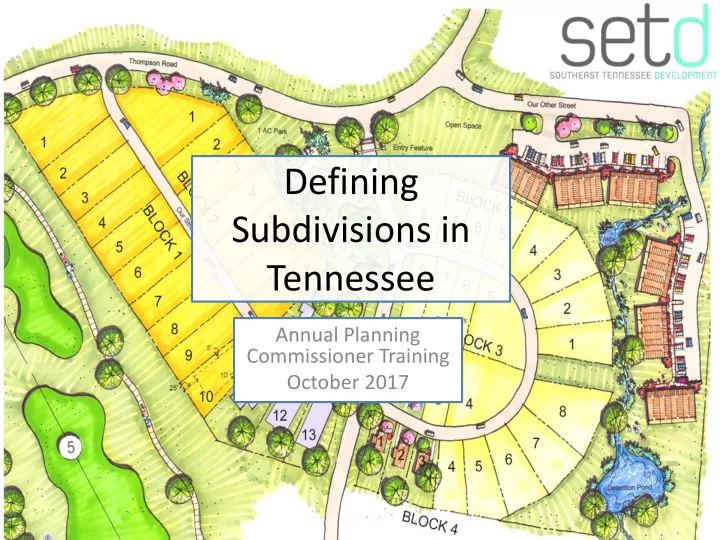
Defining Subdivisions in Tennessee

Annual Planning Commissioner Training October 2017
slide-2
SLIDE 2

What is a Subdivision?

  • Tennessee Code Annotated 13-3-401 & 13-4-301
  • (B) (i) "Subdivision" means, in all counties except those in

subdivision (4)(A), the division of a tract or parcel of land into two (2) or more lots, sites, or other divisions requiring new street or utility construction, or any division of less than five (5) acres for the purpose, whether immediate or future, of sale or building development, and includes resubdivision and, when appropriate to the context, relates to the process of resubdividing or to the land or area subdivided. (ii) As used in subdivision (4)(B)(i), "utility construction" does not include the mere extension of individual service pipes or lines for the purpose of directly connecting a single lot, site or other division to existing utility mains.

slide-3
SLIDE 3

What is a Subdivision?

  • Simply Put

– Any Division with New Lots Being Less than 5 Acres (Regardless of Infrastructure) – Any Division Requiring New Roads or Easements for Access (Regardless of Lot Size) – Any Division Requiring New Utilities to Multiple Lots – Resubdivision of Lots Where Planning Commission has Granted Approval Previously

slide-4
SLIDE 4

Approval of a Subdivision Plat

  • Tennessee Code Annotated 13-3-402 & 13-4-302

– No plat of a “SUBDIVISION” shall be filed for record or recorded until is has been approved & endorsed by in writing by a regional planning commission

  • Staff Approved Subdivisions – Not Sent to PC

– No More than 2 lots – No new utilities or roads – No variances required

  • Plat Must be Submitted by Owner
slide-5
SLIDE 5

Recording a Subdivision Plat

  • Tennessee Code Annotated 13-3-402 & 13-4-302

– (b) No county register shall receive, file or record a plat of a subdivision, or an amendment, modification, or correction to a recorded plat of a subdivision, [within the municipality] without the approval of the [regional] planning commission when and as required by this part. Each such plat so filed shall include the most recent recorded deed book number and page number for each deed constituting part of the property being platted. Notwithstanding this subsection (b), an easement or survey attached to an easement granted to the state, a county, municipality, metropolitan government,

  • r entity of the state, county, municipality or metropolitan government,

shall not constitute an amendment, modification, or correction of a recorded plat of a subdivision.

slide-6
SLIDE 6

Penalties for Selling Unapproved Lots

  • Tennessee Code Annotated 13-3-410 & 13-4-306

– (a) (1) The owner or the agent of the owner of any land shall not: (A) Transfer, sell, agree to sell, or negotiate to sell the land by reference to, exhibition

  • f, or by other use of a subdivision plat without first submitting a final subdivision plat to

the planning commission and receiving the commission's approval and before the final plat is recorded in the appropriate register's office; or (B) Falsely represent to a prospective purchaser of the land that roads or streets will be constructed by a county or other political subdivision. (2) The description by metes and bounds in the instrument of transfer or other document used in the sale or transfer does not exempt the transaction from a violation of this subsection (a). The local government through their attorney or other official designated by the legislative body, may pursue an injunction or other appropriate remedy for a violation of this subsection (a). (b) The owner or agent of the owner of any land may sell, transfer, or agree to sell any lot

  • r lots shown on a plat only after that plat has been given final plat approval by the

planning commission, and after the approved final plat is recorded in the office of the appropriate county register.

slide-7
SLIDE 7

What About Court Ordered Divisions?

  • Tennessee Code Annotated 13-3-408

– This part shall not apply to division and plats of land partitioned by a court of competent

  • jurisdiction. However, plats filed under 13-3-402

shall contain the information required by 13-3-402 even though the land has been partitioned by a court of competent jurisdiction. – Not mentioned in municipal Section of TCA

slide-8
SLIDE 8

What Can A Planning Commission Regulate

  • Tennessee Code Annotated 13-3-403 & 13-4-303

– Harmonious Development – Coordination of Roads – Adequate Opens Spaces for Traffic, Light, Air, & Recreation – Adequate Transportation & Grading of Roads – Water Supply & Connections – Drainage – Sanitary Sewer Facilities – Avoidance of Population Congestion – Avoidance of Scattered or Premature Subdivisions that Involve Danger or Injury to Health, Safety, or Prosperity Due to Lack of Water Supply, Drainage, Transportation or Other Public Services

  • r Would Necessitate an Excessive Expenditure of Public Funds

to Supply Such Services

slide-9
SLIDE 9

Conditions for Building Permits

  • Tennessee Code Annotated 13-3-411 & 13-4-308
  • Building Permits Shall Not Be Issued or Buildings Constructed Unless One of

the Following Conditions are Met:

(1) The street giving access to the lot upon which the building is proposed to be placed has been accepted or opened as, or shall have otherwise, received the legal status of, a public street prior to that time; (2) The street corresponds in its location and lines with a street shown on a subdivision plat approved by the planning commission and recorded with Register of Deeds (3) The lot fronts upon a permanent easement which conforms to all rules, regulations and specifications set by the local government’s legislative body (4) The street corresponds in its location and lines with a street shown on a street plat made and adopted by the planning commission – In municipalities, permits may be issued for lots on private easements that were recorded prior to April 21, 1987

slide-10
SLIDE 10

What About the 5+ Acre Flag Lots Is this allowed without PC Approval?

slide-11
SLIDE 11

What About the 5+ Acre Flag Lots

What about this?

slide-12
SLIDE 12

What About the 5+ Acre Flag Lots

Seriously?

slide-13
SLIDE 13

What About the 5+ Acre Flag Lots

Notice the 5 Flag Stems Side by Side

slide-14
SLIDE 14

What About the 5+ Acre Flag Lots

2 Flag Lots Contain Trailer Parks

slide-15
SLIDE 15

What About These Flag Lots

How about this one?

slide-16
SLIDE 16

Issues with 5+ Acre Flag Lots

  • Being Used to Circumvent Constructing Public

Road or Private Road/Easement Standards

  • Safety Issues – 911 Addressing
  • No Specified Minimum Road Frontage

Requirements in State Law

  • Affects Property Values & Subsequently Taxes
  • Conflicts Among Owners Sharing Easement
  • No School Bus, Mail, or Public Utility Service on

Private Roads

slide-17
SLIDE 17

What Can Be Done – 5+ Acre Flag Lots

  • Relax Easement Standards for Lots Over 5

Acres

– Reduce Road Paving Requirements – Require 911 Approved Road Name & Addressing

  • Use Building Permits to Deny Applications for

Unapproved Roads

  • Last Resort – Encourage State Legislators to

Address this Issue

slide-18
SLIDE 18

What Can Be Done – < 5 Acre Flag Lots

  • Reduce flag stem length
  • Only allow one intervening lot or partial lot

between flag lot and road providing access

  • Set distance requirements between flag stems

and proximity to road intersections

  • Prevent flag stems from changing directions

multiple times, at more than 90 degrees, or

  • nly follow exterior boundaries
slide-19
SLIDE 19

What Can Be Done – < 5 Acre Flag Lots

  • Limit the crossing of flowing or intermittent

streams, ravines, or other topographic features without culverts or bridges

  • Require topographic grade of flag stem to be

less than that of your maximum street grade

  • Ensure the flag stem provides “sufficient, safe,

and reasonable access” to the lot

slide-20
SLIDE 20

Questions?

slide-21
SLIDE 21

Southeast Tennessee Development Chad Reese (423)424-4263 CReese@sedev.org

slide-22
SLIDE 22