Subgroup #1, Dairy and Livestock Working Group Public Meeting - - PowerPoint PPT Presentation

subgroup 1 dairy and livestock working group public
SMART_READER_LITE
LIVE PREVIEW

Subgroup #1, Dairy and Livestock Working Group Public Meeting - - PowerPoint PPT Presentation

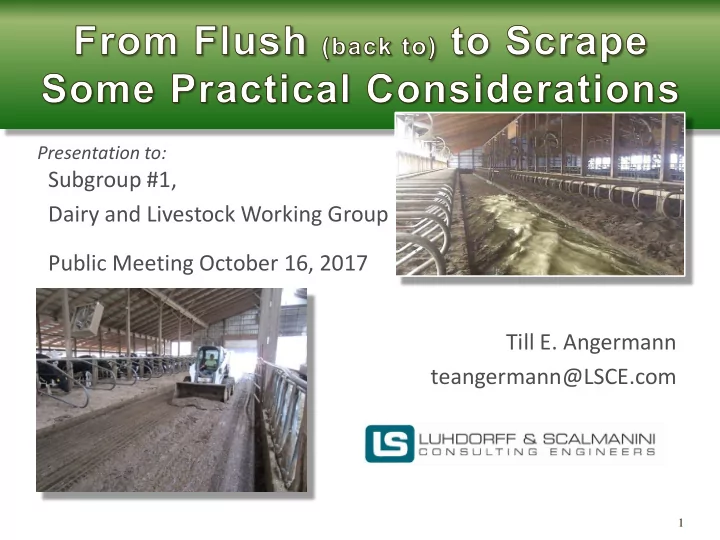
Presentation to: Subgroup #1, Dairy and Livestock Working Group Public Meeting October 16, 2017 Till E. Angermann teangermann@LSCE.com 1 Flush short course Main non-flush manure collection methods Prevalence and use of methods


slide-1
SLIDE 1

1

Presentation to:

Subgroup #1, Dairy and Livestock Working Group Public Meeting October 16, 2017 Till E. Angermann teangermann@LSCE.com

slide-2
SLIDE 2

2

  • Flush short course
  • Main non-flush manure collection methods
  • Prevalence and use of methods
  • Fate of manure
  • Conveyance, processing, storage, use
  • Effect of seasonal weather on scrape and stack
  • Effect on farm nutrient management
  • Nutrient content and agronomic implications
  • Equipment availability
  • Environmental implications
slide-3
SLIDE 3

3

  • Reconnaissance effort
  • Relies on information collected from several very

knowledgeable people who have lived on or worked with dairies in California for much of their lives

  • There are others who have not yet been spoken to

but are expected to be able to make valuable contributions (e.g., Dr. Deanne Meyer, UC Davis)

  • Quantitative statements are not based on ‘hard’ data,

but are believed to be in the ballpark based on cumulative input

slide-4
SLIDE 4

4

4Creeks, Inc.………………………………………David De Groot Hartman Engineering…………………………Craig Hartman Milk Producers Council………………………Kevin Abernathy Provost and Pritchard………………………..Steven Bommelje

John Schaap Jason Toste

Western United Dairymen…………………Melissa Lema

Jake Oosterman Paul Sousa

slide-5
SLIDE 5

5

Freestall

Manure deposition on flush lanes

Solids Separation

Recovery of fiber for bedding

Liquid Manure Lagoons

Temporary Storage

Milk Parlor

Wash Water

Field Application

Fertilization of Crops

slide-6
SLIDE 6

6

  • Recycles water from lagoon, typically uses make-up water from

milking parlor

slide-7
SLIDE 7

7

slide-8
SLIDE 8

8

  • Flushing is fully automated

and can occur any time of the day

  • Can occur with cows in the

barn

  • Zero labor
  • Extremely reliable and low

maintenance

  • Effective cleaning
  • Safest for cows and

employees

slide-9
SLIDE 9

9

Tractor (push only) Floor mounted arm Autonomous robotic devices Vacuum truck

slide-10
SLIDE 10

10

  • Cows need to be out of the area (necessitates coordination with

milking schedule, etc.)

  • Labor
slide-11
SLIDE 11

11

  • Better cleaning than steel bucket

due to squeegee effect (?)

  • Leaves thin, slippery manure film
  • Possibly less wear of the concrete

surface

slide-12
SLIDE 12

12

slide-13
SLIDE 13

13

slide-14
SLIDE 14

14

  • Moved via chain, cable, or hydraulics
  • Slow movement, 24/7 operation, cows step over it
  • Many passes per day due to low carrying capacity
slide-15
SLIDE 15

15

  • V-shaped scraper can move manure to underground channel
slide-16
SLIDE 16

16

slide-17
SLIDE 17

17

  • Different makes and models
  • Programmable, slow movement, 24/7 operation, cows don’t

mind, self-charging, self-emptying, large/small quarters

slide-18
SLIDE 18

18

  • Takes care of manure collection and conveyance
  • Possibly too heavy for some thinly poured lanes
slide-19
SLIDE 19

19

Central Valley

  • Rarely used as primary method (<5%)
  • More commonly used:
  • in South Valley (drier climate)(~10-20%)
  • for heifers (less and drier manure)
  • in the summer (drier)
  • flush can supplement scrape
  • Used on dairies with ineffective flush (~10-20% of
  • lder dairies)
  • Tractor helps push islands during flushing
slide-20
SLIDE 20

20

North Coast (Pasture Dairies)

  • Commonly used as primary method (90-95%) but

very small percentage of the state’s cow population

  • In combination with hand-scrape on very small

dairies

  • Summer: cows on pasture = less scrape
  • Winter: cows in freestall barns = more scrape
slide-21
SLIDE 21

21

2-4 dairies (chain and cable scrapers)

  • One installed in conjunction with a digester
  • Chain scraper unused since digester became non-

functional

  • One installed in combination with flush (as back-up)
  • Chain scraper unused due to high maintenance

cost

  • Some recent interest in newer versions
slide-22
SLIDE 22

22

No knowledge of current use in California

slide-23
SLIDE 23

23

It appears that there are very few dairies using vacuum trucks (10-20?). Not sure if this is their primary manure collection method.

slide-24
SLIDE 24

24

Conveyance Storage Processing Use

slide-25
SLIDE 25

25

  • Gravity alone is not sufficient to move slurry to storage location
slide-26
SLIDE 26

26

  • Gravity alone is not sufficient to move slurry to storage location
slide-27
SLIDE 27

27

  • Wet and anaerobic, no solids/liquid separation
  • Likely land application
  • Common on North Coast dairies
slide-28
SLIDE 28

28

  • Wet and anaerobic
  • Some separation of liquids but retained solids non-stackable
  • Likely land application or composting of retained solids
slide-29
SLIDE 29

29

Turns slurry into a stackable product by exerting pressure and squeezing liquid through screen Very rare in California, including the North Coast

slide-30
SLIDE 30

30

  • Composting or drying in windrows is done on a fair number of

dairies where this practice was grandfathered-in

  • Slurry can be added to (drier) corral solids
  • Slurry can be spread in corrals for drying
slide-31
SLIDE 31

31

slide-32
SLIDE 32

32

slide-33
SLIDE 33

33

Central Valley

  • Slurry drying and composting only effective in the

summer months

  • Slurry incorporation in corral solids only possible in

the summer North Coast

  • Seasonal housing differences affect frequency of

scrape

  • Winter: may haul slurry to lagoon
  • Summer: may dewater & stack or directly land apply
slide-34
SLIDE 34

34

Liquid Manure Is applied in irrigation water throughout the growing seasons in summer and winter, export very limited Slurry Could potentially be injected into irrigation stream Solid Manure Application via broadcast only preplant

slide-35
SLIDE 35

35

Liquid Manure Very limited exportability; loss of nutrients in liquid form will increase need for synthetic fertilizer Slurry Limited exportability Solid Manure Commonly exported now

slide-36
SLIDE 36

36

  • Pre-lagoon separation of coarse, fibrous, carbon-rich, nutrient-

poor solids from the liquid stream

  • Practical purpose: Recovery of excellent bedding material, keep

solids from filling lagoon

  • Stackable
slide-37
SLIDE 37

37

Did not review literature for this

  • presentation. However, nutrient

content is expected to be much higher than in the fiber separated from liquid flush stream because:

  • Majority of fine particles remain in dewatered

product (that’s where most of the organic N is)

  • Remaining moisture is from fecal liquid and urine, not

from (less concentrated) flush water

slide-38
SLIDE 38

38

Many makes and models available off-the-shelf but need to further explore…

  • Network of in-state dealerships and support services

(e.g., maintenance, repair)

  • Equipment reliability
slide-39
SLIDE 39

39

Recent and ongoing CA work (all UC Davis)*

  • Heguy, Karle, Miller, Meyer, Price, and Robinson
  • Mitloehner
  • Zhang, Kaffka, and Campbell

However, comprehensive (whole farm, all processes) and quantitative comparison difficult and currently lacking

*Subgroup #1 presentations at Meetings 2 and 3

slide-40
SLIDE 40

40

  • Liquid manure lagoons
  • Settling basins
  • Slurry pits
  • Compost piles,

windrows, drying pads

  • Flush lanes
  • Flush pumps vs. scrape

equipment

  • Equipment to haul and

process solids

  • Equipment to land apply

manure solids

  • Field land surface
  • Other
slide-41
SLIDE 41

41

  • Odor and vector issues associated with scrape
  • Increase of slurry wagons on county roads, damage

to roads, tracking on earthen materials onto roads, traffic

slide-42
SLIDE 42

42

  • The flush dairy model has many practical advantages
  • ver the scrape model including the ability to spoon-

feed manure nutrients to crops during the growing season

  • Most flush dairies also generate and manage solid

manure

slide-43
SLIDE 43

43

Diverting more Nitrogen to solid storage

  • Can help dairies with limited land base improve their

whole-farm N balance by exporting

  • May cause many significant undesirable side effects
  • May reduce methane emissions from wet storage but

increase other emissions on and off a dairy

slide-44
SLIDE 44

44

Thank You

Till E. Angermann teangermann@LSCE.com