Suggestive Facts Probabilistic Models of Human Linguistic - - PowerPoint PPT Presentation

suggestive facts probabilistic models of human linguistic
SMART_READER_LITE
LIVE PREVIEW

Suggestive Facts Probabilistic Models of Human Linguistic - - PowerPoint PPT Presentation

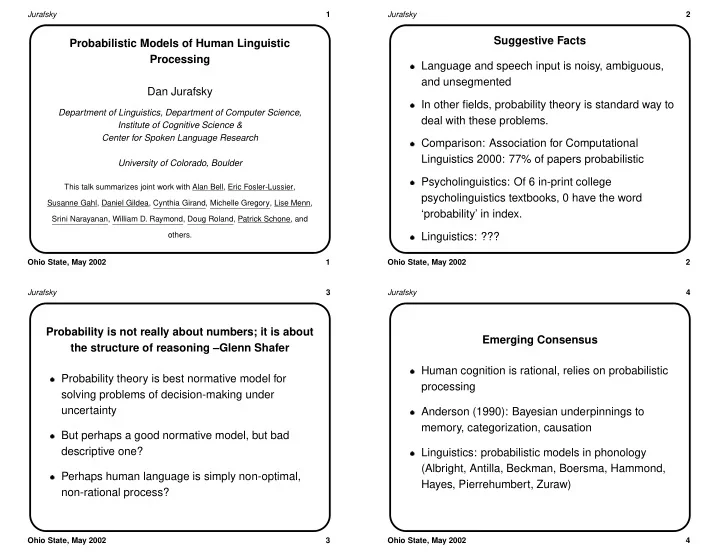
Jurafsky 1 Jurafsky 2 Suggestive Facts Probabilistic Models of Human Linguistic Processing Language and speech input is noisy, ambiguous, and unsegmented Dan Jurafsky In other fields,


slide-1
SLIDE 1

Jurafsky 1

Probabilistic Models of Human Linguistic Processing Dan Jurafsky

Department of Linguistics, Department of Computer Science, Institute of Cognitive Science & Center for Spoken Language Research University of Colorado, Boulder

This talk summarizes joint work with Alan Bell, Eric Fosler-Lussier, Susanne Gahl, Daniel Gildea, Cynthia Girand, Michelle Gregory, Lise Menn, Srini Narayanan, William D. Raymond, Doug Roland, Patrick Schone, and

  • thers.

Ohio State, May 2002 1 Jurafsky 2

Suggestive Facts

  • Language and speech input is noisy, ambiguous,

and unsegmented

  • In other fields, probability theory is standard way to

deal with these problems.

  • Comparison: Association for Computational

Linguistics 2000: 77% of papers probabilistic

  • Psycholinguistics: Of 6 in-print college

psycholinguistics textbooks, 0 have the word ‘probability’ in index.

  • Linguistics: ???

Ohio State, May 2002 2 Jurafsky 3

Probability is not really about numbers; it is about the structure of reasoning –Glenn Shafer

  • Probability theory is best normative model for

solving problems of decision-making under uncertainty

  • But perhaps a good normative model, but bad

descriptive one?

  • Perhaps human language is simply non-optimal,

non-rational process?

Ohio State, May 2002 3 Jurafsky 4

Emerging Consensus

  • Human cognition is rational, relies on probabilistic

processing

  • Anderson (1990): Bayesian underpinnings to

memory, categorization, causation

  • Linguistics: probabilistic models in phonology

(Albright, Antilla, Beckman, Boersma, Hammond, Hayes, Pierrehumbert, Zuraw)

Ohio State, May 2002 4

slide-2
SLIDE 2

Jurafsky 5

What Probability is not (necessarily)

  • Fodoristicly modular or non-modular (both kinds of

probabilistic models exist)

  • Symbolic or Connectionist (both kinds of

probabilistic models exist)

  • Committed to Early or Late use of information

(probabilities can be independent of time course)

Ohio State, May 2002 5 Jurafsky 6

So what are implications of probabilistic model?

  • Comprehension: More probable linguistic

structures are accessed with less time, effort, evidence, preferred in disambiguation, cause less processing difficulty.

  • Production: More probable structures are

accessed faster and preferred in production choice.

  • Learning: The probabilities of linguistic structures

in context play a role in grammar/lexical learning.

Ohio State, May 2002 6 Jurafsky 7

Outline of Talk

  • I: Comprehension
  • II: Production
  • III: Challenges to the Probabilistic Model
  • IV: Learning

Ohio State, May 2002 7 Jurafsky 8

Part I: Comprehension Bayesian Model of Comprehension P

  • interpretation

evidence

✂ ✄

P

  • evidence

int.

P

  • int.

P

  • evidence

(1)

Ohio State, May 2002 8

slide-3
SLIDE 3

Jurafsky 9

Lexical Frequency in Comprehension

V Howes and Solomon (1951): tachistoscopic presentation of iteratively longer duration; HF words recognized with less presentation. V Forster and Chambers (1973): HF word named more rapidly. V Rubenstein et al (1970): LD faster to HF words. V Howes (1957): Words masked by additive noise. High-frequency words identified better. A Savin (1963): recognition errors biased toward words higher in frequency than presented words. A Grosjean (1980) gating, HF words recognized earlier A Replicated crosslinguistically, for example Tyler (1984) in Dutch. Many other methods, including fixation, gaze duration, recall.

Ohio State, May 2002 9 Jurafsky 10

Frequency of Syn/Sem Category in Comprehension

  • Simpson and Burgess (1985): HF sense of homograph prime

causes faster reponse latencies to related target than LF sense.

  • Gibson (1991) Low frequency syncats cause garden path:

(2) The old man the boats. (man/N

man/V)

  • Jurafsky (1992,1996): Not just ranking; frequencies can

combine: (3) The complex houses married and single students and their

  • families. (complex/A

complex/N and house/N

house/V) (4) The building houses married and single students and their

  • families. (better)
  • house

Noun 391 Verb 8 complex Adjective 60 Noun 30

Ohio State, May 2002 10 Jurafsky 11

Constructional Frequencies in Comprehension

  • Relative rarity of reduced relative clauses could play role in their

difficulty.

  • Tabossi et al. (1994) showed reduced relatives are rare (8% of
  • ed forms occur in reduced relatives)
  • Jurafsky (1996), McRae et al. (1998), Narayanan and Jurafsky

(1998), among others showed that MC versus RR frequencies help predict reading time difficulties in MC/RR sentences.

  • Jurafsky (1996): SCFG probability for MC lower than RR:
  • 1. RR construction includes one more SCFG rule
  • 2. This SCFG rule for RR has very low probability.

Ohio State, May 2002 11 Jurafsky 12

Syntactic Subcategorization Frequencies

  • Fodor (1978), Ford et al. (1982), Clifton, Jr. et al.

(1984), Tanenhaus et al. (1985)

(5) The doctor remembered [NP the idea]. (6) The doctor remembered [S that the idea had already been proposed]. (7) The doctor suspected [NP the idea]. (8) The doctor suspected [NP that the idea would turn out not to work].

  • Trueswell et al. (1993): cross-modal naming latency

to noun him longer after S-bias verbs (The old man suspected...him) than after NP-bias verbs (The old man remembered...him).

Ohio State, May 2002 12

slide-4
SLIDE 4

Jurafsky 13

Summary: Converging Evidence for a Probabilistic Model of Comprehension

  • Lexeme frequencies (Tyler 1984; Salasoo and Pisoni 1985; inter alia
  • Lemma frequencies (Hogaboam and Perfetti 1975; Ahrens 1998;
  • Idiom frequencies (d’Arcais 1993)
  • Phonological probabilities Pierrehumbert 1994, Hay, Pierrehumbert and

Beckman (in press), Pitt and McQueen (1998)

  • Word transition probabilities MaDonald (1993), Bod (2001), McDonald,

Shillock and Brew (2001)

  • Lexical category frequencies (MacDonald 1993, Jurafsky 1996)
  • Constructional frequencies (Croft 1995; Mitchell et al. 1995; Jurafsky 1996)
  • Subcategorization probabilities Ford, Bresnan, Kaplan (1982);Clifton et al.

(1984)l Trueswell et al. (1993); Jurafsky (1996)

  • Thematic role probabilities (Trueswell et al. 1994; Garnsey et al. 1997,

McRae et al. (1998))

Ohio State, May 2002 13 Jurafsky 14

Jurafsky (1996) early model: Syntactic probabilities

  • Build multiple interpretations of input in parallel
  • Rank interpretations by their probabilities
  • Probabilities computed from:

– Stochastic context-free grammar probabilitty – Subcategorization probability of predicates

  • Limited memory causes low-probability interpretations to be

pruned.

  • Accounts for various types of garden-path effects (MV/RR,

lexical category)

  • Minus: only makes very broad reading-time predictions, only

tested on handful of examples, only handles syntactic garden-paths

Ohio State, May 2002 14 Jurafsky 15

More Sophisticated Model: Bayesian belief networks including semantics

  • Narayanan and Jurafsky (1998): Bayesian belief

network model of sentence processing

  • Model of what probability to assign to a particular

belief, how probability is updated on-line in light of new evidence.

  • Why Bayes net? Allows representation of structured

linguistic knowledge: SCFG probabilities with subcat, thematic, other lexical probabilities (potentially discourse, prosodic)

Ohio State, May 2002 15 Jurafsky 16

VP S -> NP [ V.. Sem_fit NP VP V S S -> NP ...

RR MV

NP NP VP DET N V N DET AND AND

RR MV syn syn MV RR thm thm

Arg Tense type_of(Subj) V SYNTACTIC LEXICAL/THEMATIC

  • Predicts reading time increase whenever best

interpretation is pruned

  • Models McRae et al. (1998) results on reading time

with MV/RR ambiguities.

Ohio State, May 2002 16

slide-5
SLIDE 5

Jurafsky 17

Most Recent Model: More fine-grained predictions

Narayanan and Jurafsky (2001), (2002)

  • Reaction time

– RT ∝

1 P

  • input

context

– RT increases due to limited memory/attention

Beam search

Swap between best and other interpretations

  • Preference

– Rank of interpretation ∝ P

  • interpretation

Ohio State, May 2002 17 Jurafsky 18

Part I: Comprehension: Conclusion

  • Language comprehension is probabilistic
  • Bayesian evidence-combination is one possible

model

  • Key open problem: building probabilistic models of

linguistic knowledge.

Ohio State, May 2002 18 Jurafsky 19

Part II: Probability and Production Hypothesis: Speakers compute probability of linguistic structure in production as well!

Ohio State, May 2002 19 Jurafsky 20

Previous Research: Frequency, predictability, and lexical production

  • More frequent words more likely to have schwa

vowels (Fidelholz 1975)

  • More ‘predictable’ words are shorter (Lieberman

1963; Jespersen 1923)

  • High-frequency collocations are more likely to have

internal lenition (Bush 1999; Bybee 1995/2000)

  • Methodological Conclusion: word duration reflects

probabilistic effects in production.

Ohio State, May 2002 20

slide-6
SLIDE 6

Jurafsky 21

The Probabilistic Reduction Hypothesis

Jurafsky, Bell, Gregory, and Raymond (2000) The higher the probability of a word, the more it is reduced/shortened/lenited in lexical production. Explains:

  • Phrase-frequency effect in word reduction (Bybee 1996, Krug 1998,

Bush 1999)

  • Word-repetition effect on word reduction (Fowler and Housum 1987)
  • Unpredictable words should be unreduced or longer (Lieberman

1963, Bolinger 1981, Jespersen 1922)

  • Frequency effect in word reduction (Fidelholz, Hooper)
  • Predicts: any factor that increases probability of word also

increases phonological reduction.

Ohio State, May 2002 21 Jurafsky 22

3 experiments on types of probability

Jurafsky et al. (1998),Gregory et al. (1999); Jurafsky et al. (2001); Bell et al. (2002)

  • 1. Word frequency
  • 2. Probabilistic relations between words
  • 3. Lemma (word sense) frequency

Ohio State, May 2002 22 Jurafsky 23

Local Probability Jurafsky et al. (1998); Bell et al. (1999); Gregory et al. (1999); Jurafsky et al. (2001) Relative Frequency (Prior Probability): P

  • wi
✂ ✄

Count

  • wi

∑ j Count

  • w j
✂ ✄

Count

  • wi

Total (9) Conditional Probability (Transitional Probability) P

  • wi

wi

  • 1
✂ ✄

C

  • wi
  • 1wi

C

  • wi
  • 1

(10) Conditional Probability from Next Word P

  • wi

wi

1

✂ ✄

C

  • wiwi

1

C

  • wi

1

(11)

Ohio State, May 2002 23 Jurafsky 24

Examples of highly predictable and unpredictable words

Highest Probability Lowest Probability Given Previous Word Given Previous Word P

wi

wi

1

P

wi

wi

1

rid of you’re to supposed to have of tends to at to

  • ught to

was of kind of done of able to well to sort of because to compared to feel to

Ohio State, May 2002 24

slide-7
SLIDE 7

Jurafsky 25

The Corpora

  • Switchboard corpus of 2430 American English (1991) telephone

conversations

  • 3.5 hours (38K words) phonetically labeled (Greenberg et al.

1996)

  • Two Datasets:

– function words: 5618 tokens of 10 most frequent English function word in Switchboard I, and, the, that, a, you, to, of, it , and in (of

  • 9000 total)

– content words: 2042 tokens of words ending in (underlying) t or d (of

  • 3000 total)
  • We coded multiple measures of reduction/lenition/shortening:

– duration in milliseconds – (for function words only): vowel reduction: full or reduced – (for content words only): deletion of final t/d

Ohio State, May 2002 25 Jurafsky 26

But wait!!! We can’t just look at raw durations of words!!!

  • words tend to be longer in the context of

disfluencies (pauses, repetitions)

  • length and reduction are sensitive to identity

neighboring phonemes

  • accent/stress affect word length/reduction
  • words are longer at phrase/turn/clause boundaries
  • words are shorter if speaker is speaking faster!
  • plus many other factors!!!!

Ohio State, May 2002 26 Jurafsky 27

Example of a confound: Words near disfluencies are longer

Bell, Jurafsky, Fosler-Lussier, Girand, Gildea, Gregory (2001)

Duration

109 ms Length in ms

Vowel Reduction

% vowel reduced % vowel reduced

Coda Deletion

22% 46% 61% 67% p < .0001 p < .0001 p < .0001 189 ms T r

  • u

b l e C

  • n

t e x t N

  • n

− T r

  • u

b l e C

  • n

t e x t T r

  • u

b l e C

  • n

t e x t N

  • n

− T r

  • u

b l e C

  • n

t e x t T r

  • u

b l e C

  • n

t e x t N

  • n

− T r

  • u

b l e C

  • n

t e x t

Ohio State, May 2002 27 Jurafsky 28

Methodology

  • Test if factor causes reduction by running regression
  • First we excluded word tokens based on

– phrase boundary positions (Keating and Fougeron) – special forms (cliticized you’ve), an) – polysyllables (for duration results, only used monosyllables) – accent (for one experiment)

  • We then control for ‘base model’:

– rate of speech (syl/sec) – planning problem (preceding or following disfluency) (Tree and Clark 1997;Jurafsky et al. 1998;Bell et al. 1999) – preceding and following segments (C or V, clusters) (Guy 1980, etc) – syllable type (open or closed) (e.g. it vs. a) – reduction of following vowel – (for content words) inflectional status (Fasold 1972, Labov 1972, Bybee 2000) (t more likely deleted in mist than missed) – (for content words) Identity of underlying segment (t or d) – Number of syllables (for (content word) deletion) – Number of phones (for content word) Ohio State, May 2002 28

slide-8
SLIDE 8

Jurafsky 29

Results: More frequent words are shorter

Gregory et al. (1999); article in progress

  • Word frequency plays a significant role in

t/d-deletion and duration.

  • Highest frequency words are 22% shorter than

lowest frequency words. (p

0001)

  • Highest frequency words are 11 times more likely to

have t/d-deletion than lowest frequency words.

Ohio State, May 2002 29 Jurafsky 30

Results: Predictable (from left) function words are shorter and more reduced

Jurafsky et al. (2001), Jurafsky, Bell, Fosler-Lussier, Girand, Gildea, Gregory (2001)

High Predictability Low Predictability

Duration

90 ms 109 ms

Length in ms

High Predictability Low Predictability

Vowel Reduction

% vowel reduced

57% 28%

Ohio State, May 2002 30 Jurafsky 31

Results: Predictable (from right) function words are shorter and more reduced

Jurafsky et al. (2001), Jurafsky, Bell, Fosler-Lussier, Girand, Gildea, Gregory (2001)

High Predictability Low Predictability

Duration

Length in ms

86 ms 116 ms High Predictability Low Predictability

Vowel Reduction

% vowel reduced

57% 27%

Ohio State, May 2002 31 Jurafsky 32

Role of Lemma Frequency

Jurafsky, Bell and Girand (2002, to appear) (Labphon-7)

  • Does the frequency of word sense (lemma) play a role in

production?

  • Evidence for word sense frequency in comprehension

Hogaboam and Perfetti (1975); Li and Yip (1996); Ahrens (1998)

  • Initial evidence for role for word sense in production (Berkenfield

2000 on that, Veilleux and Shattuck-Hufnagel (p.c.) on to)

  • Initial evidence against word sense frequency in production

(Jescheniak and Levelt 1994).

  • Our results: no effect of lemma frequency on reduction after

controlling for probability

Ohio State, May 2002 32

slide-9
SLIDE 9

Jurafsky 33

Summary from Part II: Lexical Production

  • More frequent words are reduced
  • Words which are predictable from neighboring words are

reduced.

  • Possible asymmetry (Bill Raymond’s (2001) and ongoing work)
  • The locus of frequency effects seems to be the lexeme rather

than the lemma.

  • Implications:

– Representation: Mental grammar stores word-to-word predictability. – Processing: Speakers are computing probability of words given context. – Speech synthesis: Better models of function word synthesis

Ohio State, May 2002 33 Jurafsky 34

Shattuck-Hufnagel’s question: locus of probability effects?

Michelle Gregory’s Dissertation (Gregory 2001)

  • Where in production process do reduction effects happen

(phonetic or phonological)?

  • Does probability have similar effect on pitch accent placement?

– 8757 switchboard words had been coded for pitch accent – Taylor TILT, Shattuck-Hufnagel POSH (variant of ETOBI (Beckman and Ayers 1997)) – Do frequency and conditional probability predict pitch accent?

Ohio State, May 2002 34 Jurafsky 35

Michelle’s Experiment

  • Use regression to control for factors

– Surrounding disfluencies – Rate of speech – Number of phones – Surrounding phrase break – POS (N, V, A, function)

  • Results

– Frequent words are 25% less likely to have accent than infrequent words. – High Prob words are 25% less likely to have accent than infrequent words.

Ohio State, May 2002 35 Jurafsky 36

Unsolved issue: what is cause of predictability effect?

Michelle Gregory’s Dissertation (Gregory 2001)

  • 1. What is the locus of the predictability effect?
  • Predictability is known to affect both word duration and also

likelihood of pitch accents.

  • Are these the same phenomenon or different ones?
  • 2. What is the cause of the predictability effect?
  • Speaker is modeling what the hearer can ”figure out”

(Jespersen 1923)?

  • Lexical priming for speaker? (Bard et al. 1999, Horton and

Keysar 1996)

  • Both?

Ohio State, May 2002 36

slide-10
SLIDE 10

Jurafsky 37

Previous Work Inconclusive

  • Fowler and Housum (1987): Words get shorter

every time they are repeated

  • Fowler suggests that speakers are modeling hearer

knowledge

  • Bard et al (2000), Brown and Dell, Horton and

Keysar 1996 suggests not

Ohio State, May 2002 37 Jurafsky 38

Michelle’s Experiment

  • A redesign of a cute idea due originally to Ellen Bard
  • Initial condition: Speaker tells a story to hearer 1
  • Followed by one of two conditions:

– A: Speaker now tells story to hearer 2 – B: Speaker retells story to hearer 1 again

  • Michelle found that condition B is shorter than condition A
  • Thus speakers shorten the words more if the hearer has heard

them before

  • Thus speakers do use model of hearer knowledge in articulation.

Ohio State, May 2002 38 Jurafsky 39

Part III: Potential Challenges to Probabilistic Models

Ohio State, May 2002 39 Jurafsky 40

Challenge 1: Surely you don’t believe that people compute little symbolic Bayes equations in their heads?

Ohio State, May 2002 40

slide-11
SLIDE 11

Jurafsky 41

No, I don’t

  • Probability theory is at Marr’s ‘computational level’
  • Characterizes one aspect (‘evidence combination’) of the

input-output properties of the computations that the mind must somehow be doing.

  • How could this be realized at lower levels?

– Most common assumption: activation level of some mental structure or a distributed pattern of activation. – Prior probabilities encoded as resting activation levels, or as weights on connections. – But also other possible realizations, such as exemplar models of phonology of Pierrehumbert (2001b) and others.

Ohio State, May 2002 41 Jurafsky 42

Challenge 2: Subcategorization frequency from corpora doesn’t match psychological experiments

  • Subcategorization counts for individual verbs
  • Counts from Sentence production/completion and

corpora are correlated (Merlo 1994, Lapata et al. 2001)

  • But correlation not that high: Merlo (1994):

NP S Trueswell vs. Garnsey r = .935 r = .916 Trueswell vs. Corpus r = .739 r = .444 Garnsey vs. Corpus r = .727 r = .585

Ohio State, May 2002 42 Jurafsky 43

2 major causes of differences in subcategorization frequencies

Roland and Jurafsky 1998, 2000, Roland et al. 2001, Roland 2001

  • Context-based Variation: ‘Isolated sentences’

differ from ‘connected discourse’

– Null complementation in connected discourse – Passives in connected discourse – Full NPs in isolated sentences

  • Word-sense Variation: Different lemmas have

different subcategorization probabilities – Controlling for word sense seems to eliminate subcategorization differences between corpora

Ohio State, May 2002 43 Jurafsky 44

Moral: True Probabilistic Model is not just Raw Frequency Doug Roland’s Dissertation (2001)

  • Corpus observations produced by true probability

model

  • p(subcat

verb, verb sense, subject, object, previous sentence, conversation topic, speaker’s model of hearer, ...)

  • If the conditioning events are different, the

probability will be different

  • In practice: can bin, remove outliers, etc (as in using

Brown numbers for comprehension experiments)

Ohio State, May 2002 44

slide-12
SLIDE 12

Jurafsky 45

Challenge 3: Maybe frequency is just an epiphenomenon Production of unaccusative verbs in English

  • Unergatives

NP [VP V]

external argument, no internal

Unaccusatives [VP V NP/CP]

internal argument, no external

  • bloom, melt, blush, etc
  • Kegl (1995): unaccusatives are hard for

agrammatic aphasics

– Production study of ‘agrammatic’ aphasic subject vs. control – Production showed significant absence of unaccusatives – Explanation: unaccusatives are like passives in involving traces – Agrammatic aphasics have difficulty with traces

Ohio State, May 2002 45 Jurafsky 46

Alternative: Lexical subcategorization frequency

Susanne Gahl, Lise Menn, Gail Ramsberger, Dan Jurafsky, Beth Elder, Molly Rewega, Audrey L. Holland (2001), drawing from Menn et al 1998, Gahl 2000

  • Hypothesis: comprehension difficulty should vary with

subcategorization frequency bias of word

  • Methodology: plausibility judgments in comprehension
  • Sentences were transitive or intransitive, hence matching or not

matching verb biases.

  • Prediction: sentences should be easier if structure matches verb

bias.

  • Prediction: no reason to expect unaccusatives to act like

passives

  • 8 subjects in Tucson and Boulder, including 3 Broca’s, 3

conduction, 2 anomics

Ohio State, May 2002 46 Jurafsky 47

Preliminary results from Gahl et al (2001) study

  • Unaccusatives as a whole are much easier than passives

(p

00001)

  • Unaccusatives as a whole are not harder than unergatives

(p

✂ ✁

691, n.s.)

  • Sentences are easier when structures match subcat frequency

bias of verb (p

001)

  • Thus Kegl’s subject’s difficulties with unaccusatives probably not

due to traces

Ohio State, May 2002 47 Jurafsky 48

Challenge 3b: Maybe frequency is just an epiphenomenon (II) Stevenson and Merlo (1997) on comprehension in normals: Unergatives are hard in reduced relatives:

The students advanced to the next grade had to study very hard. The clipper sailed to Portugal carried a crew of eight. The ship glided past the harbor guards was laden with treasure.

Unaccusatives are easier:

The witch melted in the Wizard of Oz was played by a famous actress. The oil poured across the road made driving treacherous.

Ohio State, May 2002 48

slide-13
SLIDE 13

Jurafsky 49

Stevenson and Merlo Explanation

  • An extension of Hale and Keyser (1993)
  • Verbs project their phrasal syntax in the lexicon
  • Causativized (transitive) forms of unergatives are

more complex than causativized (transitive) forms

  • f unaccusative verbs.
  • More complex in terms of number of nodes and

number of binding relations

  • Stevenson (1994) parser cannot activate structure

needed to parse transitivized unergatives because

  • f limitations on creating and binding empty nodes.

Ohio State, May 2002 49 Jurafsky 50

Alternative: Frequency Explanation for Unaccusative-Unergative Difference

Stevenson and Merlo 1997, 1998, Gahl 1998, Gahl and Jurafsky 2000

Transitive Intransitive Unergative 2869 13% 19194 87% Unaccusative 17352 54% 14817 46% Unergatives (like race) have a huge bias toward intransitive. Frequency account also explains gradient effects (some unergatives easier than others) (Filip, Tanenhaus, Carlson, Allopenna, Blatt 2001)

Ohio State, May 2002 50 Jurafsky 51

Part IV: Probability, Statistics, and Language Learning Fundamental Problem of Learning Theory: How to combine empirical knowledge (experience in the world) with rational knowledge (pre-existing learning biases)

  • Purely nativist approaches: Parameter Setting
  • Purely empirical approaches: Error

Back-Propagation, Instance-Based Generalization, Minimum Description Length

  • Our focus: learning biases plus statistical induction

Ohio State, May 2002 51 Jurafsky 52

Nature + Nurture: Representing ‘Learning Bias’

  • Minimum Description Length (Brent and Cartright

1996, deMarcken 1997, Stolcke 1994, Stabler 2001)

  • Word Learning Biases (Woodward and Markman

1991)

  • Vector Space Assumptions (Landauer and

Dumais 1997, Li, Burgess, and Lund 1998)

  • Faithfulness Gildea and Jurafsky (1996)
  • Non-linguistic Biases (Visual System: Regier

1996)

Ohio State, May 2002 52

slide-14
SLIDE 14

Jurafsky 53

Faithfulness Bias in Phonological Rule Induction

Gildea and Jurafsky (1996)

  • Idea: machine learning to induce flapping rule from I/O pairs
  • Two-level phonology: SPE rules (or OT rules) are equivalent to

finite-state automata

  • Using the OSTIA Automata-Induction Algorithm (Oncina93)
  • Given 50,000 examples of flapping:

latter: l ´ ae t axr

  • l ´

ae D axr

1 2 3 4 5 6 7 8 9 10 11 12 13 14 15 16 17 18 19 20 21 22 23 24 25 26 27 28 29 30 31 32 33 34 35 36 37 38 39 40 41 42 43 44 45 46 47 48 49 50 51 52 53 54 55 56 57 58 59 60 61 62 63 64 65 66 67 68 69 70 71 72 73 74 75 76 77 78 79 80 81 82 83 84 85 86 87 88 89 90 91 92 93 94 95 96 97 98 99 100 101 102 103 104 105 106 107 108 109 110 111 112 113 114 115 116 117 118 119 120 121 122 123 124 125 126 127 128 129 130 131 132 133 134 135 136 137 138 139 140

  • Failed to learn even the simple flapping rule

Ohio State, May 2002 53 Jurafsky 54

After adding Faithfulness Bias Told the system that, ceteris paribus, assume input and

  • utput are similar

2 1

V C r C t V V t : 0 V r V V : t C : t C : t # : t r r V : V dx

Induced rule: t

D / ´ V r

V

Ohio State, May 2002 54 Jurafsky 55

Inducing simple morphological structure Pat Schone’s dissertation (Schone 2001)

  • How does a system (or human) learn that -ed or
  • ing are suffixes?
  • Current models: based on one of two probabilistic

approaches: MDL and transition probability

Ohio State, May 2002 55 Jurafsky 56

Probabilistic Models of Word Segmentation

Saffran et al. (1996b); Saffran et al. (1996a)

  • 8-month-old infants exposed to synthesized speech from

artificial language

  • Only cues to word boundaries: transition probability between

syllables

  • Probability was higher within words (1.0) than between words

(0.33).

  • Test items included words and concatenated part-words
  • Infants reliably able to distinguish words from non-word

sequences which had both occurred in training.

Ohio State, May 2002 56

slide-15
SLIDE 15

Jurafsky 57

Minimum-Description-Length (MDL) models of morphological segmentation Brent et al. (1995), Goldsmith (2000)

  • Split input into words and affixes with shortest

resulting grammar:

  • 1. talk, walk, wipe, -s, -ed
  • 2. talk, talks, talked, walk, walks, walked, wipe,

wipes, wiped

  • Algorithm: try every possible split
  • Search strategy: focus on regions of low trans prob

Ohio State, May 2002 57 Jurafsky 58

Corpus-based induction of morphology: Semantics

Schone and Jurafsky (2000), Schone and Jurafsky (2001), Schone (2001)

  • MDL uses no semantics: thinks ally is all+y, doesn’t see

relationship between dirty and dirty

  • Solution: Add semantic knowledge, but not innate semantic

knowledge: induced empiricist semantics.

  • First find a metric for word semantic similarity
  • Then split input only if stem and stem+affix are semantically

close

Ohio State, May 2002 58 Jurafsky 59

Induction of Lexical Semantics

Latent Semantic Analysis (LSA), Hyperspace Analog to Language (HAL) Landauer and Dumais (1997); Lund et al. (1995)

  • Create a matrix from a large body of text
  • One row for each word type
  • One column for each passage
  • Each cell contains frequency that word occurred in passage.
  • Perform SVD on matrix, retaining only 100-300 high-order

dimensions

  • Result: a vector for each word:

break 0.135 0.000 0.000 0.000 0.006 0.098 0.004. . .

Ohio State, May 2002 59 Jurafsky 60

LSA modeling of Word Similarity

Landauer and Dumais (1997); Li et al. (1998)

  • Distance between words is cosine between vectors:
  • Words grouped by cosines:

break: break, spill, hit, fall, throw, hurt, pull, know, bang breakfast: breakfast, supper, lunch, dinner, dessert, juice duck: duck, cow, pig, bear, dog, doggie, horse, frog

  • Sentences grouped by combining cosines of words:

cos (”The radius of spheres.”, ”A circle’s diameter”) = .55 cos (”The radius of spheres.”, ”The music of spheres””) = .01.

Ohio State, May 2002 60

slide-16
SLIDE 16

Jurafsky 61

Pat’s application of LSA to Morphology Induction

  • LSA correctly identifies semantically-related pairs

Pairs Distance Pairs Distance car/cars 5.6 ally/allies 6.5 car/caring

  • 0.71

ally/all

  • 1.3

car/cares

  • 0.14

dirty/dirt 2.4 car/cared

  • 0.96

rating/rate 0.97

  • Significantly better at finding morphologically (suffix) related

words in CELEX (F-score): Algorithm English German Dutch Goldsmith 62.8 75.8 74.2 Schone+Jurafsky 88.1 92.3 85.8

Ohio State, May 2002 61 Jurafsky 62

Conclusion for Part IV: Probabilities and Learning

  • Statistical learning from corpora
  • Empiricist induction plus rationalist biases
  • Able to learn phonological rules, simple

concatenative morphology

  • Others have shown similar approaches to grammar

induction (Stolcke 1994, deMarcken 1997)

  • Open questions:

– Relation to phonological learning (Albright and Hayes; Beckman and Edwards; Boersma; Edwards, Beckman, Munson) – Relation to exemplar models (Pierrehumbert)

Ohio State, May 2002 62 Jurafsky 63

Conclusion

  • Probabilistic models offer a clean, motivated

solution to evidence combination, disambiguation, and choice.

  • Probability is not a replacement for structure, but an

augmentation

  • Key Future Work:

– Current work mainly in phonology (Albright, Antilla, Beckman, Boersma, Hammond, Hayes, Zuraw) and syntax (Manning). What about semantics, pragmatics? – Testing different probabilistic models against each other – Relationship between probabilities and activation-based algorithms

Ohio State, May 2002 63 Jurafsky 64

Other research Areas in my Lab

  • Speech Recognition and Understanding

– Pronunciation Modeling – Language Modeling – Dialog Modeling – Punctuation Detection

  • Computational Psycholinguistics

– Sentence Processing – Lexical Access in Production – Probabilistic Models of Human Language Processing

  • Computational Linguistics and Natural Language Processing:

– Semantic Parsing in English and Chinese – Verb-Argument Probabilities – Automatic Question Answering – Machine Learning of Natural Language – Computational Phonology

Ohio State, May 2002 64