Sum-of-Product Datatypes in SML and triangles so that we can do - - PowerPoint PPT Presentation

sum of product datatypes in sml
SMART_READER_LITE
LIVE PREVIEW

Sum-of-Product Datatypes in SML and triangles so that we can do - - PowerPoint PPT Presentation

Mo;va;ng example: geometric figures Suppose we want to represent geometric figures like circles, rectangles, Sum-of-Product Datatypes in SML and triangles so that we can do things like calculate their perimeters, scale them, etc. (Dont worry


slide-1
SLIDE 1

Sum-of-Product Datatypes in SML

CS251 Programming Languages

Fall 2017 Lyn Turbak

Department of Computer Science Wellesley College

Mo;va;ng example: geometric figures

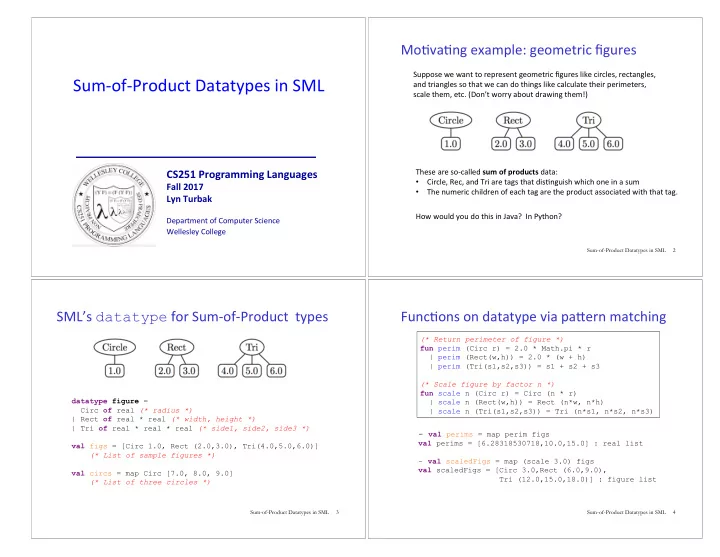
Suppose we want to represent geometric figures like circles, rectangles, and triangles so that we can do things like calculate their perimeters, scale them, etc. (Don’t worry about drawing them!) How would you do this in Java? In Python? These are so-called sum of products data:

  • Circle, Rec, and Tri are tags that dis;nguish which one in a sum
  • The numeric children of each tag are the product associated with that tag.

Sum-of-Product Datatypes in SML 2

SML’s datatype for Sum-of-Product types

datatype figure =

Circ of real (* radius *) | Rect of real * real (* width, height *) | Tri of real * real * real (* side1, side2, side3 *) val figs = [Circ 1.0, Rect (2.0,3.0), Tri(4.0,5.0,6.0)] (* List of sample figures *) val circs = map Circ [7.0, 8.0, 9.0] (* List of three circles *)

3 Sum-of-Product Datatypes in SML

Func;ons on datatype via paRern matching

(* Return perimeter of figure *)

fun perim (Circ r) = 2.0 * Math.pi * r | perim (Rect(w,h)) = 2.0 * (w + h) | perim (Tri(s1,s2,s3)) = s1 + s2 + s3 (* Scale figure by factor n *) fun scale n (Circ r) = Circ (n * r) | scale n (Rect(w,h)) = Rect (n*w, n*h) | scale n (Tri(s1,s2,s3)) = Tri (n*s1, n*s2, n*s3)

  • val perims = map perim figs

val perims = [6.28318530718,10.0,15.0] : real list

  • val scaledFigs = map (scale 3.0) figs

val scaledFigs = [Circ 3.0,Rect (6.0,9.0), Tri (12.0,15.0,18.0)] : figure list

4 Sum-of-Product Datatypes in SML

slide-2
SLIDE 2

Op;ons

datatype 'a option = NONE | SOME of 'a SML has a built-in option datatype defined as follows:

  • NONE

val it = NONE : 'a option

  • SOME 3;

val it = SOME 3 : int option

  • SOME true;

val it = SOME true : bool option

5 Sum-of-Product Datatypes in SML

Sample Use of Op;ons

  • fun into_100 n = if (n = 0) then NONE else SOME (100 div n);

val into_100 = fn : int -> int option

  • List.map into_100 [5, 3, 0, 10];

val it = [SOME 20,SOME 33,NONE,SOME 10] : int option list

  • fun addOptions (SOME x) (SOME y) = SOME (x + y)

= | addOptions (SOME x) NONE = NONE = | addOptions NONE (SOME y) = NONE = | addOptions NONE NONE = NONE; val addOptions = fn : int option -> int option -> int option

  • addOptions (into_100 5) (into_100 10);

val it = SOME 30 : int option

  • addOptions (into_100 5) (into_100 0);

val it = NONE: int option

6 Sum-of-Product Datatypes in SML

Op;ons and List.find

(* List.find : ('a -> bool) -> 'a list -> 'a option *)

  • List.find (fn y => (y mod 2) = 0) [5,8,4,1];

val it = SOME 8 : int option

  • List.find (fn z => z < 0) [5,8,4,1];

val it = NONE : int option

7 Sum-of-Product Datatypes in SML

Thinking about op;ons

What problem do op;ons solve? How is the problem solved in other languages?

8 Sum-of-Product Datatypes in SML

slide-3
SLIDE 3

Crea;ng our own list datatype

datatype 'a mylist = Nil | Cons of 'a * 'a mylist

val ints = Cons(1, Cons(2, Cons(3, Nil))) (* : int mylist *) val strings = Cons("foo", Cons ("bar", Cons ("baz", Nil))) (* : strings mylist *) fun myMap f Nil = Nil | myMap f (Cons(x,xs)) = Cons(f x, myMap f xs) (* : ('a -> 'b) -> 'a mylist -> 'b mylist *) val incNums = myMap (fn x => x + 1) ints (* val incNums= Cons (2,Cons (3,Cons (4,Nil))) : int mylistval *) val myStrings = myMap (fn s => "my " ^ s) strings (* val myStrings = Cons ("my foo", Cons ("my bar", Cons ("my baz",Nil))): string mylist *)

9 Sum-of-Product Datatypes in SML

Binary Trees

10 Sum-of-Product Datatypes in SML

SML bintree datatype for Binary Trees

datatype 'a bintree = Leaf | Node of 'a bintree * 'a * 'a bintree (* left subtree, value, right subtree *) val int_tree= Node(Node(Leaf,2,Leaf), 4, Node(Node(Leaf, 1, Node(Leaf, 5, Leaf)), 6, Node(Leaf, 3, Leaf)))

11 Sum-of-Product Datatypes in SML

bintree can have any type of element

val string_tree = Node(Node (Leaf,"like",Leaf), "green", Node (Node (Leaf,"and",Leaf), "eggs", Node (Leaf,"ham",Leaf)))

12 Sum-of-Product Datatypes in SML

slide-4
SLIDE 4

Coun;ng nodes in a binary tree

fun num_nodes Leaf = 0 | num_nodes (Node(l,v,r)) = 1 + (num_nodes l) + (num_nodes r)

  • num_nodes int_tree;

val it = 6 : int

  • num_nodes string_tree;

val it = 5 : int

13 Sum-of-Product Datatypes in SML

Your turn: height

(* val height = fn : 'a bintree -> int *) (* Returns the height of a binary tree. *) (* Note: Int.max returns the max of two ints *) fun height Leaf = 0 | height (Node(l,v,r)) = 1 + Int.max(height l, height r)

  • height int_tree;

val it = 4 : int

  • height string_tree;

val it = 3 : int

14 Sum-of-Product Datatypes in SML

Your turn: sum_nodes

(* val sum_nodes = fn : int bintree -> int *) (* Returns the sum of node values in binary tree of ints *) fun sum_nodes Leaf = 0 | sum_nodes (Node(l,v,r)) = (sum_nodes l) + v + (sum_nodes r)

  • sum_nodes int_tree;

val it = 21 : int

15 Sum-of-Product Datatypes in SML

Your turn: inlist

(* val inlist = fn : 'a bintree -> 'a list *) (* Returns a list of the node values in in-order *) fun inlist Leaf = [] | inlist (Node(l,v,r)) = (inlist l) @ [v] @ (inlist r)

  • inlist int_tree;

val it = [2,4,1,5,6,3] : int list

  • inlist string_tree;

val it = ["like","green","eggs","and","ham"] : string list

16 Sum-of-Product Datatypes in SML

This returns a list of elements as they are Encountered in an in-order traversal of a tree. We could also list them via a pre-order or post-order traversal.

slide-5
SLIDE 5

Your turn: map_tree

(* val map_tree = fn : ('a -> 'b) -> 'a bintree -> 'b bintree *) (* maps function over every node in a binary tree *) fun map_tree f Leaf = Leaf | map_tree f (Node(l,v,r)) = Node(map_tree f l, f v, map_tree f r)

  • map_tree (fn x => x*2) int_tree;

val it = Node (Node (Leaf,4,Leaf),8, Node (Node (Leaf,2,Node (Leaf,10,Leaf)),12, Node (Leaf,6,Leaf))) : int bintree

  • map_tree (fn s => String.sub(s,0)) string_tree;

val it = Node (Node (Leaf,#"l",Leaf),#"g", Node (Node (Leaf,#"e",Leaf),#"a", Node (Leaf,#"h",Leaf))) : char bintree 17 Sum-of-Product Datatypes in SML

Your turn: fold_tree

(* val fold_tree = fn : ('b * 'a * 'b -> 'b) -> 'b

  • > 'a bintree -> 'b *)

(* binary tree accumulation *) fun fold_tree comb leafval Leaf = leafval | fold_tree comb leafval (Node(l,v,r)) = comb(fold_tree comb leafval l, v, fold_tree comb leafval r)

  • fold_tree (fn (lsum,v,rsum) => lsum + v + rsum) 0 int_tree;

val it = 21 : int

  • fold_tree (fn (lstr,v,rstr) => lstr ^ v ^ rstr) " " string_tree;

val it = " like green eggs and ham " : string

18 Sum-of-Product Datatypes in SML

Binary Search Trees (BSTs) on integers

19 Sum-of-Product Datatypes in SML

You turn: Binary Search Tree inser;on

fun singleton v = Node(Leaf, v, Leaf) (* val insert: int bintree -> int -> int bintree *) fun insert x Leaf = singleton x | insert x (t as (Node(l,v,r))) = if x = v then t else if x < v then Node(insert x l, v, r) else Node(l, v, insert x r) fun listToTree xs = foldl (fn (x,t) => insert x t) Leaf xs

  • val test_bst = listToTree [4,2,3,6,1,7,5];

val test_bst = Node (Node (Node (Leaf,1,Leaf), 2, Node (Leaf,3,Leaf)), 4, Node (Node (Leaf,5,Leaf), 6, Node (Leaf,7,Leaf))) : int bintree

20 Sum-of-Product Datatypes in SML

slide-6
SLIDE 6

Your turn: Binary Search Tree membership

(val member: ''a -> ''a bintree -> bool *) fun member x Leaf = | member x (Node(l,v,r)) =

  • val test_member = map (fn i => (i, member i

test_bst)) [0,1,2,3,4,5,6,7,8]; val it = [(0,false),(1,true),(2,true),(3,true), (4,true),(5,true),(6,true),(7,true), (8,false)] : (int * bool) list

21 Sum-of-Product Datatypes in SML

Balanced Trees (PS7)

BSTs are not guaranteed to be balanced. But there are other tree data structures that do guarantee balance: AVL trees, Red/Black trees, 2-3 trees, 2-3-4 trees. In PS6 you will experiment with 2-3 trees.

22 Sum-of-Product Datatypes in SML