Summary Where have we come from? What do we currently have? - - PDF document

summary
SMART_READER_LITE
LIVE PREVIEW

Summary Where have we come from? What do we currently have? - - PDF document

Summary Where have we come from? What do we currently have? Discussion on choices of and Where could we be heading? advances in dental materials Where have we come from? Cohesive gold Pre 1960 Restorations 60 years old


slide-1
SLIDE 1

Discussion on choices of and advances in dental materials Summary

Where have we come from? What do we currently have? Where could we be heading?

Where have we come from?

  • Pre 1960

Gold Amalgam Zinc phosphate / Zinc oxide & Eugenol Bowen’s resin (BIS-GMA) 1955

  • 1960

Adhesion to enamel

  • 1980

Glass ionomer chemistry Composite bonding to enamel

  • 1990

Dentine bonding

  • 2000

No etch bonding and the rise of the posterior composite

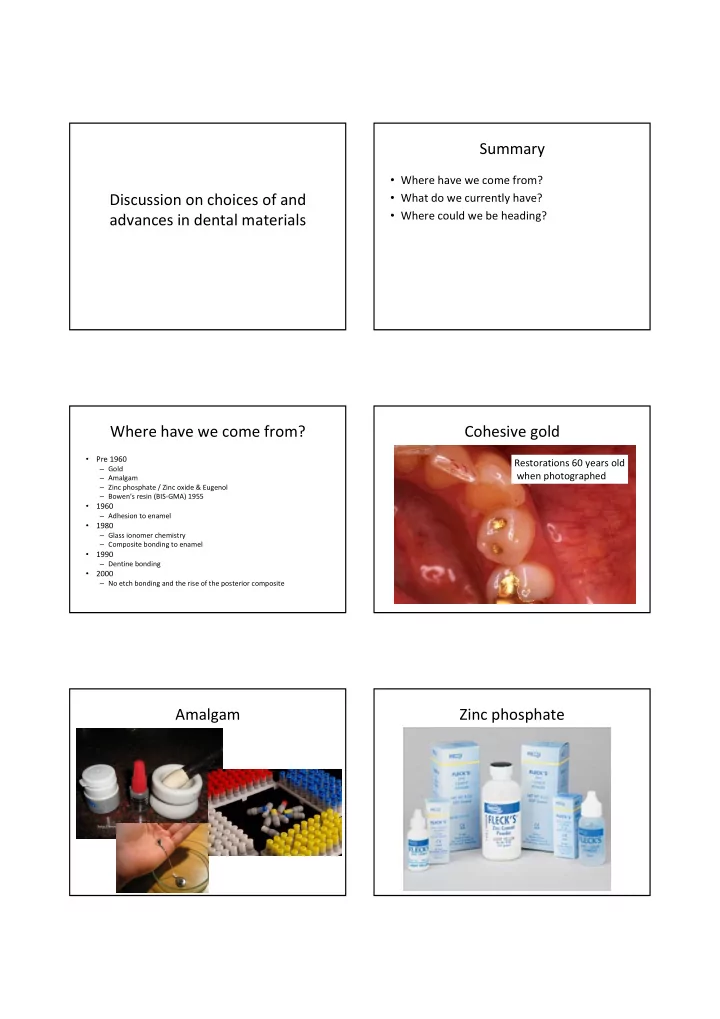
Cohesive gold

Restorations 60 years old when photographed

Amalgam Zinc phosphate

slide-2
SLIDE 2

Composite resin Composite resin Zinc cement - glass polyalkynoate spectrum Glass Ionomer Cement

Zinc

  • xide

Polyacrylic acid Alumino- slilcate glass Phosphoric acid Zinc phosphate Zinc phosphate cement cement Zinc polycarboxylate cement

Glass Glass ionomer ionomer cement cement

Silicate cement

What do we currently have? Amalgam

slide-3
SLIDE 3

Do teeth with amalgam have a high incidence of cuspal fracture?

No

1.5% in 600 teeth after 5 years 1.8% in 1400 teeth after 10 years 5% in 1213 teeth after 15 years

Bonded amalgams may fare even better

Whal Dental Update 2003;30:256-262

Do temperature changes in amalgam cause cusp fracture

No

Coefficient of thermal expansion of resin is greater than amalgam No prolonged contact with temperature extremes before swallowing Of greater importance is tooth preparation and parafunction

Do teeth with amalgam restorations have a higher rate of recurrent decay?

No

0% of 600 teeth at 5 years 1.1% of 1400 teeth at 10 years 0% of 35 teeth at 10 years <5% after 14 years (no nos.)

Do resin composite restorations usually last as long as amalgam restorations?

No 2001 study

12 yrs = median age 1827 failed amalgams 5 yrs = median age of 1548 failed composites

2000 study of 6761 teeth

median age of replaced amalgam = 10 yrs

  • and composite = 8 yrs

amalgam lasting longer than composite in C I, II III IV and V restorations

1998 study

median age of amalgam replacement = 15 yrs,

  • composite = 8 yrs

Aren’t bonded restorations preferable to amalgam restorations

Yes

Composite bonded to enamel and dentine creates a monoblock whereas amalgam may create a wedge Increasing numbers of dentists are bonding amalgam restorations Some evidence of good bond strength of amalgam to dentine

slide-4
SLIDE 4

Amalgam is over 100 years old – doesn’t that make it old fashioned?

No So is radiography, nitrous oxide, gold and rubber dam High copper formulations, factory measured components, pre-capsulated amalgam

Has amalgam been banned in Sweden and Germany?

No Amalgam use in the EU is governed by Medical Devices Directive 93/42/EEC. 1998 EU working group stated, “no scientific evidence of systemic health problems or toxic effects from dental amalgam.

Do amalgam restoration release a large amount of mercury?

No

It is estimated that a patient would have to have 2740 amalgam restorations to reach the threshold limit value of 82.20 microns per day considered dangerous for occupational exposure in the USA

Does mercury from amalgam restorations cause ill health?

No – except rare cases of allergy (Eg Lichenoid reaction)

  • Sandborgh-Englund G, Nygren AT, Ekstrand J, Elinder C-G. No evidence of renal toxicity

from amalgam fillings. Am J Physiol 1996; 271: R941–945.

  • Saxe SR, Wekstein MW, Kryscio RJ et al. Alzheimer’s disease, dental amalgam and
  • mercury. J Am Dent Assoc 1999; 130: 191–199.
  • Casetta I, Invernizzi M, Granieri E. Multiple sclerosis and dental amalgam: case-control

study in Ferrara, Italy. Neuroepidemiology 2001; 20: 134–137.

  • Rodvall Y, Ahlbom A, Pershagen G et al. Dental radiography after age 25 years, amalgam

fillings and tumours of the central nervous system. Oral Oncol 1998; 34: 265–269.

  • Lindberg NE, Linberg E, Larsson G. Psychologic factors in the etiology of amalgam illness.

Acta Odontol Scand 1994; 52: 219–228.

  • Björkman L, Pedersen NL, Lichtenstein P. Physical and mental health related to dental

amalgam fillings in Swedish twins. Community Dent Oral Epidemiol 1996; 24: 260–267

Lichenoid reaction Desquamative gingivitis

slide-5
SLIDE 5

Is there credible scientific literature that shows health problems due to mercury in dental amalgam?

No Independent analysis of data shows incorrect conclusions often drawn Data extrapolating snail cells to human clinical response Exposure to Hg levels x100 normal levels

Is mercury from dental amalgam dangerous to dental staff?

No

“the infants of dental workers actually had a lower perinatal death rate than the rest of the infants” (Ericson A, Källén

  • B. Pregnancy outcome in women working as dentists, dental assistants or dental technicians. Int

Arch Occup Environ Health 1989; 61: 329–333.)

“In a study of 21 634 male dentists and 21 202 dental assistants there was no difference in the rate of spontaneous abortions or congenital abnormalities” (Brodsky

JB, Cohen EN, Whitcher C et al. Occupational exposure to mercury in dentistry and pregnancy

  • utcome. J Am Dent Assoc 1985; 111: 779–780.)

Of 1706 dentists screened at a 1991ADA meeting, only 29 (2%) had high urinary mercury levels. These high levels were correlated to poor mercury hygiene (the use of squeeze cloths). (Echeverria D, Heyer NJ, Martin MD et al. Behavioral effects of low-level

exposure to Hg among dentists. Neurotoxicol Teratol 1995; 17: 161–168.)

Are the ingredients of resin composite non-toxic?

No The ingredients of resin composite have been shown to be

cytotoxic mutagenic To cause immunosuppresion or to inhibit DNA85 and RNA86 synthesis.

Wataha et al. stated,

‘the components of resin composites are hazardous in that they all cause significant toxicity in direct contact with fibroblasts.

Are the ingredients of resin composite non-toxic?

Composite restorations have been shown to leach between 14 and 22 separate potentially hazardous compounds, including

DLcamphorquinone, 4-dimethylaminobenzoic acid ethy ester (DMABEE), drometrizole, 1,7,7-trimethylbicyclo[2,2,1]heptane, 2,2- dimethoxy[1,2] diphenyletanone (DMBZ), ethyleneglycol dimethacrylate (EGDMA), and triethyleneglycoldimethacrylate (TEGDMA)

Does amalgam in waste water cause harmful environmental effects?

Probably not Most amalgam from dental surgeries captured by amalgam traps 3-4% of worldwide consumption of mercury is for dental purposes Estimated that 0.3% of amalgam waste is soluble

Is the death of amalgam imminent?

Not yet………

  • Sig. number of dentists still use amalgam

Many patients prefer tooth coloured restorations Such patients do not tend to have health concerns

  • ver amalgam
slide-6
SLIDE 6

Amalgam when

Strength Bulk Moisture control

“It may be prudent to consider ‘phasing down’ instead of ‘phasing out’ of dental amalgam at this

  • stage. A multi-pronged

approach should be

  • considered. Short-, medium-

and long-term strategies should be developed.”

2009 meeting published2010

  • 1. What is taught in UK dental schools

BDJ, 2010;209:129

Surveys

1989 – worldwide survey – 90% schools do NOT teach posterior composite 1998 – little change in American dental schools 1997 – paper, use of composite in load bearing posterior cavities should be, “‘limited to the occlusal surfaces of premolars, and preferably those with limited occlusal function”

Wilson N H F, Setcos J C. J Dent 1989; 17: S29 Mjör I, Wilson N H F.. J Am Dent Assoc 1998;129: 1415. Wilson N H F, Dunne S M, Gainsford I D. Int Dent J 1997; 47: 185.

Surveys

2004 – 2005. 30% of posterior restorations placed by dental students are composite

Lynch C D, McConnell R J, Wilson N H F. Eur J Dent Educ 2006; 10: 38-43. Lynch C D, McConnell R J, Wilson N H F. J Am Dent Assoc 2006; 137: 619-625. Lynch C D, McConnell R J, Wilson N H F. J Can Dent Assoc 2006; 72: 321. Lynch C D, McConnell R J, Wilson N H F. J Dent Educ 2007; 71: 430-434.

Guidelines

2007 , British Association of Teachers of Conservative Dentistry (BATCD) published a consensus document which recommended that

composite should be taught to dental students as the ‘material of choice’ when restoring posterior teeth, in particular when managing teeth with an initial lesion of caries
slide-7
SLIDE 7

Conclusions

2005 -2010 has seen great increase in use of posterior composite in dental schools Many schools now place more posterior composite than amalgam General Dental Practice surveys show more amalgams than posterior composites Some concern over teaching methods not considered best practice

Transparent matrices and transparent wedges Bevelling cavity margins

Types of Resin Composites

All contain

Resin

Susceptible to shrinkage upon polymerisation

May be modified methacrylate/acrylate OR a chemical that upon setting expands due to a ring

  • pening mechanism eg Oxirane

This expansion in resin volumes offsets to a degree the polymerisation shrinkage Still however a net shrinkage

Types of Resin Composites

All contain

Resin

Susceptible to shrinkage upon polymerisation

May be modified methacrylate/acrylate OR a chemical that upon setting expands due to a ring

  • pening mechanism eg Oxirane

This expansion in resin volumes offsets to a degree the polymerisation shrinkage Still however a net shrinkage

Filler

Type, concentration, particle size & particle size distribution control properties

Types of Resin Composites

Resin and Filler alone useless without effective coupling “The coupling agent transfers the stresses generated under loading from the rigid and brittle filler to the more flexible and ductile polymer matrix” Matrix may be regarded as a “shock absorber”

Types of Resin Composites

Classification

Method of Activation

Chemical/light

Types of Resin Composites

Classification

Method of Activation

Chemical/light

Filler particle size and distribution

slide-8
SLIDE 8

Types of Resin Composites

Conventional (1) 1 – 50 m 60 – 80 % by weight Microfilled (2) 0.01 – 0.1 m Mean = 0.04 m 30-60 % by weight Hybrid Blend of (1) & (2) (1) 75%, (2) 8 % Total 83 – 90 % by weight. Nanocomposites Uses particles less than 1 m diameter (really like (2))

Types of Resin Composites

Classification

Handling Characteristics

Packable

Highly viscous Presents packaging challenges to manufacturers

Flowable

More fluid Less filler

Types of Resin Composites

Classification

Intended clinical application

ISO 4049

Type 1 – restoration of cavities involving occlusal surfaces Type 2 – All other polymer based filling and restorative materials

Where could we be heading? Amalgam

Likely to be phased down then out Dictated by NHS SDR Informed by dental/therapy school teaching policies

Eg All direct occlusal restorations in composite

Advantages

Strength, colour and moisture tolerance

Composite

Will grow in popularity

Patient desire

Placement techniques will improve Shrinkage reduction will make for less post-

  • perative pain

Wider applications

Splinting Core build-up Occlusal rehabilitation

slide-9
SLIDE 9

And far ahead……..?

Restorations that inhibit caries and periodontal disease

Fluoride release CaPO4 release Slow release CHx

Restorations that indicate when they are failing

Colour change?