SUMTER COUNTY BOARD OF COMMISSIONERS EXECUTIVE SUMMARY SUBJECT: - - PDF document

sumter county board of commissioners executive summary
SMART_READER_LITE
LIVE PREVIEW

SUMTER COUNTY BOARD OF COMMISSIONERS EXECUTIVE SUMMARY SUBJECT: - - PDF document

SUMTER COUNTY BOARD OF COMMISSIONERS EXECUTIVE SUMMARY SUBJECT: Presentation of 2011 Growth Management Legislation REQUESTED ACTION: N/A Work Session (Report Only) DATE OF MEETING: 8/16/11 Regular Meeting Special Meeting CONTRACT: N/A


slide-1
SLIDE 1

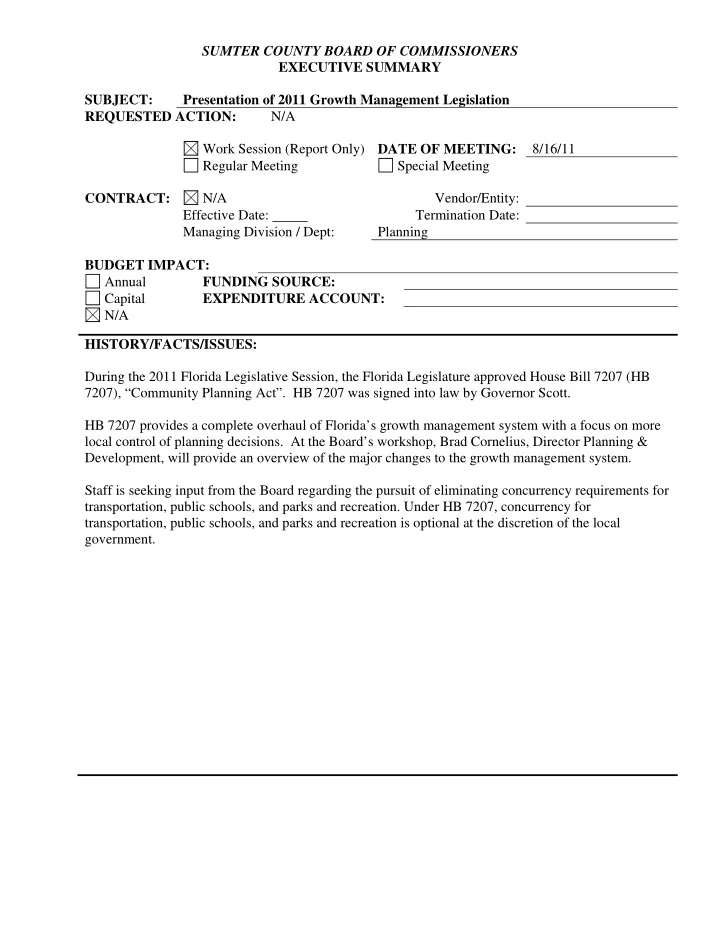
SUMTER COUNTY BOARD OF COMMISSIONERS EXECUTIVE SUMMARY SUBJECT: Presentation of 2011 Growth Management Legislation REQUESTED ACTION: N/A Work Session (Report Only) DATE OF MEETING: 8/16/11 Regular Meeting Special Meeting CONTRACT: N/A Vendor/Entity: Effective Date: Termination Date: Managing Division / Dept: Planning BUDGET IMPACT: Annual FUNDING SOURCE: Capital EXPENDITURE ACCOUNT: N/A HISTORY/FACTS/ISSUES: During the 2011 Florida Legislative Session, the Florida Legislature approved House Bill 7207 (HB 7207), “Community Planning Act”. HB 7207 was signed into law by Governor Scott. HB 7207 provides a complete overhaul of Florida’s growth management system with a focus on more local control of planning decisions. At the Board’s workshop, Brad Cornelius, Director Planning & Development, will provide an overview of the major changes to the growth management system. Staff is seeking input from the Board regarding the pursuit of eliminating concurrency requirements for transportation, public schools, and parks and recreation. Under HB 7207, concurrency for transportation, public schools, and parks and recreation is optional at the discretion of the local government.

slide-2
SLIDE 2

2011

Grow th Management Update

Sumter County BOCC Workshop August 16, 2011 Sumter County Planning & Development

slide-3
SLIDE 3

Major Legislative Changes

HB 7207 : The Community Planning Act

strengthens “the existing role, processes, and powers

  • f local governments

in the establishment and implementation of comprehensive planning programs to guide and manage future development consistent with the proper role of local government”

Laws of Florida, Chapter 2011-139

slide-4
SLIDE 4

From 1975 to 2011

  • 1975 – Recognition of need to plan.
  • 1985 – Mandatory planning – Strong State role and oversight of

local planning decisions.

  • 2011 – Mandatory planning - Shift from “What does DCA want?”

to “What does the local community want?”

  • Planning is still critical and required but from local perspective

and not State mandate.

slide-5
SLIDE 5

From DCA to DEO

  • The Florida Department of Community Affairs (DCA) is

eliminated.

  • Replaced with the Florida Department of Economic Opportunity

(DEO).

  • Focus of DEO, and other State review agencies, is on “State

Significant Resources”.

  • “State Significant Resources” – Still to be determined.

– Urban Sprawl – State/Federal Roads – Jurisdictional Wetland Systems and Waterways – Protected Wildlife Species and Habitats – Water Supply and Quality

slide-6
SLIDE 6

Deleted Items

  • State Comprehensive Plan (Chapter 187, F.S.) – Not used in

compliance determinations.

  • Energy Efficiency/Greenhouse Gas Requirements (HB 697).
  • Rule 9J-5, F.A.C. – Parts moved to Chapter 163, F.S.

– Compatibility/Suitability – Density/Intensity – Goals, Objectives, and Policies – Level of Service – Population Projections

slide-7
SLIDE 7

Development of Regional Impact (DRI) Changes

  • Automatic 4-year Extension to Build-Out Dates (Notify Local

Government by December 31, 2011).

– Villages extended build-out date from 2014 to 2018

  • Exempts

– Industrial – Movie Theater – Mining (Phosphate) – Hotel

  • Provides Greater Flexibility in Changes to Retail, Office, and

Attraction/Recreation DRIs.

  • Confirms DRI Exemptions from Previous Year Legislation.
slide-8
SLIDE 8

DRI Changes

  • Aggregation – Eliminates “Sharing of Infrastructure”.
  • Cannot Require DRI by Local Comprehensive Plan or State

Agency Agreement.

– Monarch Ranch DRI Requirement

slide-9
SLIDE 9

Evaluation & Appraisal Report (EAR)

  • The County is required to evaluate and update the Comprehensive

Plan at least every seven years.

  • The State no longer reviews the EAR and the EAR is not formally

adopted by local government.

  • Local government sends a letter to the State stating the results of

the EAR and our intent to update the Comprehensive Plan within 12 months of the letter.

  • Next EAR is due September 2012 – It’s only a letter!
slide-10
SLIDE 10

Comprehensive Plan Elements

No Change to Required Elements Except Public Schools – Now Optional Required Elements

  • Capital Improvements - Schedule of Capital Improvements
  • Future Land Use – Future Land Use Map
  • Transportation
  • Utilities
  • Conservation – Water Supply Plan
  • Recreation and Open Space
  • Housing
  • Intergovernmental Coordination

Optional Elements

  • Economic Development
  • Public Safety
  • Public Schools
slide-11
SLIDE 11

Future Land Use

  • Amount of land in each land use category must allow

adequate choices for residents and businesses – not limited by projected population.

  • Bureau of Economic and Business Research Medium

Population Projections are Minimum not Maximum.

  • New urban sprawl test for future land use amendments.
  • Meet 4 of 8 requirements.
  • County’s and cities’ adoption of the ISBA/JPAs will

facilitate compliance.

slide-12
SLIDE 12

Concurrency

  • Concurrency – Assure public facilities are available to meet

the demands of new development.

  • Significant change in 1985 concurrency mandate.
  • Concurrency still required:

– Potable Water and Sanitary Sewer. – Stormwater. – Solid Waste.

  • Concurrency optional at discretion of local government:

– Transportation. – Public Schools. – Parks and Recreation.

  • Elimination of concurrency requires Comprehensive Plan

amendment but not subject to State review.

slide-13
SLIDE 13

Transportation Concurrency

  • Unintended Consequences

– Discourage development within urban/built-up areas. – Complex, difficult, and expensive. – Focus on automobile – not creative.

  • Limited transportation level of service deficiencies.

– Primarily State roads. – Artificial level of service standards. – Coordination with developers. – Strong coordination with Lake-Sumter MPO and FDOT. – Impact fees.

slide-14
SLIDE 14

Transportation Concurrency

  • Recommend to eliminate transportation concurrency.

– Maintain congestion management system with Lake-Sumter MPO to identify, plan, and prioritize road capacity needs. – Maintain requirements for improvements to sub-standard roads and site access/operational improvements. – Maintain ability for developers to enter into Proportionate Share Agreements with County for road improvements and related Impact Fee Agreements. – Does not impact existing developer obligations or agreements.

  • Consider implementing Indexing of Road Impact Fee.

– Road Impact Fee Ordinance allows for the BOCC to index the Road Impact Fee based on Consumer Price Index.

slide-15
SLIDE 15

Public School Concurrency

Source: Sumter School District Strategic Plan Student Enrollment

2000 4000 6000 8000 2001-02 2002-03 2003-04 2004-05 2005-06 2006-07 2007-08 2008-09 2009-10 School Year Students Villages Charter Sumter Total

  • Coordination & Cooperation – Not Concurrency.
  • Retain Interlocal Agreement (less Concurrency).
slide-16
SLIDE 16

Parks and Recreation Concurrency

  • County Focus – Passive/Regional Parks.

– Interlocal Service Boundary Agreements – City Active Parks.

  • Coordination with State Agencies for public access/recreation on

State owned lands.

  • Eliminate concurrency
slide-17
SLIDE 17

Financial Feasibility

  • The Comprehensive Plan does not have to demonstrate financial

feasibility.

  • The Capital Improvements 5-year Schedule simply lists projects

as funded or not funded and prioritizes.

  • The Capital Improvements 5-year Schedule must be annually

updated by Ordinance and not by Comprehensive Plan Amendment.

  • Continue to prepare Capital Improvements 5-Year Schedule in

coordination with annual budget process.

slide-18
SLIDE 18

Administrative Procedures

  • Removed limitation of frequency of Large Scale Comprehensive

Plan Amendments.

  • Maintained 10 acre limitation for Small Scale Comprehensive Plan

Amendment but increased annual acreage from 80 acres to 120 acres.

  • Eliminated the timing and location limitation for Small Scale

Comprehensive Plan Amendments.

  • Allows Small Scale Comprehensive Plan Amendments to include

a text amendment directly related to the map amendment.

slide-19
SLIDE 19

Administrative Procedures

  • Expedited Review Process – Nearly all Large Scale Amendments.

– Transmittal Hearing at ZAB and BOCC. – Submit to DCA/DEO and other State Agencies. – DCA/DEO and other State Agencies submit comments within 30 days. – County has 180 days to consider comments and adopt or not adopt amendment. – DCA/DEO does not Issue a Notice of Intent but may challenge adopted amendment. – Cut time from 8-12 months to 4-6 months.

  • Coordinated Review Process – EAR Based Amendments, etc.

– Similar to existing process.

  • Opportunity to resolve disputes with DCA/DEO through negotiated

settlement retained.

slide-20
SLIDE 20

Small but Significant Changes

  • Maximum duration of Development Agreements increased from 20

to 30 years.

  • Permits extended two years upon notice to local government.
  • Added additional data and analysis requirements for Housing

Element.

slide-21
SLIDE 21

Questions?