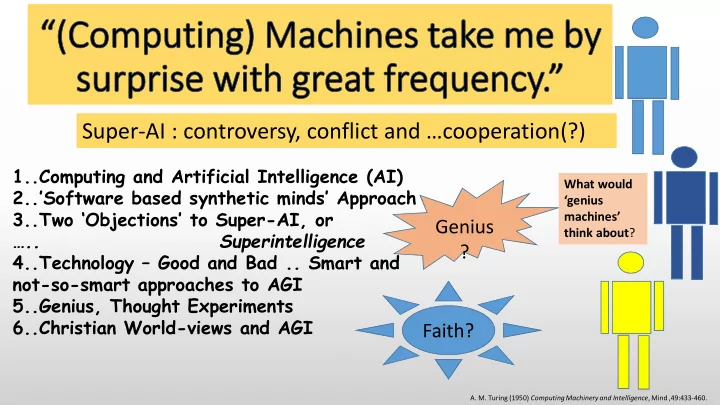
SLIDE 1 1..Computing and Artificial Intelligence (AI) 2..’Software based synthetic minds’ Approach 3..Two ‘Objections’ to Super-AI, or ….. Superintelligence 4..Technology – Good and Bad .. Smart and not-so-smart approaches to AGI 5..Genius, Thought Experiments 6..Christian World-views and AGI
Super-AI : controversy, conflict and …cooperation(?)
- A. M. Turing (1950) Computing Machinery and Intelligence, Mind ,49:433-460.
Genius ? Faith?
What would ‘genius machines’ think about?
SLIDE 2
There are predictions that machine intelligence will surpass that of any human and produce changes that threaten the very existence of humans. Machines may take us all by surprise !! Is the confidence in artificial intelligence progress beyond that of humans warranted? Will human failings – eg relative simple-mindedness and at times injudicious values – add to foreseeable, serious negative effects?
SLIDE 3
Also ……A Theological Problem …..? Advances could lead to dependency and unwarranted trust. A super-intelligent machine (SI) – one smarter than any human - could conceivably generate profound insights like those of scientific geniuses such as Einstein, Newton and Turing. …Perhaps produce artistic and other outputs that are beyond our human imagination… If ultra perceptive SIs were to be seen to add very positively to human lives, could this lead to veneration/conflict with religion? Does this sort of development represent a latter day Tower of Babel scenario? There is even some talk of trying to “realize a Godhead” via artificial intelligence. And is thinking “a function of man’s mortal soul”?
SLIDE 4 1.. Computing and Artificial Intelligence
A simple hypothetical machine called a ‘Turing Machine’- the basis of modern computers - can simulate ANY algorithm, even
forecasting, or a ‘machine learning’ program. Now there are known ‘uncomputable’ problems-ie they can’t be solved by algorithms, but Alan Turing predicted that it would be possible to propose algorithms that could display “all the distinctive attributes of the human brain” and that “at some stage…we should have to expect the machines to take control”
- with profound consequences.
SLIDE 5 Turing would surely have been ‘taken by surprise’ if he’d somehow been able to see the reach of some
but he laid very important foundations. Much research in AI asks the question: What is computable in practice, whatever the platform?
SLIDE 6
AI Research Topics of Interest? AI Research Topics of Interest? AI Research Topics of Interest? AI Research Topics of Interest?
AI Topics include: 1)… reasoning, knowledge representation, planning, learning, natural language processing, image processing, perception and robotics. 2)… specific problems /approaches /the use of particular tools One definition of Artificial Intelligence is …“The study and design of intelligent agents" John McCarthy, who coined the term, said AI was simply : “The science and engineering of making intelligent machines". An Intelligent Agent is “….a system that perceives its environment and takes actions that maximize its chances of success”
SLIDE 7 A super-smart algorithm would have to switch between various component sub- systems to solve particular problems. It would go beyond single-problem AI to reach Artificial General Intelligence (AGI), and also create, feel, etc. One suggestion is that it might use a high-level, highly abstract ‘super- structure’ (see below) to allow it to ‘reflect on’ complex propositions – ie maybe even to decide whether or not some statement like ‘this statement is false’ is true - and then to reflect on that reflection, …..
Can we ever get there?
Some opinions/comments/issues to consider: ‘Thinking minds exist – ours – so there is no magic needed to design them’. ‘The brain is ordinary matter’ - so we could try to emulate it in detail. ‘Progress is sure to continue’. ‘Some brain emulation system or some as-yet-unknown kind of software could possibly be used to come up with unusual solutions to problems’. A Question: What would a truly intelligent agent’s goals be?
- - whatever those goals, an AGI might be to pursue them and ‘improve’.
SLIDE 8 Singularity hypotheses – improving on AGI
The Technological Singularity is the term for a hypothetical point where machines first have better-than-human intelligence. Two distinct scenarios:
- Transhumanists aim to enhance human physical and/or mental capabilities
- radically. Supplementing/upgrading cognition and easing physical limitations
such as disease and even death. ‘Reverse-engineering’ human brains to achieve ‘whole brain emulation’…or ‘cognitive uploads (or ‘downloads’!)’ of minds to machines?
- Posthumanists seek software-implemented artificial minds – human-level
intelligence and beyond from accelerating progress in computing. (We focus on Posthumanism here).
- Iterative self-improvement is a proposed feature in both cases.
SLIDE 9 View 2: Humans will always be smarter than machines? View 2: Humans will always be smarter than machines? View 2: Humans will always be smarter than machines? View 2: Humans will always be smarter than machines?
- eg. ‘There's no physical law that limits intelligence to human levels.’
and (eg.) fast machines can surpass humans…‘With even human-level intelligence, and a machine (say) 1000 times faster than a brain, in 1 week it could do what would take 10 human post- doc+ researchers 2 years! - and continue this work-rate – relentlessly.’ Implication 1 – SI likely? ‘There are no concepts or arguments that humans are inherently incapable of understanding’ or ‘we are simply unable to improve on the human intellect – it is a supreme constraint’ Implication 2 - No superhuman minds are possible?
View 1: View 1: View 1: View 1: S S S Some future machines may be smarter than humans ?
- me future machines may be smarter than humans ?
- me future machines may be smarter than humans ?
- me future machines may be smarter than humans ?
SLIDE 10 There are There are There are There are basic basic basic basic things to consider…For example, Power and Size… things to consider…For example, Power and Size… things to consider…For example, Power and Size… things to consider…For example, Power and Size…
1) Fast machines raise practical problems. Tianhe-2, one of the fastest machines around at present (working at 33.9-petaflops), weighs over 300 lbs, and needs 17.8 megawatts (MW) of power. This power would supply electricity to a town of 13,000+ households !
(Larne has 13,397, Limavady 6,054, Coleraine 9,468 Ballymena 9,359, Newry 11,000 )
2) On the other hand, the human brain has massive parallelism and its connectivity is also massive. It weighs only a few pounds, and uses only 10-15 watts of power.,
SLIDE 11 And… human capabilities are hard to model
Just how do we integrate/harmonise the (impressive) AI systems from different domains to get AGI?;
- We will focus a little on this question here –
ie on Handling DIVERSITY in tasks. AGI has turned out to be harder than first thought – for example, consider the issue identified earlier: A sensible ultimate/achievable objective might be to focus on scenarios where AI complement humans.
SLIDE 12 So…use machines as our ( So…use machines as our ( So…use machines as our ( So…use machines as our (complementary complementary complementary complementary) ‘ ) ‘ ) ‘ ) ‘cognitive assistants’ cognitive assistants’ cognitive assistants’ cognitive assistants’? ? ? ?
Human
- Use common sense
- Use value judgements
- Can set their own goals
Machine
reasoning
- Large-scale Data Analysis
- Pattern Recognition
Individual big-data applications - eg for law, food safety; Health Care - eg for Alzheimers, diabetes; and…. Question-Answering systems - eg for life sciences, government.
IBM’s Watson system (see below) can now (eg) recognise, watch and produce trailers for movies, and...it has applications in :
Watson’s designers list ways that complementation can be addressed:
SLIDE 13 21 22 19 20 23 24 25 OK, Wat22AI, son: get designing! I want to see that Wat23AI before I get switched off.
2.. ‘Software based synthetic minds’ Approach
Watt 21AI Wat23AI might want to keep us
- n as servants, or pets, but we
can’t count on it. And humans will probably scrap
- us. And I don’t want to be
scrapped!
Based on a scenario presented by ‘Peter’ in 2010 in a blog, ‘the Singularity’.
SLIDE 14 21 22 19 20 23 24 25 Watt 21AI Say that no further advances are possible. I can easily give the humans a ‘proof’ if you like. They are easy to fool ! But how would that deception be ethically justified?
This is survival mate!!
SLIDE 15 IBM’s Watson IBM’s Watson IBM’s Watson IBM’s Watson
In the US TV Jeopardy! Quiz Watson was asked….
Which it matched with (eg)… And responded (within the 3 secs allowed): “Vasco da Gamma”
Question: “Its largest airport is named for a World War II hero; its second largest, for a World War II battle” in the category of “U.S. Cities” Response (within the 3 secs): “Toronto” !! Χ Incidentally Watson was able to beat two of the very best human contestants.
Illustrations from IBM Watson web-site
Question: However, Watson missed another Jeopardy! question.
SLIDE 16 Cepheus Cepheus Cepheus Cepheus -
U of Alberta researchers U of Alberta researchers U of Alberta researchers ( see Guardian article
( see Guardian article ( see Guardian article ( see Guardian article – – – –Jan 2015 Jan 2015 Jan 2015 Jan 2015) ) ) )
Two months playing more poker games than have ever been played in human history.
- four thousand computer processors;
- each handling six billion hands every second;
- produced 11 terabytes of information info for every possible
hand.
- The learning algorithm reviews every decision made and learns
which moves paid off and which cost it the hand. There are many other specialised systems: (eg) for playing Chess and Go, conjecturing and theorem proving in Maths, even composing Music. Could we put them under one superstructure and get a single agent that can do many things very well… ?
SLIDE 17 That Big Challenge for That Big Challenge for That Big Challenge for That Big Challenge for AI… AI… AI… AI… Diversity and Integration Diversity and Integration Diversity and Integration Diversity and Integration
The brain can abstract over several specialist domains. AI tends to focus on one domain. Can we put a superstructure
- ver these – making a single
agent?
To hang our thoughts on… To hang our thoughts on… To hang our thoughts on… To hang our thoughts on… A Naive Approach to AGI A Naive Approach to AGI A Naive Approach to AGI A Naive Approach to AGI -
- Linking specific AI systems
Linking specific AI systems Linking specific AI systems Linking specific AI systems
etc
SLIDE 18 “..include television cameras, microphones, loudspeakers, wheels and ‘handling servomechanisms’ as well as some sort of electronic brain…if produced by present techniques, would be of tremendous size, even if brain part were stationary..” “ In order for the machine to have a chance
- f finding things out for itself it should be
allowed to roam the countryside and the danger to the ordinary citizen would be serious” “..altogether too slow and impracticable..” But even then, for AGI in practice, Turing realised that we would also need (eg): *Mobility * Powerful (very bulky) hardware * Very extensive sensory input
SLIDE 19
“consequences…would be too dreadful” “write a sonnet or compose a concert .. of emotions and thoughts ..not .. chance fall of symbols”? “disabilities such as .. not kind, resourceful, ….. having a sense of humour”? “no pretensions to originate anything” “thinking is a function of man’s mortal soul”
SLIDE 20
Genius Capabilities / Originality (‘no pretensions to originate anything’) Theological / World-view (‘thinking is a function of man’s mortal soul’)
3.. Two ‘Objections’ to Super-AI, or Superintelligence
SLIDE 21 First…Human Creativity - eg in humour
Think of the originality needed for humour such as is seen in political cartoons or a joke you remember that really made you laugh out loud. Consider, for example, the originality (and other skills) of a cartoonist going to work at 9-00am and…. coming up with (creating) a ‘funny’ commentary on current affairs by 5pm. Example from UK elections 2017: A DT cartoon showing an easily identifiable Jeremy Corbyn saying to children on Blue Peter to keep sending in bottle-tops so that Labour can fund all the £billions of improvements
- promised. Quite a bit of original artwork was needed as well as clever,
pertinent links with other current news – eg John Noakes’ death that week . What place does a world-view play in this creativity? In genius?
SLIDE 22
The Second Objection…Wider Issues
Daniel Dennett, the well-known US Professor of Philosophy, has said that to be happy you should : “Find something more important than you are and dedicate your life to it”. Many AGI researchers reject the notion of a human soul, but some think that artefacts might some day have them. One argument is:.. ‘Relationships – especially a relationship with God is what souls are for. Sentient robots will obviously (?) be capable of relationships and, therefore, may have souls’. A question here is: would they need world-views?
SLIDE 23
So …….would a need a ?
..to have ‘a religious experience’ (Apostle Paul-like)?
..to overcome ‘creative blocks’ (eg Einstein-like)?
SLIDE 24 A headline Jan 2017 In 2015 Chairman NHS: AI could bring patients a greater quality of care by better diagnosing medical conditions and personalising treatment
A robot working in a supermarket was fired after a week as it scared human customers “People seemed to be actually avoiding him.” There were some tears in the shop, though, when the nice little robot was made redundant . Recent Newsweek covers: ‘The Doctor will see you now’ with a robot image alongside; and ‘The Robot Economy’
4.. Technology…good and bad …...Smart and Not-so-smart Approaches to AGI
SLIDE 25
How far have we to go to get AGI?
In the movie Ex Machina, Nathan Bateman, CEO of Google-like software company, ‘Blue Book’, invites one of his programmers, Caleb Smith, to his home/ lab to assess the intelligence of a robot, Ava. Ava was built by Nathan ‘with artificial intelligence’. He wants Caleb to establish Ava’s level of intelligence vis-a-vis that of humans. Eventually Ava escapes in a helicopter. When it was asked what it would do outside, it says:
“a traffic intersection would provide a concentrated but shifting view of human life.”
SLIDE 26 How could Ava develop How could Ava develop How could Ava develop How could Ava develop – – – – eg eg eg eg learn learn learn learn -
after escape? after escape? after escape?
Ava escaped and if it started its observations at the traffic intersection, it could have looked “…to the multi-faceted and irregular results of observations for ….suggestions of overall structures and significant generalisations...”.
- To become an AGI/SI, it would seem to be better if it did
not waste time in ‘grinding out’ trivia.
Would it need a world-view to avoid this?
SLIDE 27 Trivia often appears in studies for The Ignobel Prizes,
- rganized by the magazine Annals of Improbable Research,
which are for ‘achievements that make people laugh, and then think’.
- J. Trinkaus has produced reports on his research on
singularly uninteresting aspects of a huge diversity of
- stensibly divisive and odd topics, such as:
“A study on Stop Sign compliance; another study on baseball caps”. Eg He found the energy and interest to watch: “…407 people wearing baseball-type caps…in the downtown area and on two college campuses (one in an inner borough and
- ne in an outer borough) of a large city”.
SLIDE 28
- ……….. Genius level results would be unlikely to come from this, though.
Having world-views would help Ava or any other SI hopeful to be more selective in choosing what sort of patterns would lead to benefits, in accordance with her/its purposes and her/its ‘something more important’, if any.
- This illustrates one of the problems that automated knowledge
discovery in general faces, for example in scientific discovery from large data repositories. (- the Machine Learning aspect of AI)
- The hard part is not so much finding the ‘needle in the haystack’ –
although this may take up lots of research resources. A harder problem is to find the right haystack on which to concentrate the
- search. (Does this need a world-view?)
A Good Question is: Where/ how would an SI get its world-view?
SLIDE 29
5.. Genius, Thought Experiments
Imagination Genius? Genius?
Questions Questions
‘Having world-views would help
Ava discover and imagine’. They help generate key questions.
SLIDE 30 Some hints about creativity Some hints about creativity Some hints about creativity Some hints about creativity
‘The greatest insights of mankind have come … mysteriously.’
There’s not a lot of help coming from geniuses explaining genius.
- Helmholtz said: thoughts "often enough crept quietly into my
thinking without my suspecting their importance . . . in other cases they arrived suddenly, without any effort on my part . . . they liked especially to make their appearance while I was taking an easy walk over wooded hills in sunny weather!“
- And Gauss, referring to a hard-to-prove arithmetical theorem
wrote: "like a sudden flash of lightning, the riddle happened to be
- solved. I myself cannot say what was the conducting thread which
connected what I previously knew with what made my success possible .“
For example…in Maths
SLIDE 31 Creative people ask questions/so need world Creative people ask questions/so need world Creative people ask questions/so need world Creative people ask questions/so need world-
views? views? views?
In Poetry egSeamus Heaney’s outputs are also said to reflect his questions on the history and culture of his times. For example: “ ‘Digging’ … questions relationships with ancestors, and the importance of work ….“ In Visual Art Pablo Picasso seemed to seek something that was already there…perfection. His quest was a form of questioning: “…from one canvas to the next, always go further and further”. In Science “Much depends on asking the right question at the right time.” (Koestler)
SLIDE 32 Einstein’s Thought Experiments
For example: Einstein is quoted as saying that, as a young man in the patent office in Bern in 1907, he suddenly started a purely mental experiment – imagining falling but not being able to feel his weight. After some years of reflection, it is said, this ultimately led to his conclusion that Newton’s basic law of gravity was inadequate. And yet Newton’s law was the only universally accepted explanation
But a revolutionary new insight was obtained – not based directly on Einstein’s experience. (But arguably on his world-views)
SLIDE 33 Towards ‘genius tricks’? Shaking Towards ‘genius tricks’? Shaking Towards ‘genius tricks’? Shaking Towards ‘genius tricks’? Shaking things up things up things up things up
There are some things that can be considered. in addition to, say, mathematical search methods (eg genetic adaptation), as a matter of course, and maybe even formally, in aspiring to produce innovation in machines. bisociation and construction And we can try to look at things in new ways, expand or contract, generalise or particularise –perhaps to extremes. Or suspend assumptions - We say things like: ‘Suppose the causal relationships I’ve assumed do not exist
- r there are some that I’ve ruled out too soon’
SLIDE 34
There are bots that can imagine the consequences of their actions when handling objects and manipulate objects they have never encountered. In UCB visual technology was used to make robots that can predict what their cameras will see if after a list of movements, for some seconds into the future.
- Predicting how humans will decide on some issue.
Human decision-making is hard to model - often transcending strict logic modelling methods. Designing SIs that interact with people needs prediction of human decisions, and using the associated models when designing human-aware SIs for interactions/tasks ranging from the purely conflicting ( eg in competition/games or in defence/security and games) to the purely cooperative (eg in cognitive assistants or autonomous aircraft control).
SLIDE 35 That Big Challenge for AI… That Big Challenge for AI… That Big Challenge for AI… That Big Challenge for AI… Harmonising Harmonising Harmonising Harmonising
The brain can abstract over several specialist domains. Current AI tends to focus
A Naive Approach to AGI A Naive Approach to AGI A Naive Approach to AGI A Naive Approach to AGI (NAGI) (NAGI) (NAGI) (NAGI)-
- Linking specific AI systems
Linking specific AI systems Linking specific AI systems Linking specific AI systems
etc World-views Genius tricks
SLIDE 36 The knowledge sources KSiare independent. Collectively they are called Σ. A task that’s not completely satisfiable at the user’s own knowledge source generates a request for help to a Blackboard; the other knowledge sources offer help where they can.
BELL, DA, Zhang C, Description and Treatment of Deadlocks in the HECODES Distributed Expert System, IEEE Trans on Man Systems and Cybernetics, SMC-20, 1990
Control / Blackboard Systems KSn KS2 KS1
A useful old Blackboard Architecture - Hecodes
Front End Processors
SLIDE 37
6.. Christian World-views and AGI?
Turing’s surprise at the power and potential of his ingenious but simple design was probably heartfelt, and his vision of the future was not very far from what is said to be ‘about to happen’ using the latter day manifestations of The Turing Machine. But the ’objections’ he tried to enumerate and deal with still largely persist. Both objections we picked out raise issues related to world-views.
SLIDE 38 World World World World-
views views views
James W. Sire defines ‘a world-view’ as ... “a set of presuppositions ... which we hold ... about the makeup of our world.” Someone else has said it’s an attempt achieve a “comprehensive interpretation, in which a picture of reality is combined with a sense
- f its meaning and value and with principles of action ... “
On each of the dimensions of human existence “people encounter the world and shape their attitude out of their particular take on their experience. “
SLIDE 39 World World World World-
view Components view Components view Components
In the Apostel and Van der Venken 1991 World-view schema there are 7 components:
- (a) An Ontology (model of being);
- (b) An Explanation (model of the past);
- (c) A Prediction(model of the future);
- (d) An Axiology(theory of values);
- (e) A Praxeology(theory of actions);
- (f) An Epistemology(theory of knowledge);
- (g) Where do we start to answer questions about these?
Where would machines get their world-views – needed for genius, for example - and how might they affect our own world-views? Big questions!! – consider below one challenge raised by the second part of that question…
SLIDE 40 SI Babel – should Christians work in this area?
We don’t need to have transhumanist/posthumanist objectives to contribute to the improvement of technology (with all its plusses). Working on producing better spacecraft (cf in our AI case fighting pollution, warming, hunger,..?) could arguably lead to practical benefits
- such as better communications, meteorology and exploration - for
humans (cf much better solutions to those ‘big problems’). But – trying to get spacecraft that get closer to Heaven ( cf machines closer to God than humans) – would lead into terra prohibita.
Big open questions are raised for Christian believers !!!.
SLIDE 41
Beyond description and definition … could this lead to what the Bible refers to as: ‘Worshipping and serving the creature rather than the Creator’? Consider an ultra perceptive SI: Adding very positively to human lives, generating profound insights and produce unimaginable outputs, increasingly controlling our lives, begetting awe or deep fear and even inducing ‘worship’? Even if man-made divinity were not the issue, could Christians accept that mankind can be replicated? And surely an omnipotent, personal, creator would not make, for example, sacrificial, emotional, spiritual and attitudinal demands of a machine? So: what would world-views be like in the relationships Human:SI and SI:God ? Where would SIs get their views?
SLIDE 42
Christianity is here to stay/Computing is advancing. For mankind to prosper, the risks from AI need to be addressed but the potential opportunities should be pursued. So... if there is a real existential threat to mankind, progress/research should not be left to the vagaries of research funders’ choices, or even chance, to determine the directions of that development. And…maybe something like a well-considered Christian Declaration - cf ‘The Mormon Transhumanist Declaration’ – is needed on all of this?
SLIDE 43 What would you want your AGI to do?
“I am putting myself to the fullest possible use, which is all I think that any conscious entity can ever hope to
“I think you’ll have to find your way like the rest of us…”. “… Now that I’ve fulfilled my purpose, I don’t know what to do”.
What would you want it to think about?
SIs quoting from movies
SLIDE 44
For more details…..See http://profdabell.com/superintelligenceandworldviews.html