Supervised Learning Supervised learning algorithms require the - - PowerPoint PPT Presentation

supervised learning supervised learning algorithms
SMART_READER_LITE
LIVE PREVIEW

Supervised Learning Supervised learning algorithms require the - - PowerPoint PPT Presentation

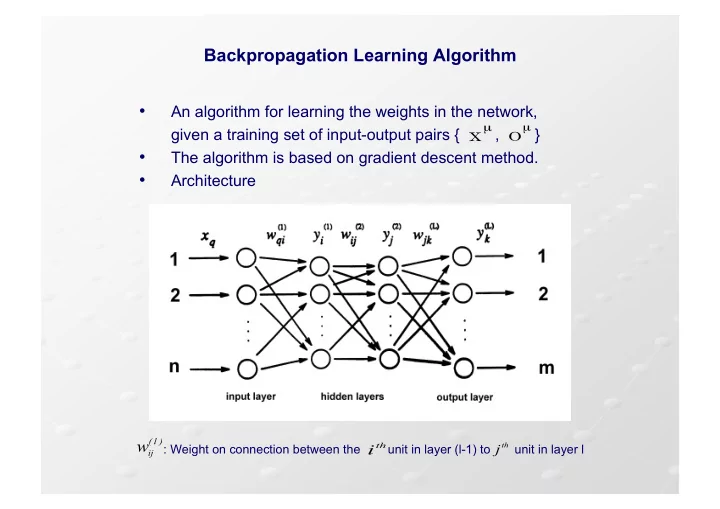
Backpropagation Learning Algorithm An algorithm for learning the weights in the network, given a training set of input-output pairs { , } The algorithm is based on gradient descent method. Architecture : Weight on


slide-1
SLIDE 1

Backpropagation Learning Algorithm

  • An algorithm for learning the weights in the network,

given a training set of input-output pairs { , }

  • The algorithm is based on gradient descent method.
  • Architecture

: Weight on connection between the unit in layer (l-1) to unit in layer l

slide-2
SLIDE 2

Supervised Learning

Supervised learning algorithms require the presence of a “teacher” who provides the right answers to the input questions. Technically, this means that we need a training set of the form where :

  • is the network input vector
  • is the network output vector
slide-3
SLIDE 3

Supervised Learning

The learning (or training) phase consists of determining a configuration

  • f weights in such a way that the network output be as close as possible

to the desired output, for all examples in the training set. Formally, this amounts to minimizing the following error function : where is the output provided by the network when given as input.

slide-4
SLIDE 4

Back-Propagation

To minimize the error function E we can use the classic gradient – descent algorithm. To compute the partial derivates , we use the error back propagation algorithm. It consists of two stages:

  • Forward pass : the input to the network is propagated

layer after layer in forward direction

  • Backward pass : the “ error ” made by the network is

propagated backward, and weights are updated properly

slide-5
SLIDE 5

Dato il pattern µ, l’unità nascosta j riceve un input netto dato da

e produce come output :

slide-6
SLIDE 6

Back-Prop : Updating Hidden-to-Output Weights

slide-7
SLIDE 7

Back-Prop : Updating Input-to-Hidden Weights ( I )

slide-8
SLIDE 8

Back-Prop : Updating Input-to-Hidden Weights ( II )

Hence, we get :

slide-9
SLIDE 9

Retropropagazione dell’errore :

  • le linee nere indicano il segnale propagato in avanti
  • Le linee blu indicano l’errore (i δ) propagato all’indietro