Supporting a Fresh Start Linking Individuals with Benefits upon - - PDF document

supporting a fresh start
SMART_READER_LITE
LIVE PREVIEW

Supporting a Fresh Start Linking Individuals with Benefits upon - - PDF document

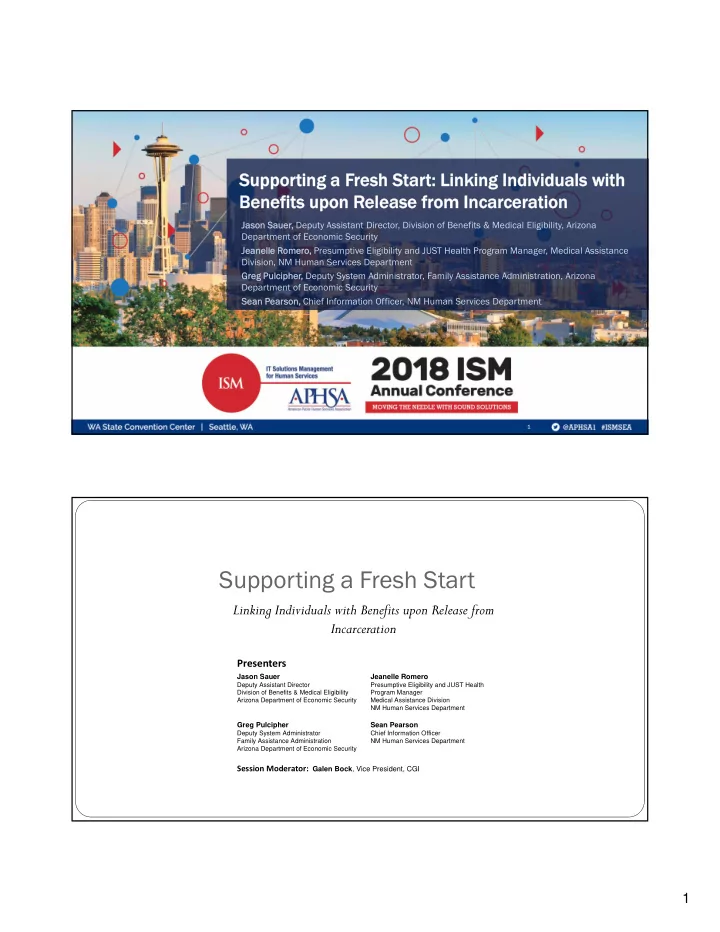
Supp Suppor orting a ng a Fresh Star esh Start: Linking Individuals with Linking Individuals with Benef Benefits upo upon R Release fr lease from om Incar Incarcera eratio ion Jason Jason Sauer Sauer, Deputy Assistant Director,


slide-1
SLIDE 1

1

1

Supp Suppor

  • rting a

ng a Fresh Star esh Start: Linking Individuals with Linking Individuals with Benef Benefits upo upon R Release fr lease from

  • m Incar

Incarcera eratio ion

Jason Jason Sauer Sauer, Deputy Assistant Director, Division of Benefits & Medical Eligibility, Arizona Department of Economic Security Jeanelle elle Romero, , Presumptive Eligibility and JUST Health Program Manager, Medical Assistance Division, NM Human Services Department Greg Greg Pulci Pulciphe her, Deputy System Administrator, Family Assistance Administration, Arizona Department of Economic Security Sean P Sean Pear arso son, Chief Information Officer, NM Human Services Department

Supporting a Fresh Start

Linking Individuals with Benefits upon Release from Incarceration

Presenters

Jason Sauer

Deputy Assistant Director Division of Benefits & Medical Eligibility Arizona Department of Economic Security

Jeanelle Romero

Presumptive Eligibility and JUST Health Program Manager Medical Assistance Division NM Human Services Department

Greg Pulcipher

Deputy System Administrator Family Assistance Administration Arizona Department of Economic Security

Sean Pearson

Chief Information Officer NM Human Services Department

Session Moderator: Galen Bock, Vice President, CGI

slide-2
SLIDE 2

2

AZ Department of Economic Security & AZ Department of Corrections

Second Chance Center Programs

Background

– Incarcerated inmates apply for Medical Assistance (Medicaid) coverage within 30 days of their release date (2016)* – Second Chance Center (SCC) campuses created as a pilot program in three state prisons (2017) – SCC Inmates apply for SNAP (2018)* *Corrections Officers act as assistors with application entry

slide-3
SLIDE 3

3

Second Chance Centers

  • SCC complexes currently in two male prisons (Phoenix &

Tucson) and one female prison (Phoenix).

  • Inmates apply for SCC program and complete screening

process prior to acceptance

  • Inmates agree to be transferred to SCC corrections

complex

  • Setting is similar to a college environment

Second Chance Centers

  • DES staff on site
  • Coordinate access to a variety of services
  • Job fairs/job coaching/resume development/interview training
  • Vocational Rehabilitation
  • SNAP

, Medicaid, TANF eligibility

  • Child support (payment and case processing)
  • Veterans services (if applicable)
  • Workforce readiness
slide-4
SLIDE 4

4

Second Chance Center Data

– Currently Participating – as of June 7, 2018 the participants enrolled in the program – Completed – number of inmates completing program since the establishment of the SCC’s (March 27, 2017) – Placements –the total number of job placements among inmates who completed program since SCC establishment. Currently there are 10/30/60/90 day follow ups from the SCC after release – successful placement would be considered if a job was accepted within 90 days of release.

Prison / SCC Name Lewis: Eagle Point Unit Perryville: Piestewa Unit Tucson: Manzanita Unit Total Currently Participating 218 40 42 300 Completed 621 195 264 1,080 Placements 293 87 245 625

Data as of: Thursday, 06/07/2018

Second Chance Center Funding

  • Currently WIOA and Wagner-Peyser funds are used

toward the reentry programs/SCC’s.

slide-5
SLIDE 5

5

Second Chance Center Services

  • Holistic approach towards employment:

– Mental health – Vocational rehabilitation – SNAP/Medicaid

  • Education & information to support employment:

– I-9 documents (ID and SS card) – Treatment/support programs – Education & Life Skills programs – Workforce Readiness – Other services needed to secure & maintain employment

Workforce Readiness

  • Workforce readiness:

– Resume development – Interview preparation (how to explain offenses/incarceration to employers) – Job skills training – Job search assistance – On site job fairs – Connections to resources for clothing, housing, transportation upon release – Transportation options

slide-6
SLIDE 6

6

Assistance Programs

  • Overview of Assistance Programs provided to

inmates

– Information on SNAP , Medicaid, TANF are presented to inmates within 60 days of release – SNAP FAQ included – Map of the who, what, when, where, how in programs – SNAP ED

Assistance Programs

slide-7
SLIDE 7

7

Assistance Programs Assistance Programs

slide-8
SLIDE 8

8

Assistance Application Process Assistance Application Process

  • Inmates apply for SNAP

, Medicaid, TANF assistance programs 30 days from release

  • Applications are completed with Corrections

Officer acting as assistor

  • Inmates who are reuniting with their families may

be added to family case (as a change)

slide-9
SLIDE 9

9

Eligibility Determination Eligibility Determination - Post Release

  • Corrections provides list of inmates released daily
  • Specialized DBME unit enters release date into

system; applications are pro-rated to date of release

  • Inmates complete SNAP interview as soon as

possible after release

  • If expedited case, EBT card can be picked up in
  • ffice same day (funds available next day)
slide-10
SLIDE 10

10

Eligibility Determination - Post Release Technical/System Solutions

  • Establishing the inmate special case load in

HEAplus (2 years ago)

  • Establishing a table of incarceration facilities that

are participating in the program

  • Using the inmate release date for the proration

date in determining eligibility and initial benefit (AZTECS)

slide-11
SLIDE 11

11

Future Challenges

  • Expansion to additional corrections complexes and

workload/capacity

  • Prioritization of population in relation to others
  • Geographic barriers
  • Technology
  • Potential for QC errors
  • Data on recidivism limited for short term impact

Supporting a Fresh Start

Linking Individuals with Benefits upon Release from Incarceration

Sean P Sean Pearson arson Chief Information Officer Jean anelle R lle Romero mero Program Manager

slide-12
SLIDE 12

12

  • Medicaid State Plan Amendment for presumptive eligibility

– January 2014

  • New Mexico Legislature passed Senate Bill 42 in early 2015;

Governor Susana Martinez signed it into law effective July 1, 2015.

  • Primary goal was to ensure that the Medicaid‐eligible inmate

population has timely access to health care services when released from prison or jail:

  • Behavioral health conditions and substance use disorders
  • Co‐morbidities
  • Reduce recidivism

2 4

Incarceration shall not be a basis to terminate or deny eligibility for Medicaid. A Medicaid eligible individual will have their Medicaid benefits suspended until release. An incarcerated individual not enrolled in Medicaid, may apply for Medicaid while incarcerated. Upon release, an individual who remains Medicaid eligible will have their Medicaid benefits

  • reinstated. Allowing the

individual to access healthcare.

slide-13
SLIDE 13

13

  • Allows individuals who are eligible and enrolled in Medicaid at the

point of incarceration to maintain their Medicaid eligibility.

  • Individual remains Medicaid eligible but benefits are “suspended” after

30 days of incarceration

  • Allows individuals who were not enrolled prior to incarceration the

ability apply while incarcerated or at release.

  • Mandates prisons and jails to notify the Medicaid agency when an

enrollee is incarcerated and when the inmate is released.

  • Allows Medicaid agency to automatically reactivate benefits when

the inmate is released from jail or prison.

  • The Human Services Department (HSD) entered into inter‐

governmental agreements with participating prisons and jails

  • Train jail/prison staff as certified Presumptive Eligibility Determiners
  • Participating prisons and jails required to share daily inmate booking and release

information with HSD through a secure interface

  • Prison/jail IT systems – not originally designed to interface with HSD IT systems

(created template for all facilities to follow)

  • Incarceration information interfaces directly with the

Medicaid eligibility system (ASPEN)

  • ASPEN interfaces with the Medicaid Management Information

System (MMIS)

  • Extensive testing done with each rollout
  • Adding to system maintenance and operations – faster county

rollouts going forward

slide-14
SLIDE 14

14

  • Most Medicaid recipients receive services through a Managed Care

Organization (MCO)

  • Justice‐involved enrollees have benefits automatically suspended after

30 or more days of incarceration

  • Once suspension is in place, capitation payments to the MCO cease
  • Qualifying inpatient hospital claims may be eligible for

reimbursement through FFS Medicaid while benefits are suspended

  • Justice‐involved individual released from prison/jail:
  • Release data sent from correctional facility
  • Individual’s benefits are reinstated
  • Individual is re‐enrolled with MCO (if applicable)
  • Capitation payments to the MCO resume
  • Released individual does not need to complete new Medicaid

application

  • Allows for immediate access to benefits
slide-15
SLIDE 15

15

  • Adopted a new rule allowing HSD to suspend a Medicaid enrollee’s

benefits 30 days after incarceration rather than terminate eligibility

  • Inmate defined as an individual who has been incarcerated for 30

days or more

  • Inmate may apply for or recertify Medicaid eligibility while

incarcerated.

  • An inmate is not eligible for Medicaid‐covered services while

incarcerated

  • Exception for qualifying inpatient hospital stays of 24 hours or more
slide-16
SLIDE 16

16

  • State Plan approval to train and certify prison and jail staff as Presumptive

Eligibility Determiners (PEDs) and Medicaid application assisters – January 2014.

  • Eligibility rule excludes an inmate from the household if he or she is a:
  • “non‐filer” an inmate of a public institution is not included in the household

if he or she neither files a tax return nor is claimed as a tax dependent which requires that mandatory household members be living together.

  • An inmate of a public institution is included in the household with other

mandatory household members if he or she is expected to file a tax return or be claimed as a tax dependent

  • Decision to apply change in household composition only at annual

recertification, administrative renewal or auto‐renewal

  • Protects other household members from detrimental eligibility changes due

to reduced household size

Currently participating counties/agencies:

New Mexico Department of Corrections (12 facilities; 7,200 approximate daily population) San Juan County (563 approximate daily population) Bernalillo County (1,489 approximate daily population) Sandoval County ( 389 approximate daily population) Children Youth and Families Department (4 Juvenile Justice Facilities; 144 approximate daily population) Santa Fe County Adult and Juvenile (530 approximate daily population) Dona Ana County Adult and Juvenile (780 approximate daily population) New Mexico Department of Health ‐ Forensic Unit (58 approximate daily population) Rio Arriba County (140 approximate daily population)

slide-17
SLIDE 17

17

10000 2014 2015 2016 20172018 January - June Totals

CY JUST Health Program Numbers

Just Health Program Numbers PE Granted Just Health Program Numbers Applications Submitted Just Health Program Numbers Applications Approved

August 2014 through June 2018

  • 1,505 Presumptive Eligibility determinations
  • 9,365 ongoing applications filed
  • 8,675 ongoing application approved
  • 20,372 suspensions; 14,071 reinstatements
  • $5 million inpatient hospital claims paid
  • Implementation SB 42 HSD has established working partnerships with:
  • New Mexico Corrections Department
  • New Mexico Children, Youth and Families Department
  • Bernalillo County Detention Center and
  • County Jail Administrators Affiliate
  • Established a Work Group comprised of several county jail administrators to discuss issues

relating to SB 42.

  • Phased approach to statewide implementation
  • Application processing unit that was established to handle Justice‐involved individuals very

efficient & timely

slide-18
SLIDE 18

18

  • Making necessary changes and testing IT systems is complex and time‐

consuming

  • Medicaid eligibility system, MMIS, county‐level IT systems
  • Requires education of prison/jail staff and management about Medicaid

and the importance linking inmates to coverage and services.

  • Partnerships are critical. Workgroup established with Medicaid agency

and prison/jail administrators to communicate and troubleshoot issues.

  • Prison/jail staffing shortages and lack of resources are very real problems;

this initiative can be a heavy burden on prison/jail staff.

  • Complex policy issues ‐ eligibility impacts and payment/capitation

considerations.

 Centennial Care 2.0 will begin on January 1, 2019:

  • Each MCO will be required to have a dedicated position for justice‐involved transitions,

including for releases occurring on weekends and after hours

  • Each MCO will be required to work with the facilities to facilitate care coordination prior to

release as the next important phase of the project in order to ensure access to services right away (i.e., prescriptions, transportation, BH appointments, etc.)

  • Goal of reduced recidivism through access to proper care upon release

 NM House Bill 19 (HB19)

  • Introduced in January, 2018 Session and signed into law March, 2018
  • Reiterates SB42 provisions/definitions regarding incarcerated individuals
  • Requires NM HSD to provide a Behavioral Health Screening tool to participating counties

 Expanding our access to incarcerated individuals data through a new service

slide-19
SLIDE 19

19 Sean Pearson Chief Information Officer NM Human Services Department Sean.Pearson@state.nm.us Jeanelle Romero Presumptive Eligibility & JUST Health Program Manager NM Human Services Department 505‐827‐7713 (Office) JeanelleC.Romero@state.nm.us

Supporting a Fresh Start

Linking Individuals with Benefits upon Release from Incarceration

Questions?