Symbolic Approach for Side-Channel Resistance Analysis of Masked - - PowerPoint PPT Presentation

symbolic approach for side channel resistance analysis of
SMART_READER_LITE
LIVE PREVIEW

Symbolic Approach for Side-Channel Resistance Analysis of Masked - - PowerPoint PPT Presentation

Introduction / Motivation Symbolic Method Experiments Conclusion Symbolic Approach for Side-Channel Resistance Analysis of Masked Assembly Codes Workshop PROOFS In` es Ben El Ouahma Quentin Meunier Karine Heydemann Emmanuelle Encrenaz


slide-1
SLIDE 1

Introduction / Motivation Symbolic Method Experiments Conclusion

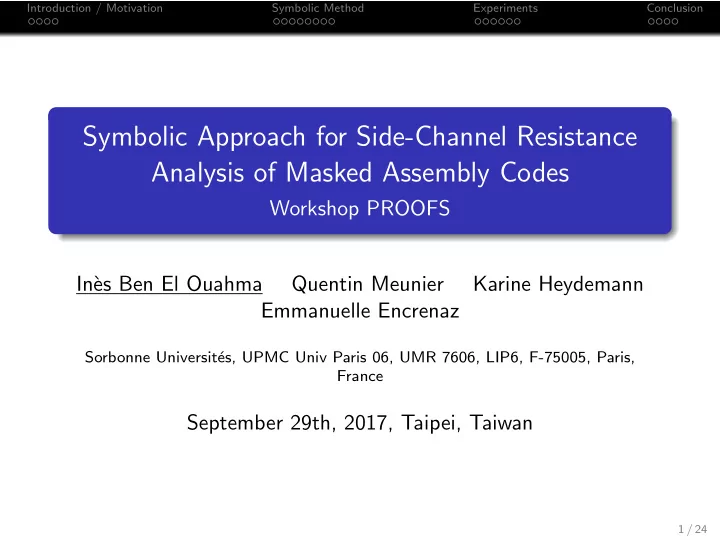
Symbolic Approach for Side-Channel Resistance Analysis of Masked Assembly Codes

Workshop PROOFS In` es Ben El Ouahma Quentin Meunier Karine Heydemann Emmanuelle Encrenaz

Sorbonne Universit´ es, UPMC Univ Paris 06, UMR 7606, LIP6, F-75005, Paris, France

September 29th, 2017, Taipei, Taiwan

1 / 24

slide-2
SLIDE 2

Introduction / Motivation Symbolic Method Experiments Conclusion

1

Introduction / Motivation

2

Symbolic Method

3

Experiments

4

Conclusion

2 / 24

slide-3
SLIDE 3

Introduction / Motivation Symbolic Method Experiments Conclusion

Side-Channel Attacks

EM emission Power Consumption Execution time

Measurements Statistical analysis for key recovery Side channels

3 / 24

slide-4
SLIDE 4

Introduction / Motivation Symbolic Method Experiments Conclusion

The Masking Countermeasure

Aim: observation of d intermediate computations cannot reveal the secret x = ⇒ d-th order masking Splits a secret x in d+1 shares using random uniform variables called masks Operation-dependent, i.e boolean masking: x ⊕ m At software level, usually added in the source code (easy to identify secret variables) Problems Need to ensure that a masked program is leakage free in practice Compilation flow and optimizations (reordering, removal...) may affect masking effectiveness

4 / 24

slide-5
SLIDE 5

Introduction / Motivation Symbolic Method Experiments Conclusion

Masked Programs Security: Existing Formal Verifications

[Bayrak,CHES13] SAT verification of sensitivity: an operation on a secret must involve a random variable which is not a don’t care variable (i.e it affects the result) Low level: LLVM programs × Security property not sufficient [Eldib,TACAS14] SMT verification of perfect masking, i.e statistical independency of intermediate computations from secrets Strong security property × C level & Bit-blasted programs (could be applied to low level) × Lack of scalability (combinatorial blow-up of the enumeration) [Barthe,Eurocrypt15] t-non-interference: joint probability distribution of any t intermediate expressions is independent from secrets Strong security property Good scalability × Cannot conclude for some cases

5 / 24

slide-6
SLIDE 6

Introduction / Motivation Symbolic Method Experiments Conclusion

Our Goal

To verify side channel resistance: Of 1st order masked programs At assembly level In the value-based model: instruction result leaks Considering that: leakage-free instruction ⇐ ⇒ result is statistically independent from secrets With a symbolic approach that infers the distribution type of instruction expressions

6 / 24

slide-7
SLIDE 7

Introduction / Motivation Symbolic Method Experiments Conclusion

Plan

1

Introduction / Motivation

2

Symbolic Method

3

Experiments

4

Conclusion

7 / 24

slide-8
SLIDE 8

Introduction / Motivation Symbolic Method Experiments Conclusion

Verification Scheme

# r0 ← k ; r1 ← m1; r2 ← m2; r3 ← m3 1 eor r4 , r0 , r1 # k ⊕ m1 2 eor r5 , r0 , r2 # k ⊕ m2 3 and r5 , r5 , r3 # ( k ⊕ m2) & m3 4 and r5 , r5 , r4 # ( k ⊕ m1) & ( ( k ⊕ m2) & m3) k m1 m2 m3

& &

mask mask mask secret Data dependency graph of the last instruction

Is the root distribution statistically independent from k?

◮ Inputs tagged with a

distribution type

◮ Bottom-up combination of

distribution types using defined inference rules

8 / 24

slide-9
SLIDE 9

Introduction / Motivation Symbolic Method Experiments Conclusion

Symbolic Approach

4 distribution types for variables and expressions: Random Uniform Distribution (RUD) Unknown Distribution (UKD) Constant (CST) (Statistically) Independent from Secrets Distribution (ISD): not necessarily uniform but identical for all values of the secrets.

k: secret m1, m2: masks e = (k ⊕ m1) & m2 e’= (k ⊕ m1) & m1 k m1 m2 e        P(e=0)= 3

4

P(e=1)= 1

4

1 1 1 1 1 1        P(e=0)= 3

4

P(e=1)= 1

4

1 1 1 1 1 e’        P(e’=0)= 1

2

P(e’=1)= 1

2

1 1        P(e’=0)=1 P(e’=1)=0

9 / 24

slide-10
SLIDE 10

Introduction / Motivation Symbolic Method Experiments Conclusion

Independence Notions

Which distribution types assert that an expression is statistically independent from secrets? Dependence between expression e and variable v: structural = ⇒ v appears in e statistical = ⇒ the distribution of the result of e depends on v = ⇒ Need to keep track of structural dependencies: (k ⊕ m) & m Safe types: e∼RUD e∼ISD e∼UKD with no structural dependency on any secret Unsafe type: e∼UKD{dep} with structural dependency on some secret variable: dep ∩ S = ∅

10 / 24

slide-11
SLIDE 11

Introduction / Motivation Symbolic Method Experiments Conclusion

Dominant Masks

Aim: to find a mask that randomizes the whole expression Dom Rule expression e = e’ ⊕ m or e = e’ + m mod 2n m∼RUD{m} m ∈ dep(e’) = ⇒ e∼RUD and m is a dominant mask of e. 2 sets of dominant masks: dom⊕(e) the set of xor dominant masks of e dom+(e) the set of additive dominant masks of e Examples: dom⊕((k + m1) ⊕ (k ⊕ m1 ⊕ m2)) = m2 dom+((k + m1) ⊕ 0) = dom+(k + m1) = m1

11 / 24

slide-12
SLIDE 12

Introduction / Motivation Symbolic Method Experiments Conclusion

Other Inference Rules

By distribution types: Set of rules for ⊕, + mod 2n Set of rules for AND and OR Disjoint rule for binary operators u∼ISD{dep0} and v∼ISD{dep1} No masks in common: dep0 ∩ dep1 ∩ M = ∅ = ⇒ (u op v)∼ISD{dep0 ∪ dep1} for every binary operation op ⊲ More details in the paper

12 / 24

slide-13
SLIDE 13

Introduction / Motivation Symbolic Method Experiments Conclusion

Running Example

Type inference for the last instruction i4: (k ⊕ m1) & ((k ⊕ m2) & m3)

k m1 m2 m3

& &

RUD{m1} RUD{m3} RUD {k, m1} RUD {k, m2} ISD {k, m2, m3} ISD {k, m1, m2, m3} RUD{m2} UKD{k}

⊲ i4 is statistically independent from k

13 / 24

slide-14
SLIDE 14

Introduction / Motivation Symbolic Method Experiments Conclusion

Bit Level Analysis

When no conclusion is possible at word level: = ⇒ split the expression into several expressions at bit level e0 e1 en e2 e ... ⊲ case 1: e0 e1 en e2 mn m2m1m0 ...

ei ∼RUD and different dominant mask for each ei

⊲ case 2: e0 ei en ei+1 ... ei-1 ... ISD CST CST

Concatenation of an ISD bit with CST bits

⊲ case 3: e0 ei en ei ... ... ISD CST CST ... ISD CST

Deduplicated ISD bit and concatenation with CST bits

Example from mix columns in AES:

e = ((LSR(mt1 ⊕ mp ⊕ sbox5, 7) ⊕ LSR(mt2 ⊕ mp ⊕ sbox10, 7)) + (((LSR(mt1 ⊕ mp ⊕ sbox5, 7) ⊕ LSR(mt2 ⊕ mp ⊕ sbox10, 7)) ≪ 1) b7 = mt17 ⊕ mp7 ⊕ sbox57 ⊕ mt27 ⊕ mp7 ⊕ sbox107 e = ⇒ 0000 00b7b7 = ⇒ ISD

14 / 24

slide-15
SLIDE 15

Introduction / Motivation Symbolic Method Experiments Conclusion

Plan

1

Introduction / Motivation

2

Symbolic Method

3

Experiments

4

Conclusion

15 / 24

slide-16
SLIDE 16

Introduction / Motivation Symbolic Method Experiments Conclusion

Comparison with Two Methods

Our method: distribution type inference implemented in Python C-enumerative: generates a C program that computes the expression distribution by enumerating on all variable values

◮ returns: RUD, ISD or vulnerable

SMT-enumerative: extends Eldib et al.’s approach for n-bit variables ( generates a SMT problem that searches for two values of a secret for which the expression distribution is different )

◮ returns: ISD or vulnerable 16 / 24

slide-17
SLIDE 17

Introduction / Motivation Symbolic Method Experiments Conclusion

Benchmarks

Program #ASM Size # masks # secrets Secure in inst in bits literature Boolean programs for comparison with SMT P6 [Eldib,TACAS14] 8 1 3 3 × Masked Chi [Eldib,TACAS14] 8 1 2 3

  • Algorithms for switching between boolean and arithmetic maskings

Goubin Conversion [Goubin01] 8 4 2 1

  • Coron Conversion

[Coron15] 37 4 3 1

  • Cryptographic algorithms

Masked AES 1st round [Herbst06] 422 8 6 16 + 16

  • Simon TI 1st round

[Shahverdi17] 15 32 5 3 + 2

  • 17 / 24
slide-18
SLIDE 18

Introduction / Motivation Symbolic Method Experiments Conclusion

Experimental Comparison

Ref (enumeration) Symbolic Program # RUD # ISD # Vuln # RUD # ISD # UKD # CST P6 6 2 6 2 Masked Chi 2 2 4 2 2 4 Goubin Conversion 7 1 5 3 Coron Conversion 19 11 7 14 10 13 Masked AES 1st round

  • 302

120 Simon TI 1st round

  • 7

4 3 1

Enumeration methods = ⇒ sound, complete but not applicable on AES/Simon Symbolic method = ⇒ sound {Vuln} ⊆ {UKD} but not complete

18 / 24

slide-19
SLIDE 19

Introduction / Motivation Symbolic Method Experiments Conclusion

Verification Time

Program Symbolic Enum C SMT time time time P6 <1s <1s <1s Masked Chi <1s <1s <1s Goubin <1s <1s 35mn Conversion Coron 2s 1s 5,6h Conversion Masked AES 22s

  • 1st round

Simon TI 8.5s

  • 1st round

C-enumeration = ⇒ fast but only for small programs SMT-enumeration = ⇒ can be long even for small programs Symbolic method = ⇒ better scalability

19 / 24

slide-20
SLIDE 20

Introduction / Motivation Symbolic Method Experiments Conclusion

Bit Level vs. Word Level Analysis

Program #UKDw #UKDb #total inst P6 8 Masked Chi 4 4 8 Goubin Conversion 3 3 8 Coron Conversion 21 13 37 Masked AES 1st round 80 422 Simon 1st round 7 4 15

With bit level analysis: For Coron Conversion & Simon TI: around 40% of unsafe instructions become safe For Masked AES: ALL unsafe instructions become safe

20 / 24

slide-21
SLIDE 21

Introduction / Motivation Symbolic Method Experiments Conclusion

Plan

1

Introduction / Motivation

2

Symbolic Method

3

Experiments

4

Conclusion

21 / 24

slide-22
SLIDE 22

Introduction / Motivation Symbolic Method Experiments Conclusion

Conclusion

We proposed a symbolic method:

For verifying side channel robustness of 1st order masked programs at assembly level Using type inference of expression distributions Scalable, sound but not complete

Perspectives for future work:

Automatic tool that analyses an assembly code Refine the set of rules / bit level analysis Combine with enumerative approach at bit level (need to consider inter-bit dependencies) Extend to other leakage models (e.g transition-based model) / higher masking orders

22 / 24

slide-23
SLIDE 23

Introduction / Motivation Symbolic Method Experiments Conclusion

References

[Bayrak,CHES13] Ali Galip Bayrak, Francesco Regazzoni, David Novo, Paolo Ienne. Sleuth: Automated Verification of Software Power Analysis Countermeasures. CHES 2013: 293-310 [Eldib,TACAS14] Hassan Eldib, Chao Wang, Patrick Schaumont. SMT-Based Verification of Software Countermeasures against Side-Channel Attacks. TACAS 2014: 62-77 [Barthe,Eurocrypt15] Gilles Barthe, Sonia Belad, Franois Dupressoir, Pierre-Alain Fouque, Benjamin Grgoire, Pierre-Yves Strub. Verified Proofs of Higher-Order

  • Masking. EUROCRYPT (1) 2015: 457-485

[Goubin01] Louis Goubin. A sound method for switching between boolean and arithmetic masking. In Cryptographic Hardware and Embedded SystemsCHES 2001, pages 315. Springer, 2001. [Coron15] Jean-S ebastien Coron, Johann Grosch adl, Mehdi Tibouchi, and Praveen Kumar Vadnala. Conversion from arithmetic to boolean masking with logarithmic

  • complexity. In International Workshop on Fast Software Encryption, pages 130149.

Springer, 2015. [Herbst06] Christoph Herbst, Elisabeth Oswald, and Stefan Mangard. An aes smart card implementation resistant to power analysis attacks. In ACNS, volume 3989, pages 239252. Springer, 2006. [Shahverdi17] Aria Shahverdi, Mostafa Taha, and Thomas Eisenbarth. Lightweight side channel resistance. Threshold implementations of simon. IEEE Transactions on Computers, 66(4):661671, 2017.

23 / 24
slide-24
SLIDE 24

Introduction / Motivation Symbolic Method Experiments Conclusion

Thank you for your attention!

24 / 24

slide-25
SLIDE 25

Backup Slide 1

Algorithm 1 Distribution inference algorithm

1: function infer(e) 2:

if e is a leaf then

3:

if e ∈ S then return UKD{e}

4:

else if e ∈ M then return RUD{e}

5:

else return CST

6:

else

7:

le{ld} = infer(e.left child)

8:

re{rd} = infer(e.right child)

9:

if ∃ rule for (le{ld} e.op re{rd}) that returns RUD{dep} then

10:

return RUD{dep}

11:

else if ∃ rule for (le{ld} e.op re{rd}) that returns ISD{dep} then

12:

return ISD{dep}

13:

else return UKD{dep}

25 / 24