Synthetic Biology: applications the needs of a growing and ageing - - PDF document

synthetic biology applications
SMART_READER_LITE
LIVE PREVIEW

Synthetic Biology: applications the needs of a growing and ageing - - PDF document

DSM key activity areas Health Advanced, cost-effective health and medical innovations, and healthier food and beverages, to meet Synthetic Biology: applications the needs of a growing and ageing global population Emrah Nikerel, Nutrition


slide-1
SLIDE 1

1 Challenge the future

Synthetic Biology: applications

Emrah Nikerel, DSM Biotechnology Center

Slide 2

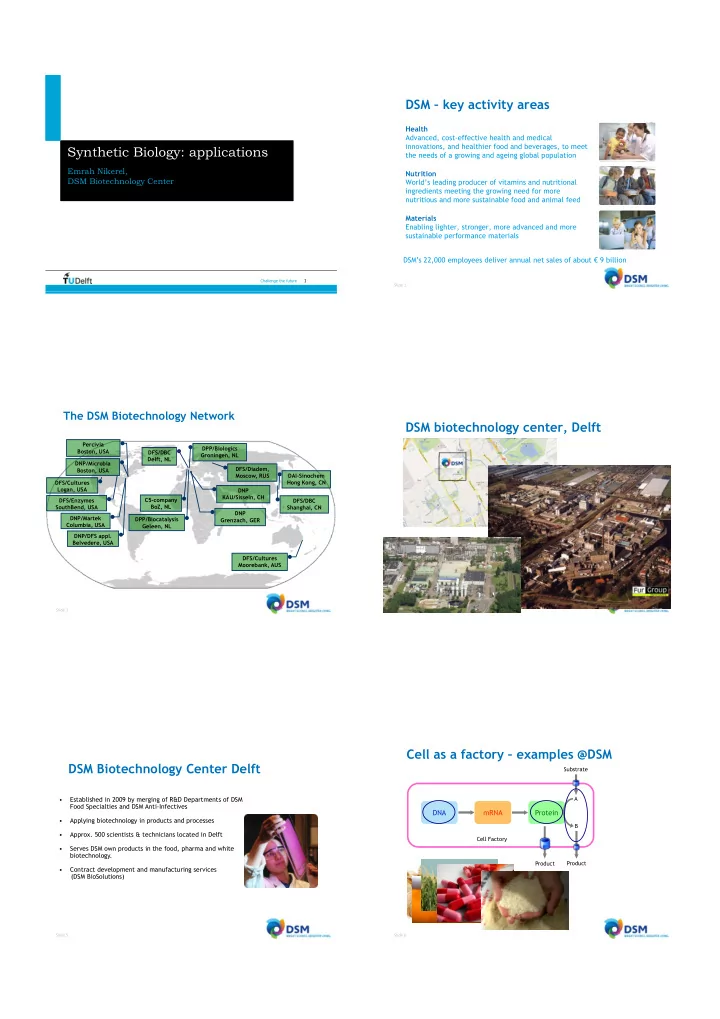
DSM – key activity areas

Health Advanced, cost-effective health and medical innovations, and healthier food and beverages, to meet the needs of a growing and ageing global population Nutrition World’s leading producer of vitamins and nutritional ingredients meeting the growing need for more nutritious and more sustainable food and animal feed Materials Enabling lighter, stronger, more advanced and more sustainable performance materials DSM’s 22,000 employees deliver annual net sales of about € 9 billion

Slide 3

DFS/DBC Shanghai, CN

The DSM Biotechnology Network

DNP/Microbia Boston, USA DNP/DFS appl. Belvedere, USA DFS/DBC Delft, NL DPP/Biocatalysis Geleen, NL DNP KAU/Sisseln, CH DNP Grenzach, GER DFS/Diadem, Moscow, RUS DPP/Biologics Groningen, NL Percivia Boston, USA DNP/Martek Columbia, USA DFS/Cultures Logan, USA DFS/Cultures Moorebank, AUS DFS/Enzymes SouthBend, USA C5-company BoZ, NL DAI-Sinochem Hong Kong, CN

Slide 4

DSM biotechnology center, Delft

Slide 5

DSM Biotechnology Center Delft

  • Established in 2009 by merging of R&D Departments of DSM

Food Specialties and DSM Anti-Infectives

  • Applying biotechnology in products and processes
  • Approx. 500 scientists & technicians located in Delft
  • Serves DSM own products in the food, pharma and white

biotechnology.

  • Contract development and manufacturing services

(DSM BioSolutions)

Slide 6

Cell as a factory – examples @DSM

DNA mRNA Protein

Substrate A B Product Cell Factory Product

slide-2
SLIDE 2

Slide 7

Pathway & Strain

Metabolic model / knowledge base

Product pathway Precursor supply By-products Energy supply Redox balance Compartments Transport Alternative routes

NADH NAD ATP ADP

S P Design

Analyze Build & Test

Slide 8

Metabolites

  • vitamins, pharmaceuticals, chemicals

(e.g. antibiotics, citric acid, arachidonic acid) Proteins

  • Enzymes

(e.g. PreventASe™, Panamore™, Maxiren™ , Maxilact™,….. Biomass

  • Yeast Extracts, cultures

e.g.Maxarome™, Delvo-Yog™

Examples of Products produced by Biotechnology

Slide 9

BiosucciniumTM succinic acid

a Versatile Building Block for Multiple Applications

Slide 10

transporter

  • S. cerevisiae Metabolic Engineering Strategy

Introduction of red. TCA cycle, glyoxylate shunt and export

X

Alcohol dehydrogenase Net stoichiometry combining 2 pathways: 1.4Glc + 1.2CO2 = 2.4Succ + 2.4ATP Ymax = 1.71 mol/mol = 1.12 g/g

From <1 g/L to

High product concentrations

And many other modifications

11 Challenge the future

What is it all about with Biotechnology

A wide ranging scientific field which includes the manipulation of living organisms that results in new products

  • r processes by that cell.

Production hosts Saccharomyces cerevisiae (beer, wine, cheese) Aspergillus niger (citrate) Clostriduim, Acetobacter (acetone, butanol) Many, many more Genetic engineering, Metabolic Engineering Synthetic Biology More complex compounds, e.g. including plant pathways

12 Challenge the future

How Old Is Biotechnology ?

10,000 BC Domesticat ing Crops Domesticating Animals 8,000-9,000 BC 6,000 BC Brewing Beer 4,000 BC Leavening Bread 1880’s ¡ Production of Vaccines 1940’s ¡ Production of Antibiotics 1980’s ¡ ¡Use ¡of ¡genetically ¡modified ¡

  • rganisms
slide-3
SLIDE 3

13 Challenge the future

Discovered the Laws Governing the Genetic Inheritance of Traits by Scientific Experimentation Founded Modern Genetics

14 Challenge the future

How Old is Modern Biotechnology?

15 Challenge the future 16 Challenge the future

Modern Biotechnology

  • Molecular Biology
  • microbiology
  • biochemistry
  • cell biology
  • Molecular Genetics
  • Genetic Engineering: Moving a gene

from one organism to another

  • chemical engineering
  • biomanufacturing

17 Challenge the future

  • If you were to build an

iPhone using components from ¡the ¡mid ¡1980s…

  • Battery 5 times as large
  • Antenna sticking out
  • GPS receiver hefty

backpack and batteries

  • Motion sensor was

mechanical

  • Two ¡film ¡camera’s
  • Processor match Cray X-MP

And what about Biotech apps ?

18 Challenge the future

Most projects are Herculean.

Slide Drew Endy

slide-4
SLIDE 4

19 Challenge the future

We need new tools.

Slide Drew Endy

Purification and use of EcoRI restriction endonuclease … After converting the BstEII site into an BamHI site … the fragment was inserted into the unique BamHI site … the amplified product was cleaved with SpeI and HindIII…

Much of rDNA basics unchanged past 30+ years

20 Challenge the future

SB Technology drivers

21 Challenge the future 22 Challenge the future 23 Challenge the future

Key concepts in Synthetic Biology

  • Abstraction, Standardization: allows non-biologists to work

with cells.

  • Great example of initiative: parts registry database, iGEM

projects.

24 Challenge the future

Synthetic biology application examples: iGEM projects

  • The availability of the SB technology drives not only academia,

industry, but also education, small enterprises, backyard labs etc.

  • iGEM: international Genetically Engineered Machine competition:

Yearly , student competition students come up with their own ideas, concepts, and realize them

  • ver summer
slide-5
SLIDE 5

25 Challenge the future 26 Challenge the future 27 Challenge the future 28 Challenge the future 29 Challenge the future 30 Challenge the future

slide-6
SLIDE 6

31 Challenge the future 32 Challenge the future 33 Challenge the future 34 Challenge the future 35 Challenge the future 36 Challenge the future

slide-7
SLIDE 7

37 Challenge the future 38 Challenge the future 39 Challenge the future 40 Challenge the future 41 Challenge the future 42 Challenge the future

slide-8
SLIDE 8

43 Challenge the future 44 Challenge the future 45 Challenge the future 46 Challenge the future 47 Challenge the future 48 Challenge the future

slide-9
SLIDE 9

49 Challenge the future 50 Challenge the future 51 Challenge the future 52 Challenge the future 53 Challenge the future 54 Challenge the future

slide-10
SLIDE 10

55 Challenge the future 56 Challenge the future 57 Challenge the future 58 Challenge the future 59 Challenge the future

Take home messages

  • SB applications enabled by technology, is the new era, both

in applications, and conceptual thinking.

  • It has a quite wide area of application
  • Has its origins in different areas
  • Molecular Biology, Microbiology, Metabolic Engineering
  • Nanotechnology (esp. bottom-up approaches)
  • Information technology
  • Engineering
  • SB is not only for biologists!!

60 Challenge the future

Context project: programming life

slide-11
SLIDE 11

61 Challenge the future

From Synthetic Genome to a Synthetic Cell

  • Full length assembly of a

Mycoplasma genome

  • Transplantation of

genome

  • Synthetic Cell announced

for 2010

Gibson et al. (2008) PNAS 105(51): 20404-20409 George Church, Harvard (3/2009)

July 2010 Sep 2011

62 Challenge the future

Context project: programming life

  • In biotechnology applications typically,
  • We manipulate the DNA (genotype),
  • We observe the physiological response (phenotype)
  • Predicting the phenotype from genotype is a great challenge.

 One way to achieve this: whole cell models (simple, yet comprehensive)

63 Challenge the future

Building virtual whole cells (concept)

Whole cell model for Mycoplasma genitalium

64 Challenge the future

Building whole cell models

  • Basic elements in a cell:
  • DNA,
  • Protein, ribosome,
  • Metabolism,
  • Transporters,
  • Cellular infrastructure (e.g. lipids)

65 Challenge the future

Building a whole-cell from scratch

Objective: grow on Substrate available in the environment

66 Challenge the future

Building a whole-cell from scratch

𝑤, = 𝑤 ∙ 𝑢𝑠𝑏𝑜𝑡𝑞𝑝𝑠𝑢𝑓𝑠 ∙ 𝑇 𝑇 + 𝐿

,

First thing to do: bring the substrate into the cell

Transporter protein synthesis rate: 𝑙 ∙ 𝐸𝑂𝐵 Alternative transporters, have different capacity, or affinity, defined by 𝑙 or 𝐿

,

slide-12
SLIDE 12

67 Challenge the future

Building a whole-cell from scratch

𝑤 = 𝑓 ∙ 𝑇 𝑇 + 𝐿

  • Then, produce a valuable product, from the substrate, by metabolizing it

The synthesis rate of enzyme responsible for metabolism: 𝑙 ∙ 𝐸𝑂𝐵

68 Challenge the future

Building a whole-cell from scratch

𝑤, = 𝑢𝑠𝑏𝑜𝑡𝑞𝑝𝑠𝑢𝑓𝑠 ∙ 𝑄 𝑄 + 𝐿

,

Then, the product should be transported outside the cell

69 Challenge the future

Building a whole-cell from scratch

The ¡cell ¡has ¡also ¡invest ¡in ¡it’s ¡infrastructure, for cell walls, proteins other than metabolism.

Lipid synthesis rate: 𝑙 ∙ 𝐸𝑂𝐵 ∙ 𝑄 Protein synthesis rate: 𝑙 ∙ 𝐸𝑂𝐵 ∙ 𝑄 Cell growth rate: 𝜈 = 𝑇 ∙ 𝑀𝑗𝑞𝑗𝑒 ∙ 𝑄𝑠𝑝𝑢𝑓𝑗𝑜 ∙ 𝐷𝑓𝑚𝑚

70 Challenge the future

list of mathematical expressions for the whole cell model

𝑒𝐸𝑂𝐵 𝑒𝑢 = 𝑤 ∙ 𝜈 ∙ 𝐸𝑂𝐵 𝑒𝑀𝑗𝑞𝑗𝑒 𝑒𝑢 = 𝑙 ∙ 𝐸𝑂𝐵 ∙ 𝑇 − 𝜈 ∙ 𝑀 𝑒𝑈𝑠𝑏𝑜𝑡𝑞𝑝𝑠𝑢𝑓𝑠 𝑒𝑢 = 𝑙 ∙ 𝐸𝑂𝐵 ∙ 𝑇 − 𝜈 ∙ 𝑈𝑠 𝑒𝑓 𝑒𝑢 = 𝑙 ∙ 𝐸𝑂𝐵 − 𝜈 ∙ 𝑓 − 𝑙 ∙ 𝑓 𝑒𝑄𝑠𝑝𝑢𝑓𝑗𝑜 𝑒𝑢 = 𝑙 ∙ 𝐸𝑂𝐵 − 𝜈 ∙ 𝑄 − 𝑙

𝑄

𝑒𝑇𝑣𝑐𝑡 𝑒𝑢 = 𝑤 − 𝑤 − 𝑤 ¡ 𝑒𝑇𝑣𝑐𝑡 𝑒𝑢 = 𝑡𝑣𝑞𝑞𝑚𝑧 − 𝑤 ∙ 𝐷𝑓𝑚𝑚 𝑒𝑄𝑠𝑝𝑒 𝑒𝑢 = 𝑤 − 𝑤

− 𝑤 − 𝑤

𝑒𝐷𝑓𝑚𝑚 𝑒𝑢 = 𝜈 𝐸𝑂𝐵, 𝑀𝑗𝑞𝑗𝑒, 𝑄𝑠𝑝𝑢𝑓𝑗𝑜 ∙ 𝐷𝑓𝑚𝑚 𝑤 = 𝑙 ∙ 𝐸𝑂𝐵 ∙ 𝑄𝑠𝑝𝑒 𝑤 = 𝑙 ∙ 𝐸𝑂𝐵 ∙ 𝑄𝑠𝑝𝑒 𝑤

= 𝑙 ∙ 𝑈𝑠𝑏𝑜𝑡𝑞𝑝𝑠𝑢𝑓𝑠 ∙

𝑇 𝑇 + 𝐿 𝑤

= 𝑙

  • ∙ 𝑈𝑠𝑏𝑜𝑡𝑞𝑝𝑠𝑢𝑓𝑠 ∙ 𝑄𝑠𝑝𝑒

𝑤 = 𝑤 ∙ 𝑓 ∙ 𝑇 𝑇 + 𝐿 ¡ 𝜈 = 𝑇 ∙ 𝑀𝑗𝑞𝑗𝑒 ∙ 𝑄𝑠𝑝𝑢𝑓𝑗𝑜

71 Challenge the future

Example simulation of a whole cell, grown on substrate

S is converted into P, cells grow

72 Challenge the future

Example simulation of a whole cell, grown on substrate

What happens,

  • if the transporter is under a stronger promoter?
  • we synthetize DNA, expressing a better

transporter?

slide-13
SLIDE 13

73 Challenge the future

What do I want?

  • Whole-cell simulator:

A software platform where we can simulate a phenotype response to changes into genotype.

  • The software should be
  • Able to simulate the physiology over time, optimize for a

selected output.

  • Modular, to test a variety of cellular components.
  • Scalable, as our knowledge increases more modules would be

incorporated.

74 Challenge the future