System Enhancements for Accessing Broadcast Services in All-IP - - PDF document

system enhancements for accessing broadcast services in
SMART_READER_LITE
LIVE PREVIEW

System Enhancements for Accessing Broadcast Services in All-IP - - PDF document

System Enhancements for Accessing Broadcast Services in All-IP Networks Patrick Stupar Krishna Pandit and Wolfgang Granzow Patrick Stupar, Krishna Pandit, and Wolfgang Granzow Qualcomm CDMA Technologies GmbH Motivation 54.2 % 36 4 %


slide-1
SLIDE 1

System Enhancements for Accessing Broadcast Services in All-IP Networks

 Patrick Stupar Krishna Pandit and Wolfgang Granzow  Patrick Stupar, Krishna Pandit, and Wolfgang Granzow  Qualcomm CDMA Technologies GmbH

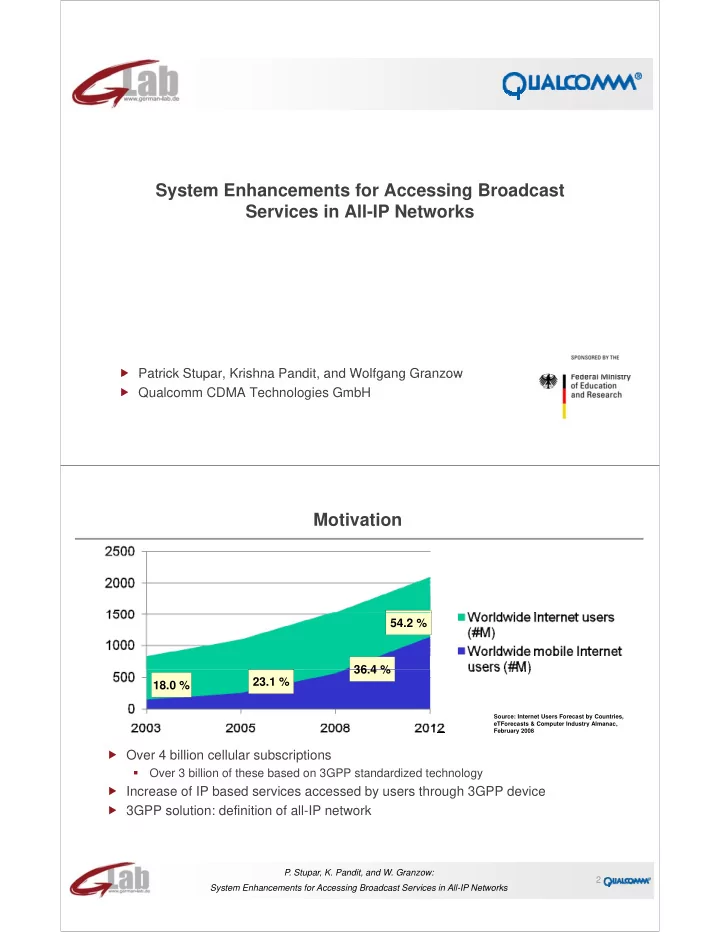
Motivation

36 4 % 54.2 %

Source: Internet Users Forecast by Countries, eTForecasts & Computer Industry Almanac,

18.0 % 23.1 % 36.4 %

 Over 4 billion cellular subscriptions

  • Over 3 billion of these based on 3GPP standardized technology

February 2008

 Increase of IP based services accessed by users through 3GPP device  3GPP solution: definition of all-IP network

2

  • P. Stupar, K. Pandit, and W. Granzow:

System Enhancements for Accessing Broadcast Services in All-IP Networks

slide-2
SLIDE 2

All IP Network definition

 “All IP Network” (AIPN) paradigm

  • The deployment relies on the usage of Internet Protocol (IP) on all the network nodes
  • Every base station implements IP functionalities (acts as an IP access router)

Inter orking bet een different mobile s stems is based on IP

  • Interworking between different mobile systems is based on IP
  • Enables new technologies deployment with minimal extensions to the core network

reducing CAPEX

P bli I t t Trusted non-3GPP Access Public Internet 3GPP Enhanced Packet Core PGW 3GPP GPRS Core ePDG GERAN Access UTRAN Access E-UTRAN Access Untrusted non- 3GPP Access (E.g. WiFi)

3

  • P. Stupar, K. Pandit, and W. Granzow:

System Enhancements for Accessing Broadcast Services in All-IP Networks

Broadcast technology integration in an AIPN

 Challenges for integration of broadcast technology/services in an AIPN

  • The broadcast services rely on a central entity acting as content provider
  • Solutions may require synchronized data packets delivery (see e.g. evolved Multimedia

Broadcast Multicast Service - eMBMS)

 Adopted approach: interworking between broadcast system and AIPN  Adopted approach: interworking between broadcast system and AIPN

  • Provisioning of broadcast services to the user over different access systems
  • Depending e.g. on the user scenario, network load conditions, and radio conditions, the access

system can be dynamically changed

  • Reference architectures: 3GPP Evolved Packet Core (EPC) and eMBMS
  • Reference architectures: 3GPP Evolved Packet Core (EPC) and eMBMS

BM-SC

Content Provider

Trusted non-3GPP Access Public Internet 3GPP Enhanced Packet Core (EPC) MBMS-GW PGW 3GPP GPRS Core Access Packet Core (EPC) ePDG GERAN Access UTRAN Access E-UTRAN Access Untrusted non- 3GPP Access (E.g. WiFi)

4

  • P. Stupar, K. Pandit, and W. Granzow:

System Enhancements for Accessing Broadcast Services in All-IP Networks

(E.g. WiFi)

slide-3
SLIDE 3

EMBMS reference architecture model

  • Provides the eNodeB

MBSFN A

  • Provides the eNodeB

with the multicast related information (defined by MBMS-GW)

  • Admission control

Allocation of radio

MBSFN Area

(Multimedia Broadcast multicast service Single Frequency Network)

  • Allocation of radio

resources

  • Membership function
  • Session and Transmission function
  • Service Announcement function
  • Content synchronization
  • IP multicast

distribution of MBMS user plane data (M1 reference point)

5

  • P. Stupar, K. Pandit, and W. Granzow:

System Enhancements for Accessing Broadcast Services in All-IP Networks

E-UTRAN EPC Public Internet

Interworking scenarios and problem statement

 Interworking scenarios

  • Resources optimization - counting

– Number of users in a MBSFN area is low Unicast channel can be sed to deli er the broadcast ser ice – Unicast channel can be used to deliver the broadcast service

  • Retention priority

– Network can not deliver through broadcast channel all the broadcast services – Broadcast services not delivered through broadcast channel are unicasted Broadcast services not delivered through broadcast channel are unicasted

 Problem statement

  • In the above scenarios the service may stop being available over the broadcast

channel

  • Interrupting the service would mean a bad user experience and is unacceptable for
  • perators
  • WLAN interworking is one option to enable service continuity
  • An architecture and protocols to enable WLAN interworking with the MBMS bearer

An architecture and protocols to enable WLAN interworking with the MBMS bearer service need to be designed

6

  • P. Stupar, K. Pandit, and W. Granzow:

System Enhancements for Accessing Broadcast Services in All-IP Networks

slide-4
SLIDE 4

Possible architectural approaches

 Architecture 1

  • Re-usage of existing interfaces for EPC-WLAN interworking

 Architecture 2

D fi i i f i f b PDG/WLAN d MBMS GW

  • Definition of an interface between ePDG/WLAN and MBMS-GW

 For each considered architectures there are 2 possible solutions based on the IP transmission mode transmission mode

  • Unicast vs. multicast

7

  • P. Stupar, K. Pandit, and W. Granzow:

System Enhancements for Accessing Broadcast Services in All-IP Networks

Architecture 1 – Re-use non-3GPP access architecture

  • IP Access Router for 3GPP access
  • Connects the 3GPP network to public

Internet (through SGi) Anchor mobility among 3GPP and

  • Anchor mobility among 3GPP and

non-3GPP accesses End point of data traffic encryption tunnel

 Two possible flavors

  • Multicast routing in the network between PGW and ePDG/WLAN

8

  • P. Stupar, K. Pandit, and W. Granzow:

System Enhancements for Accessing Broadcast Services in All-IP Networks

  • Unicast tunneling between PGW and UE
slide-5
SLIDE 5

Architecture 1 – Considerations

 IP Multicast based approach

  • The service packets are transmitted on IP multicast through the SGi interface
  • The PDN-GW forward the IP multicast packets to the UE

Impact on the e isting architect re

  • Impact on the existing architecture

– Multicast routing protocol capability is required in

  • PDN-GW
  • Network implementing the SGi interface

Network implementing the SGi interface

  • Network between the ePDG and the PDN-GW

– Multicast routing protocols usage must not taken as granted

  • Several networks do not implement it

 IP Unicast based approach

  • The BM-SC transmits the packets in IP unicast using as IP destination the UE address
  • Impact on the existing architecture

Th PDN GW d t b i f d h th th k t d t b t – The PDN-GW needs to be informed whether the packets need to be sent over WLAN or EPC

9

  • P. Stupar, K. Pandit, and W. Granzow:

System Enhancements for Accessing Broadcast Services in All-IP Networks

Architecture 2 – New interface WLAN and MBMS-GW

 ePDG interface can be based on GTP

  • M1 interface between MBMS GW and eNodeB is GTP based

10

  • P. Stupar, K. Pandit, and W. Granzow:

System Enhancements for Accessing Broadcast Services in All-IP Networks

  • M1 interface between MBMS-GW and eNodeB is GTP based
slide-6
SLIDE 6

Architecture 2 – Considerations

 IP Multicast based approach

  • The service packets are transmitted on IP multicast through the M1 interface as when

sent to the eNodeB

  • Impact on the existing architecture
  • Impact on the existing architecture

– M1 interface between MBMS-GW and ePDG – Control plane interface between ePDG and MME – If the usage of WLAN needs to be selective (e.g. streaming service requires E- g ( g g UTRAN only) BM-SC needs to be “technology” aware

 IP Unicast based approach

  • IP unicast based M1 for E-UTRAN is not specified

N i t t i t b i t d b th MBMS GW i f E UTRAN – No point-to-point bearer is created by the MBMS-GW in case of E-UTRAN

  • If M1 interface can be unicast for E-UTRAN, impact on the existing architecture are:

– Control plane interface between ePDG and MME – If the usage of WLAN needs to be selective (e g streaming service requires E- If the usage of WLAN needs to be selective (e.g. streaming service requires E UTRAN only) BM-SC needs to be WLAN aware

11

  • P. Stupar, K. Pandit, and W. Granzow:

System Enhancements for Accessing Broadcast Services in All-IP Networks

Comparison of 2 architectures

PROS CONS Re-use non-3GPP access multicast Requires no new interfaces Require multicast routing protocol deployment access - multicast interfaces protocol deployment Re-use non-3GPP access unicast

  • Requires no new

interfaces

  • Minimal impact to existing

Non-optimal delivery of traffic access - unicast

  • Minimal impact to existing

architecture p y Interface WLAN and Optimized integration Extensions to existing architecture (control plane MBMS-GW - multicast (traffic not routed through the internet) architecture (control plane MME-ePDG and user plane ePDG-MBMS-GW) Same as m lticast based Same as m lticast based Interface WLAN and MBMS-GW - unicast Same as multicast based solution (M2 interface can implement unicast or multicast) Same as multicast based solution (M2 interface can implement unicast or multicast)

12

  • P. Stupar, K. Pandit, and W. Granzow:

System Enhancements for Accessing Broadcast Services in All-IP Networks

) )

slide-7
SLIDE 7

Conclusions

 Study and analysis of interworking between an AIPN and a broadcast service system

  • Reference: 3GPP eMBMS and EPC architecture

 Identification of scenarios for inter orking bet een AIPN and a broadcast ser ice  Identification of scenarios for interworking between AIPN and a broadcast service system  Proposal of 2 possible approaches suitable for the identified scenarios

  • Architecture 1 – re-usage of existing interfaces

Architecture 1 re usage of existing interfaces

  • Architecture 2 – definition of a new interface

 Comparison of solutions

  • Architecture 1

– Limited impact on existing architecture – Requires transmission of broadcast service through the public Internet (i.e. not controlled by the mobile network operator) A hit t 2

  • Architecture 2

– Higher impact on existing architecture – Keeps transmission of broadcast service within mobile operator network

13

  • P. Stupar, K. Pandit, and W. Granzow:

System Enhancements for Accessing Broadcast Services in All-IP Networks

THANK YOU!

14

  • P. Stupar, K. Pandit, and W. Granzow:

System Enhancements for Accessing Broadcast Services in All-IP Networks