T-79.159 Cryptography and Data Security Lecture 11: Security - - PDF document

t 79 159 cryptography and data security
SMART_READER_LITE
LIVE PREVIEW

T-79.159 Cryptography and Data Security Lecture 11: Security - - PDF document

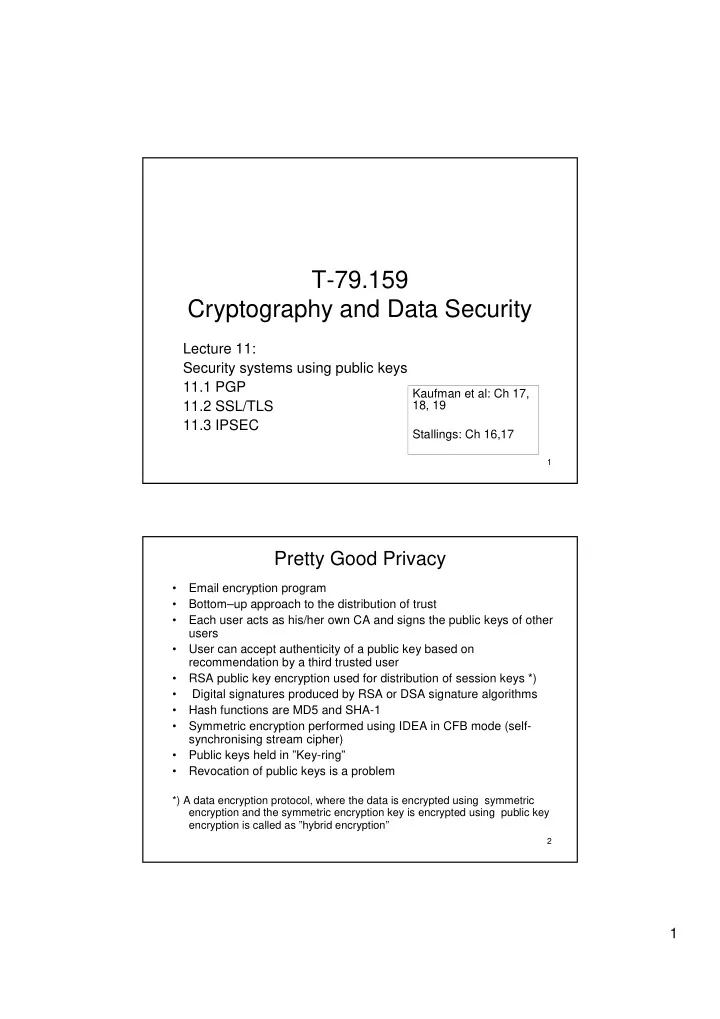
T-79.159 Cryptography and Data Security Lecture 11: Security systems using public keys 11.1 PGP Kaufman et al: Ch 17, 11.2 SSL/TLS 18, 19 11.3 IPSEC Stallings: Ch 16,17 1 Pretty Good Privacy Email encryption program


slide-1
SLIDE 1

1

1

T-79.159 Cryptography and Data Security

Lecture 11: Security systems using public keys 11.1 PGP 11.2 SSL/TLS 11.3 IPSEC

Kaufman et al: Ch 17, 18, 19 Stallings: Ch 16,17

2

Pretty Good Privacy

  • Email encryption program
  • Bottom–up approach to the distribution of trust
  • Each user acts as his/her own CA and signs the public keys of other

users

  • User can accept authenticity of a public key based on

recommendation by a third trusted user

  • RSA public key encryption used for distribution of session keys *)
  • Digital signatures produced by RSA or DSA signature algorithms
  • Hash functions are MD5 and SHA-1
  • Symmetric encryption performed using IDEA in CFB mode (self-

synchronising stream cipher)

  • Public keys held in ”Key-ring”
  • Revocation of public keys is a problem

*) A data encryption protocol, where the data is encrypted using symmetric encryption and the symmetric encryption key is encrypted using public key encryption is called as ”hybrid encryption”

slide-2
SLIDE 2

2

3

Secure Sockets Layer /Transport Layer Security

  • SSL (by Netscape) adds security to the TCP level of the Internet

Protocol stack

  • Reliable end-to-end service.
  • TLS developed by IETF is basically equivalent to SSL v 3.1

Structure:

  • Hypertext Transfer Protocol (Web client/server interaction) an
  • perate on top of SSL

SSL Alert Protocol

SSL Record Protocol TCP IP

SSL Change Cipher Spec Protocol HTTP SSL Handshake Protocol

4

SSL Record Protocol

Application data fragment compressed fragment MAC added encrypted SSL record header appended

slide-3
SLIDE 3

3

5

SSL Record Protocol Crypto

  • The MAC is similar to HMAC (indeed, an early version of HMAC)

with the difference that OPAD and IPAD fields are concatenated to the data (not xored as in HMAC) based on MD5 or SHA-1

  • Block Cipher Algorithms available (key size in bits):

– IDEA (128) – RC2-40 (40) – DES-40 (40) – DES (56) – 3DES (112-168) – Fortezza (Skipjack) (80)

  • Stream Cipher Algorithms available (key size)

– RC4-40 (40) – RC4-128 (128)

6

FORTEZZA

  • FORTEZZA is a registered trademark of the U.S.

National Security Agency (NSA)

– Defense Message System – Encrypted voice communications over secure telephones.

  • FORTEZZA cards

– cryptographic "co-processors" – provide authentication (DSA), data integrity (SHA-1), and confidentiality (KEA and Skipjack).

  • FORTEZZA-enabled devices

– PCMCIA-based crypto cards – serial port devices, Ethernet cards, and modems. – Cellular telephones, pagers, PDAs, and other mobile devices.

  • Microsoft supports FORTEZZA in its products.
slide-4
SLIDE 4

4

7

SSL Handshake Protocol

  • Phase 1: Establishing Security Capabilities

– Nonces – Session ID – Cipher Suite

1. Key Exchange method: RSA, Fixed, ephemeral, or anonymous Diffie-Hellman, Fortezza 2. Cipher Algorithm: Any of the ones mentined above; Cipher type: Stream or Block; Exportability: Yes or No; 3. Hash algorithm: MD5 or SHA-1; Hash size: 0, 16 (MD5), or 20 (SHA-1) 4. Key Material (session key data) and IV size (for CBC mode)

– Compression method

  • Phase 2: Server Authentication and Key Exchange
  • Phase 3: Client Authentication and Key Exchange
  • Phase 4: Finish

– Explicit verification that the authentication and key exchange was successful

8

IPSec

  • The toolbox for building Virtual Private Networks

(VPN)

– Secure branch office connectivity over Internet – Secure Remote Access over Internet – Extranet and Intranet connectivity with partners – Enhanced electronic commerce security

  • Efficient protection if IPSec implemented in firewall
  • IPSec is below transport layer and so is transparent

to applications

  • IPSec is typically transparent to end users
  • IPSec can be used to provide secure remote login for

individual users.

slide-5
SLIDE 5

5

9

Network A

SEGA NEA

Network B

SEGB NEB

10

IP Security Architecture

Specifications: RFC 2401 Architecture RFC 2402 Packet Authentication extension RFC 2406 Packet Encryption Extension RFC 2408 Key Management Capabilities Other documents in the following areas:

  • 1. Architecture: general concepts, security requirements, definitions and

mechanisms

  • 2. Encapsulating Security Payload (ESP)
  • 3. Authentication Header (AH)
  • 4. Encryption Algorithms
  • 5. Authentication Algorithms
  • 6. Key Management Scemes
  • 7. Domain of Interpretation (DoI)
slide-6
SLIDE 6

6

11

End-to-End Security (Transport Mode)

B A B A B A

A B 1 2

data data data

12

VPN Security (Tunnel Mode)

B A 2 1 B A

B A 2 1

A B data data data

slide-7
SLIDE 7

7

13

IP HDR TCP HDR PAYLOAD IP HDR ESP HDR TCP HDR

PAYLOAD

padding MAC

Transport mode:

encrypted integrity protected

TCP HDR

PAYLOAD

IP HDR ESP HDR TCP HDR

PAYLOAD

padding MAC

Tunnel mode:

encrypted integrity protected

IP HDR IP HDR

14

IKEv2

Initiator (i) Responder (r) HDR, SAi1, KEi, Ni HDR, SAr1, KEr, Nr, [CERTREQ] HDR,SK{IDi,[CERT,][CERTREQ,][IDr,]AUTH,SAi2,TSi,TSr} HDR, SK{IDr, [CERT,] AUTH, SAr2, TSi, TSr}

Based on Diffie-Hellman Key Exchange KEi=ga, KEr=gb SK=gab

slide-8
SLIDE 8

8

15

IKEv2

Initiator (i) Responder (r) HDR, SAi1, KEi, Ni HDR, SAr1, KEr, Nr, [CERTREQ] HDR, SK {IDi, [CERTREQ,] [IDr,] SAi2, TSi, TSr} HDR, SK {IDr, [CERT,] AUTH, EAP } HDR, SK {EAP, [AUTH] } HDR, SK {EAP, [AUTH], SAr2, TSi, TSr }

Secure Legacy Authentication (SLA)

Cryptographic binding 16

Legacy Protocols - EAP

  • IETF PPPEXT working group:

RFC 2284 Extensible Authentication Protocol (EAP)

  • EAP is not an authentication protocol in itself, but a standard way of

encapsulating an authentication protocol.

  • Composed of message pairs: EAP_Request - EAP_Response; final

pair: EAP_Success/EAP_Failure

  • EAP types have been standardised (”legacy” protocols):

RFC2716: PPP EAP TLS Authentication Protocol – Internet Drafts: EAP SIM Authentication EAP AKA Authentication Protected EAP Protocol (PEAP) EAP-SKE authentication and key exchange protocol Microsoft EAP CHAP Extensions The EAP GPRS Protocol (EAP-GPRS)