
3HP2-9 1
The Cooling and Safety Design of a Pair of Binary Leads for the MICE Coupling Magnets
- L. Wang, S. Sun, Y. Cao, L. X. Yin, X. L. Guo, H. Pan, M. A. Green, Senior Member, IEEE, D. R. Li, A.
Demello, and S. P. Virostek
Abstract—The key to being able to operate the superconducting solenoids in the Muon Ionization Cooling Experiment (MICE) using cryocoolers running at around 4.2 K is the application of high temperature superconducting (HTS) leads. Because the MICE magnets are not shielded, all of them will have a stray magnetic field in the region where the coolers and the HTS leads are located. The behavior of the HTS leads depends strongly on the HTS material used for the leads, the magnetic field and their warm end temperature. A pair of binary leads consisting of copper leads and HTS leads made from oriented multiple strands
- f BSCCO wires will be used for electrical transfer of the MICE
coupling magnet for the purpose of reducing the heat leak through the leads to 4.2 K region. This paper mainly discusses the detailed design of the HTS leads and their cooling. Protection for the HTS leads during a power failure is discussed as well. Index Terms—Cu leads, HTS leads, and safety design.
- I. INTRODUCTION
HE Muon Ionization Cooling Experiment, to be operated at the Rutherford Appleton Laboratory in UK, will provide the first demonstration of the muon ionization cooling technique, which is critical to the success of a future muon-based accelerator and neutrino factory [1]. A pair of superconducting coupling magnets will be used for the MICE cooling channel in order to keep the beam from expanding beyond the edge of the RF cavity thin windows, through which the muon beam passes [2]. The magnet is a single solenoid coil with an inner diameter of 1.5 m and a length of 281 mm, which is designed to be cooled by cryocoolers [3]. It will be powered by using a unipolar 300 A/0-20 V power supply and its maximum operation current is 210 A while the MICE cooling channel runs at gradient mode [1]. In order to reduce the heat leak induced directly from room temperature to 4.2 K, a pair of binary current leads composed
- f conventional copper leads and high temperature
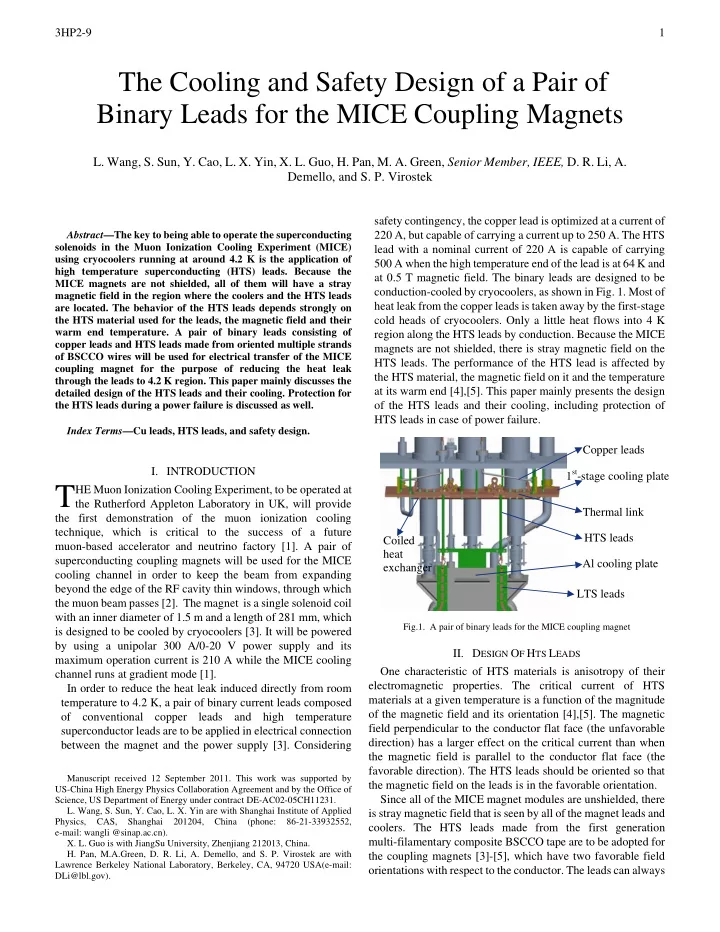
superconductor leads are to be applied in electrical connection between the magnet and the power supply [3]. Considering safety contingency, the copper lead is optimized at a current of 220 A, but capable of carrying a current up to 250 A. The HTS lead with a nominal current of 220 A is capable of carrying 500 A when the high temperature end of the lead is at 64 K and at 0.5 T magnetic field. The binary leads are designed to be conduction-cooled by cryocoolers, as shown in Fig. 1. Most of heat leak from the copper leads is taken away by the first-stage cold heads of cryocoolers. Only a little heat flows into 4 K region along the HTS leads by conduction. Because the MICE magnets are not shielded, there is stray magnetic field on the HTS leads. The performance of the HTS lead is affected by the HTS material, the magnetic field on it and the temperature at its warm end [4],[5]. This paper mainly presents the design
- f the HTS leads and their cooling, including protection of
HTS leads in case of power failure.
c.cn). Manuscript received 12 September 2011. This work was supported by US-China High Energy Physics Collaboration Agreement and by the Office of Science, US Department of Energy under contract DE-AC02-05CH11231.
- L. Wang, S. Sun, Y. Cao, L. X. Yin are with Shanghai Institute of Applied
Physics, CAS, Shanghai 201204, China (phone: 86-21-33932552, e-mail: wangli @sinap.a
- X. L. Guo is with JiangSu University, Zhenjiang 212013, China.
- H. Pan, M.A.Green, D. R. Li, A. Demello, and S. P. Virostek are with
Lawrence Berkeley National Laboratory, Berkeley, CA, 94720 USA(e-mail: DLi@lbl.gov).
Copper leads 1st-stage cooling plate
Fig.1. A pair of binary leads for the MICE coupling magnet
- II. DESIGN OF HTS LEADS
One characteristic of HTS materials is anisotropy of their electromagnetic properties. The critical current of HTS materials at a given temperature is a function of the magnitude
- f the magnetic field and its orientation [4],[5]. The magnetic
field perpendicular to the conductor flat face (the unfavorable direction) has a larger effect on the critical current than when the magnetic field is parallel to the conductor flat face (the favorable direction). The HTS leads should be oriented so that the magnetic field on the leads is in the favorable orientation. Since all of the MICE magnet modules are unshielded, there is stray magnetic field that is seen by all of the magnet leads and
- coolers. The HTS leads made from the first generation
multi-filamentary composite BSCCO tape are to be adopted for the coupling magnets [3]-[5], which have two favorable field
- rientations with respect to the conductor. The leads can always
T
Thermal link HTS leads Coiled heat exchanger Al cooling plate LTS leads