"T "To a man with a hammer, ith h everything looks like - - PowerPoint PPT Presentation

t to a man with a hammer ith h everything looks like a
SMART_READER_LITE
LIVE PREVIEW

"T "To a man with a hammer, ith h everything looks like - - PowerPoint PPT Presentation

Topic 9 Introduction to Recursion I t d ti t R i Underneath the Hood. "T "To a man with a hammer, ith h everything looks like a nail everything looks like a nail" -Mark Twain Mark Twain CS 307 Fundamentals of CS 307


slide-1
SLIDE 1

Topic 9 I t d ti t R i Introduction to Recursion

"T ith h "To a man with a hammer, everything looks like a nail" everything looks like a nail

  • Mark Twain

Mark Twain

CS 307 Fundamentals of Computer Science Introduction to Recursion

1

Underneath the Hood.

CS 307 Fundamentals of Computer Science Introduction to Recursion

2

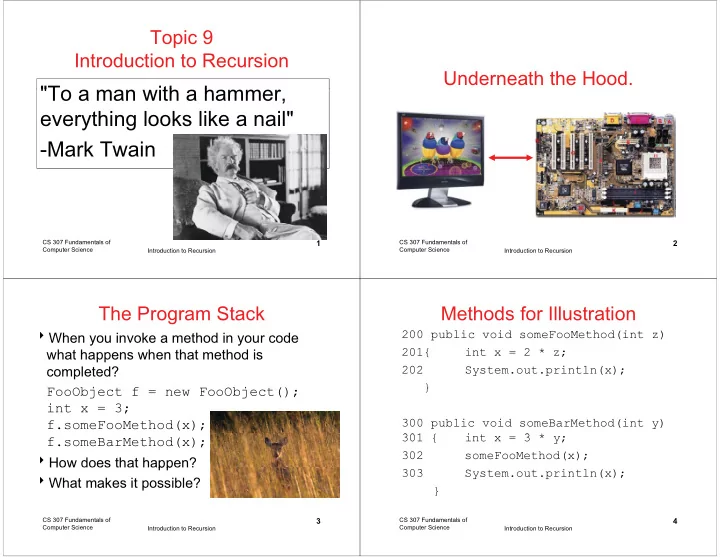
The Program Stack

When you invoke a method in your code what happens when that method is completed? FooObject f = new FooObject(); int x = 3; f.someFooMethod(x); f.someBarMethod(x); How does that happen? pp What makes it possible?

CS 307 Fundamentals of Computer Science Introduction to Recursion

3

Methods for Illustration

200 bli id F M th d(i t ) 200 public void someFooMethod(int z) 201{ int x = 2 * z; 202 i l ( ) 202 System.out.println(x); } 300 public void someBarMethod(int y) 301 { i 3 * 301 { int x = 3 * y; 302 someFooMethod(x); 303 System.out.println(x); }

CS 307 Fundamentals of Computer Science Introduction to Recursion

4

slide-2
SLIDE 2

The Program Stack

When your program is executed on a processor the commands are converted into another set of instructions and assigned memory locations.

– normally a great deal of expansion takes place 101 FooObject f = new FooObject(); 102 int x = 3; 103 f.someFooMethod(x); 104 f h d( ) 104 f.someBarMethod(x); Von Neumann Architecture

CS 307 Fundamentals of Computer Science Introduction to Recursion

5

Basic CPU Operations

A CPU k i f t h A CPU works via a fetch command / execute command loop and a program counter loop and a program counter Instructions stored in memory (Just like data!) (Just like data!)

101 FooObject f = new FooObject(); j j (); 102 int x = 3; 103 f.someFooMethod(x); 104 f B M th d( ) 104 f.someBarMethod(x);

What if someFooMethod is stored at memory location 200?

CS 307 Fundamentals of Computer Science Introduction to Recursion

6

memory location 200?

More on the Program Stack

101 FooObject f = new FooObject(); 102 int x = 3; 103 f.someFooMethod(x); 104 f.someBarMethod(x); Line 103 is really saying go to line 200 with f as the implicit parameter and x as the explicit parameter

When someFooMethod is done what happens? pp

  • A. Program ends
  • B. goes to line 103

C Goes back to whatever method called it

CS 307 Fundamentals of Computer Science Introduction to Recursion

7

  • C. Goes back to whatever method called it

Activation Records and the Program Stack Program Stack

When a method is invoked all the relevant i f ti b t th t th d information about the current method (variables, values of variables, next line of d t b t d) i l d i code to be executed) is placed in an activation record The activation record is pushed onto the program stack A stack is a data structure with a single access point, the top.

CS 307 Fundamentals of Computer Science Introduction to Recursion

8

p , p

slide-3
SLIDE 3

The Program Stack

Data may either be added (pushed) or removed (popped) from a stack but it is always f

top

from the top.

– A stack of dishes – which dish do we have easy access to?

CS 307 Fundamentals of Computer Science Introduction to Recursion

9

Using Recursion Using Recursion

CS 307 Fundamentals of Computer Science Introduction to Recursion

10

A Problem

W it th d th t d t i h h i t k Write a method that determines how much space is take up by the files in a directory A directory can contain files and directories A directory can contain files and directories How many directories does our code have to examine? How would you add up the space taken up by the files in a single directory

– Hint: don't worry about any sub directories at first

Directory and File classes Directory and File classes in the Directory class:

public File[] getFiles() public Directory[] getSubdirectories()

in the File class

bli i t tSi ()

CS 307 Fundamentals of Computer Science Introduction to Recursion

11

public int getSize()

Attendance Question 2

How many levels of directories have to be visited?

  • A. 0
  • B. Unknown

U

  • C. Infinite

D 1

  • D. 1
  • E. 8

CS 307 Fundamentals of Computer Science

Introduction to Recursion

12

slide-4
SLIDE 4

Sample Directory Structure

scottm cs307 AP

m1.txt m2.txt A.pdf

hw

AB.pdf a1.htm a2.htm a3.htm a4.htm

CS 307 Fundamentals of Computer Science Introduction to Recursion

13

Code for getDirectorySpace()

bli i t tDi t S (Di t d) public int getDirectorySpace(Directory d) { int total = 0; File[] fileList = d.getFiles(); e[] e st d.get es(); for(int i = 0; i < fileList.length; i++) total += fileList[i].getSize(); Directory[] dirList = d.getSubdirectories(); for(int i = 0; i < dirList.length; i++) t t l + tDi t S (di Li t[i]) total += getDirectorySpace(dirList[i]); return total; }

CS 307 Fundamentals of Computer Science Introduction to Recursion

14

Attendance Question 3

Is it possible to write a non recursive method to do this?

  • A. Yes
  • B. No

CS 307 Fundamentals of Computer Science

Introduction to Recursion

15

Iterative getDirectorySpace()

public int getDirectorySpace(Directory d) public int getDirectorySpace(Directory d) { ArrayList dirs = new ArrayList(); File[] fileList; Directory[] dirList; y dirs.add(d); Directory temp; int total = 0; hil ( ! di i () ) while( ! dirs.isEmpty() ) { temp = (Directory)dirs.remove(0); fileList = temp.getFiles(); for(int i = 0; i < fileList length; i++) for(int i 0; i < fileList.length; i++) total += fileList[i].getSize(); dirList = temp.getSubdirectories(); for(int i =0; i < dirList.length; i++) dirs.add( dirList[i] ); } return total; }

CS 307 Fundamentals of Computer Science Introduction to Recursion

16 }

slide-5
SLIDE 5

Simple Recursion Examples Simple Recursion Examples

CS 307 Fundamentals of Computer Science Introduction to Recursion

17

Wisdom for Writing Recursive Methods

CS 307 Fundamentals of Computer Science Introduction to Recursion

18

The 3 plus 1 rules of Recursion

  • 1. Know when to stop
  • 2. Decide how to take one step
  • 3. Break the journey down into that step and a

smaller journey s a e jou ey

  • 4. Have faith

From Common Lisp: A Gentle Introduction to Introduction to Symbolic Computation by David Touretzky

CS 307 Fundamentals of Computer Science Introduction to Recursion

19

Writing Recursive Methods

R l f R i Rules of Recursion

  • 1. Base Case: Always have at least one case that

can be solved without using recursion can be solved without using recursion

  • 2. Make Progress: Any recursive call must

progress toward a base case. progress toward a base case.

  • 3. "You gotta believe." Always assume that the

recursive call works. (Of course you will have to design it and test it to see if it works or prove that it always works.)

A recursive solution solves a small part of A recursive solution solves a small part of the problem and leaves the rest of the problem in the same form as the original

CS 307 Fundamentals of Computer Science Introduction to Recursion

20

problem in the same form as the original

slide-6
SLIDE 6

N!

the classic first recursion problem / example N!

5! = 5 * 4 * 3 * 2 * 1 = 120 int res = 1; for(int i = 2; i <= n; i++) res *= i;

CS 307 Fundamentals of Computer Science Introduction to Recursion

21

Factorial Recursively

Mathematical Definition of Factorial 0! = 1 N! = N * (N - 1)! The definition is recursive.

// pre n >= 0 public int fact(int n) { if(n == 0) { ( ) return 1; else return n * fact(n 1); return n * fact(n-1); }

CS 307 Fundamentals of Computer Science Introduction to Recursion

22

Big O and Recursion

Determining the Big O of recursive methods can be tricky. A recurrence relation exits if the function is defined recursively. The T(N), actual running time, for N! is recursive ecu s e T(N)fact = T(N-1)fact + O(1) This turns out to be O(N) This turns out to be O(N)

– There are N steps involved

CS 307 Fundamentals of Computer Science Introduction to Recursion

23

Common Recurrence Relations

T(N) T(N/2) + O(1) > O(l N) T(N) = T(N/2) + O(1) -> O(logN)

– binary search

T(N) = T(N-1) + O(1) -> O(N) T(N) = T(N-1) + O(1) -> O(N)

– sequential search, factorial

T(N) = T(N/2) + T(N/2) + O(1) -> O(N), ( ) ( ) ( ) ( ) ( ),

– tree traversal

T(N) = T(N-1) + O(N) -> O(N^2)

– selection sort

T(N) = T(N/2) + T(N/2) + O(N) -> O(NlogN)

t – merge sort

T(N) = T(N-1) + T(N-1) + O(1) -> O(2^N)

– Fibonacci

CS 307 Fundamentals of Computer Science Introduction to Recursion

24

– Fibonacci

slide-7
SLIDE 7

Tracing Fact With the Program Stack Program Stack

System.out.println( fact(4) ); System.out.println( fact(4) );

CS 307 Fundamentals of Computer Science Introduction to Recursion

25

System.out.println( fact(4) );

top

Calling fact with 4

4 in method fact n 4

partial result = n * fact(n-1)

in method fact

CS 307 Fundamentals of Computer Science Introduction to Recursion

26

System.out.println( fact(4) );

top

Calling fact with 3

n 3 in method fact 4 i th d f t n

partial result = n * fact(n-1)

top n 4

partial result = n * fact(n-1)

in method fact

CS 307 Fundamentals of Computer Science Introduction to Recursion

27

System.out.println( fact(4) );

Calling fact with 2

n 2 in method fact top n 3 in method fact

partial result = n * fact(n-1)

top 4 i h d f n

partial result = n * fact(n-1)

in method fact n 4

partial result = n * fact(n-1)

in method fact

CS 307 Fundamentals of Computer Science Introduction to Recursion

28

System.out.println( fact(4) );

slide-8
SLIDE 8

Calling fact with 1

n 1

partial result = n * fact(n-1)

in method fact top n 2 in method fact

partial result n fact(n 1)

n 3 in method fact

partial result = n * fact(n-1)

4 i h d f n

partial result = n * fact(n-1)

in method fact n 4

partial result = n * fact(n-1)

in method fact

CS 307 Fundamentals of Computer Science Introduction to Recursion

29

System.out.println( fact(4) );

Calling fact with 0 and returning 1

n in method fact t n 1 in method fact n

returning 1 to whatever method called me

top n 2 in method fact n 1

partial result = n * fact(n-1)

in method fact n 2

partial result = n * fact(n-1)

in method fact n 3

partial result = n * fact(n-1)

in method fact n 4

partial result = n * fact(n 1)

in method fact

CS 307 Fundamentals of Computer Science Introduction to Recursion

30

System.out.println( fact(4) ); partial result = n * fact(n-1)

Returning 1 from fact(1)

n 1

partial result = n * 1, 1 h h d ll d

in method fact top n 2 in method fact

return 1 to whatever method called me

n 3 in method fact

partial result = n * fact(n-1)

n 3

partial result = n * fact(n-1)

in method fact n 4

partial result = n * fact(n-1)

in method fact

CS 307 Fundamentals of Computer Science Introduction to Recursion

31

System.out.println( fact(4) );

Returning 2 from fact(2)

n 2 in method fact

partial result = 2 * 1, return 2 to whatever method called me

top n 3

partial result = n * fact(n-1)

in method fact n 4

ti l lt * f t( 1)

in method fact

p ( ) System.out.println( fact(4) ); partial result = n * fact(n-1)

CS 307 Fundamentals of Computer Science Introduction to Recursion

32

slide-9
SLIDE 9

Returning 6 from fact(3)

n 3 in method fact n 3 in method fact

partial result = 3 * 2, return 6 to whatever method called me

top n 4

ti l lt * f t( 1)

in method fact

return 6 to whatever method called me System.out.println( fact(4) ); partial result = n * fact(n-1)

CS 307 Fundamentals of Computer Science Introduction to Recursion

33

Returning 24 from fact(4)

n 4 in method fact

partial result = 4 * 6, System.out.println( fact(4) );

top

return 24 to whatever method called me

CS 307 Fundamentals of Computer Science Introduction to Recursion

34

Calling System.out.println

System.out.println( 24 );

top ??

CS 307 Fundamentals of Computer Science Introduction to Recursion

35

Evaluating Recursive Methods Evaluating Recursive Methods

CS 307 Fundamentals of Computer Science Introduction to Recursion

36

slide-10
SLIDE 10

Evaluating Recursive Methods

you must be able to evaluate recursive methods public static int mystery (int n){ if( n == 0 ) ( ) return 1; else else return 3 * mystery(n-1); } // what is returned by mystery(5)

CS 307 Fundamentals of Computer Science Introduction to Recursion

37

Evaluating Recursive Methods

Draw the program stack!

m(5) = 3 * m(4) ( ) ( ) m(4) = 3 * m(3) m(3) = 3 * m(2) m(3) 3 m(2) m(2) = 3 * m(1) m(1) = 3 * m(0) m(1) 3 m(0) m(0) = 1

  • > 3^5 = 243

with practice you can see the result

  • > 3 5 = 243

CS 307 Fundamentals of Computer Science Introduction to Recursion

38

Attendance Question 4

Wh t i t d b ? What is returned by mystery(-3) ?

  • A. 0
  • B. 1

C Infinite loop

  • C. Infinite loop
  • D. Syntax error

E R i d k fl

  • E. Runtime error due to stack overflow

CS 307 Fundamentals of Computer Science

Introduction to Recursion

39

Evaluating Recursive Methods

What about multiple recursive calls?

public static int bar(int n){ if( n <= 0 ) return 2; else return 3 + bar(n-1) + bar(n-2); }

Draw the program stack and REMEMBER Draw the program stack and REMEMBER your work

CS 307 Fundamentals of Computer Science Introduction to Recursion

40

slide-11
SLIDE 11

Evaluating Recursive Methods

Wh t i t d b ? What is returned by bar(5)? b(5) = 3 + b(4) + b(3) b(4) = 3 + b(3) + b(2) b(3) = 3 + b(2) + b(1) b(3) = 3 + b(2) + b(1) b(2) = 3 + b(1) + b(0) b(1) 3 b(0) b( 1) b(1) = 3 + b(0) + b(-1) b(0) = 2 b(-1) = 2

CS 307 Fundamentals of Computer Science Introduction to Recursion

41

Evaluating Recursive Methods

Wh t i t d b ? What is returned by bar(5)? b(5) = 3 + b(4) + b(3) b(4) = 3 + b(3) + b(2) b(3) = 3 + b(2) + b(1) b(3) = 3 + b(2) + b(1) b(2) = 3 + b(1) + b(0) //substitute in results b(1) 3 2 2 b(1) = 3 + 2 + 2 = 7 b(0) = 2 b(-1) = 2

CS 307 Fundamentals of Computer Science Introduction to Recursion

42

Evaluating Recursive Methods

Wh t i t d b ? What is returned by bar(5)? b(5) = 3 + b(4) + b(3) b(4) = 3 + b(3) + b(2) b(3) = 3 + b(2) + b(1) b(3) = 3 + b(2) + b(1) b(2) = 3 + 7 + 2 =12 b(1) b(1) = 7 b(0) = 2 b(-1) = 2

CS 307 Fundamentals of Computer Science Introduction to Recursion

43

Evaluating Recursive Methods

Wh t i t d b ? What is returned by bar(5)? b(5) = 3 + b(4) + b(3) b(4) = 3 + b(3) + b(2) b(3) = 3 + 12 + 7 = 22 b(3) = 3 + 12 + 7 = 22 b(2) = 12 b(1) b(1) = 7 b(0) = 2 b(-1) = 2

CS 307 Fundamentals of Computer Science Introduction to Recursion

44

slide-12
SLIDE 12

Evaluating Recursive Methods

Wh t i t d b ? What is returned by bar(5)? b(5) = 3 + b(4) + b(3) b(4) = 3 + 22 + 12 = 37 b(3) = 22 b(3) = 22 b(2) = 12 b(1) b(1) = 7 b(0) = 2 b(-1) = 2

CS 307 Fundamentals of Computer Science Introduction to Recursion

45

Evaluating Recursive Methods

Wh t i t d b ? What is returned by bar(5)? b(5) = 3 + 37 + 22 = 62 b(4) = 37 b(3) = 22 b(3) = 22 b(2) = 12 b(1) b(1) = 7 b(0) = 2 b(-1) = 2

CS 307 Fundamentals of Computer Science Introduction to Recursion

46

Unplugged Activity

Double the number of pieces of candy in a bowl. Only commands we know are:

– take one candy out of bowl and put into infinite supply – take one candy from infinite supply and place in bowl – do nothing d bl h b f i f d i h b l – double the number of pieces of candy in the bowl

Thanks Stuart Reges

CS 307 Fundamentals of Computer Science Introduction to Recursion

47

g

Recursion Practice

W it th d i T P (i t b Write a method raiseToPower(int base, int power) // //pre: power >= 0 Tail recursion refers to a method where the recursive call is the last thing in the method

CS 307 Fundamentals of Computer Science Introduction to Recursion

48

g

slide-13
SLIDE 13

Finding the Maximum in an Array

public int max(int[] values){ Helper method or create smaller arrays each time

CS 307 Fundamentals of Computer Science Introduction to Recursion

49

Attendance Question 5

When writing recursive methods what should be done first?

  • A. Determine recursive case
  • B. Determine recursive step

ete e ecu s e step

  • C. Make recursive call

D Determine base case(s)

  • D. Determine base case(s)
  • E. Determine Big O

CS 307 Fundamentals of Computer Science

Introduction to Recursion

50

Your Meta Cognitive State

Remember we are learning to use a tool. It is not a good tool for all problems.

– In fact we will implement several algorithms and methods where an iterative (looping without recursion) solution would work just fine

After learning the mechanics and basics of recursion the real skill is knowing what problems or class of problems to apply it to

CS 307 Fundamentals of Computer Science Introduction to Recursion

51

A Harder(??) Problem

CS 307 Fundamentals of Computer Science Introduction to Recursion

52

slide-14
SLIDE 14

Mine Sweeper

Game made popular due to its inclusion with Windows (from 3.1 on) What happens when you click on a cell that has 0 (zero) mines bordering it?

Result of Result of clicking marked marked cell.

CS 307 Fundamentals of Computer Science Introduction to Recursion

53

The update method

Initially called with the x and y coordinates of a cell with a 0 inside it meaning the cell does not have any bombs bordering it. Must reveal all cells neighboring this one and if any of them are 0s do the same thing

2

  • 1

2 2 1 2 2

  • 1

3 2 2 1 1 1 3

  • 1
  • 1

1

  • 1 indicates a

2

  • 1

3 1 1 1 1

mine in that cell

CS 307 Fundamentals of Computer Science Introduction to Recursion

54

Update Code

CS 307 Fundamentals of Computer Science Introduction to Recursion

55