Table of Contents - - PDF document

table of contents
SMART_READER_LITE
LIVE PREVIEW

Table of Contents - - PDF document

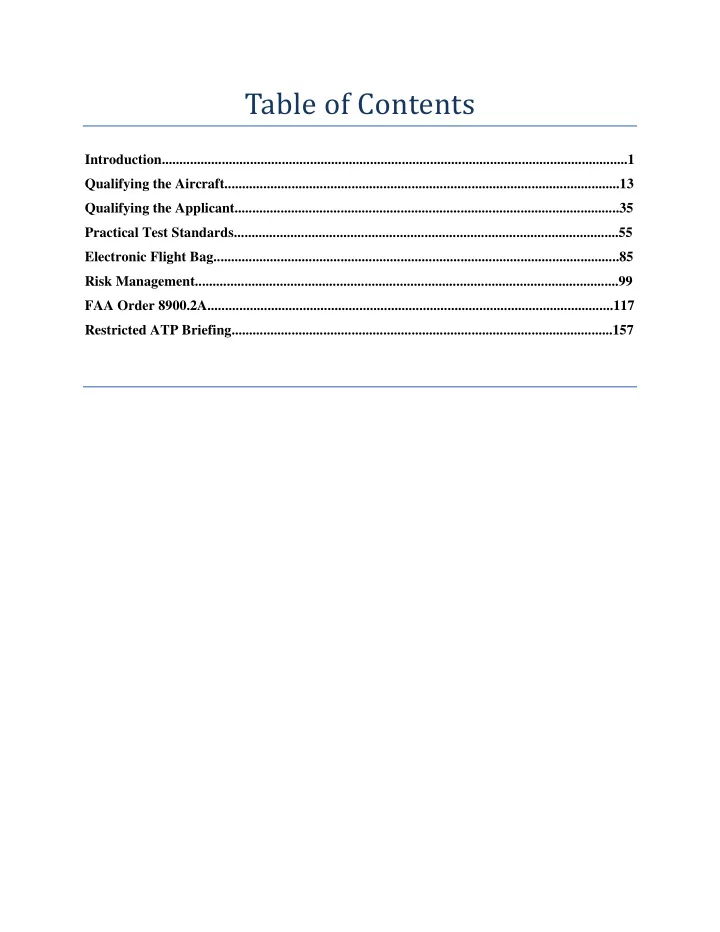
Table of Contents Introduction....................................................................................................................................1 Qualifying the


slide-1
SLIDE 1

Table of Contents

Introduction....................................................................................................................................1 Qualifying the Aircraft................................................................................................................13 Qualifying the Applicant.............................................................................................................35 Practical Test Standards.............................................................................................................55 Electronic Flight Bag...................................................................................................................85 Risk Management........................................................................................................................99 FAA Order 8900.2A...................................................................................................................117 Restricted ATP Briefing............................................................................................................157

slide-2
SLIDE 2
slide-3
SLIDE 3

Federal Aviation Administration

Presented to: Designated Pilot Examiners By: AFS-640 Date: FY2015

Designated Pilot Examiner Recurrent Training

Introduction

Federal Aviation Administration Recurrent DPE Training, Part II FY2015

Federal Aviation Administration Designee Standardization Branch, AFS-640 P.O. Box 25082 Oklahoma City, OK 73125-5029 (405) 954-4220 FAX: (405) 954-4748

Designee Standardization Branch Mailing Address

2

1

slide-4
SLIDE 4

Federal Aviation Administration Recurrent DPE Training, Part II FY2015

AFS-640 Designee Standardization Branch Organizational Chart

Larry West AFS 640, Branch Manager

Todd Burk, DPE Recurrent Course Manager Operations Inspector/Instructor Kelly Sweeten DPE Initial Course Manager Operations Inspector/Instructor Randy Burke Operations Inspector/Instructor Mark Rogers DPE Online Course Manager Operations Inspector/Instructor

3 Federal Aviation Administration Recurrent DPE Training, Part II FY2015

Larry West AFS-640 Branch Manager Sandra Stratton Instructional Systems Specialist Tony Marci Instructional Systems Specialist Denna Lamson Program Management Analyst

AFS-640 Designee Standardization Branch Organizational Chart

4

2

slide-5
SLIDE 5

Federal Aviation Administration Recurrent DPE Training, Part II FY2015

AFS-610 Light Sport Branch Organizational Chart

5

Mike Sees AFS-610 Branch Manager Larry Clymer ASI, Operations Mark Aldridge ASI, Operations Edsel Ford ASI, Airworthiness

Federal Aviation Administration Recurrent DPE Training, Part II FY2015

RANDY BURKE

Randy Burke Randy Burke To Todd Burk dd Burk

TODD BURK

Kelly Sweeten Kelly Sweeten

KELLY SWEETEN

Mark Rogers Mark Rogers

MARK ROGERS

Sign In Sheet

6

3

slide-6
SLIDE 6

Federal Aviation Administration Recurrent DPE Training, Part II FY2015

3/30/2010 Kenneth G. Pannell Po box 25082 Oklahoma City, OK, 73125 United States Thank you for attending the Recurrent Designated Pilot Examiner Seminar. Please click on the following link to fill out your course evaluation and ask any questions you would like answered. https://av-info.faa.gov/DsgReg/Enroll/Certificate.aspx?cn=3304045327 To view and print your Certification of Completion, click the link below. https://av-info.faa.gov/DsgReg/Enroll/Certificate.aspx?cn=760910025018 Thank you, Federal Aviation Administration AFS-640, Designee Standardization Branch

Feedback on AFS-640 Recurrent Seminar

7

Course Completion Certificate Online Course Critique

Federal Aviation Administration Recurrent DPE Training, Part II FY2015

Completion Certificate

8

05/22/2015

4

slide-7
SLIDE 7

Federal Aviation Administration Recurrent DPE Training, Part II FY2015

Seminar Material Covers National Policy Only

9 Federal Aviation Administration Recurrent DPE Training, Part II FY2015

http://www.academy.faa.gov/afs650/designee_feedback.asp

Feedback on Regulations, Orders, & Policy

10

5

slide-8
SLIDE 8

Federal Aviation Administration Recurrent DPE Training, Part II FY2015

EOC Test Lectures

Seminar Hours

Class Begins 8:00 AM 1 hour Lunch Class Ends 5:00 PM

11

Class Discussion

Federal Aviation Administration Recurrent DPE Training, Part II FY2015

Break Times

  • We will attempt to allow a 10 minute break each

hour during class.

  • Be back promptly

12

6

slide-9
SLIDE 9

Federal Aviation Administration Recurrent DPE Training, Part II FY2015

Please set to “OFF” or “VIBRATE” & NO Texting during class

Cell Phones

13 Federal Aviation Administration Recurrent DPE Training, Part II FY2015

Course Objective

14

  • Given the DPE Recurrent Course Part I (on-line),

the DPE Recurrent Course Part II (classroom lectures), & a comprehensive end-of course test, you will identify key components of the airman certification process.

7

slide-10
SLIDE 10

Federal Aviation Administration Recurrent DPE Training, Part II FY2015

Course Outline

1) Course Introduction 2) Qualifying the Aircraft 3) Qualifying the Applicant 4) Practical Test Standards 5) Electronic Flight Bags 6) Risk Management 7) FAA Order 8900.2

15 Federal Aviation Administration Recurrent DPE Training, Part II FY2015

Interactive Turning Point Response Cards A Response Card has been assigned to each student. Do NOT trade Response Cards with another student!

16

8

slide-11
SLIDE 11

Federal Aviation Administration Recurrent DPE Training, Part II FY2015

Operating The TP Response Cards

17

Your TP Selector has been set to Presentation Mode and on Channel 17 You do NOT need to press Menu button before each response

CH# 17

Presentation Mode Channel 17 Federal Aviation Administration Recurrent DPE Training, Part II FY2015

Answer Displayed

18

CH# 17

Your Answer:

1/A

Your answer will be displayed briefly – then the unit will go into a “power save” mode. If your answer is A, press ONLY “1/A” on your Response Card. The checkmark indicates your answer was received.

9

slide-12
SLIDE 12

Federal Aviation Administration Recurrent DPE Training, Part II FY2015

Changing Your Answer

19

As long as polling is open, you can change your answer by pressing any other key.

Polling Open

CH# 17

Your Answer:

1/A

CH# 17

Your Answer:

2/B

CH# 17

Your Answer:

3/C

CH# 17

Your Answer:

4/D

Federal Aviation Administration Recurrent DPE Training, Part II FY2015

Polling will automatically close when timer reaches “00” - or

  • nce all participants have

submitted an answer When polling is closed and you try to change your answer, you will see the message “Not accepting answers”.

00

Polling Closed

Changing Your Answer (Cont’d)

20

CH# 17

Not Accepting Answers!

10

slide-13
SLIDE 13

Federal Aviation Administration Recurrent DPE Training, Part II FY2015 21

Designee Vision

  • In the future, designees will be used in increasing

numbers and given new responsibilities

  • The designee role is vital to the success of the

aviation community, as it provides the foundation for evaluation of FAA certificate applicants

Federal Aviation Administration Recurrent DPE Training, Part II FY2015 22

Any Questions?

11

slide-14
SLIDE 14

12

slide-15
SLIDE 15

Federal Aviation Administration

Presented to: Designated Pilot Examiners By: AFS-640 Date: FY 2015

Designated Pilot Examiner Recurrent Training

Qualifying the Aircraft

Federal Aviation Administration Recurrent DPE Training, Part II FY 2015

2

Objectives

  • On an End-of-Course Test, and IAW Parts

39,43,61,91 you will identify, if applicable:

– Airworthiness and Registration Certificates – Operating Limitation Placards Instrument markings POH/AFM – Weight and Balance Data and Equipment List 13

slide-16
SLIDE 16

Federal Aviation Administration Recurrent DPE Training, Part II FY 2015

3

Prerequisites Overview

  • The following items will be covered:

– Airworthiness and Registration Certificates – Operating Limitations Placards Instrument markings – POH/AFM – Proper Logbook Entries – Weight and Balance Data and Equipment List – Required Instruments and Equipment for Day and Night VFR – Determining Airworthiness of the airplane with inoperative Instruments and Equipment with and without an MEL

Federal Aviation Administration Recurrent DPE Training, Part II FY 2015

4

Scenario

  • A private pilot applicant presents his application

(8710-1, 8710-11) and aircraft logbooks.

  • During a review of the aircraft logbooks you

discover that a propeller AD may not have been complied with…

14

slide-17
SLIDE 17

Federal Aviation Administration Recurrent DPE Training, Part II FY 2015

5

What action should be taken?

1. Issue a Notice of Disapproval 2. Start the test and see if the applicant catches the discrepancy 3. Advise the applicant of the discrepancy and see if it can be

  • resolved. If not, do not begin the test.

4. Test this task orally

1. 2. 3. 4.

0% 0% 0% 0%

15

Response Counter

Federal Aviation Administration Recurrent DPE Training, Part II FY 2015

6

Qualifying the Aircraft

  • FAA Order 8900.2 requires that the Examiner

review the following prior to beginning the practical test:

– Maintenance records – Aircraft logbooks – Airworthiness certificate – Radio Station License (if required) – Aircraft registration 15

slide-18
SLIDE 18

Federal Aviation Administration Recurrent DPE Training, Part II FY 2015

7

Standard Airworthiness Certificate

Federal Aviation Administration Recurrent DPE Training, Part II FY 2015

8

Safe For Flight

  • What is meant by the term "in a condition for safe
  • peration?"

16

slide-19
SLIDE 19

Federal Aviation Administration Recurrent DPE Training, Part II FY 2015

9

Aircraft Registration

  • Registration Certificates now have an Expiration

date! If it is expired:

– You can renew online however you must be in possession of a valid certificate. – Takes 3 weeks from application to issuing registration.

14 CFR Part 47 Federal Aviation Administration Recurrent DPE Training, Part II FY 2015

10

Aircraft Registration

  • Verify the N-Number matches the Aircraft

Registration, Data Plate, and Tail Number

  • Make sure signature is legible, not faded.
  • Aircraft Make and Model is correct
  • Serial Number is correct

17

slide-20
SLIDE 20

Federal Aviation Administration Recurrent DPE Training, Part II FY 2015

11

Scenario

  • When the applicant arrives, and introductions are

complete, he hands the Examiner his FTN and User ID along with the aircraft documents and logbooks.

  • The examiner begins to review the 8710-1 in IACRA

and the aircraft logbooks and quiz the applicant on what instruments are required for the day VFR and maintenance and inspection requirements.

  • It is determined that the applicant’s knowledge is

deficient and the examiner decides to issue a Notice

  • f Disapproval.

Federal Aviation Administration Recurrent DPE Training, Part II FY 2015

12

Has the examiner followed proper procedure?

1. Yes, Examiner never accepted the application so the test never began. 2. No, Examiner should only review the aircraft records as part of the practical test 3. No, Examiner should only start questioning the applicant after the application has been accepted and has announced “the test has begun.”

1. 2. 3.

0% 0% 0%

15

Response Counter

18

slide-21
SLIDE 21

Federal Aviation Administration Recurrent DPE Training, Part II FY 2015

13

Before beginning the practical test the…

1. Applicant must be examined for their knowledge of airworthiness requirements 2. Examiner must review aircraft logbooks and certificates to qualify the aircraft for the practical test 3. Examiner must determine the aircraft is safe for flight.

1. 2. 3.

0% 0% 0%

15

Response Counter

Federal Aviation Administration Recurrent DPE Training, Part II FY 2015

14

Experimental Homebuilt

19

slide-22
SLIDE 22

Federal Aviation Administration Recurrent DPE Training, Part II FY 2015

15

Experimental Operating Limitations

Federal Aviation Administration Recurrent DPE Training, Part II FY 2015

16

Operating Limitations

  • Each Aircraft issued an Experimental

Airworthiness Certificate has its own operating Limitations

  • Phase 1 Prescribed the Aircraft is capable of safe

flight

  • Phase 2 More liberal Operating limitation become

effective

20

slide-23
SLIDE 23

Federal Aviation Administration Recurrent DPE Training, Part II FY 2015

17

Experimental Category

  • Issued to…

– Operate and aircraft that does not have a type certificate – Does not conform to type design and is in a condition for safe operation – Issued for primary category kit-built aircraft that was assembled without the supervision and quality control of a production certificate holder

Federal Aviation Administration Recurrent DPE Training, Part II FY 2015

18

Experimental Category

  • Research and Development
  • Customer Crew training
  • Sales demonstration
  • Market surveys
  • Showing compliance with regulations
  • Exhibition
  • Air racing
  • Operation amateur-built, kit-built, or light-sport aircraft

21

slide-24
SLIDE 24

Federal Aviation Administration Recurrent DPE Training, Part II FY 2015

19

Restricted Category

Aircraft Type Certificated

  • Agriculture (Spraying dusting, seeding, livestock, and predatory

animal control)

  • Forest and Wildlife Conservation
  • Aerial Surveying (Photography Mapping, Energy exploration)
  • Weather Modification (Cloud Seeding)
  • Aerial Advertising - (Sky Writing, banner towing, airborne signs, PA

Systems or any other Operation Specified by the Administrator)

Federal Aviation Administration Recurrent DPE Training, Part II FY 2015

20

Condition Inspection Vs. Annual Inspection

  • Part 43 Appendix A

– Major Alterations and Repairs

  • Part 43 Appendix B

– Recording of Major Repairs and Alterations 22

slide-25
SLIDE 25

Federal Aviation Administration Recurrent DPE Training, Part II FY 2015

21

Condition Inspection Vs. Annual Inspection

  • Part 43 Appendix D

– Includes scope and detail of items to be included in Annual and 100 Hour Inspections

  • Part 43 Appendix E

– Altimeter System Test and Inspection

  • Part 43 Appendix F

– ATC Transponder Tests and Inspection

Federal Aviation Administration Recurrent DPE Training, Part II FY 2015

22

Aircraft and Equipment Required for the Practical Test

  • Appropriate Category Class and Type
  • Standard Airworthiness
  • Special Airworthiness

– Limited – Primary – Light Sport 23

slide-26
SLIDE 26

Federal Aviation Administration Recurrent DPE Training, Part II FY 2015

23

Aircraft and Equipment Required for the Practical Test

  • Has other than a standard airworthiness

certificate or special airworthiness in

– Limited – Primary – Light sport

  • An aircraft of same category class and type of

Foreign Registry

14 CFR Part 61.45 Federal Aviation Administration Recurrent DPE Training, Part II FY 2015

24

Aircraft and Equipment Required for the Practical Test

  • An aircraft used for a practical test must have:

– Equipment for each Area of Operation required for the Practical Test – No Operating limitations that prohibit its use for any Areas of Operation required for the practical test

14 CFR Part 61.45

24

slide-27
SLIDE 27

Federal Aviation Administration Recurrent DPE Training, Part II FY 2015

25

Scenario

  • A Commercial Applicant provides a Piper Archer

for a Commercial ASEL test. He states that the school’s Piper Arrow has been out of service and complex training was done in the Seminole. He also says that his instructor told him that he could use the Seminole to demonstrate complex proficiency on the practical test. Discuss

Federal Aviation Administration Recurrent DPE Training, Part II FY 2015

26

Scenario

  • A Private Pilot Applicant provides a North American

AT-6 for his practical test. Review of the pilot’s logbook shows that all required training has been

  • completed. However there are no endorsements for

high performance , complex, or tailwheel. When the applicant is questioned about this he states that his instructor said that it was not required for the purpose of the practical test. It was explained to him that once he passed the test he would have demonstrated competency in all three areas.

25

slide-28
SLIDE 28

Federal Aviation Administration Recurrent DPE Training, Part II FY 2015

27

Type Certificate Data Sheet

  • The TCDS is a formal

description of the aircraft, engine or propeller. It lists limitations and information required for type certification including airspeed limits, weight limits, thrust limitations, etc.

Federal Aviation Administration Recurrent DPE Training, Part II FY 2015

28

Supplemental Type Certificates

  • A supplemental type certificate (STC) is a type

certificate (TC) issued when an applicant has received FAA approval to modify an aircraft from its

  • riginal design.
  • FAA Order 8900.1, Flight Standards Information

Management System (FSIMS) identifies types of alterations that:

– May be approved, under specific conditions, for field approval – Must either be evaluated by the FAA Aircraft Certification Engineering Division or the STC process 26

slide-29
SLIDE 29

Federal Aviation Administration Recurrent DPE Training, Part II FY 2015

29

Day VFR

  • What are the minimum VFR Flight Instrument and

equipment requirements?

14 CFR Part 91.205 (b) Federal Aviation Administration Recurrent DPE Training, Part II FY 2015

30

Minimum Equipment List

27

slide-30
SLIDE 30

Use of MEL

Federal Aviation Administration Recurrent DPE Training, Part II FY 2015

32

Upon preflight inspection the applicant discovers that there are several rivets lose on the underside of the horizontal

  • stabilizer. They have flown the aircraft in and there are no

repair shops on the field.

1. Tell the applicant that they are okay and continue 2. Issue the applicant a Notice of Disapproval since they flew the aircraft in that condition 3. Issue a Letter of Discontinuance and help the applicant arrange for a Special Flight Permit to a place where the repairs can be made

1. 2. 3.

0% 0% 0%

15

Response Counter

28

slide-31
SLIDE 31

Federal Aviation Administration Recurrent DPE Training, Part II FY 2015

33

Airworthiness Directives

  • Airworthiness Directives (ADs) are legally

enforceable regulations issued by the FAA in accordance with 14 CFR Part 39 to correct an unsafe condition in a product.

  • Part 39 defines a product as an aircraft, engine,

propeller, or appliance.

Federal Aviation Administration Recurrent DPE Training, Part II FY 2015

34

http://www.faa.gov/regulations_policies/airworthiness_directives/ 29

slide-32
SLIDE 32

Federal Aviation Administration Recurrent DPE Training, Part II FY 2015

35

Compliance Records

Federal Aviation Administration Recurrent DPE Training, Part II FY 2015

36

Maintenance and Inspection Requirements

  • This M-Pamphlet provides

information to owner/operators and AMTs on how to conduct a complete review of all maintenance-related data on the aircraft you operate and/or maintain, the steps in extracting the valuable information from this data, and how to develop an additional items checklist to be used in conjunction with the aircraft’s preflight checklist for all future preflight inspections.

30

slide-33
SLIDE 33

Federal Aviation Administration Recurrent DPE Training, Part II FY 2015

37

Appropriate Record Keeping

  • Appropriate record keeping requirements
  • 1. A description (or reference to data acceptable to the

Administrator) of work performed.

  • 2. The date of completion of the work performed.
  • 3. The name of the person performing the work if other than the

person specified in paragraph (a)(4) of this section.

  • 4. If the work performed on the aircraft, airframe, aircraft engine,

propeller, appliance, or component part has been performed satisfactorily, the signature, certificate number, and kind of certificate held by the person approving the work. The signature constitutes the approval for return to service only for the work performed.

14 CFR Part 43.9

31

slide-34
SLIDE 34

Federal Aviation Administration Recurrent DPE Training, Part II FY 2015

39

Appropriate Record Keeping

Federal Aviation Administration Recurrent DPE Training, Part II FY 2015

40

Scenario

  • An applicant for a Flight Instructor Airplane

Single Engine add-on, holds a Commercial Pilot Certificate and Flight Instructor Multi-Engine; Which aircraft may be used for the practical test?

– Cessna C-182 – Piper Saratoga – Beechcraft A-23 Musketeer 32

slide-35
SLIDE 35

Federal Aviation Administration Recurrent DPE Training, Part II FY 2015

41

Scenario

  • An applicant holds an Expired Flight Instructor

Airplane single engine, Airplane multi-engine instrument airplane, and Rotorcraft-Helicopter. She also holds a commercial Glider and elects to add Glider to her Flight Instructor Certificate. Will this renew all of her other Flight Instructor ratings?

Federal Aviation Administration Recurrent DPE Training, Part II FY 2015

42

Review

  • Airworthiness and Registration Certificates
  • Operating Limitations Placards Instrument markings
  • POH/AFM
  • Proper Logbook Entries
  • Weight and Balance Data and Equipment List
  • Required Instruments and Equipment for Day VFR
  • Determining Airworthiness of the airplane with

inoperative Instruments and Equipment with and without an MEL

33

slide-36
SLIDE 36

Federal Aviation Administration Recurrent DPE Training, Part II FY 2015

43

Questions?

34

slide-37
SLIDE 37

Federal Aviation Administration

Presented to: Designated Pilot Examiners By: AFS-640 Date: FY 2015

Designated Pilot Examiner Recurrent Training

Qualifying the Applicant

Federal Aviation Administration Recurrent DPE Training, Part II FY 2015

2

Objectives

  • On an End-of-Course Test, and IAW 14 CFR,

Part 61, you will identify:

– Appointment Phase – Pre-Test Briefing

  • Applicant & DPE PBR Requirements
  • Reasons For Denial of Application
  • Pilot Partial Practical Test
  • Medical Certificate Requirements
  • Knowledge Test Requirements

– Restricted ATP Requirements 35

slide-38
SLIDE 38

Federal Aviation Administration Recurrent DPE Training, Part II FY 2015

3

Appointment Phase

PTS Introduction Private Pilot – Airplane Practical Test Prerequisites

  • An applicant for the Private Pilot—Airplane Practical Test

is required by 14 CFR Part 61 to:

1. Be at least 17 years of age; 2. Be able to read, speak, write, and understand the English

  • language. If there is a doubt, use AC 60-28, English Language

Skill Standards; 3. Have passed the appropriate private pilot knowledge test since the beginning of the 24th month before the month in which he

  • r she takes the practical test;

4. Have satisfactorily accomplished the required training and

  • btained the aeronautical experience prescribed;

Federal Aviation Administration Recurrent DPE Training, Part II FY 2015

4

Appointment Phase

Figure 7-8A, Pilot Examiner Test Guide (First Page)

Pilot Examiners should use the Examiner Test Guide and the appropriate Practical Test Standard(s) to organize their plan of action. This guide is not a substitute for a plan of action. You may modify this material to meet your specific

  • needs. Pilot Examiners should assure that they give three briefings to each applicant: Pretest, Preflight, and Postflight.

APPOINTMENT

  • 1. Applicant

Name ____________________ Telephone_________________

  • 2. Instructor

Name ____________________ Telephone_________________

  • 3. Practical Test

Certificate and/or rating sought__________ Retest (Yes/No) Yes - FAX copy Aircraft make and model _______________ Location of test - time and date __________

  • 4. Required Documentation

Class of medical (if applicable) __ Valid knowledge test results (if applicable) __ Aircraft - certificates, logbooks, and equipment __________ FAA Form 8710-1, Airman Certificate and/or Rating Application, completed and (if required) signed by instructor; IACRA - Applicant's FTN & Application ID No. ___________ Special considerations - drug convictions ____________ Identification - Photo/signature I.D. __ Flight time records and requirements __ Required endorsements __

  • 5. Practical Test Standards (PTSs)

Are you familiar with the PTS__ PTS checklist of required equipment __

  • 6. Fee ____

36

slide-39
SLIDE 39

Federal Aviation Administration Recurrent DPE Training, Part II FY 2015

5

Application

  • Applicant must submit a completed application

form in accordance with FAR 61.39:

– FAA Form 8710-1, Airman Certificate and/or Rating Application or – FAA Form 8710-11, Airman Certificate and/or Rating Application – Sport Pilot – IACRA (Integrated Airman Certification and Rating Application)

FAR 61.39 Federal Aviation Administration Recurrent DPE Training, Part II FY 2015

6

Application

NOTE:

  • “Graduates of Part 141 pilot schools or Part 142

training centers must provide their aeronautical experience in section III, even though the graduation certificate is evidence of having completed the course of training.”

FAA Order 8900.2, Ch. 7

37

slide-40
SLIDE 40

Federal Aviation Administration Recurrent DPE Training, Part II FY 2015

7

Pilot’s Bill of Rights (PBR)

PILOT’S BILL OF RIGHTS WRITTEN NOTIFICATION OF INVESTIGATION The information you submit on the attached FAA Form ______________________________________ Airman Certificate Rating Application will be used by the Administrator of the Federal Aviation Administration as part of the basis for issuing an airman certificate, rating, or inspection authorization to you under Title 49, United States Code (USC) section 44703(a), if the Administrator finds, after investigation, that you are qualified for, and physically able to perform the duties related to the certificate, rating, or inspection authorization for which you are applying. Therefore, in accordance with the Pilot’s Bill

  • f Rights, the Administrator is providing you with this written notification of investigation of your

qualifications for an airman certificate, rating, or inspection authorization:

  • The nature of the Administrator’s investigation, which is precipitated by your submission of this

application, is to determine whether you meet the qualifications for the airman certificate, rating, or………..

Federal Aviation Administration Recurrent DPE Training, Part II FY 2015

8

General Eligibility Requirements

  • Minimum Age
  • Read, Speak, Write, & Understand English
  • Meet minimum aeronautical experience requirements
  • Hold prerequisite Pilot Certificate or Rating (if required)
  • Pass FAA Knowledge Test (if required)
  • Receive CFI Training Endorsements
  • Receive CFI Recommendation (if required)

14 CFR Part 61

38

slide-41
SLIDE 41

Federal Aviation Administration Recurrent DPE Training, Part II FY 2015

9

Part 61

Denial of Application

  • DPE must deny application if Applicant does not

meet requirements for certificate or rating:

– Drug conviction dated within 1 year of application – Does not have appropriate I.D. – Application is incomplete and cannot be corrected at time of Practical Test

Federal Aviation Administration Recurrent DPE Training, Part II FY 2015

10

Part 61; 8710-1 or 8710-11

Denial of Application

  • If the application is denied:

– Do NOT issue Notice of Disapproval or Letter of Discontinuance – Do not conduct the Practical Test – Return the application to Applicant NOTE: For any unusual circumstances, contact your POI or refer applicant to the FSDO 39

slide-42
SLIDE 42

Federal Aviation Administration Recurrent DPE Training, Part II FY 2015

11

Who is responsible for determining the Pilot Applicant is eligible for the Certificate or Rating sought prior to issuing the Airman Certificate?

1. The Recommending CFI 2. The Applicant 3. The Designated Pilot Examiner 4. The DPE’s Principal Operations Inspector (POI)

1. 2. 3. 4.

0% 0% 0% 0%

15

Response Counter

Federal Aviation Administration Recurrent DPE Training, Part II FY 2015

12

§61.39(f)(g)

  • If all increments of the practical test for a certificate or

rating are not completed on the same date, then all the remaining increments of the test must be completed within 2 calendar months after the month the applicant began the test.

  • If all increments of the practical test for a certificate or

rating are not completed within 2 calendar months after the month the applicant began the test, the applicant must retake the entire practical test.

Incomplete Test

40

slide-43
SLIDE 43

Federal Aviation Administration Recurrent DPE Training, Part II FY 2015

13

§61.43(f)(1)

Partial Practical Test

  • If a Practical Test is discontinued – the Applicant

must pass the remainder within a 60-day period after the date the Practical Test was discontinued in order to receive credit for those areas previously passed.

Federal Aviation Administration Recurrent DPE Training, Part II FY 2015

14

41

slide-44
SLIDE 44

Federal Aviation Administration Recurrent DPE Training, Part II FY 2015

15

§61.39

Medical Certificate

  • At the time of Practical Test,

an Applicant must hold at least a Third-Class Medical if:

– Medical Certificate is required for that Pilot Certificate or Rating – Any portion of the Practical Test was conducted in an aircraft

Federal Aviation Administration Recurrent DPE Training, Part II FY 2015

16

Scenario

  • An applicant has an expired CFI certificate and

an expired medical certificate, they wish to reinstate their CFI single-engine certificate...

42

slide-45
SLIDE 45

Federal Aviation Administration Recurrent DPE Training, Part II FY 2015

17

Do they need a current medical certificate in order to take the practical test?

  • 1. No, if the examiner acts as PIC
  • 2. Yes, a third class medical is

required

  • 3. No

1. 2. 3.

0% 0% 0%

Federal Aviation Administration Recurrent DPE Training, Part II FY 2015

18

FAR 61.23(b)

Medical Certificate

  • A medical certificate is NOT required for a

practical test:

– In a Flight Simulator or FTD only – In a Glider or Balloon – For a Sport Pilot or Sport Pilot Flight Instructor Certificate in a Light Sport Aircraft – Taken by a U.S. Armed Forces Military Pilot meeting the requirements of FAR 61.23(b)(9) 43

slide-46
SLIDE 46

Federal Aviation Administration Recurrent DPE Training, Part II FY 2015

19

Scenario

  • A Pilot Applicant comes to you having used

IACRA, but has lost the “raised seal” hard copy

  • f their FAA Knowledge Test results.

Federal Aviation Administration Recurrent DPE Training, Part II FY 2015

20

Is the electronic copy of the FAA Knowledge Test located in the IACRA data base considered an “official copy” - sufficient to continue the Practical Test?

1. Yes 2. No

1. 2.

0% 0%

15

Response Counter

44

slide-47
SLIDE 47

Federal Aviation Administration Recurrent DPE Training, Part II FY 2015

21

Expired Knowledge Tests

  • SFAR 100-2 covers the use of expired Knowledge

Tests, CFI’s, etc…

– For military and civilian personnel in support of U.S armed forces operations

Federal Aviation Administration Recurrent DPE Training, Part II FY 2015

22

An applicant possessing only the IACRA electronic copy of the Airman Knowledge Test Report, has sufficient Knowledge Test documentation in order to continue with the certification Practical Test.

1. True 2. False

1. 2.

0% 0%

15

Response Counter

45

slide-48
SLIDE 48

Federal Aviation Administration Recurrent DPE Training, Part II FY 2015

23

Restricted ATP CTP

  • As of August 1, 2014 an Applicant for an ATP

Multiengine Certificate must have a Graduation Certificate from a Certification Training Program (CTP) if applying to take a Airline Transport Pilot Multi-Engine Knowledge Test (ATM).

  • Even if they already hold an ATP Certificate in

another category/class!!!

FAR 61.156

ATM Knowledge Test Expiration

46

slide-49
SLIDE 49

Federal Aviation Administration Recurrent DPE Training, Part II FY 2015

25

Restricted ATP Airplane Multi-Engine

  • Eligibility Requirements

– Must be at least 21 years of age. – Must hold an Unrestricted Commercial with Airplane and Instrument Rating or – Meet the Military Experience requirements under FAR 61.73 or – Hold a Foreign ATP with Instrument or Foreign Commercial with Instrument Privileges

Federal Aviation Administration Recurrent DPE Training, Part II FY 2015

26

Restricted ATP Airplane Multi-Engine

  • If using one of the Degree Programs as the

eligibility requirement, the Commercial Pilot Certificate & Instrument Rating MUST have been

  • btained through a 141 approved school

associated with an institution of higher education.

Per 14 CFR 61.160(b)(3)

47

slide-50
SLIDE 50

Federal Aviation Administration Recurrent DPE Training, Part II FY 2015

27

Restricted ATP Airplane Multi-Engine

  • And the Restricted ATP Applicant MUST present

“official transcripts or other documentation” certifying the graduate has completed the program (Original Transcripts Only – NO Photocopies)

Per 14 CFR 61.160(b)(4) Federal Aviation Administration Recurrent DPE Training, Part II FY 2015

28

Restricted ATP Airplane Multi-Engine

  • The official transcript must include the following

language:

– The [insert institution’s name] certifies that the recipient of this degree has successfully completed all of the aviation coursework requirements of § 61.160[(b) or (d)] and therefore meets the academic eligibility requirements of § 61.160[(b) or (d)].

Per FAA Order 8900.1, Vol 5, Ch 3, Sec 1, P.5-804

48

slide-51
SLIDE 51

Federal Aviation Administration Recurrent DPE Training, Part II FY 2015

29

Restricted ATP Airplane Multi-Engine

  • Experience Requirements

– 14 CFR 61.160(a) - Military trained with airplane single/multiengine rating or an ATP AMEL certificate concurrently with airplane type rating with a minimum of 750 hours of total time. – 14 CFR 61.160(b) or (d) - Graduate of a Bachelor’s degree in an aviation major with airplane single/multiengine or ATP AMEL certificate concurrently with airplane type rating with a minimum of 1,000 hours total time (60 college credits). – 14 CFR 61.160(b) or (d) - Graduate of a Bachelor’s degree in an aviation major with airplane single/multiengine or ATP AMEL certificate concurrently with airplane type rating with 1,250 hours total time (30 college credits).

Federal Aviation Administration Recurrent DPE Training, Part II FY 2015

30

Restricted ATP Airplane Multi-Engine

– 14 CFR 61.160(a) - Military trained with airplane single/multiengine rating or an ATP 14 CFR 61.160(c)

  • Graduate of an Associate’s degree in an aviation

major with airplane single/multiengine or ATP AMEL certificate concurrently with airplane type rating with a minimum of 1,250 hours total time (30 college credits). – 14 CFR 61.160(f) - Has 1500 total hours as a pilot, 200 hours of cross country and also meets the remaining ATP hours under 14 CFR 61.159 (i.e. 1500 total hours, 250 PIC, 75 instrument, and 100 night PIC) - This Applicant is not required to be Military or an Aviation College Graduate.

Continued

49

slide-52
SLIDE 52

Federal Aviation Administration Recurrent DPE Training, Part II FY 2015

31

Restricted ATP Airplane Multi-Engine

  • If applying under the Military Experience

requirements under FAR 61.73 –

  • Must not have been removed from flying status:

– Lack of Proficiency – Disciplinary Reasons Involving AC Operations

Federal Aviation Administration Recurrent DPE Training, Part II FY 2015

32

Restricted ATP Airplane Multi-Engine

  • Per FAR 61.159(a)(3)

– Of the 50 hours required within Airplane Class – a maximum of 25 hours may be in a “Full Flight Simulator” representing the class of airplane for the rating sought….IF the training was accomplished under FAR 135, 121, 141, or 142. NOTE: The 25 hours MUST have been in a Level A-D Simulator. 50

slide-53
SLIDE 53

Federal Aviation Administration Recurrent DPE Training, Part II FY 2015

33

Removal of Restricted ATP Limitations

  • If applicant meets requirements of §61.159,

administrative action can be taken to remove limitations from the Restricted ATP

Federal Aviation Administration Recurrent DPE Training, Part II FY 2015

34

Restricted ATP

  • Regulations

– 14 CFR 61, Subpart G, 61.153 & 61.160 – 14 CFR 121.410, 14 CFR 135.336, – 14 CFR 141.11, 14 CFR 142.54

  • Orders

– FAA Order 8900.2, CH 7, Sec 10 – FAA Order 8900.1, VOL 5, CH 2, Sec 18 – FAA Order 8900.1, VOL 5, CH 1, Sec 3 51

slide-54
SLIDE 54

Federal Aviation Administration Recurrent DPE Training, Part II FY 2015

35

Examiner’s Responsibility

Federal Aviation Administration Recurrent DPE Training, Part II FY 2015

36

Lesson Review

  • In this lesson we covered:

– Appointment Phase – Pre-Test Briefing

  • Applicant & DPE PBR Requirements
  • Reasons For Denial of Application
  • Partial Practical Test
  • Medical Certificate Requirements
  • Knowledge Test Requirements

– Restricted ATP Requirements 52

slide-55
SLIDE 55

Federal Aviation Administration Recurrent DPE Training, Part II FY 2015

37

Questions?

53

slide-56
SLIDE 56

54

slide-57
SLIDE 57

Federal Aviation Administration

Presented to: Designated Pilot Examiners By: AFS-640 Date: FY 2015

Designated Pilot Examiner Recurrent Training

Practical Test Standards PTS

Federal Aviation Administration

Federal Aviation Administration Recurrent DPE Training, Part II FY 2015

2

Objectives

  • On an End-of-Course Test, and IAW the Practical

Test Standards (PTS), you will identify:

– Current Changes within the PTS – Developing Scenarios – Developing and Using A Plan of Action – Special Emphasis Areas – SEED Inspections 55

slide-58
SLIDE 58

Federal Aviation Administration Recurrent DPE Training, Part II FY 2015

3

SCENARIO

  • You received a call from an applicant for a Private Pilot

practical exam to be conducted tomorrow. In order to meet FAA standards for the exam what should you do to make sure the standards are current?

Federal Aviation Administration Recurrent DPE Training, Part II FY 2015

4

Where can changes be found to an updated PTS?

1. In the Introduction 2. In each Area of Operation 3. In the Record of Changes

1. 2. 3.

0% 0% 0%

15

Response Counter

56

slide-59
SLIDE 59

Federal Aviation Administration Recurrent DPE Training, Part II FY 2015

5

Have You Checked Your PTS?

  • Electronic Revisions can occur overnight!
  • PTS should be checked daily for currency before

testing an applicant

  • Log in to http://www.faa.gov to verify that you

have a current PTS before you give a test

Federal Aviation Administration Recurrent DPE Training, Part II FY 2015

6

FAA Home Page

57

slide-60
SLIDE 60

Federal Aviation Administration Recurrent DPE Training, Part II FY 2015

7

Federal Aviation Administration Recurrent DPE Training, Part II FY 2015

8

58

slide-61
SLIDE 61

Federal Aviation Administration Recurrent DPE Training, Part II FY 2015

9

Federal Aviation Administration Recurrent DPE Training, Part II FY 2015

10

59

slide-62
SLIDE 62

Federal Aviation Administration Recurrent DPE Training, Part II FY 2015

11

SCENARIO

  • You just finished the knowledge portion of the

Private Pilot exam and go to the aircraft. During the preflight you notice that the aircraft doesn’t have a wet compass.

Federal Aviation Administration Recurrent DPE Training, Part II FY 2015

12

Can you conduct the practical exam without a wet compass in the aircraft?

1.

  • No. Only a wet compass will do

2. Yes, but only in VFR 3.

  • Yes. It is authorized by the PTS

1. 2. 3.

0% 0% 0%

15

Response Counter

60

slide-63
SLIDE 63

Federal Aviation Administration Recurrent DPE Training, Part II FY 2015

13

Private Pilot Practical Test Standards for Airplane (SEL, MEL, SES, MES)

(FAA-S-8081-14B with Changes 5)

  • AOO VII Task A

“magnetic direction indicator” instead of “magnetic compass.” – “5. Demonstrates use of magnetic direction indicator in navigation, to include turns to new headings. “

Federal Aviation Administration Recurrent DPE Training, Part II FY 2015

14

SCENARIO

  • You’re conducting a Private Pilot exam and you

want to test the applicant’s knowledge of a simultaneous glider and towplane release failure.

61

slide-64
SLIDE 64

Federal Aviation Administration Recurrent DPE Training, Part II FY 2015

15

As an examiner how would you test the applicant

  • n a simultaneous glider and towplane release

failure?

1. Ask the applicant to demonstrate a landing with the glider and towplane attached 2. Test this task orally 3. Wait till you get to 200’ and break the tow rope

1. 2. 3.

0% 0% 0%

15

Response Counter

Federal Aviation Administration Recurrent DPE Training, Part II FY 2015

16

An examiner MUST check for notes that relate to tasks and elements on how the exam should be conducted. 62

slide-65
SLIDE 65

Federal Aviation Administration Recurrent DPE Training, Part II FY 2015

17

Private Pilot PTS Glider (FAA-S-8081-22)

  • IV. AREA OF OPERATION:

LAUNCHES AND LANDINGS

  • G. TASK: Aerotow – Abnormal

Occurrences

  • Q. TASK: Landings – Normal and

Crosswind Landing

– To clarify the intent, extent, and condition of the evaluation.

Federal Aviation Administration Recurrent DPE Training, Part II FY 2015

18

FAA-S-8081-22 Page 1-16

63

slide-66
SLIDE 66

Federal Aviation Administration Recurrent DPE Training, Part II FY 2015

19

SCENARIO

A helicopter instructor calls you for information on the Private / Instrument combined practical exam.

Federal Aviation Administration Recurrent DPE Training, Part II FY 2015

20

Will the combination of Practical Test Standards require the applicant to land and perform an Instrument Preflight after completion of the Private Exam?

1.

  • No. Only the more extensive task

needs to be completed 2. Yes, but the Private must be completed first 3.

  • No. Overlapping tasks are

authorized by the PTS

1. 2. 3.

0% 0% 0%

15

Response Counter

64

slide-67
SLIDE 67

Federal Aviation Administration Recurrent DPE Training, Part II FY 2015

21

Private Pilot Practical Test Standards for Rotorcraft (Helicopter, Gyroplane) (FAA-S-8081-15A with Change 1)

  • Change 1 (May 6, 2013)

– Added language to the General Information section

  • f the Introduction regarding combined practical

tests (page 1)

  • Reason: Change in Federal Aviation Regulation

(14 CFR part 61, section 61.65).

Federal Aviation Administration Recurrent DPE Training, Part II FY 2015

22

SCENARIO

  • During the flight portion of an instrument exam, an

applicant asks the examiner to assist with radios while the applicant is setting up for the approach.

65

slide-68
SLIDE 68

Federal Aviation Administration Recurrent DPE Training, Part II FY 2015

23

What should your response be based on the applicant’s request?

1. Setup the approach 2. Assist as requested 3. Evaluate single-pilot operations

1. 2. 3.

0% 0% 0%

15

Response Counter

Federal Aviation Administration Recurrent DPE Training, Part II FY 2015

24

Instrument Rating PTS FAA-S-8081-4E Airplane & Helicopter

Single-Pilot Resource (SRM) Management

  • The examiner shall evaluate the applicant’s ability throughout

the practical test to use good aeronautical decision-making procedures in order to evaluate risks.

  • The examiner shall accomplish this requirement by

developing a scenario that incorporate as many Tasks as possible to evaluate the applicants risk management in making safe aeronautical decisions. 66

slide-69
SLIDE 69

Federal Aviation Administration Recurrent DPE Training, Part II FY 2015

25

Instrument Rating PTS FAA-S-8081-4E Airplane & Helicopter

Six areas of SRM:

  • 1. Aeronautical Decision Making
  • 2. Risk Management
  • 3. Task Management
  • 4. Situational Awareness
  • 5. Controlled Flight Into Terrain Awareness
  • 6. Automation Management

Federal Aviation Administration Recurrent DPE Training, Part II FY 2015

26

Instrument Rating PTS FAA-S-8081-4E Airplane & Helicopter

Six areas of SRM:

  • 1. Aeronautical Decision Making
  • 2. Risk Management
  • 3. Task Management
  • 4. Situational Awareness
  • 5. Controlled Flight Into Terrain Awareness
  • 6. Automation Management

67

slide-70
SLIDE 70

Federal Aviation Administration Recurrent DPE Training, Part II FY 2015

27

Instrument Rating PTS FAA-S-8081-4E Airplane & Helicopter

SRM and the 5P Check

Plan - Plane - Pilot - Passengers - Programming Identify, Analyze, and Make Decisions

FAA-H-8083-2

Federal Aviation Administration Recurrent DPE Training, Part II FY 2015

28

Instrument Rating PTS FAA-S-8081-4E Airplane & Helicopter

SRM and the 5P Check

Plan - Plane - Pilot - Passengers - Programming Identify, Analyze, and Make Decisions

FAA-H-8083-2

68

slide-71
SLIDE 71

Federal Aviation Administration Recurrent DPE Training, Part II FY 2015

29

  • After completing the knowledge portion of the

exam you proceed to the aircraft. You observe the applicant conduct the preflight of the aircraft.

SCENARIO

Federal Aviation Administration Recurrent DPE Training, Part II FY 2015

30

What should the examiner use to assess whether the applicant used good judgment on a task that is being observed?

1. Airplane Flying Handbook 2. Pilot Operating Handbook 3. Judgment Assessment Matrix

1. 2. 3.

0% 0% 0%

15

Response Counter

69

slide-72
SLIDE 72

Federal Aviation Administration Recurrent DPE Training, Part II FY 2015

31

Judgment Assessment Matrix

A Judgment Assessment Matrix is provided as a tool to evaluate the applicant’s Single-Pilot Resource Management (SRM) skills objectively.

Federal Aviation Administration Recurrent DPE Training, Part II FY 2015

32

Scenario Testing For SRM

  • Single-Pilot Resource Management (SRM)

managing all resources available to a single-pilot.

  • SRM available resources can include human

resources, hardware, and information.

  • SRM is a set of skill competencies that must be

evident in all Tasks in the practical test standard that applies to single-pilot operation.

70

slide-73
SLIDE 73

Federal Aviation Administration Recurrent DPE Training, Part II FY 2015

33

Scenario Testing For SRM

  • Single-Pilot Resource Management (SRM)

managing all resources available to a single-pilot.

  • SRM available resources can include human

resources, hardware, and information.

  • SRM is a set of skill competencies that must be

evident in all Tasks in the practical test standard that apply to single-pilot operation.

Federal Aviation Administration Recurrent DPE Training, Part II FY 2015

34

Scenario Testing

  • At least two requirements for a scenario

– Must have a purpose (reason to go) – Consequences (flight not completed)

  • A scenario is a single mission that is planned

and carried out.

– Trigger events by the examiner – Demonstrates most Areas of Operations and Tasks 71

slide-74
SLIDE 74

Federal Aviation Administration Recurrent DPE Training, Part II FY 2015

35

Developing Scenarios

  • What do I want to evaluate?

– Information From Accident Data – Personal Experiences

  • Does your scenario effectively evaluate

– Areas of Operation – Special Emphasis Areas

  • Is your scenario realistic and flexible?
  • Does your scenario provide enough information to

allow the applicant to make informed decisions and evaluate correlative skills?

Federal Aviation Administration Recurrent DPE Training, Part II FY 2015

36

Developing Scenarios

  • What do I want to evaluate?

– Information From Accident Data – Personal Experiences

  • Does your scenario effectively evaluate

– Areas of Operation – Special Emphasis Areas

  • Is your scenario realistic and flexible?
  • Does your scenario provide enough information to

allow the applicant to make informed decisions and evaluate correlative skills?

72

slide-75
SLIDE 75

Federal Aviation Administration Recurrent DPE Training, Part II FY 2015

37

Why do we use Scenarios?

Good in evaluating pilot judgment, knowledge and skill Evaluate correlative abilities

Federal Aviation Administration Recurrent DPE Training, Part II FY 2015

38

Written Plan of Action

  • Developing

– Written Plan of Action (POA)

  • In paper or electronic form

– Conducted entirely in English – From the Examiner Test Guide – Appropriate PTS

  • The areas of Operations and Tasks

73

slide-76
SLIDE 76

Federal Aviation Administration Recurrent DPE Training, Part II FY 2015

39

Written Plan of Action

  • Developing

– Scenarios from appropriate PTS

  • The Areas of Operations and Tasks

– In accordance with appropriate regulations – Limitations of Aircraft Flight Manual (AFM)

Federal Aviation Administration Recurrent DPE Training, Part II FY 2015

40

Written Plan of Action

Develop a scenario that incorporates as many of the required tasks as you can within a realistic setting.

74

slide-77
SLIDE 77

Federal Aviation Administration Recurrent DPE Training, Part II FY 2015

41

  • An applicant is preparing to depart for a cross

country flight…

SCENARIO

Federal Aviation Administration Recurrent DPE Training, Part II FY 2015

42

Prior to take off, which of the following will determine if the applicant has completed items critical for safety of flight?

1. Emergency Memory Items 2. Check List of Take-Off Items 3. Use of Memorized Check List

1. 2. 3.

0% 0% 0%

15

Response Counter

75

slide-78
SLIDE 78

Federal Aviation Administration Recurrent DPE Training, Part II FY 2015

43

Checklist Usage

  • Evaluate Applicant on Appropriate Use of

Checklist

  • Dependent on the Specific TASK being

Evaluated.

  • Evaluate knowing when Checklist Usage is

Unsafe or Impractical. Emergency Memory Items.

  • Proper Visual Scanning SHOULD be Used with

Checklist Usage.

Federal Aviation Administration Recurrent DPE Training, Part II FY 2015

44

Checklist Usage

  • Evaluate Applicant on Appropriate Use of

Checklist

  • Dependent on the Specific TASK being

Evaluated.

  • Evaluate knowing when Checklist Usage is

Unsafe or Impractical. Emergency Memory Items.

  • Proper Visual Scanning SHOULD be Used with

Checklist Usage.

76

slide-79
SLIDE 79

Federal Aviation Administration Recurrent DPE Training, Part II FY 2015

45

Checklist Usage

Completes and Follows the Appropriate Checklist

Federal Aviation Administration Recurrent DPE Training, Part II FY 2015

46

Special Emphasis Areas

  • Examiners shall evaluate special emphasis items

throughout the entire practical exam

77

slide-80
SLIDE 80

Federal Aviation Administration Recurrent DPE Training, Part II FY 2015

47

Which of the following statements are true?

1. All Special Emphasis Areas SHALL be tested throughout the practical exam 2. SRM should be tested for all Areas of Operation with the use of the Judgment Assessment Matrix 3. Not all Special Emphasis Areas will be listed under a Task, but must be evaluated during the practical test. 4. All of the above

1. 2. 3. 4.

0% 0% 0% 0%

15

Response Counter

Federal Aviation Administration Recurrent DPE Training, Part II FY 2015

48

Special Emphasis Areas

  • All Special Emphasis Areas SHALL be tested

throughout the practical exam

  • SRM should be tested for all Areas of Operation

with the use of the Judgment Assessment Matrix

  • Not all Special Emphasis Areas will be listed

under a Task, but must be evaluated during the practical test.

78

slide-81
SLIDE 81

Federal Aviation Administration Recurrent DPE Training, Part II FY 2015

49

  • Prior to beginning the flight portion Practical

Exam…

SCENARIO

Federal Aviation Administration Recurrent DPE Training, Part II FY 2015

50

  • Prior to beginning the flight portion Practical

Exam…

SCENARIO

79

slide-82
SLIDE 82

Federal Aviation Administration Recurrent DPE Training, Part II FY 2015

51

When should Collision Avoidance be discussed?

1. During the Pretest Briefing 2. During the Preflight Briefing 3. During the Postflight

1. 2. 3.

0% 0% 0%

15

Response Counter

Federal Aviation Administration Recurrent DPE Training, Part II FY 2015

52

Collision Avoidance

  • 91.113 - operating an aircraft so as to see and

avoid other aircraft.

  • Airplane Flying Handbook - clearing procedure

before ALL turns and before executing maneuver

  • 8900.2 PREFLIGHT BRIEFING - Clearing the area

before maneuvers

  • Should be reflected in the examiners Plan of

Action

80

slide-83
SLIDE 83

Federal Aviation Administration Recurrent DPE Training, Part II FY 2015

53

SCENARIO

During the flight exam, you, the examiner, MUST take the controls…

Federal Aviation Administration Recurrent DPE Training, Part II FY 2015

54

What type of performance would this action cause when corrective intervention is required?

1. Notice of Disapproval 2. Repeat maneuver 3. Letter of Discontinuance

1. 2. 3.

0% 0% 0%

15

Response Counter

81

slide-84
SLIDE 84

Federal Aviation Administration Recurrent DPE Training, Part II FY 2015

55

Unsatisfactory Performance

  • Areas of unsatisfactory performance and

grounds for disqualification are:

– Any action or lack of action by the applicant that requires corrective intervention by the examiner to maintain safe flight. – Failure to use proper and effective visual scanning techniques to clear the area before and while performing maneuvers. – Consistently exceeding tolerances stated in the Objective – Failure to take prompt corrective action when tolerances are exceeded

Federal Aviation Administration Recurrent DPE Training, Part II FY 2015

56

Special Emphasis Evaluation of a Designee (SEED)

  • Team-focused in-depth evaluation of a Title 14 of

the Code of Federal Regulations (14 CFR) part 183 designees.

  • Data-driven approach
  • Designees that exhibit indicators that potentially

pose a higher risk to FAA certification processes

82

slide-85
SLIDE 85

Federal Aviation Administration Recurrent DPE Training, Part II FY 2015

57

Special Emphasis Evaluation of a Designee (SEED)

  • Evaluation Performance Levels
  • AFS-650 will perform national SEEDs.
  • Regional team will perform regional SEEDs.
  • Managing FAA office will perform field office

SEEDs.

Federal Aviation Administration Recurrent DPE Training, Part II FY 2015

58

Practical Test Standards

Please Make Comments & Recommendations AFS630comments@faa.gov Snail Mail: Address on Intro Page

83

slide-86
SLIDE 86

Federal Aviation Administration Recurrent DPE Training, Part II FY 2015

59

Review

  • In this lesson we discussed

– Current Changes within the PTS – Developing Scenario's – Developing and Using A Plan of Action – Special Emphasis Areas – SEED Inspections

Federal Aviation Administration Recurrent DPE Training, Part II FY 2015

60

QUESTIONS?

84

slide-87
SLIDE 87

Presented to: Designated Pilot Examiners By: AFS-640, Designee Standardization Branch Date: FY 2015

Federal Aviation Administration

Recurrent Designated Pilot Examiner

Electronic Flight Bag

Recurrent DPE Training, Part 2 FY/2015 2 Federal Aviation Administration

Objective

  • On an End-of-Course Test, and in accordance

with 14 CFR, Part 61, Part 91, and FAA Advisory Circulars, the DPE will be able to identify:

– Electronic Flight Bag (EFB) Definitions – EFB Classifications – EFB Software Types – EFB Uses – Portable Electronic Devices – Practical Test Considerations 85

slide-88
SLIDE 88

Recurrent DPE Training, Part 2 FY/2015 3 Federal Aviation Administration

EFB Definition

  • An electronic display system intended primarily

for flight deck or cabin crew member use that includes the hardware and software necessary to support an intended function.

– May be used to display charts, perform calculations

  • r store manuals

Recurrent DPE Training, Part 2 FY/2015 4 Federal Aviation Administration

EFB Terminology

  • Hardware Classifications

– Class 1 EFB – Class 2 EFB – Class 3 EFB

  • Software Types

– Type “A” applications – Type “B” applications – Type “C” applications 86

slide-89
SLIDE 89

Recurrent DPE Training, Part 2 FY/2015 5 Federal Aviation Administration

What is an EFB?

  • May be a portable electronic device

Class 1 and Class 2

AC 91-21

Recurrent DPE Training, Part 2 FY/2015 6 Federal Aviation Administration

EFB History

  • Laptops and portable electronic computing

devices have been used in the past.

  • Flight planning software, logbook programs and

aircraft performance software has also been used.

  • Goal is to work towards a paperless cockpit.

87

slide-90
SLIDE 90

Recurrent DPE Training, Part 2 FY/2015 7 Federal Aviation Administration

EFB Hardware Classifications

  • Class 1

– Commercial off-the-shelf (COTS) computer systems

  • Laptop, Tablet PC’s

– Portable – Not attached to an aircraft mounting device – Used on the ground or in the air

Recurrent DPE Training, Part 2 FY/2015 8 Federal Aviation Administration

EFB Hardware Classifications

  • Class 1

– May connect to ship’s power through a certified power source – Recommended quick disconnect from power and/or data sources for emergency egress – Have read-only data connectivity to other aircraft systems. – Should be properly stowed for take-off and landing. 88

slide-91
SLIDE 91

Recurrent DPE Training, Part 2 FY/2015 9 Federal Aviation Administration

EFB Hardware Classifications

  • Class 1

Recurrent DPE Training, Part 2 FY/2015 10 Federal Aviation Administration

EFB Hardware Classifications

  • Class 2

– Generally commercial off-the-shelf (COTS) computer systems

  • Laptop, Tablet PC’s

– Portable – Connected to an aircraft mounting device during normal operations. – Required to go through an administrative control process to add, remove or use in the aircraft. – May connect to power and data ports during normal

  • perations.

AC 120-76

89

slide-92
SLIDE 92

Recurrent DPE Training, Part 2 FY/2015 11 Federal Aviation Administration

EFB Hardware Classifications

  • Class 2

Recurrent DPE Training, Part 2 FY/2015 12 Federal Aviation Administration

EFB Hardware Classifications

  • Class 3

– Systems are installed equipment that require Aircraft Certification (AIR) approval, except:

  • User modifiable software used to host Type “A”

and Type “B” applications Performance calculations, Weight and Balance, etc. 90

slide-93
SLIDE 93

Recurrent DPE Training, Part 2 FY/2015 13 Federal Aviation Administration

EFB Hardware Classifications

  • Class 3

Recurrent DPE Training, Part 2 FY/2015 14 Federal Aviation Administration

Which class of EFB Hardware Classification requires an administrative control process to add, remove or use an EFB in the aircraft?

  • 1. Class 1
  • 2. Class 2
  • 3. Class 3

1. 2. 3.

0% 0% 0%

15

Response Counter

91

slide-94
SLIDE 94

Recurrent DPE Training, Part 2 FY/2015 15 Federal Aviation Administration

EFB Software Types

  • Type “A”

– May be hosted on any hardware class – Do not require AIR design approval – Examples:

  • POH
  • Aircraft Maintenance Manuals
  • More are found in AC 120-76

Recurrent DPE Training, Part 2 FY/2015 16 Federal Aviation Administration

EFB Software Types

  • Type “B”

– May be hosted on any hardware class – Does not require AIR design approval – Examples:

  • Aircraft performance software
  • Navigation Charts
  • Electronic checklist
  • More are found in AC 120-76

92

slide-95
SLIDE 95

Recurrent DPE Training, Part 2 FY/2015 17 Federal Aviation Administration

EFB Software Types

  • Type “C”

– Require AIR design approval – Example:

  • Primary flight displays

Recurrent DPE Training, Part 2 FY/2015 18 Federal Aviation Administration

Which type of EFB Software uses Navigation Charts?

  • 1. Type A
  • 2. Type B
  • 3. Type C

1. 2. 3.

0% 0% 0%

15

Response Counter

93

slide-96
SLIDE 96

Recurrent DPE Training, Part 2 FY/2015 19 Federal Aviation Administration

EFB Uses

  • Approach charts
  • En-route charts
  • Weather
  • Operations Manuals
  • Maintenance Manuals
  • Log book
  • Cabin surveillance video
  • Performance
  • Flight planning

Recurrent DPE Training, Part 2 FY/2015 20 Federal Aviation Administration

Portable Electronic Device

  • No person may operate, nor may any operator
  • r pilot in command of an aircraft allow the
  • peration of, any portable electronic device on

any aircraft while it is operated under IFR, except for:

– Any portable electronic device that the operator of the aircraft has determined will not cause interference with the navigation or communication system of the aircraft on which it is to be used

14 CFR § 91.21, AC 91-21

94

slide-97
SLIDE 97

Recurrent DPE Training, Part 2 FY/2015 21 Federal Aviation Administration

Practical Test Considerations

  • DPE’s Responsibility

– Ensure the applicant has met the requirements of Part 91.21 in accordance with AC 91-21 – Verify EFB information is current – Assess the applicant’s ability to utilize EFB

Recurrent DPE Training, Part 2 FY/2015 22 Federal Aviation Administration

Scenario

  • During the flight portion of the test the

applicant’s EFB fails…

95

slide-98
SLIDE 98

Recurrent DPE Training, Part 2 FY/2015 23 Federal Aviation Administration

Is the applicant required to have a back up materials?

  • 1. Yes
  • 2. No

1. 2.

0% 0%

15

Response Counter

Recurrent DPE Training, Part 2 FY/2015 24 Federal Aviation Administration

EFB Websites

  • www.cmcelectronics.ca/efb/ct1000g.htm
  • www.avrotec.com
  • www.echoflight.com
  • www.jeppesen.com
  • www.paperlesscockpit.com

96

slide-99
SLIDE 99

Recurrent DPE Training, Part 2 FY/2015 25 Federal Aviation Administration

Review

  • In this lesson we discussed the following items:

– Electronic Flight Bag (EFB) Definitions – EFB Classifications – EFB Software Types – EFB Uses – Portable Electronic Devices – Practical Test Considerations 97

slide-100
SLIDE 100

98

slide-101
SLIDE 101

Federal Aviation Administration

Presented to: Designated Pilot Examiners By: AFS-640 Date: FY 2015

Recurrent Designated Pilot Examiner

Risk Management

Federal Aviation Administration Recurrent DPE Training, Part II FY 2015

Objective

  • On an End-of-Course test, you will be able to

evaluate the applicant’s ability to use risk management when conducting a practical test

99

slide-102
SLIDE 102

Federal Aviation Administration Recurrent DPE Training, Part II FY 2015

Overview

  • Recognizing a Hazard
  • Managing Risks
  • Human Behavior
  • PAVE Model
  • Risk Assessment Matrix
  • DECIDE Model
  • 3P Model

Federal Aviation Administration Recurrent DPE Training, Part II FY 2015

HAZARD

  • A Hazard is a present condition, event object, or

circumstance that could lead to or contribute to an unplanned or undesired event such as an accident.

.30 Caliber Bullet hole that was improperly repaired by previous owner

100

slide-103
SLIDE 103

Federal Aviation Administration Recurrent DPE Training, Part II FY 2015

HAZARD

  • A Hazard is a present condition, event object, or

circumstance that could lead to or contribute to an unplanned or undesired event such as an accident.

.30 Caliber Bullet hole that was improperly repaired by previous owner

Federal Aviation Administration Recurrent DPE Training, Part II FY 2015

Recognizing a Hazard

  • Are these hazards?

– Weak battery – Shoulder harness clip that keeps slipping off – Fuel drain that drips – A small knick in the propeller – A close temperature dew point spread – Frost on the wings – A inoperative ammeter – Pilot’s or passenger’s personality

101

slide-104
SLIDE 104

Federal Aviation Administration Recurrent DPE Training, Part II FY 2015

Learning to Influence Outcomes

  • How do the following affect safety?

– Personality – Education – Regulation – Experience

FAA H-8083-2 pg. 1-2

Federal Aviation Administration Recurrent DPE Training, Part II FY 2015

What is Risk?

  • Risk is the future impact of a hazard that is not

controlled or eliminated. – Knick in a propeller is not properly evaluated the potential for failure is unknown – Weak battery may not have sufficient power if charging system fails in IFR conditions – Temperature dew point spread may narrow, resulting weather lower than allowable minimums for approach

FAA H-8083-2 pg. 1-5

102

slide-105
SLIDE 105

Federal Aviation Administration Recurrent DPE Training, Part II FY 2015

Managing Risks

  • Look at the simple realities of what you are about

to do and ask… – Is it Safe? – Is it Legal? – Does it make Sense?

  • There are many cases when the pilot’s

acceptability of risk exceeds their capabilities.

FAA H-8083-2 pg. 1-5

Federal Aviation Administration Recurrent DPE Training, Part II FY 2015

Human Behavior

  • Human Behavior is Defined as:

– A product of factors that cause people to act in predictable ways.

  • Why do we function the way we do?
  • What factors influence human behavior?

FAA H-8083-2 pg. 2-2

103

slide-106
SLIDE 106

Federal Aviation Administration Recurrent DPE Training, Part II FY 2015

THERE IS A DIRECT CORRELATION

FAA H-8083-2 pg. 2-2

Federal Aviation Administration Recurrent DPE Training, Part II FY 2015

Accident Prone Pilots

  • Disdain toward rules
  • High correlation between accidents and safety

violations on their driving record.

  • Thrill Seeking and Adventuresome
  • Impulsive rather than methodical and disciplined
  • Disregard for or the underutilization of outside

sources of information including co-pilots, flight attendants, flight instructors, ATC.

FAA H-8083-2 pg. 2-2

104

slide-107
SLIDE 107

Federal Aviation Administration Recurrent DPE Training, Part II FY 2015

P A V E

ilot ircraft En ironment xternal Pressures

FAA H-8083-2 pg. 3-1

Federal Aviation Administration Recurrent DPE Training, Part II FY 2015

FAA H-8083-2 pg. 4-2

105

slide-108
SLIDE 108

Federal Aviation Administration Recurrent DPE Training, Part II FY 2015

Aeronautical Decision Making A Basic Staple

  • ADM is a cornerstone in Managing Risk

– Provides a structured framework – Utilizes known processes – Applies recognized pathways

FAA H-8083-2 pg. 5-1

Federal Aviation Administration Recurrent DPE Training, Part II FY 2015

Steps for Good Decision Making

  • Identifying personal attitudes hazardous to safe

flight

  • Learning Behavior modification techniques
  • Learning how to recognize and cope with stress
  • Developing risk assessment tools
  • Using all resources
  • Evaluating effectiveness of one’s ADM Skills

FAA H-8083-2 pg. 5-3

106

slide-109
SLIDE 109

Federal Aviation Administration Recurrent DPE Training, Part II FY 2015

Analytical Decision-Making DECIDE Model

  • Detect a change or hazard.

Estimate the need to counter or react to the change. Choose a desirable outcome for the flight. Identify Actions that can successfully control the change. Do take necessary action. Evaluate the Effect of the action

FAA H-8083-2 pg. 5-3

Federal Aviation Administration Recurrent DPE Training, Part II FY 2015

Common Operational Pitfalls

  • Scud Running
  • Get-There-Itis
  • Continuing VFR into IMC
  • Loss of Situational Awareness
  • Flying Outside the Envelope

FAA H-8083-2 pg. 5-6

107

slide-110
SLIDE 110

Federal Aviation Administration Recurrent DPE Training, Part II FY 2015

FAA H-8083-2 pg. 5-10

Federal Aviation Administration Recurrent DPE Training, Part II FY 2015

What can hurt me, my passengers, or my aircraft?

FAA H-8083-2 pg. 5-10

108

slide-111
SLIDE 111

Federal Aviation Administration Recurrent DPE Training, Part II FY 2015

How can this hazard hurt me, and how badly?

FAA H-8083-2 pg. 5-10

Federal Aviation Administration Recurrent DPE Training, Part II FY 2015

How can this hazard hurt me, and how badly?

FAA H-8083-2 pg. 5-10

109

slide-112
SLIDE 112

Federal Aviation Administration Recurrent DPE Training, Part II FY 2015

How can this hazard hurt me, and how badly?

FAA H-8083-2 pg. 5-10

Federal Aviation Administration Recurrent DPE Training, Part II FY 2015

  • Mitigate the Risk

 Effective Scanning  Pilot Proficiency  Proper Maintenance  Minimize exposure  Personal Minimums  Passenger Briefing

What can I do to make sure this hazard does not hurt me or anyone else?

FAA H-8083-2 pg. 5-10

110

slide-113
SLIDE 113

Federal Aviation Administration Recurrent DPE Training, Part II FY 2015

Single Pilot Resource Management

  • The art of managing all

the resources available to a pilot prior to and during flight to ensure a successful flight.

FAA H-8083-2 pg. 6-1

Federal Aviation Administration Recurrent DPE Training, Part II FY 2015

111

slide-114
SLIDE 114

Federal Aviation Administration Recurrent DPE Training, Part II FY 2015

Designee Responsibility

  • How do you evaluate the applicant’s ability to

assess different risks during a practical test? – Flight Planning Assessments – Preflight checks of aircraft – Weather – Pilot’s personal experience level – Pilot Health

27 Federal Aviation Administration Recurrent DPE Training, Part II FY 2015

Scenario

  • A pilot is on a trip home and reaches a remote airport

to refuel. After taking on fuel he performs a run up and discovers a 350RPM Mag drop. He leans the mixture to peak, and again sees a 350 Mag drop accompanied by a rough running engine. There is no repair facility on field and he figures that he can continue the flight on one mag.

FAA H-8083-2 pg. 1-5

112

slide-115
SLIDE 115

Federal Aviation Administration Recurrent DPE Training, Part II FY 2015

1. No repair facility 2. Expense of staying at a hotel 3. The airplane can fly just as well on

  • ne magneto

4. Weather considerations 5. All of the above

Why did he make this decision?

29

1. 2. 3. 4. 5.

0% 0% 0% 0% 0%

15

Response Counter

Federal Aviation Administration Recurrent DPE Training, Part II FY 2015

1. Mismanage their workload 2. Monitor and multi task 3. Lack concentration 4. Ignore other crew members

One characteristic of a successful Pilot is they can…

30

1. 2. 3. 4.

0% 0% 0% 0%

15

Response Counter

113

slide-116
SLIDE 116

Federal Aviation Administration Recurrent DPE Training, Part II FY 2015

1. Thrill Seeking and adventuresome 2. Impulsive rather than methodical and disciplined 3. Lacking situational awareness 4. All of the Above

Accident Prone pilots are generally characterized as…

31

1. 2. 3. 4.

0% 0% 0% 0%

15

Response Counter

Federal Aviation Administration Recurrent DPE Training, Part II FY 2015

Review

  • Recognizing a Hazard
  • Managing Risks
  • Human Behavior
  • PAVE Model
  • Risk Assessment Matrix
  • DECIDE Model
  • 3P Model

Shockwave Flash Object

114

slide-117
SLIDE 117

Federal Aviation Administration Recurrent DPE Training, Part II FY 2015

Questions?

33

115

slide-118
SLIDE 118

116

slide-119
SLIDE 119

Presented to: Designated Pilot Examiners By: AFS-640, Designee Standardization Branch Date: FY-2015

Federal Aviation Administration

Recurrent DPE Training Part II

FAA Order 8900.2A

Federal Aviation Administration

2 DPE Recurrent Training, Part II FY-2015

OBJECTIVES

  • On an End-of-Course Test and IAW FAA Order

8900.2A, you will identify: – DPE rules and criteria for issuing Pilot Certificates, and performing certification functions – Requirements for DPE currency, renewal, and geographic limitations – Consequences for falsifying testing records

117

slide-120
SLIDE 120

Federal Aviation Administration

3 DPE Recurrent Training, Part II FY-2015

OBJECTIVES (Cont.)

  • Physical location of examiner during Practical

Test

  • Applicant’s aircraft registration requirements
  • Procedures for handling special situations

Federal Aviation Administration

4 DPE Recurrent Training, Part II FY-2015

OVERVIEW

  • FAA Order 8900.2A reflects:

– Important Changes to Designee Policy – Procedures Changes – Changes to 14 CFR, Part 61 PUBLIC WEB SITE http://fsims.avs.faa.gov

118

slide-121
SLIDE 121

Federal Aviation Administration

5 DPE Recurrent Training, Part II FY-2015

FAA Order 8900.2A

  • When differences in guidance appear between

FAA Order 8900.2A and 8900.1, use the document with the most current revision date

  • 8900.2A provides mandatory standardized

procedures and policy for those who administer Practical Tests and issue Temporary Airman Certificates

Federal Aviation Administration

6 DPE Recurrent Training, Part II FY-2015

  • Chapters 1-5 Applies to all FAA Designees

– Ch 1 – General Information – Ch 2 – Selection & Appointment – Ch 3 – Oversight, Training, & Renewal – Ch 4 – Termination & Appeal – Ch 5 – Privileges, Limitations, & Responsibilities

  • Chapter 7 - DPE Program

FAA Order 8900.2A

119

slide-122
SLIDE 122

Federal Aviation Administration

7 DPE Recurrent Training, Part II FY-2015

Chapter 1 Conducting Practical Tests

  • DPE must notify the FAA before conducting a

Practical Test

  • Managing FAA Office will establish specific

procedures for this notification – For detailed information see Chap 7, Sec 2, Para 6

Federal Aviation Administration

8 DPE Recurrent Training, Part II FY-2015

Chapter 2 Selection and Appointment

  • DPE applicants must successfully complete the

DPE Initial Course before being selected

  • Once appointed, recurrent training must be

completed every 24 calendar months

  • DPEs must attend their managing FAA office’s

required training every 12 calendar months

120

slide-123
SLIDE 123

Federal Aviation Administration

9 DPE Recurrent Training, Part II FY-2015

Chapter 2 Appointment

  • By signing the designee application, the

designee applicant acknowledges that designation is a privilege and not a right

  • FAA Administrator can terminate any designation

at any time or for any reason he or she deems appropriate

Federal Aviation Administration

10 DPE Recurrent Training, Part II FY-2015

Chapter 2 Applying for Relocation

  • If DPEs wish to relocate, they must submit a new

application to the receiving FAA office

  • The originating FAA office must transfer the

entire designee file to the gaining office

121

slide-124
SLIDE 124

Federal Aviation Administration

11 DPE Recurrent Training, Part II FY-2015

Chapter 2 Serving Outside of the U.S.

  • Designees may be appointed to serve outside of

the U.S. when: – Serving U.S. citizens abroad – FAA can properly supervise designee activities – Designee is subject to limitations as provided by current FAA policy regarding the certification of airmen outside of the U.S.

Federal Aviation Administration

12 DPE Recurrent Training, Part II FY-2015

Chapter 2 General Eligibility Requirements

  • DPEs must exhibit integrity, professionalism, and

sound judgment

  • DPEs must be able to fluently read, write, speak,

and understand the English language – Designees are not required to be U.S. citizens

122

slide-125
SLIDE 125

Federal Aviation Administration

13 DPE Recurrent Training, Part II FY-2015

How often must examiners meet with their local FSDO?

1. 2. 3.

  • 1. Only when AFS-640 conducts

training

  • 2. Every 6 calendar months
  • 3. Annually

15

Response Counter

Federal Aviation Administration

14 DPE Recurrent Training, Part II FY-2015

Chapter 2 Technology Access

  • DPEs must have:
  • Access to the internet
  • Computer and printer with hardware/software

sufficient to support the required activities

123

slide-126
SLIDE 126

Federal Aviation Administration

15 DPE Recurrent Training, Part II FY-2015

Chapter 3 Oversight

  • Designees MUST direct questions to their

Managing FAA Office

  • Designee must receive specific instructions from

their Managing FAA Office regarding the proper conduct of their authorized functions!!!

Federal Aviation Administration

16 DPE Recurrent Training, Part II FY-2015

Chapter 3 Oversight

  • Managing FAA Office will observe the DPE

when conducting their first Practical Test

– FAA personnel may inspect or observe designees at any time with or without prior notice

124

slide-127
SLIDE 127

Federal Aviation Administration

17 DPE Recurrent Training, Part II FY-2015

Chapter 3 Initial Training Seminar

  • Course managers cannot permit completion of

the DPE Initial Seminar if applicant is more than 1 hour late

  • Designees or applicants will be marked absent

after 15 minutes have elapsed from announced start time at beginning of each day or after scheduled breaks

– If marked absent twice in the same seminar, the student will not receive credit for training

Federal Aviation Administration

18 DPE Recurrent Training, Part II FY-2015

Chapter 3 Recurrent Training

  • Designee is responsible for ensuring their

training currency is up to date

  • Designees will be marked absent after 15 minutes

have elapsed from each announced start time

– If marked absent twice in the same seminar, student will not receive credit for training

  • Designee must forward a copy of their Recurrent

Training Certificate to their Managing FAA Office

125

slide-128
SLIDE 128

Federal Aviation Administration

19 DPE Recurrent Training, Part II FY-2015

Chapter 3 Recurrent Training (cont.)

  • Designee may complete DPE Initial

Standardization seminar in lieu of the recurrent training to meet the recurrent requirement

  • Designees must not exercise their designation

privileges unless their training is current and up to date!!!

Federal Aviation Administration

20 DPE Recurrent Training, Part II FY-2015

Chapter 3 Expiration

  • Initial appointment is for a period of 1 year

– After initial appointment, Managing FAA Office will determine the duration of the designation – The duration of the designation cannot exceed 3 years

126

slide-129
SLIDE 129

Federal Aviation Administration

21 DPE Recurrent Training, Part II FY-2015

Chapter 3 Renewal

  • Designee may be renewed if continuation is

justified and in the FAA’s interest

  • Designee is responsible for submitting a timely

renewal package

– DPE must apply for renewal to the Managing FAA Office at least 45 calendar days before expiration

  • f the designation

Federal Aviation Administration

22 DPE Recurrent Training, Part II FY-2015

Chapter 3 Renewal

  • Designee Renewal Package must include:

– Copy of current COA Letter – Record of all designee activity since last renewal – Current certificate of training – FAA Form 8710-6, Examiner Designation and Qualification Record

127

slide-130
SLIDE 130

Federal Aviation Administration

23 DPE Recurrent Training, Part II FY-2015

FAA Form 8710-6

Federal Aviation Administration

24 DPE Recurrent Training, Part II FY-2015

You must send your renewal package to the FAA at least _____ days prior to the expiration of your designation.

1. 2. 3.

  • 1. 60 business
  • 2. 30 business
  • 3. 45 calendar

15

Response Counter

128

slide-131
SLIDE 131

Federal Aviation Administration

25 DPE Recurrent Training, Part II FY-2015

Chapter 4 Termination

  • Termination is action by the FAA to rescind a

designation at any time and for any reason the Administrator considers appropriate

  • Two types of Termination

– Termination for Cause – Termination Not-for-Cause

Federal Aviation Administration

26 DPE Recurrent Training, Part II FY-2015

Chapter 4 Termination and Appeal

  • Termination cannot be appealed when based on:

– Lack of need – Inability of the Managing FAA Office to manage – Loss of prerequisite certification – Failure to meet training requirements

129

slide-132
SLIDE 132

Federal Aviation Administration

27 DPE Recurrent Training, Part II FY-2015

When can a designee appeal their termination?

  • A. Lack of need
  • B. Loss of prerequisite

certification

  • C. Failure to meet

training requirements

  • D. None of the above

A. B. C. D.

0% 0% 0% 0%

15 Response Counter

Federal Aviation Administration

28 DPE Recurrent Training, Part II FY-2015

Chapter 5

Privileges, Limitations, & Responsibilities

  • All tests must be conducted in the English

language

  • Designee must ensure the applicant understands

all fees charged, including fees for retesting, before the designee accepts the airman application

130

slide-133
SLIDE 133

Federal Aviation Administration

29 DPE Recurrent Training, Part II FY-2015

Chapter 5 (cont.)

  • DPEs can issue any Pilot Certificate that is

administrative in nature - provided they have received initial training from their Managing FAA Office

  • If authorized by their Managing FAA Office,

designees may accept applications for pilot certification on the basis of a Foreign Pilot License

Federal Aviation Administration

30 DPE Recurrent Training, Part II FY-2015

Chapter 5 Observation of Practical Tests

  • Designees must not allow anyone other than an

ASI to observe a practical test!!!

  • For designee training purposes only, exceptions

may be authorized in writing by the Managing FAA Office

  • Designees must not combine teaching with

testing

131

slide-134
SLIDE 134

Federal Aviation Administration

31 DPE Recurrent Training, Part II FY-2015

Chapter 5 Geographical Area

  • Practical tests must start and conclude within the

authorized geographical area

  • If designee wants to administer a Practical Test
  • utside of the geographical area, they must:

– Request authorization in writing to Managing FAA Office

  • Provide date and address of testing site
  • At least 7 working days prior to scheduled activity

Federal Aviation Administration

32 DPE Recurrent Training, Part II FY-2015

Chapter 5 Responsibilities

  • Each designee must represent the Administrator

in a manner that reflects positively on the FAA!

  • DPE is expected to make his/her services

available to all applicants on an equitable basis

  • DPEs must give undivided attention to the

applicant during entire testing period

132

slide-135
SLIDE 135

Federal Aviation Administration

33 DPE Recurrent Training, Part II FY-2015

Chapter 5 Responsibilities

  • DPEs must ensure that any discussion following

a Practical Test is private and confidential

  • FAA values the participation of FAA Designees

as FAASTeam Representatives in providing support for safety meetings

  • DPE must maintain a high degree of knowledge &

skill in the subject areas required for airman certification, evaluation, and testing techniques

Federal Aviation Administration

34 DPE Recurrent Training, Part II FY-2015

Chapter 7 General

  • All DPEs must meet the currency requirements of

FAR Part 61 – this includes 61.56, 61.57, & 61.58 (if applicable)

  • If a medical certificate is required for the

designation it must be kept current

  • Any CFI required for the designation must be

kept current for the duration of the designation

  • Rotorcraft Helicopter DPEs must have each Make

& Model listed on their COA Letter in order to give a Practical Test

133

slide-136
SLIDE 136

Federal Aviation Administration

35 DPE Recurrent Training, Part II FY-2015

Chapter 7 General

  • Airmen who have had any certificate revoked are

ineligible to become a DPE – Unless they have a written recommendation from the Managing FAA Office & the Regional Flight Standards Division

Federal Aviation Administration

36 DPE Recurrent Training, Part II FY-2015

Chapter 7 General

  • DPE must have logged at least 5 Hours as PIC in

each Make & Model in order to give a Practical Test in: – Multi-Engine Airplane – Helicopter

134

slide-137
SLIDE 137

Federal Aviation Administration

37 DPE Recurrent Training, Part II FY-2015

Chapter 7 General

  • Glider DPEs must demonstrate skill in aero tow,

ground tow, or self-launch procedures as authorized

  • LTA Balloon DPEs may conduct Practical Tests

in Airborne Heater or Gas Balloons as indicated

  • n the DPEs Pilot Certificate

Federal Aviation Administration

38 DPE Recurrent Training, Part II FY-2015

Chapter 7

Figure 7-4, Recent Pilot-in-Command Experience Required for Renewal

Aircraft Type PIC Experience in the Preceding 12 Months Airplane 60 hours (10 hours in each class authorized) Airplane-Light Sport 12 hours Rotorcraft 25 hours (5 hours in each class authorized) Gliders 3 hours, which included at least 3 flights Lighter-than-Air-Airship 40 hours Lighter-than-Air-Balloon 5 hours, which included at least 3 flights Weight Shift Control 12 hours Powered Parachute 5 hours

FAA Order 8900.2A page 7-7

135

slide-138
SLIDE 138

Federal Aviation Administration

39 DPE Recurrent Training, Part II FY-2015

Chapter 7 General

  • PIC experience obtained while administering

practical tests will not be considered for the purposes of the recent PIC experience required

  • f the designation
  • DPE is responsible to maintain at least the recent

pilot-in-command experience

  • The FAA will check this during the yearly

required oversight

FAA Order 8900.2A page 7-7

Federal Aviation Administration

40 DPE Recurrent Training, Part II FY-2015

Chapter 7

Types of Designations:

PE – Private & Recreational Pilot Certification Practical Tests CE – Commercial Pilot Certification Practical Tests CIRE – Commercial & Instrument Rating Practical Tests ATPE– ATP & Type Rating Practical Tests FIE – Original Issuance, Renewal, & Reinstatement CFI Practical Tests

136

slide-139
SLIDE 139

Federal Aviation Administration

41 DPE Recurrent Training, Part II FY-2015

Chapter 7

Types of Designations:

FIRE – CFI Renewal Certification: Administrative Only NDPE/FEE – Pilot Certification Practical Tests in Vintage/Former Military Airplanes FEE – Flight Engineer Practical Tests & PCs PPE – 61.58 PIC Proficiency Checks ACR – FIRCs & 141 Flight Schools Examining Authority: Administrative Only

Federal Aviation Administration

42 DPE Recurrent Training, Part II FY-2015

Chapter 7

Types of Designations:

MCE – Commercial Pilot Certificates, Instrument Ratings, & Pilot Type Ratings: Administrative Only FPE – Private Pilot Certificates & Ratings at the Private Pilot level GIE – Basic, Advanced, & Instrument Ground Instructor Certificates SPE/SFIE – Sport Pilot & Sport Pilot Flight Instructor Practical Test in LSA Only

137

slide-140
SLIDE 140

Federal Aviation Administration

43 DPE Recurrent Training, Part II FY-2015

A DPE must have______hours PIC in the last 12 months for renewal.

1. 2. 3. 4.

1. 60 Hours - Airplane 2. 25 Hours - Rotorcraft 3. 5 Hours - LTA Balloon 4. All of the above

15

Response Counter

Federal Aviation Administration

44 DPE Recurrent Training, Part II FY-2015

Chapter 7

Types of Designations

  • Each designation added requires a

demonstration of competency appropriate to the Aircraft or FSTD and designation sought!

138

slide-141
SLIDE 141

Federal Aviation Administration

45 DPE Recurrent Training, Part II FY-2015

Chapter 7 Designee COA Letters

Designee COA Letters will list each Practical Test authorization for: – Helicopters – Powered-Lift – Turbine Powered Airplanes (Single and Multi) – Large Aircraft (Over 12,500 lbs) – Vintage Airplanes – FAA Qualified FSTD

Federal Aviation Administration

46 DPE Recurrent Training, Part II FY-2015

Chapter 7 Designee COA Letters

Designee COA Letters will list each Practical Test authorization for: – Small Multiengine Airplanes (5 Hours PIC in Make and Model) – Airplane Single Engine – Land and/or Sea – Single Engine Turbine Powered (5 Hours PIC in Make and Model)

139

slide-142
SLIDE 142

Federal Aviation Administration

47 DPE Recurrent Training, Part II FY-2015

Chapter 7 Interim Authorization

  • DPEs may receive interim authorization to give a

Practical Test in an aircraft NOT listed on their COA Letter if: – DPE is current & qualified in Make & Model – Approved in writing by Managing FAA Office – Authorization does not exceed 30 days

Federal Aviation Administration

48 DPE Recurrent Training, Part II FY-2015

Chapter 7 Conduct Certification Functions

  • Designees must conduct the entire Practical

Test in English using a written POA developed from the Examiner Test Guide and appropriate PTS

  • DPE must develop a scenario that allows the

evaluation of most of the Areas of Operations and Tasks required in the practical tests with minimum disruptions

140

slide-143
SLIDE 143

Federal Aviation Administration

49 DPE Recurrent Training, Part II FY-2015

Chapter 7 Conduct Certification Functions

  • Designee must conduct practical tests in accordance

with the appropriate: – FARs – PTS – AFM – Under no circumstances may a DPE intentionally allow an applicant to violate an FAR, fail to comply with an ATC clearance, or create a potentially hazardous situation

Federal Aviation Administration

50 DPE Recurrent Training, Part II FY-2015

Chapter 7 Testing Applicants Trained by the Designee

Aircraft Categories Flight Instruction Time Airplane and Helicopter 3.0 Hours Light Sport Aircraft 2.0 Hours Glider and Balloon 1.5 Hours Powered Parachute 1.0 Hours

141

slide-144
SLIDE 144

Federal Aviation Administration

51 DPE Recurrent Training, Part II FY-2015

Chapter 7

Airman Knowledge Tests

  • DPE may not be involved in conducting or

monitoring any portion of airman knowledge tests

Federal Aviation Administration

52 DPE Recurrent Training, Part II FY-2015

Chapter 7

Status of DPE During Practical Tests

  • DPE is not PIC of the aircraft during a Practical Test -

unless the DPE agrees to act in that capacity by prior arrangement with the applicant.

  • The FAA strongly recommends that a DPE not agree to

act as PIC of a flight during a practical test! 142

slide-145
SLIDE 145

Federal Aviation Administration

53 DPE Recurrent Training, Part II FY-2015

Chapter 7

Physical Location During Practical Tests

  • DPE must accompany applicant in aircraft during all

Practical Tests

  • DPE is expected to be located in the other pilot

crewmember station when conducting Practical Test in an aircraft that only requires 1 pilot crewmember

  • DPE may give the Practical Test from a designated jump

seat or place in the cabin from which the applicant can be adequately observed, provided another pilot who is qualified to act as the PIC occupies the other pilot crewmember station

Federal Aviation Administration

54 DPE Recurrent Training, Part II FY-2015

Chapter 7

Physical Location During Practical Tests

  • If a Sport Pilot Applicant presents a single-seat LSA

the SPE can proceed with the Practical Test. Pilot will have a limitation placed on his/her Sport Pilot Certificate – “NO PASSENGER CARRIAGE AND FLIGHT IN A SINGLE-PILOT LIGHT-SPORT AIRCRAFT ONLY.”

143

slide-146
SLIDE 146

Federal Aviation Administration

55 DPE Recurrent Training, Part II FY-2015

Must a helicopter DPE fly with the Applicant during full touchdown auto rotations?

1. 2. 3.

1. Yes, the DPE must always be in the aircraft 2. No, the DPE can observe from the ground 3. No, auto rotations to a full touchdown must be listed on the examiner’s COA letter 15

Response Counter

Federal Aviation Administration

56 DPE Recurrent Training, Part II FY-2015

Chapter 7

Other Commercial Flying

  • Flight time accrued as a DPE is not deemed to be
  • ther commercial flying with respect to the flight

and duty time limitations stated in FAR 121, 125, and 135

  • If DPE serves as a required crewmember during a

Practical Test, flight time is deemed to be other commercial flying

144

slide-147
SLIDE 147

Federal Aviation Administration

57 DPE Recurrent Training, Part II FY-2015

Chapter 7

Experimental Aircraft

  • DPE may conduct a Practical Test in an

Experimental Aircraft provided that all the following conditions are met – Designee is willing – Applicant is not prohibited from accomplishing the required tasks; or – Another aircraft of the same category, class, and type, as appropriate, is provided for those tasks that cannot be accomplished in the experimental aircraft

Federal Aviation Administration

58 DPE Recurrent Training, Part II FY-2015

Chapter 7

Public Aircraft

  • Public aircraft that do not hold an FAA airworthiness

certificate are not authorized for use in a Practical Test or maintaining recency of experience under Part 61

  • Public aircraft are not authorized to be used for the

purposes of receiving pilot training for the furtherance of a certificate, rating, or recency of experience or for conducting a Practical Test for an airman certificate or rating

  • Prohibition on conducting a Practical Test in a public

aircraft does not apply to military aircraft

145

slide-148
SLIDE 148

Federal Aviation Administration

59 DPE Recurrent Training, Part II FY-2015

FAR 61.45(e)

Aircraft with single controls - A practical test may be conducted in an aircraft having a single set of controls, provided the:

  • Examiner agrees to conduct the test;
  • Test does not involve a demonstration of

instrument skills

  • Proficiency of the applicant can be observed by

an examiner who is in a position to observe the applicant

Federal Aviation Administration

60 DPE Recurrent Training, Part II FY-2015

Chapter 7

PCATD, BATD, AATD, FSTD

  • PCATDs, BATDs, AATDs, and FSTDs Levels 1-3 are

prohibited from use during a Practical Test

  • Only FSTDs Level 4-7 and Levels A-D are authorized,

and only for those Areas of Operation that are individually listed in the Tasks v/s Simulation Device Credit in the applicable PTS – Designee must have the device listed on their COA letter as well

  • Must be used in accordance with a curriculum

approved for use at a Part 141 Pilot School or Part 142 Training Center

146

slide-149
SLIDE 149

Federal Aviation Administration

61 DPE Recurrent Training, Part II FY-2015

Chapter 7

Engine Shutdown on Multiengine PT

  • DPE who conducts Multiengine Practical Tests

must discuss methods of simulating engine failure with the Applicant during the required preflight briefing

  • Both the designee and the applicant must

discuss and follow the AFM recommended procedures

  • The feathering of one propeller must be

demonstrated in flight in multiengine airplanes if equipped

Federal Aviation Administration

62 DPE Recurrent Training, Part II FY-2015

Chapter 7

Number of Practical Tests Per Day

  • DPE may not conduct more than 2 practical tests

in 1 calendar-day (i.e., midnight to midnight)

  • Unless that DPE has received written permission

from the Managing FAA Office

  • Initial Tests, Retests, Discontinuances, &

Continuations of Practical Tests are all considered Practical Tests

  • Private/Instrument Rating combined counts as 2

practical tests

147

slide-150
SLIDE 150

Federal Aviation Administration

63 DPE Recurrent Training, Part II FY-2015

Chapter 7

Number of Practical Tests Per Day

  • Initial CFI Practical Tests are limited to 1 Practical

Test per day

  • SPEs are limited to 2 Sport Pilot Practical Tests

per day & 1 Sport Pilot Flight Instructor Practical Tests per day

Federal Aviation Administration

64 DPE Recurrent Training, Part II FY-2015

Chapter 7

Demonstration of Aeronautical Knowledge

  • Ground Portion MUST precede Flight Portion of

Practical Test

  • No simultaneous testing – unless a crew trained

under Part 141 or 142

  • Trick questions must be avoided
  • DPE should maintain a relaxed atmosphere
  • DPE will evaluate the Applicants’ Risk

Management in making safe aeronautical decisions

148

slide-151
SLIDE 151

Federal Aviation Administration

65 DPE Recurrent Training, Part II FY-2015

Chapter 7

Demonstration of Aeronautical Skill

  • Unsatisfactory Performance

– Issue Notice of Disapproval, FAA Form 8060-5 – Applicant receives credit only for AOAs satisfactorily completed – Applicant may be retested on ANY Task, even those previously passed

  • Applicant may continue the Practical Test with

consent of DPE

Federal Aviation Administration

66 DPE Recurrent Training, Part II FY-2015

May a DPE give a Practical Test in an AATD?

1. 2. 3.

1.

  • Yes. If the school uses it for training

2.

  • No. It does not qualify

3. Yes, but only after contacting the FSDO 15

Response Counter

149

slide-152
SLIDE 152

Federal Aviation Administration

67 DPE Recurrent Training, Part II FY-2015

Chapter 7 Letter of Discontinuance

  • Prior to DPE observing unsatisfactory

performance

  • DPE returns ALL paperwork  issues

Discontinuance ‒ Does not extend Knowledge Test ‒ Credit for satisfactory Tasks good for 60 days

Federal Aviation Administration

68 DPE Recurrent Training, Part II FY-2015

Chapter 7

Incomplete Practical Test

  • Intent of DPE must be to complete the entire

practical test in 1 day

  • DPEs must not schedule the test to be planned

as a multiple day event

  • Extenuating circumstances may allow for

deviations

150

slide-153
SLIDE 153

Federal Aviation Administration

69 DPE Recurrent Training, Part II FY-2015

Chapter 7

Practical Test Briefings

  • DPE must conduct 3 briefings:

– Pretest – Preflight – Postflight

  • Must use a written POA
  • Must discuss simulated engine failure for

Multiengine aircraft

Federal Aviation Administration

70 DPE Recurrent Training, Part II FY-2015

Chapter 7

Accidents & Incidents During Practical Tests

  • If an accident or incident occurs during a

practical test, designee should ensure that PIC follows prescribed procedures for reporting the

  • ccurrence
  • DPE must notify Managing FAA Office of the

accident or incident as soon as possible

  • SPEs must notify AFS-610 in the event of an

accident during a practical test

151

slide-154
SLIDE 154

Federal Aviation Administration

71 DPE Recurrent Training, Part II FY-2015

Chapter 7 Conduct of Practical Tests

  • DPE must not allow the conduct of successive

Practical Tests to degenerate into a predictable pattern that can be recognized by Pilot Applicants or Instructors

Federal Aviation Administration

72 DPE Recurrent Training, Part II FY-2015

What is the Examiner required to do prior to the flight portion of the Practical Test?

1. 2. 3.

1. Nothing 2. Conduct a safety briefing in flight 3. Conduct a preflight safety briefing 15

Response Counter

152

slide-155
SLIDE 155

Federal Aviation Administration

73 DPE Recurrent Training, Part II FY-2015

Chapter 7

Knowledge Tests

  • DPEs must look at the embossed seal FAA

Computer Knowledge Test Report & ensure that the Applicant’s name and identification appear

  • n the aeronautical knowledge test results
  • Embossed seal must be legible
  • Duplicate copies of the report are not acceptable!

– Not even IACRA!!!

Federal Aviation Administration

74 DPE Recurrent Training, Part II FY-2015

Chapter 7

Medical Certificate

  • Flight Instructor Practical Tests for:

– Original Issuance – CFI Renewal – CFI Reinstatement

  • Are not required to hold any class FAA Medical

Certificate if the DPE is willing to be PIC

153

slide-156
SLIDE 156

Federal Aviation Administration

75 DPE Recurrent Training, Part II FY-2015

Chapter 7 FAA (Application) Forms

  • Must be completed in ink, typewritten, or IACRA
  • Must be signed by the Applicant prior to

beginning Practical Test

  • All Unsatisfactory retests require a CFI

Recommendation on the Application – FAR 61.49

Federal Aviation Administration

76 DPE Recurrent Training, Part II FY-2015

Chapter 7 FAA (Application) Forms

  • If the Practical test is started with a paper

Application (8710-1 or 8710-11) it must be completed with paper

  • Certification File is then sent to the Managing

FAA Office within 7 Calendar Days

  • DPE must also notify the Managing FAA Office of

the reason for using paper instead of IACRA

154

slide-157
SLIDE 157

Federal Aviation Administration

77 DPE Recurrent Training, Part II FY-2015

Chapter 7 FAA Order 8900.1

“Pilot Examiners and ASI’s must have the capability to use IACRA if the Airman Applicant elects to use IACRA.”

  • FAA Order 8900.1, Vol 5, Ch1, P. 5-52

Federal Aviation Administration

78 DPE Recurrent Training, Part II FY-2015

Chapter 7

Discrepancies “If a discrepancy that cannot be immediately corrected exists in any of the documents, return the Application and all submitted documents to the

  • Applicant. Inform the Applicant of the reasons for

ineligibility and explain how the Applicant may correct the discrepancies.”

FAA Order 8900.2A

155

slide-158
SLIDE 158

Federal Aviation Administration

79 DPE Recurrent Training, Part II FY-2015

Designated Pilot Examiners

If you cannot determine the Pilot Applicant meets the requirements for the Pilot Certificate or Rating DO NOT CONDUCT THE PRACTICAL TEST!!!

Federal Aviation Administration

80 DPE Recurrent Training, Part II FY-2015

FAA Order 8900.2A

Questions?

156

slide-159
SLIDE 159

Presented to: Designated Pilot Examiners By: AFS-640, Designee Standardization Branch Date: FY 2015

Federal Aviation Administration

Restricted ATP Briefing

Restricted ATP Certification Under FAR 61.160

Federal Aviation Administration 2 Recurrent DPE Training, Part 2 FY 2015

OBJECTIVES

  • In accordance with 14 CFR, Part 61, you will

become familiar with:

– Reasons for Restricted ATP Application – Restricted ATP Eligibility Requirements – Restricted ATP Flight Time Requirements – Restricted ATP “CTP” Requirements – FAA Advisory Circular References – Certificate limitations 157

slide-160
SLIDE 160

Federal Aviation Administration 3 Recurrent DPE Training, Part 2 FY 2015

Restricted ATP

Congress passed the “Airline Safety and Federal Aviation Extension Act of 2012” Public Law 111-216 This law required that the FAA revise the ATP training and certification requirements.

Federal Aviation Administration 4 Recurrent DPE Training, Part 2 FY 2015

Restricted ATP

As of August 1, 2013, ALL Airplane pilots employed in 121 Air Carrier Operations are required to hold an ATP Certificate. Restricted ATP Certificates are issued only for the Airplane category: Airplane Multi-Engine Land & Sea

158

slide-161
SLIDE 161

Federal Aviation Administration 5 Recurrent DPE Training, Part 2 FY 2015

Restricted ATP

Why would a Pilot Applicant apply for a Restricted ATP instead of a Standard ATP Certificate? Answer:

  • Not having met the 23 year age requirement for

the Standard ATP Certificate

  • Not having met all the flight experience

requirements of 61.159 for the Standard ATP Certificate

  • Or both……..

§61.160

Federal Aviation Administration 6 Recurrent DPE Training, Part 2 FY 2015

Restricted ATP

  • Must be at least 21 years of age.
  • Must hold an Unrestricted Commercial with

Airplane and Instrument Rating or

  • Meet the Military Experience requirements under

FAR 61.73 or

  • Hold a Foreign ATP with Instrument or Foreign

Commercial with Instrument Privileges

ELIGIBILITY REQUIREMENTS

§61.153

159

slide-162
SLIDE 162

Federal Aviation Administration 7 Recurrent DPE Training, Part 2 FY 2015

EXPERIENCE REQUIREMENTS Restricted ATP

1. 14 CFR 61.160(a) - Military trained with airplane single/multiengine rating or an ATP AMEL certificate concurrently with airplane type rating with a minimum of 750 hours of total time. 2. 14 CFR 61.160(b) or (d) - Graduate of a Bachelor’s degree in an aviation major with airplane single/multiengine or ATP AMEL certificate concurrently with airplane type rating with a minimum of 1,000 hours total time (60 college credits). 3. 14 CFR 61.160(b) or (d) - Graduate of a Bachelor’s degree in an aviation major with airplane single/multiengine or ATP AMEL certificate concurrently with airplane type rating with 1,250 hours total time (30 college credits).

§61.160

Federal Aviation Administration 8 Recurrent DPE Training, Part 2 FY 2015

EXPERIENCE REQUIREMENTS Restricted ATP

4. 14 CFR 61.160(c) - Graduate of an Associate’s degree in an aviation major with airplane single/multiengine or ATP AMEL certificate concurrently with airplane type rating with a minimum of 1,250 hours total time (30 college credits). 5. 14 CFR 61.160(f) - Has 1500 total hours as a pilot, 200 hours of cross country and also meets the remaining ATP hours under 14 CFR 61.159 (i.e. 1500 total hours, 250 PIC, 75 instrument, and 100 night PIC) - This Applicant is not required to be Military or an Aviation College Graduate.

§61.160

160

slide-163
SLIDE 163

Federal Aviation Administration 9 Recurrent DPE Training, Part 2 FY 2015

Restricted ATP CTP

  • As of August 1, 2014

– Applicant for an ATP Multiengine Certificate must have a Graduation Certificate from a Certification Training Program (CTP) if applying to take a ATP Multi Knowledge Test (ATM) or Practical Test for a Multiengine ATP Certificate.

  • Even if they already hold an ATP Certificate in

another category/class

Federal Aviation Administration 10 Recurrent DPE Training, Part 2 FY 2015

ATP Certification Training Program (CTP)

EFFECTIVE DATE AUGUST 1, 2014

  • Required of all applicants for an ATP multi-engine

class rating

  • 14 CFR 61.156
  • 14 CFR 141

161

slide-164
SLIDE 164

Federal Aviation Administration 11 Recurrent DPE Training, Part 2 FY 2015

ATP Certification Training Program (CTP)

EFFECTIVE DATE AUGUST 1, 2014

  • Required of all applicants for an ATP multi-engine

class rating

  • 14 CFR 61.156
  • 14 CFR 141

Federal Aviation Administration 12 Recurrent DPE Training, Part 2 FY 2015

ATP Certification Training Program (CTP)

EFFECTIVE DATE AUGUST 1, 2014

  • Required of all applicants for an ATP multi-engine

class rating

  • 14 CFR 61.156
  • 14 CFR 141

162

slide-165
SLIDE 165

Federal Aviation Administration 13 Recurrent DPE Training, Part 2 FY 2015

Restricted ATP

AC 61-138 AC 61-139

Federal Aviation Administration 14 Recurrent DPE Training, Part 2 FY 2015

Restricted ATP

Limitations

The following limitation will be placed on ALL Restricted ATP Certificates: “Restricted in accordance with 14 CFR 61.167” ONLY those Applicants who do not posses 1500 hours total time will receive the additional limitation: “Holder does not meet the PIC aeronautical experience of ICAO” If the airman meets the 1500 Total flight time requirements, the certificate will carry only the limitation: “Restricted in accordance with 14 CFR 61.167” 163

slide-166
SLIDE 166

Federal Aviation Administration 15 Recurrent DPE Training, Part 2 FY 2015

Review

  • In this briefing we covered 14 CFR, Part 61

regarding:

– Reasons for Restricted ATP Application – Category/Class of Restricted ATP – Restricted ATP Flight Time Requirements – Restricted ATP “CTP” Requirements – FAA Advisory Circular References – Restricted ATP Certificate limitations

Federal Aviation Administration 16 Recurrent DPE Training, Part 2 FY 2015

Restricted ATP Questions?

164