Table of Contents - - PDF document

table of contents
SMART_READER_LITE
LIVE PREVIEW

Table of Contents - - PDF document

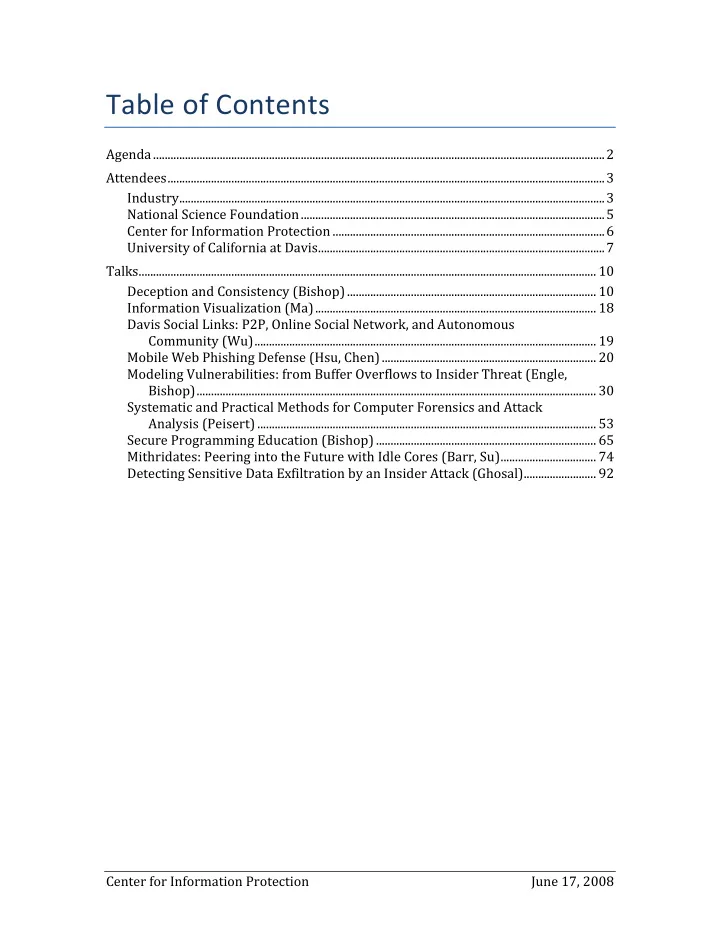
Table of Contents Agenda............................................................................................................................................................2


slide-1
SLIDE 1

Center for Information Protection June 17, 2008

Table of Contents

Agenda............................................................................................................................................................2 Attendees.......................................................................................................................................................3 Industry...................................................................................................................................................3 National Science Foundation.........................................................................................................5 Center for Information Protection ..............................................................................................6 University of California at Davis...................................................................................................7 Talks.............................................................................................................................................................. 10 Deception and Consistency (Bishop)...................................................................................... 10 Information Visualization (Ma)................................................................................................. 18 Davis Social Links: P2P, Online Social Network, and Autonomous Community (Wu)...................................................................................................................... 19 Mobile Web Phishing Defense (Hsu, Chen).......................................................................... 20 Modeling Vulnerabilities: from Buffer Overflows to Insider Threat (Engle, Bishop).......................................................................................................................................... 30 Systematic and Practical Methods for Computer Forensics and Attack Analysis (Peisert) ..................................................................................................................... 53 Secure Programming Education (Bishop) ............................................................................ 65 Mithridates: Peering into the Future with Idle Cores (Barr, Su)................................. 74 Detecting Sensitive Data Exfiltration by an Insider Attack (Ghosal)......................... 92

slide-2
SLIDE 2

Center for Information Protection June 17, 2008

Agenda

8:30 AM Continental breakfast. 9:00 AM Introduction and overview. 9:10 AM UC Davis and the Center. 9:30 AM NSF and the I/UCRC Program; how to join. 10:15 AM The Center for Information Protection. 11:00 AM Break. 11:15 AM Potential projects: 11:15AM Deception and Consistency (Matt Bishop) 11:40AM Information Visualization (Kwan‐Liu Ma) 12:05PM Davis Social Links: P2P, Online Social Network, and Autonomous Community (S. Felix Wu) 12:30PM Mobile Web Phishing Defense (Francis Hsu) 12:55PM Modeling Vulnerabilities: from Buffer Overflows to Insider Threat (Sophie Engle) 1:20PM Systematic and Practical Methods for Computer Forensics and Attack Analysis (Sean Peisert) 1:45PM Secure Programming Education (Matt Bishop) 2:10PM Mithridates: Peering into the Future with Idle Cores (Earl Barr) 2:35PM Detecting Sensitive Data Exfiltration by an Insider Attack (Dipak Ghosal) 12:15PM Working lunch. 3:00PM Break. 3:15PM Discussion of goals for the center. 3:45PM Discussion of potential projects, LIFE forms, and other project ideas. 4:30PM Discussion with NSF Program Director.

slide-3
SLIDE 3

Center for Information Protection June 17, 2008

Industry and Government

Gene Kim Co‐Founder and Chief Technology Officer Tripwire, Inc. 326 SW Broadway, 3rd Floor Portland, OR 97205 phone: (503) 276‐7500 email: genek@tripwire.com Morris Moore Vice President, Security Technology Motorola, Inc. 6500 River Place Blvd., Building 7 MD: RP‐1E Austin, TX 78730 phone: (512) 427‐7305 email: Morris.Moore@motorola.com Gary Morgan Public Private Partnerships Program Lead Pacific Northwest National Laboratories 902 Battelle Boulevard

  • P. O. Box 999

Richland, WA 99352 phone: (509) 375‐2373 email: gary.morgan@pnl.gov Alan Paller Director of Research SANS 8120 Woodmont Ave., #205 Bethesda, MD 20814 phone: (301) 951‐0102 x 108 email: apaller@sans.org Alex Stamos Principal Partner Information Security Partners, LLC phone: (415) 378‐9580 email: alex@isecpartners.com

slide-4
SLIDE 4

Center for Information Protection June 17, 2008 Shirley Ann Stern Security Program Manager, Global Product Security Oracle 500 Oracle Parkway M/S 5OP948 Redwood Shores, CA 94065 phone: (650) 607‐5887 email: shirley‐ann.stern@oracle.com Jacob West Manager, Security Research Group Fortify Software 2215 Bridgepointe Parkway, Suite 400 San Mateo, CA 94404 phone: (650) 358‐5625 email: jwest@fortify.com

slide-5
SLIDE 5

Center for Information Protection June 17, 2008

National Science Foundation

Rita Rodriguez I/UCRC Program Director National Science Foundation 4201 Wilson Boulevard Arlington, VA 22230 phone: (703) 292‐8950 email: rrodrigu@nsf.gov Alex Schwarzkopf Consultant and former I/UCRC Program Director National Science Foundation 4201 Wilson Boulevard Arlington, VA 22230 phone: (703) 292‐5359 email: aschwarz@nsf.gov

slide-6
SLIDE 6

Center for Information Protection June 17, 2008

Center for Information Protection

Doug Jacobson Director, Center for Information Protection Professor, Iowa State University 2419 Cover Hall Department of Computer and Electrical Engineering Iowa State University Ames, IA 50011 phone: (515) 294‐8307 email: dougj@iastate.edu

slide-7
SLIDE 7

Center for Information Protection June 17, 2008

University of California at Davis

Nina Amenta Professor and Vice‐Chair, Department of Computer Science University of California at Davis One Shields Ave. Davis, CA 95616‐8562 phone: (530) 754‐5377 email: amenta@cs.ucdavis.edu Earl Barr Research Assistant, Department of Computer Science University of California at Davis One Shields Ave. Davis, CA 95616‐8562 email: etbarr@ ucdavis.edu Matt Bishop Professor, Department of Computer Science University of California at Davis One Shields Ave. Davis, CA 95616‐8562 phone: (530) 752‐8060 email: bishop@cs.ucdavis.edu Hao Chen Professor, Department of Computer Science University of California at Davis One Shields Ave. Davis, CA 95616‐8562 phone: (530) 754‐5375 email: hchen@cs.ucdavis.edu Sophie Engle Research Assistant, Department of Computer Science University of California at Davis One Shields Ave. Davis, CA 95616‐8562 email: sjengle@ucdavis.edu

slide-8
SLIDE 8

Center for Information Protection June 17, 2008 Dipak Ghosal Professor, Department of Computer Science University of California at Davis One Shields Ave. Davis, CA 95616‐8562 phone: (530) 754‐9251 email: ghosal@cs.ucdavis.edu Greg Gibbs Director of Development, College of Engineering University of California at Davis One Shields Ave. Davis, CA 95616 phone: (530) 754‐9673 email: glgibbs@ucdavis.edu Karl Levitt Professor, Department of Computer Science University of California at Davis One Shields Ave. Davis, CA 95616‐8562 phone: (530) 752‐0832 email: levitt@cs.ucdavis.edu Kwan‐Liu Ma Professor, Department of Computer Science University of California at Davis One Shields Ave. Davis, CA 95616‐8562 phone: (530) 752‐6958 email: ma@cs.ucdavis.edu Karen McDonald Associate Dean, Research and Graduate Studies, College of Engineering University of California at Davis One Shields Ave. Davis, CA 95616 phone: (530) 752‐0559 email: kamcdonald@ucdavis.edu Sean Peisert Post‐Doctoral Scholar, Department of Computer Science University of California at Davis One Shields Ave. Davis, CA 95616‐8562 phone: (530) 752‐2149 email: peisert@cs.ucdavis.edu

slide-9
SLIDE 9

Center for Information Protection June 17, 2008

  • S. Felix Wu

Professor, Department of Computer Science University of California at Davis One Shields Ave. Davis, CA 95616‐8562 phone: (530) 754‐7070 email: wu@cs.ucdavis.edu

slide-10
SLIDE 10

Center for Information Protection June 17, 2008

Deception and Consistency

Matt Bishop, Vicentiu Neagoe bishop@cs.ucdavis.edu The use of deception is one of the many defensive techniques being explored today. In the past, defenders of systems have used deception haphazardly, but now researchers are developing systematic methods of deception. The cornerstone of these methods is consistency: projecting a “false reality”, or “fiction”, that the attacker is to accept as reality. We challenge the necessity of this cornerstone. This talk presents questions on the need for consistency in deception. We then discuss how to add deceptive mechanisms to the host, and examine two common functions (deleting a file and obtaining the name of the current working directory) to demonstrate the effects of inconsistency in deception, and ways to add it. Biography: Professor Matt Bishop’s research area is computer security, in which he has been active since 1979. He is especially interested in vulnerability analysis and denial of service problems, but maintains a healthy concern for formal modeling (especially of access controls and the Take‐Grant Protection Model) and intrusion detection and response. He has also worked extensively on the security of various forms of the UNIX operating system. He is involved in efforts to improve education in information assurance, and is a charter member of the Colloquium for Information Systems Security Education. His textbook, Computer Security: Art and Science, was published by Addison‐Wesley in December 2002.

slide-11
SLIDE 11

6/17/08 1

Matt Bishop Vicentiu Neagoe

1 June 17, 2008 June 17, 2008 2

Matt Bishop Department of Computer Science University of California at Davis 1 Shields Ave. Davis, CA 95616-8562 phone: (530) 752-8060 email: bishop@cs.ucdavis.edu www: http://seclab.cs.ucdavis.edu/~bishop

slide-12
SLIDE 12

6/17/08 2

 Create confusion in attacker

  • Induce delay in decision making

 Waste their time  Make them go away on their own  Distract them towards a different path

  • Stir up curiosity about bizarre behavior

 Blur the line between what is allowed and

what is not allowed

 Trigger alerts and heavy analysis

3 June 17, 2008

 Previous work assumed consistency is

critical to successful defense

  • Attacker gains the advantage is deception is

detected

  • Inconsistency will expose presence of

deception

 So what?

  • If attacker knows deception is used, they still

must distinguish between what is deceptive and what is real

4 June 17, 2008
slide-13
SLIDE 13

6/17/08 3

 Inconsistent deception easier to

implement than consistent deception

  • Use regular deception techniques but don’t

worry about consistency

 Make the system behave unpredictably

  • May be malfunctioning
  • Undergoing modification
  • Defense response
5 June 17, 2008

Performed Action Response Response truthfulness Verify response Verify truthfulness Consistent

No Deleted False File exists True No No Deleted False File gone False Yes No Not Deleted True File exists True Yes No Not Deleted True File gone False No Yes Not Deleted False File exists False Yes Yes Not Deleted False File gone True No Yes Deleted True File exists False No Yes Deleted True File gone True Yes real system consistent deception

6 June 17, 2008
slide-14
SLIDE 14

6/17/08 4 User Kernel Program

System Call Table Current directory info

sys_read() sys_getcwd() sys_getdents() d_path()

/dev/kmem pwd /proc

7 June 17, 2008

 Vertical – separate paths return different

answers

 Horizontal – same path returns different

answer

8 June 17, 2008
slide-15
SLIDE 15

6/17/08 5

 Process needs to determine its current

working directory

  • Relative path names interpreted with respect

to that directory

  • Is current working directory the real one or
  • ne created as part of a deception?

 In the latter case, the system wants to lie about the name

9 June 17, 2008

User Kernel Program

System Call Table Current directory info

sys_read() sys_getcwd() sys_getdents() d_path()

/dev/kmem pwd /proc

10 June 17, 2008
slide-16
SLIDE 16

6/17/08 6 User Kernel Program

System Call Table Current directory info

sys_read() sys_getcwd() sys_getdents() d_path()

/dev/kmem pwd /proc

11 June 17, 2008

 Inconsistency does not mean deception

  • System could be flaky or malfunctioning

 If attacker believes deception is being

used, may try to evaluate sources

  • The richer semantically a component is, the

harder to make it appear consistent

 Many types of inconsistency

  • Data: results vary
  • Semantics: expression of results vary
12 June 17, 2008
slide-17
SLIDE 17

6/17/08 7  Given a file that an attacker wants access to,

determine paths through kernel that can be used to obtain information or access

  • Establish methodology to do this

 Add horizontal, vertical deception  Evaluate how attacker can “break” this

  • How can attacker determine deception is being

used?

  • How can attacker distinguish non-deceptive

responses from deceptive responses?

13 June 17, 2008

 V. Neagoe and M. Bishop, “Inconsistency in Deception

for Defense,” Proceedings of the New Security Paradigms Workshop pp. 31–38 (Sep. 2006).

 D. Rogers, Host-level Deception as a Defense against

Insiders, M.S. Thesis (2004)

14 June 17, 2008
slide-18
SLIDE 18

Center for Information Protection June 17, 2008

Information Visualization

Kwan­Liu Ma ma@cs.ucdavis.edu Information collected for security assurance or business competitive advantage exhibits exponential growth, a daunting challenge we must address in order to extract knowledge from and maximize utilization of all the available information. Visualization, proving very effective for comprehending enormous amounts of data in many other domains, offers a promising solution for this pressing problem. This presentation gives an overview of UCD VIDI group‘s information visualization research. Biography: Professor Ma’s research interests include scientific visualization, information visualization, computer graphics, user interface design, and high‐ performance computing. He is the recipient of an NSF PECASE award and the Schlumberger Foundation Technical award.

slide-19
SLIDE 19

Center for Information Protection June 17, 2008

Davis Social Links: P2P, Online Social Network, and Autonomous Community

  • S. Felix Wu

wu@cs.ucdavis.edu In this talk, we will discuss the impact of Internet architecture design on network

  • security. In the past few years, there have been many attempts to develop solution

to protect our networked system against large‐scale attacks such as worm, DDoS, and spam. However, it seems to us (and more and more clearly) that most, if not all,

  • f the proposed solutions are not likely to be effective, given the growth of attacks in

numbers and depth. Therefore, the network community has been trying to understand the fundamental issues and the root cause for these large‐scale network

  • attacks. One possible idea, currently being actively developed at UC Davis, is called

DSL (Davis Social Links). Under DSL, we integrate the concepts of P2P, social networks, and trust management into the network layer, while we remove the requirement of global network identity (e.g., IP addresses or even email addresses, for the context of spam). While we are still in a very early stage regarding DSL, we will go through a few examples of DSL as well as technical considerations. Biography: Professor Wu’s research focuses on network security, specifically intrusion detection and protection for network protocols such as OSPF, BGP, IPsec, TCP, HTTP and 802.11. The nature of his research is very “experimental”, meaning that he builds prototype systems and performs experiments to validate and evaluate new architectural concepts for the security of our Internet.

slide-20
SLIDE 20

Center for Information Protection June 17, 2008

Mobile Web Phishing Defense

Francis Hsu fhsu@cs.ucdavis.edu Mobile devices with embedded browsers allow users to enjoy the same web resources they have on traditional computing platforms, but also expose them to the same problems. We examined the migration of the browser to mobile devices and the changes that affect a user’s vulnerability to phishing attacks. Due to inherent hardware limitations on the platform, browser designers alter elements found in traditional browsers that normally aid users in defending against phishing attacks. Our user study identified and demonstrated potential phishing attacks that could successfully fool users into giving up their credentials. We propose examining changes to be made in browser, website and network design to create user‐friendly anti‐phishing solutions. A major factor contributing to the success of phishing attacks on the web is our reliance on password authentication. Mobile devices connected to cellular networks do provide a resource not found in traditional network connections—the authentication of the device itself to the cellular network. To leverage the cellular network infrastructure, we have designed WebCallerID, a Web authentication scheme using mobile phones as authentication tokens and cellular network providers as trusted identify providers. The scheme eliminates users participation from the authentication process and so prevents security mistakes that could expose them to phishing attacks. Mobile devices have access to other bits of information about a user (GPS, voice, camera, local wireless networks) that we envision a multi‐factor authentication system can use with WebCallerID to provide reliable and usable authentication services. Advisor: Prof. Hao Chen, hchen@cs.ucdavis.edu

slide-21
SLIDE 21

6/16/2008 1

Mobile Web Phishing Defense

Francis Hsu, Yuan Niu, Hao Chen {fhsu niu hchen}@cs ucdavis edu {fhsu, niu, hchen}@cs.ucdavis.edu Computer Science, UC Davis

Phishing

Human factors

problem – users problem – users give up credentials to the wrong party

2 million victims and

$1.2 billion in losses for US banks in 2003

slide-22
SLIDE 22

6/16/2008 2

Goal: Eliminate phishing

Problem:

Users give up their passwords in an Users give up their passwords in an authentication session

Solution:

  • 1. Stop users before they enter passwords
  • 2. Remove users and passwords from the

authentication session

Mobile Device Limitations

Physical restrictions

S i

Screen size Input interface Vendor restrictions Limits on running additional software Upgrades

slide-23
SLIDE 23

6/16/2008 3

URL Display

http://welcometo.bankofamerica.malweb.org/index.jsp

  • No https indication
  • Truncation from middle – lose effective second level domain
  • Long URLs never fully displayed
5

Chrome

Lack of trusted

chrome elements

Which of these is a forgery?

chrome elements

Developers actively

try to remove chrome from view

Chrome

6

Chrome Page Content

slide-24
SLIDE 24

6/16/2008 4

SSL

What can a user do here? Even if they wanted to, users can’t Even if they wanted to, users can t Examine SSL certificates Diagnose invalid certificates

7

Mitigation Strategies

Browser designer Sites need to identify themselves to the user Sites need to identify themselves to the user Keep effective second level domain name Website authors Site designers should shorten URLs Network administrators Network level anti-phishing proxy filters

8
slide-25
SLIDE 25

6/16/2008 5

Goal: Eliminate phishing

Problem:

Users give up their passwords in an Users give up their passwords in an authentication session

Solution:

  • 1. Stop users before they enter passwords
  • 2. Remove users and passwords from the

authentication session

Cellular Based Authentication

Cellular devices authenticate to network,

network authenticates user to websites network authenticates user to websites

Advantages Usability – Without active user participation,

users can’t make security mistakes

Ease of deployment – Takes advantage of existing

Ease of deployment Takes advantage of existing infrastructure, billions of cell phones and users

Trust – Wireless network authentication relatively hard

to attack from the outside

10
slide-26
SLIDE 26

6/16/2008 6

WebCallerID Architecture Protocol

Relying Party

Log me in! Authentication Request

Get user profile associated with IP address

User’s Browser Identity Server

Authentication Request

slide-27
SLIDE 27

6/16/2008 7

Protocol

Authentication Assertion

Relying Party

Get user profile associated with IP address

Authentication Assertion

User’s Browser Identity Server

Implementation

Based on OpenID, but could be used with other

SSO systems SSO systems

AJAX client handles all authentication for user,

user simply clicks “Login” and the network handles the rest

Unique identity per RP (directed identity) prevents Unique identity per RP (directed identity) prevents

colluding RPs from tracking a user across sites Construct identity per RP via keyed hash of (user, domain)

14
slide-28
SLIDE 28

6/16/2008 8

Deployment

No changes needed for

user clients user clients

No changes needed for

OpenID enabled relying parties

Works with

cell phone based

browsers browsers

PCs with cellular modem PCs with a tethered phone Multihomed usage scenario

Security Benefits

Users don’t need to:

C t d b d d

Create and remember good passwords Identify malicious relying parties Carry another physical token Websites don’t need to: Store and handle user authentication data Worry about phishing sites stealing

valid credentials

16
slide-29
SLIDE 29

6/16/2008 9

Mobile Device Authentication

Multi-factor authentication

M l ti di id

Many sensors – location, audio, video,

wireless networks

Combine multiple forms of evidence to

authenticate

Passive system

Mi i l i t ti

Minimal user interaction Mimics human authentication processes

slide-30
SLIDE 30

Center for Information Protection June 17, 2008

Modeling Vulnerabilities: from Buffer Overflows to Insider Threat

Sophie Engle sjengle@ucdavis.edu This proposal explores how to model all types of vulnerabilities, from traditional vulnerabilities such as buffer overflows to vulnerabilities involving covert channels, social engineering, and insider threat. To achieve this, we look at expanding the Unifying Policy Hierarchy (Carlson 2006) to other areas of security. With a unified formal model that captures these aspects, we can perform more comprehensive threat analysis for a system in a non ad hoc manner. Advisor: Prof. Matt Bishop, bishop@cs.ucdavis.edu

slide-31
SLIDE 31

!"#$%&'()*+%'$,-.&%&/&$0

!"#$%&'(#)*+,*-#.%//#0112# ! 34*(5%6#748*#09#:112

!"#$%&'!!("%#)("!*#+,%-#%./,.0("%-1"(2-

"#$%&'()*+,'

  • ".(/01232(2/4(5))6/-7

;<=#>?!"@"A#">B#C**D'8E#F#CG5*/'8E#H4/8*-%I'/'D'*(A#=-G+#J4KK*-#L&*-K/GM(#DG#>8('5*-#3N-*%D#F#748*#09O#:112#F#</'5*#:

!"/&1-/&"'

slide-32
SLIDE 32

;<=#>?!"@"A#">B#C**D'8E#F#CG5*/'8E#H4/8*-%I'/'D'*(A#=-G+#J4KK*-#L&*-K/GM(#DG#>8('5*-#3N-*%D#F#748*#09O#:112#F#</'5*#P

!"/&1-/&"'

QN%D#5G*(#'D#+*%8#KG-#%#(6(D*+#DG#I*#(*R4-*S

;<=#>?!"@"A#">B#C**D'8E#F#CG5*/'8E#H4/8*-%I'/'D'*(A#=-G+#J4KK*-#L&*-K/GM(#DG#>8('5*-#3N-*%D#F#748*#09O#:112#F#</'5*#T

!"/&1-/&"'

QN%D#5G*(#'D#+*%8#KG-#%#(6(D*+#DG#I*#(*R4-*S $%89&:;,,8(9':<='>

slide-33
SLIDE 33

;<=#>?!"@"A#">B#C**D'8E#F#CG5*/'8E#H4/8*-%I'/'D'*(A#=-G+#J4KK*-#L&*-K/GM(#DG#>8('5*-#3N-*%D#F#748*#09O#:112#F#</'5*#U

!"/&1-/&"'

QN%D#5G*(#'D#+*%8#KG-#%#(6(D*+#DG#I*#(*R4-*S :;**#?(@'(A&9<9'B(@8(&*9&B'=9>

;<=#>?!"@"A#">B#C**D'8E#F#CG5*/'8E#H4/8*-%I'/'D'*(A#=-G+#J4KK*-#L&*-K/GM(#DG#>8('5*-#3N-*%D#F#748*#09O#:112#F#</'5*#V

!"/&1-/&"'

QN%D#5G*(#'D#+*%8#KG-#%#(6(D*+#DG#I*#(*R4-*S #*,8(;<?%#=&C'B($'=9#*9(%;D'(;::'99> #*,8(;<?%#=&C'B(<9'=(;::#<*?9(%;D'(;::'99>

slide-34
SLIDE 34

;<=#>?!"@"A#">B#C**D'8E#F#CG5*/'8E#H4/8*-%I'/'D'*(A#=-G+#J4KK*-#L&*-K/GM(#DG#>8('5*-#3N-*%D#F#748*#09O#:112#F#</'5*#9

!"/&1-/&"'

QN%D#5G*(#'D#+*%8#KG-#%#(6(D*+#DG#I*#(*R4-*S *#(@<EE'=(#D'=E,#F(@<+9> *#(@<EE'=(#D'=E,#F(D<,*'=;@&,&?&'9>

;<=#>?!"@"A#">B#C**D'8E#F#CG5*/'8E#H4/8*-%I'/'D'*(A#=-G+#J4KK*-#L&*-K/GM(#DG#>8('5*-#3N-*%D#F#748*#09O#:112#F#</'5*#2

!"/&1-/&"'

QN%D#5G#%//#GK#DN*(*#*W%+,/*(#N%&*#'8#RG++G8S

slide-35
SLIDE 35

;<=#>?!"@"A#">B#C**D'8E#F#CG5*/'8E#H4/8*-%I'/'D'*(A#=-G+#J4KK*-#L&*-K/GM(#DG#>8('5*-#3N-*%D#F#748*#09O#:112#F#</'5*#X

!"/&1-/&"'

QN%D#5G#%//#GK#DN*(*#*W%+,/*(#N%&*#'8#RG++G8S

4GH/2I

;<=#>?!"@"A#">B#C**D'8E#F#CG5*/'8E#H4/8*-%I'/'D'*(A#=-G+#J4KK*-#L&*-K/GM(#DG#>8('5*-#3N-*%D#F#748*#09O#:112#F#</'5*#01

!"/&1-/&"'

QN%D#5G*(#'D#+*%8#KG-#%#(6(D*+#DG#I*#(*R4-*S $%89&:;,,8(9':<='> !"#$%&'()*$+),- ?%'($%89&:;,(='J<&='A'*?9(#E(?%'(989?'A

slide-36
SLIDE 36

;<=#>?!"@"A#">B#C**D'8E#F#CG5*/'8E#H4/8*-%I'/'D'*(A#=-G+#J4KK*-#L&*-K/GM(#DG#>8('5*-#3N-*%D#F#748*#09O#:112#F#</'5*#00

!"/&1-/&"'

QN%D#5G*(#'D#+*%8#KG-#%#(6(D*+#DG#I*#(*R4-*S :;**#?(@'(A&9<9'B(@8(&*9&B'=9> !"#$%&'()*$+),- %#F(?%'(989?'A(&9(!"#$"%$% ?#(@'(<9'B

;<=#>?!"@"A#">B#C**D'8E#F#CG5*/'8E#H4/8*-%I'/'D'*(A#=-G+#J4KK*-#L&*-K/GM(#DG#>8('5*-#3N-*%D#F#748*#09O#:112#F#</'5*#0:

!"/&1-/&"'

QN%D#5G*(#'D#+*%8#KG-#%#(6(D*+#DG#I*#(*R4-*S #*,8(;<?%#=&C'B($'=9#*9(%;D'(;::'99> #*,8(;<?%#=&C'B(<9'=(;::#<*?9(%;D'(;::'99> !"#$%&'()*$+),- F%#(&9(;<?%#=&C'B(E#=(F%;?(?8$'(#E(;::'99

slide-37
SLIDE 37

;<=#>?!"@"A#">B#C**D'8E#F#CG5*/'8E#H4/8*-%I'/'D'*(A#=-G+#J4KK*-#L&*-K/GM(#DG#>8('5*-#3N-*%D#F#748*#09O#:112#F#</'5*#0P

!"/&1-/&"'

QN%D#5G*(#'D#+*%8#KG-#%#(6(D*+#DG#I*#(*R4-*S *#(@<EE'=(#D'=E,#F(@<+9> *#(@<EE'=(#D'=E,#F(D<,*'=;@&,&?&'9> !"#$%&'()*$+),- ?%'(B&EE'='*:'(@'?F''*(@<+(K(D<,*'=;@&,&?8

;<=#>?!"@"A#">B#C**D'8E#F#CG5*/'8E#H4/8*-%I'/'D'*(A#=-G+#J4KK*-#L&*-K/GM(#DG#>8('5*-#3N-*%D#F#748*#09O#:112#F#</'5*#0T

!"/&1-/&"'

QN%D#5G*(#'D#+*%8#KG-#%#(6(D*+#DG#I*#(*R4-*S *#(D<,*'=;@&,&?&'9 MN*-*#%#!"#$%&'()#)*+ '(#%#(*D#GK#RG85'D'G8( DN%D#+%6#/*%5#DG#%#,GD*8D'%/#,G/'R6#&'G/%D'G8

slide-38
SLIDE 38

;<=#>?!"@"A#">B#C**D'8E#F#CG5*/'8E#H4/8*-%I'/'D'*(A#=-G+#J4KK*-#L&*-K/GM(#DG#>8('5*-#3N-*%D#F#748*#09O#:112#F#</'5*#0U

!"/&1-/&"'

.GM#5G#M*#5*K'8*#,G/'R6S

;<=#>?!"@"A#">B#C**D'8E#F#CG5*/'8E#H4/8*-%I'/'D'*(A#=-G+#J4KK*-#L&*-K/GM(#DG#>8('5*-#3N-*%D#F#748*#09O#:112#F#</'5*#0V

2-34(,"+'#

slide-39
SLIDE 39

;<=#>?!"@"A#">B#C**D'8E#F#CG5*/'8E#H4/8*-%I'/'D'*(A#=-G+#J4KK*-#L&*-K/GM(#DG#>8('5*-#3N-*%D#F#748*#09O#:112#F#</'5*#09

2-34(,"+'#

.GM#5G#M*#5*K'8*#,G/'R6S 1*&E8&*+(4#,&:8(L&'=;=:%8 Y!"#$%&#'()*+,%-#)./'0)%12/)3)Z

;<=#>?!"@"A#">B#C**D'8E#F#CG5*/'8E#H4/8*-%I'/'D'*(A#=-G+#J4KK*-#L&*-K/GM(#DG#>8('5*-#3N-*%D#F#748*#09O#:112#F#</'5*#02

5'&67&'()8"%&37)9&$,-,3:7

G=;:,'(4#,&:8

! @*,-*(*8D(#DN*#'8D*8D#%85#M'//#GK#,G/'R6#+%[*-( ! C%6#8GD#I*#*W,/'R'D/6#(,*R'K'*5 ,-'./#%A \%85*- '(#%4DNG-']*5#DG#-*%5#K'/*#!"#$%"&'('

slide-40
SLIDE 40

;<=#>?!"@"A#">B#C**D'8E#F#CG5*/'8E#H4/8*-%I'/'D'*(A#=-G+#J4KK*-#L&*-K/GM(#DG#>8('5*-#3N-*%D#F#748*#09O#:112#F#</'5*#0X

5'&67&'()8"%&37)9&$,-,3:7

.';9&@,'(4#,&:8

! @*,-*(*8D(#DN*#'8D*8D#%85#M'//#GK#,G/'R6#+%[*-( ! 3%[*(#'8DG#%RRG48D#DN*#+*RN%8'R(#%85#%&%'/%I/*# %RR*((#RG8D-G/(#GK#DN*#(6(D*+ ,-'./#%A !(*-#%RRG48D#(#)$"! '(#%4DNG-']*5#DG#-*%5#K'/*# !"#$%"&'('

;<=#>?!"@"A#">B#C**D'8E#F#CG5*/'8E#H4/8*-%I'/'D'*(A#=-G+#J4KK*-#L&*-K/GM(#DG#>8('5*-#3N-*%D#F#748*#09O#:112#F#</'5*#:1

5'&67&'()8"%&37)9&$,-,3:7

2#*E&+<='B(4#,&:8

! @*,-*(*8D(#DN*#,G/'R6#RG8K'E4-*5#G8#DN*#+%RN'8* ,-'./#%A ^//#4(*-#%RRG48D(#%-*#%4DNG-']*5#DG#-*%5#K'/*# !"#$%"&'('

slide-41
SLIDE 41

;<=#>?!"@"A#">B#C**D'8E#F#CG5*/'8E#H4/8*-%I'/'D'*(A#=-G+#J4KK*-#L&*-K/GM(#DG#>8('5*-#3N-*%D#F#748*#09O#:112#F#</'5*#:0

5'&67&'()8"%&37)9&$,-,3:7

M:?<;,(4#,&:8

! @*,-*(*8D(#DN*#,G/'R6#R4--*8D/6#'8#*KK*RD#G8#DN*# +%RN'8* ,-'./#%A ;G#4(*-#R%8#-*%5#K'/*#!"#$%"&'(' Y,GD*8D'%//6#-*(4/D#GK#5*8'%/#GK#(*-&'R*#%DD%R[Z

;<=#>?!"@"A#">B#C**D'8E#F#CG5*/'8E#H4/8*-%I'/'D'*(A#=-G+#J4KK*-#L&*-K/GM(#DG#>8('5*-#3N-*%D#F#748*#09O#:112#F#</'5*#::

5'&67&'()8"%&37)9&$,-,3:7

G=;:,'(4#,&:8

&#4.5'/)%4*(367%$#8/'0)%3+./+.

.';9&@,'(4#,&:8

01$2)3%&24#).)*'*)1$241542+2*%.

2#*E&+<='B(4#,&:8

61#)7+4'2471$5)8"&%341$42+2*%.

M:?<;,(4#,&:8

61#)7+47"&&%$*#+4)$4%55%7*41$42+2*%.

slide-42
SLIDE 42

;<=#>?!"@"A#">B#C**D'8E#F#CG5*/'8E#H4/8*-%I'/'D'*(A#=-G+#J4KK*-#L&*-K/GM(#DG#>8('5*-#3N-*%D#F#748*#09O#:112#F#</'5*#:P

5'&67&'()8"%&37)9&$,-,3:7

G4 .4

./'0'1/ /*%'='*? N<,*'=;@&,&?8

;<=#>?!"@"A#">B#C**D'8E#F#CG5*/'8E#H4/8*-%I'/'D'*(A#=-G+#J4KK*-#L&*-K/GM(#DG#>8('5*-#3N-*%D#F#748*#09O#:112#F#</'5*#:T

5'&67&'()8"%&37)9&$,-,3:7

.4 24

1/'0'2/ 2#*E&+<=;?&#* N<,*'=;@&,&?8

slide-43
SLIDE 43

;<=#>?!"@"A#">B#C**D'8E#F#CG5*/'8E#H4/8*-%I'/'D'*(A#=-G+#J4KK*-#L&*-K/GM(#DG#>8('5*-#3N-*%D#F#748*#09O#:112#F#</'5*#:U

5'&67&'()8"%&37)9&$,-,3:7

24 M4

24(0'M4 3<*?&A' N<,*'=;@&,&?8

;<=#>?!"@"A#">B#C**D'8E#F#CG5*/'8E#H4/8*-%I'/'D'*(A#=-G+#J4KK*-#L&*-K/GM(#DG#>8('5*-#3N-*%D#F#748*#09O#:112#F#</'5*#:V

8,";"0-%

slide-44
SLIDE 44

;<=#>?!"@"A#">B#C**D'8E#F#CG5*/'8E#H4/8*-%I'/'D'*(A#=-G+#J4KK*-#L&*-K/GM(#DG#>8('5*-#3N-*%D#F#748*#09O#:112#F#</'5*#:9

8,";"0-% <

)O$;*B(;$$,&:;?&#*(#E(?%'(%&'=;=:%8

;<=#>?!"@"A#">B#C**D'8E#F#CG5*/'8E#H4/8*-%I'/'D'*(A#=-G+#J4KK*-#L&*-K/GM(#DG#>8('5*-#3N-*%D#F#748*#09O#:112#F#</'5*#:2

8,";"0-% <

)O$;*B(;$$,&:;?&#*(#E(?%'(%&'=;=:%8

>8('5*-#3N-*%D <GR'%/#_8E'8**-'8E !+"%$*'/9 ;*DMG-[#H'*M,G'8D

slide-45
SLIDE 45

;<=#>?!"@"A#">B#C**D'8E#F#CG5*/'8E#H4/8*-%I'/'D'*(A#=-G+#J4KK*-#L&*-K/GM(#DG#>8('5*-#3N-*%D#F#748*#09O#:112#F#</'5*#:X

8,";"0-% <

)O$;*B(;$$,&:;?&#*(#E(?%'(%&'=;=:%8

/*9&B'=(6%=';? <GR'%/#_8E'8**-'8E !+"%$*'/9 ;*DMG-[#H'*M,G'8D

;<=#>?!"@"A#">B#C**D'8E#F#CG5*/'8E#H4/8*-%I'/'D'*(A#=-G+#J4KK*-#L&*-K/GM(#DG#>8('5*-#3N-*%D#F#748*#09O#:112#F#</'5*#P1

='0&#$,)>:,$-/

!"#$%&%'()"*"+",'-'./(",'0/.$12'."+".')-%'.1&%

  • 3&)/,$4"5'0,$+$."6"%'&)-*'-')$6)",'0/.$12'."+".7
slide-46
SLIDE 46

;<=#>?!"@"A#">B#C**D'8E#F#CG5*/'8E#H4/8*-%I'/'D'*(A#=-G+#J4KK*-#L&*-K/GM(#DG#>8('5*-#3N-*%D#F#748*#09O#:112#F#</'5*#P0

='0&#$,)>:,$-/

!"#$%&%'()"*"+",'-'./(",'0/.$12'."+".')-%'.1&%

  • 3&)/,$4"5'0,$+$."6"%'&)-*'-')$6)",'0/.$12'."+".7

LBA#`%(+'8 +%6#4(*#DN*#(6(D*+#DG#-*%5 +*5'R%/#-*RG-5(#DG#D-*%D#,%D'*8D(a

;<=#>?!"@"A#">B#C**D'8E#F#CG5*/'8E#H4/8*-%I'/'D'*(A#=-G+#J4KK*-#L&*-K/GM(#DG#>8('5*-#3N-*%D#F#748*#09O#:112#F#</'5*#P:

='0&#$,)>:,$-/

!"#$%&%'()"*"+",'-'./(",'0/.$12'."+".')-%'.1&%

  • 3&)/,$4"5'0,$+$."6"%'&)-*'-')$6)",'0/.$12'."+".7

LBA#`%(+'8 +%6#4(*#DN*#(6(D*+#DG#-*%5 +*5'R%/#-*RG-5(#DG#D-*%D#,%D'*8D(a =BA#!(*-#%RRG48D#*#+%,) +%6#4(*#DN* (6(D*+#DG#-*%5#+*5'R%/#-*RG-5(a

slide-47
SLIDE 47

;<=#>?!"@"A#">B#C**D'8E#F#CG5*/'8E#H4/8*-%I'/'D'*(A#=-G+#J4KK*-#L&*-K/GM(#DG#>8('5*-#3N-*%D#F#748*#09O#:112#F#</'5*#PP

8,";"0-% <

)O$;*B(;$$,&:;?&#*(#E(?%'(%&'=;=:%8

>8('5*-#3N-*%D <GR'%/#_8E'8**-'8E !+"%$*'/9

  • '?F#=P(N&'F$#&*?

;<=#>?!"@"A#">B#C**D'8E#F#CG5*/'8E#H4/8*-%I'/'D'*(A#=-G+#J4KK*-#L&*-K/GM(#DG#>8('5*-#3N-*%D#F#748*#09O#:112#F#</'5*#PT

?$/@",4)*&$@;"&'/

>8#G-'E'8%/#%,,-G%RNO#*%RN#(6(D*+#N%(#'D(#GM8# %((GR'%D*5#,G/'R6#N'*-%-RN6a

slide-48
SLIDE 48

;<=#>?!"@"A#">B#C**D'8E#F#CG5*/'8E#H4/8*-%I'/'D'*(A#=-G+#J4KK*-#L&*-K/GM(#DG#>8('5*-#3N-*%D#F#748*#09O#:112#F#</'5*#PU

?$/@",4)*&$@;"&'/

>8#G-'E'8%/#%,,-G%RNO#*%RN#(6(D*+#N%(#'D(#GM8# %((GR'%D*5#,G/'R6#N'*-%-RN6a L#F(B#(F'('O$;*B(?%&9(?#(;(A#='( *'?F#=PQ@;9'B(;$$=#;:%>

;<=#>?!"@"A#">B#C**D'8E#F#CG5*/'8E#H4/8*-%I'/'D'*(A#=-G+#J4KK*-#L&*-K/GM(#DG#>8('5*-#3N-*%D#F#748*#09O#:112#F#</'5*#PV

8,";"0-% <

)O$;*B(;$$,&:;?&#*(#E(?%'(%&'=;=:%8

A 19'(A#B',(?#($'=E#=A(?%=';?(;*;,89&9

slide-49
SLIDE 49

;<=#>?!"@"A#">B#C**D'8E#F#CG5*/'8E#H4/8*-%I'/'D'*(A#=-G+#J4KK*-#L&*-K/GM(#DG#>8('5*-#3N-*%D#F#748*#09O#:112#F#</'5*#P9

>:,$-/)B'-%70&0

345!'6+5#&,$,7 8#-9$*"'&)"'!6-07':"&(""*'."+".%'/;' DN*#,G/'R6#N'*-%-RN6O#'a*a#*&*-6MN*-*# DMG#RG8(*R4D'&*#/*&*/(#5G#8GD#+%DRNa

;<=#>?!"@"A#">B#C**D'8E#F#CG5*/'8E#H4/8*-%I'/'D'*(A#=-G+#J4KK*-#L&*-K/GM(#DG#>8('5*-#3N-*%D#F#748*#09O#:112#F#</'5*#P2

>:,$-/)B'-%70&0

!<-0'=*-.2%$%7 6%=';?(M*;,89&9 ;*WDO#5*D*-+'8*#DN*#,GD*8D'%/#DN-*%D# R%4(*5#I6#DN*(*#E%,(a

slide-50
SLIDE 50

;<=#>?!"@"A#">B#C**D'8E#F#CG5*/'8E#H4/8*-%I'/'D'*(A#=-G+#J4KK*-#L&*-K/GM(#DG#>8('5*-#3N-*%D#F#748*#09O#:112#F#</'5*#PX

>:,$-/)B'-%70&0

!<-0'=*-.2%$%7 3N-*%D#^8%/6('( 6%=';?( 5&?&+;?&#*

;<=#>?!"@"A#">B#C**D'8E#F#CG5*/'8E#H4/8*-%I'/'D'*(A#=-G+#J4KK*-#L&*-K/GM(#DG#>8('5*-#3N-*%D#F#748*#09O#:112#F#</'5*#T1

>:,$-/)B'-%70&0

!<-0'=*-.2%$%7 3N-*%D#^8%/6('( 3N-*%D# C'D'E%D'G8 2#9?0R'*'E&?( M*;,89&9

slide-51
SLIDE 51

;<=#>?!"@"A#">B#C**D'8E#F#CG5*/'8E#H4/8*-%I'/'D'*(A#=-G+#J4KK*-#L&*-K/GM(#DG#>8('5*-#3N-*%D#F#748*#09O#:112#F#</'5*#T0

>:,$-/)B'-%70&0

!<-0'=*-.2%$%7 3N-*%D#^8%/6('( 3N-*%D# C'D'E%D'G8 "G(D?J*8*K'D# ^8%/6('(

;<=#>?!"@"A#">B#C**D'8E#F#CG5*/'8E#H4/8*-%I'/'D'*(A#=-G+#J4KK*-#L&*-K/GM(#DG#>8('5*-#3N-*%D#F#748*#09O#:112#F#</'5*#T:

8,";"0-% <

)O$;*B(;$$,&:;?&#*(#E(?%'(%&'=;=:%8

A 19'(A#B',(?#($'=E#=A(?%=';?(;*;,89&9 C 4='9'*?(E&*B&*+9(&*(;(F&P&(E#=A;?

slide-52
SLIDE 52

;<=#>?!"@"A#">B#C**D'8E#F#CG5*/'8E#H4/8*-%I'/'D'*(A#=-G+#J4KK*-#L&*-K/GM(#DG#>8('5*-#3N-*%D#F#748*#09O#:112#F#</'5*#TP

D+$0/&"'0E

slide-53
SLIDE 53

Center for Information Protection June 17, 2008

Systematic and Practical Methods for Computer Forensics and Attack Analysis

Sean Peisert peisert@cs.ucdavis.edu Who attacked this computer system? What actions did they take? What damage did they do? With what degree of certainty, and under what assumptions, do we make these assertions? These questions are asked during the computer attack analysis process, but they are often hard to answer in practice. Computer scientists and security practitioners have made headway on developing functional systems for attack analysis. Some of those systems are based on theoretical models that help to construct complete solutions, but there are serious and important gaps in these

  • systems. The result is an incomplete picture of the attack, or an incorrect analysis of

what happened. The goals of this project are to understand and improve methods used in forensic logging and computer attack analysis. To do this, we plan to extend the Laocoön model of forensics, and modify a system to enable us to implement the model. We will evaluate methods and assumptions used in attack analysis. In particular, we intend to apply these techniques to forensic technology used in the legal system, and to the insider problem. Biography: Dr. Peisert received his Ph.D. in Computer Science from UC San Diego in

  • 2007. He is currently a postdoctoral scholar at UC Davis, an I3P Fellow, and a Fellow
  • f the San Diego Supercomputer Center (SDSC). In the UC Davis Computer Security

Laboratory, he performs research in a number of topics relating to security, including computer forensic analysis, intrusion detection, vulnerability analysis, security policy modeling, electronic voting, and the design of secure systems. Previously, he was a postdoctoral scholar and lecturer in the Computer Science and Engineering department at UC San Diego, a computer security researcher at SDSC, and co‐founded a now‐defunct software company. He is currently working with Professor Matt Bishop.

slide-54
SLIDE 54

Systematic and Practical Methods for Computer Attack Analysis and Forensics

  • Dr. Sean Peisert

UC Davis Computer Science Dept. NSF I/UCRC Meeting ~ Davis, CA June 17, 2008

When We Need Audit Logs

  • Computer forensics in courts
  • Recovering from an attack
  • Compliance (HIPAA, SOx)
  • Human resources cases
  • Debugging or verifying correct results (e.g., electronic

voting machines)

  • Performance analysis
  • Accounting

2

1 2 Monday, June 16, 2008

slide-55
SLIDE 55

We’re terrible analyzing events on computers Audit data is usually...

  • overwhelming
  • free-form
  • useless
  • misleading (easily altered)

4

3 4 Monday, June 16, 2008

slide-56
SLIDE 56

We’re collecting too much bad information...

5

...and using it in courts and elections.

6

5 6 Monday, June 16, 2008

slide-57
SLIDE 57

We need to...

  • understand what the purpose of the analysis is
  • understand what data can answer that

purpose, with X% accuracy, and under a set of Y assumptions

  • log the data
  • give tools and techniques to an analyst to

analyze that data

7

How is computer forensics done now?

  • file & filesystem analysis (Coroner’s Toolkit,

Sleuth Kit, EnCase, FTK)

  • syslog, tcpwrappers
  • process accounting logs
  • IDS logs
  • packet sniffing

8

7 8 Monday, June 16, 2008

slide-58
SLIDE 58

What do we need? What are we missing?

9

A Systematic Approach is Better

10

9 10 Monday, June 16, 2008

slide-59
SLIDE 59

Forensic Art & Science

  • But computer science can only answer part of it.
  • Forensic analysis is an art, but there are scientific
  • components. What are they?
  • Determining what to log
  • Determining relevance of logged data
  • what is relevant?
  • what is not relevant?
  • under what circumstances something might be

relevant?

  • Using the results to constrain and correlate data.
  • This can be measured, systematized and automated.

11

Measurement Example: Empirical Study of Firewall Rules

  • How are firewalls configured?
  • How should firewalls be configured?
  • What are the top, known vulnerabilities?
  • What are the top, known attacks?
  • What are we missing? Is that OK?

12

11 12 Monday, June 16, 2008

slide-60
SLIDE 60

Laocoön: A Model of Forensic Logging

  • Attack graphs of goals.
  • Goals can be attacker goals or defender goals (i.e., “security

policies”)

  • Pre-conditions & post-conditions of those goals.
  • Method of translating those conditions into logging

requirements.

  • Logs are in a standardized and parseable format.
  • Logged data can be at arbitrary levels of granularity.

13

Attack Graphs

  • Intruder goals can be

enumerated.

  • Vulnerabilities, attacks,

and exploits cannot (or in many cases, we would patch them).

  • Defender goals can also

be enumerated. They are called security polices.

... ... ... ... ... ... ...

a b c d start of attack intermediate steps (too many!) end goals of intruder

14

13 14 Monday, June 16, 2008

slide-61
SLIDE 61

Security Policies

  • Security policies can be reverse-engineered
  • r enforced, automatically.
  • Policies can be binary (block access) or

flexible (log something).

  • Policies can be static (always do this) or

dynamic (uh oh—an intruder)

15

Applying Security Policies

  • Applying Laocoön to security policies guides

where to place instrumentation and what to log.

  • The logged data needs to be correlated with a

unique path identifier.

  • Branches of a graph unrelated to the attack can

be automatically pruned.

  • Avoid recording data where events can be

recreated because they are deterministic.

16

15 16 Monday, June 16, 2008

slide-62
SLIDE 62

Pruning Paths

A B C D start of attack intermediate steps end goals of intruder A B C D start of attack intermediate steps end goals of intruder

17

What are the assumptions for using current forensic tools?

18

  • Often that there’s only one person who

had access to the machine.

  • Often that the owner of the machine was

in complete control (as opposed to malware).

  • Probably a lot of other assumptions that

we have no clue about.

17 18 Monday, June 16, 2008

slide-63
SLIDE 63

Summary: we can do better

  • Forensics, attack analysis, logging, and

auditing are broken.

  • We seek to work on real-world problems

with real-world data to construct and implement useful, usable, real-world software solutions.

19

Proposed Project

  • Research practicality and tradeoffs in conditional access

control (e.g., allow & log vs. block)

  • Implement conditional access control with several

countermeasures, including logging.

  • For the logging portion, implement forensic logging of

system & function calls, and analysis tools to correlate and prune data unrelated to the end goals that an analyst is concerned with.

  • If there is time, attempt to do this via virtual machine

introspection.

20

19 20 Monday, June 16, 2008

slide-64
SLIDE 64

Selected Recent Publications

  • S. Peisert, M. Bishop, and K, Marzullo, "Computer Forensics In Forensis," Proc. of the

3rd Intl. IEEE Wkshp. on Systematic Approaches to Digital Forensic Engineering, May 2008.

  • S. Peisert, M. Bishop, S. Karin, and K. Marzullo, "Analysis of Computer Intrusions

Using Sequences of Function Calls," IEEE Trans. on Dependable and Secure Computing (TDSC), 4(2), Apr.-June 2007.

  • S. Peisert and M. Bishop, "How to Design Computer Security Experiments," Proc. of

the 5th World Conf. on Information Security Education, June 2007.

  • S. P. Peisert, "A Model of Forensic Analysis Using Goal-Oriented Logging," Ph.D.

Dissertation, UC San Diego, Mar. 2007.

  • S. Peisert, M. Bishop, S. Karin, and K. Marzullo, "Principles-Driven Forensic Analysis,"
  • Proc. of the New Security Paradigms Workshop (NSPW), Sept. 2005.

21

Questions?

  • Dr. Sean Peisert
  • Email: peisert@cs.ucdavis.edu
  • More information and recent publications:
  • http://www.sdsc.edu/~peisert/

22

21 22 Monday, June 16, 2008

slide-65
SLIDE 65

Center for Information Protection June 17, 2008

Secure Programming Education

Matt Bishop bishop@cs.ucdavis.edu We present an approach to emphasizing good programming practices and style throughout a curriculum. This approach draws on a clinic model used by English programs to reinforce the practice of clear, effective writing, and law schools to teach students legal writing. We present our model and some very preliminary results when we used it. We also discuss the next steps. Biography: Professor Matt Bishop’s research area is computer security, in which he has been active since 1979. He is especially interested in vulnerability analysis and denial of service problems, but maintains a healthy concern for formal modeling (especially of access controls and the Take‐Grant Protection Model) and intrusion detection and response. He has also worked extensively on the security of various forms of the UNIX operating system. He is involved in efforts to improve education in information assurance, and is a charter member of the Colloquium for Information Systems Security Education. His textbook, Computer Security: Art and Science, was published by Addison‐Wesley in December 2002.

slide-66
SLIDE 66

6/17/08 1

Matt Bishop

1 June 17, 2008 June 17, 2008 2

Matt Bishop Department of Computer Science University of California at Davis 1 Shields Ave. Davis, CA 95616-8562 phone: (530) 752-8060 email: bishop@cs.ucdavis.edu www: http://seclab.cs.ucdavis.edu/~bishop

slide-67
SLIDE 67

6/17/08 2

 Few students write robust programs

  • Curriculum already crowded
  • Emphasis in most courses on getting

programs working right

 How can we improve quality of programs

that students write throughout undergraduate, graduate work?

  • In particular, how can we get students to think

about security considerations?

3 June 17, 2008

 Meaningless without definition of

“security”

 Some requirements implicit

 Notions usually implicit here

 Robustness: paranoia, stupidity, dangerous implements, can’t happen here  Security: program does not add or delete privileges, information unless specifically required to do so

 Really, just aspects of software assurance

4 June 17, 2008
slide-68
SLIDE 68

6/17/08 3  Add security to exercises for general classes

  • Intro programming: integer or buffer overflow
  • Database: something on SQL injection
  • Programming languages: type clashes
  • Operating systems: race conditions

 Workshop held in April looked at ways to

do this (thanks, SANS!)

  • Web site under development
  • Proposal for future workshop being developed
5 June 17, 2008

 Students must know how to write

  • Critical in all majors requiring communication,

literary analysis skills

 Many don’t

  • Majors provide support for writing in classes

(law, English, rhetoric, etc.)

 Does not add material to curriculum

  • Instructors focus on content, not mechanics
  • Provides reinforcement
6 June 17, 2008
slide-69
SLIDE 69

6/17/08 4

 Genesis: operating system class

  • TA deducted for poor programming style
  • Dramatic improvement in quality of code!

 Programming foundational in CS

  • Just like writing is in English (and, really, all

majors …)

  • Clinicians assume students know some

elements of style

  • Level of students affect what clinic teaches
7 June 17, 2008

 Assist students

  • Clinicians examine program, meet with

student to give feedback

  • Clinic does not grade style

 Assist instructors

  • Clinic grades programs’ styles
  • Meet with students to explain grade, how the

program should have been done

  • Class readers can focus on program

correctness (as defined by assignment)

8 June 17, 2008

Interaction with students is critical to success

slide-70
SLIDE 70

6/17/08 5

 Tested in computer security class

 Class emphasizes robust, secure programming

 Setup for class

 Class had to analyze small program for security problems  Class applied Fortify code analysis tool to larger program, and traced attack paths

 Thanks to Fortify for giving us access to the tool!

9 June 17, 2008

 Write program to check attributes of file;

if correct, change ownership, permissions

  • If done wrong, leads to TOCTTOU flaw

 Students had to get program checked at

clinic before submitting it

  • Students sent program to clinician first
  • Clinician reviewed program before meeting

with student

  • Student then could modify program
June 17, 2008 10
slide-71
SLIDE 71

6/17/08 6

Programming Problem Before After TOCTTOU race condition 100% 12% Unsafe calls (strcpy, strcat, etc.) 53% 12% Format string vulnrability 18% 0% Unnecessary code 59% 53% Failure to zero out password 70% 0% No sanity checking on modification time 82% 35% Poor style 41% N/A

June 17, 2008 11

 Unsafe function calls

  • 4 did not set last byte of target to NUL

 Unnecessary code

  • 2: unnecessary checking; 7: errors or unnecessary

system calls

 Zero out password

  • 2 did so at end of program

 Sanity checking (not pointed out to all)

  • 4 found it despite no mention

 Style greatly cleaned up

June 17, 2008 12
slide-72
SLIDE 72

6/17/08 7

 Students required to participate upon

pain of not having program graded

  • Probably too harsh; 7/24 did not do program

 Clinician not TA

  • Students seemed to prefer this
  • In general, students unfamiliar with robust,

secure programming before class

 Clinic uses handouts for other classes

June 17, 2008 13

 Need to do this for more classes  Need more helpful material, especially for

beginning students

 If successful, can help improve state of

programming without impacting material taught in computer science classes

June 17, 2008 14
slide-73
SLIDE 73

6/17/08 8

 Extend web pages to provide students

help in creating good programs

  • Many out there, but typically at too advanced

a level for beginning programming students

 Try clinic in non-security, advanced classes

  • In 2006, also tried for 1 program in second

programming course; results good

  • Need more experience to figure out what the

best way to run this clinic is

June 17, 2008 15

 M. Bishop and B. J. Orvis, “A Clinic to Teach Good

Programming Practices,” Proceedings from the Tenth Colloquium on Information Systems Security Education pp. 168–174 (June 2006).

 M. Bishop and D. Frincke, “Teaching Secure

Programming,” IEEE Security & Privacy Magazine 3(5) pp. 54–56 (Sep. 2005).

 M. Bishop, “Teaching Context in Information Security,”

Proceedings of the Sixth Workshop on Education in Computer Security pp. 29–35 (July 2004).

 M. Bishop, “Teaching Computer Security,” Proceedings of

the Workshop on Education in Computer Security pp. 78–82 (Jan. 1997).

16 June 17, 2008
slide-74
SLIDE 74

Center for Information Protection June 17, 2008

Mithridates: Peering into the Future with Idle Cores

Earl Barr, Mark Gabel, David Hamilton, and Zhendong Su barr@cs.ucdavis.edu The presence of multicore machines, and the likely explosion in the number of cores in future CPUs brings with it the challenge and prospect of many idle cores: How can we utilize the additional, necessarily parallel cycles they provide? We propose Mithridates, a technique that uses idle cores to speed up programs that use dynamic checks to ensure a program's execution does not violate certain program invariants. Our insight is to take a program with invariants and transform it into a worker, shorn of the program's invariant checking, and one or more scouts that do the minimum work necessary to perform those checks. Then we run the worker and scouts in parallel. Ideally, the scouts run far enough ahead to complete invariant checks before the worker queries them. In other words, the scouts peer into the set

  • f future states of their progenitor, and act as “short‐sighted oracles.”

We have evaluated Mithridates on an ordered list, as a motivating example, and on Lucene, a widely used document indexer from the Apache project. We systematically transformed these examples to extract the worker and the scouts. In both examples, we successfully utilized idle cores to reclaim much of the performance lost to invariant checking. With seven scouts, the Mithridates version of Lucene reduces the time spent checking the invariant by 92%. We believe Mithridates will bring invariants that are normally discarded after development into reach for production use. Advisor: Prof. Zhendong Su, su@cs.ucdavis.edu

slide-75
SLIDE 75

Mithridates: Peering into the Future with Idle Cores

–Earl T. Barr –Mark Gabel –David J. Hamilton –Zhendong Su

2

The Multicore Future

“The power wall + the memory wall + the ILP

wall = a brick wall for serial performance.'' David Patterson

“If you build it, they will come.”

– 10, 100, 1000 cores

There will be spare cycles. What do we do with them?

slide-76
SLIDE 76

3

Redundant Computation

Cheap computation

changes the economics of exploiting parallelism.

Swap expensive

communication with recomputation.

Parallelize short “nuggets” of

code, such as invariants

4

Sequential Execution

slide-77
SLIDE 77

5

Concurrent Execution

6

Concurrent Execution

communication cost communication cost

Communcation cost = synchronization + sending

Z z z

slide-78
SLIDE 78

7

Traditional Parallelism

input available result required

Z z z

8

Narrow Window

input available result required Traditional techniques fail to parallelize code when

  • verlap < 2 * comm. cost

Z z z

slide-79
SLIDE 79

9

Mithridates

input available result required Eliminate input communication cost.

  • verlap < 1 * comm. cost

10

What about result communication?

result required

Run ahead to reduce the

synchronization cost of result communication

– Specialize via slicing – Schedule result calculation

across n threads

Small results

– invariants one bit

slide-80
SLIDE 80

11

Slicing

input available input available input available result required

Z z z

12

Slicing

input available input available result required

Z z z

slide-81
SLIDE 81

13

Approach

Transform a checked program into

A worker

– Core application logic, shorn of invariant checks

Scouts

– Minimum code necessary to check invariants

assigned to them

Then execute in parallel

14

Architecture

slide-82
SLIDE 82

15

Coordination

int a[10]; ... for(int i; i < 10; i++) { t = f(i); assert (t < 10); assert (t >= 0); sem.up(); } ... int a[10]; ... for(int i; i < 10; i++) { t = f(i); sem.down(); sum += a[t]; } ... Original Worker Scout int a[10]; ... for(int i; i < 10; i++) { t = f(i); assert (t < 10); assert (t >= 0); sum += a[t]; } ...

16

Scout Transformation

Assign invariants to each scout Remove code not related to assigned invariants

– Program slicing

Scouts do less work, so they can run ahead Short-sighted oracles

slide-83
SLIDE 83

17

Control Flow Graph

18

Environment

Any data not computed by the program

– I/O, embedded programs, entropy

... sem.down(); d = q.dequeue(); ... ... d = prompt user; ... ... d = prompt user; q.enqueue(d); sem.up(); ... Original Worker Scout

slide-84
SLIDE 84

19

Invariant Scheduling

... ... 1 ... 2 ... n-1 ... int a[10]; ... for(int i; i < 10; i++) { t = f(i); : assert (t < 10 && t >= 0); sum += a[t]; } ...

Trace

s0 s1 s2 sn-1

20

Linked List

slide-85
SLIDE 85

21

Linked List Results

22

Apache Lucene

slide-86
SLIDE 86

23

Future Work

Pre-compute expensive functions? Extend to multi-threaded code Automate the transformation

– Javassist – Soot – WALA

Share Memory 24

Memory Cost

O(n * (|P| + e))

– n = number of scouts + 1 – |P| is the high-water size of

Program Stack Heap

– e is

input queue semaphores code to check invariants
slide-87
SLIDE 87

25

Memory Sharing

Worker s1 s0 w0 w1 w0 w0 w1 w1 w0 w0 w1 w1

26

Questions?

slide-88
SLIDE 88

27

Related Work

Thread level speculation (TLS)

– Specialized hardware – Rollback implies expected performance gain

Mithridates: Language-level, source-to-source

– Runs on commercially-available, commodity

machines today

– Predictable performance gain

28

Related Work

Shadow processing

– Main and Shadow – Shadow trails Main to produce debugging output

Mithridates

– Enforces safety properties (sound) – Formal transformation – Invariant scheduling

slide-89
SLIDE 89

29

Summary Static Costs

Mithridates TLS Traditional Input Handling Rewrite to synchronize environmental interactions Identify guess points Identify input available Result Handling Identify result required and rewrite to insert milestones Add logic to detect and resolve conflict and identify result required Identify result required

30

Summary Runtime Costs

Mithridates TLS Traditional Input Handling Synchronized environmental interaction Communication cost Communication cost Result Handling Communication cost

  • mitigation (slicing &

invariant scheduling) Communication cost + conflict resolution Communication cost

slide-90
SLIDE 90

31

Questions?

32

Issues – Handling Libraries

Libraries – not applications Few Concerns / High Cohesion

Ps Pw

is too large

slide-91
SLIDE 91

33

Assumptions

Cores run at same speed Cores share main memory We do not model cache effects We have source code 34

Related Work: TLS

input available input available input available result required

Z z z

input available result required

Z z z

guessed input

slide-92
SLIDE 92

Center for Information Protection June 17, 2008

Detecting Sensitive Data Exfiltration by an Insider Attack

Dipak Ghosal ghosal@cs.ucdavis.edu Methods to detect and mitigate insider threats are critical elements in the overall information protection strategy. Within the broader scope of insider threats, we focus on detecting exfiltration of sensitive data through the high‐speed network. We propose a multilevel approach that consists of three main components: 1) network level application identification, 2) content signature generation and detection, and 3) covert communication detection. The key scientific approach used for all the above components is applying statistical and signal processing techniques on network traffic to generate signatures and/or extract features for classification

  • purposes. In this talk, I will present the overall research directions and some

preliminary results. Biography: Professor Ghosal’s primary research interests are in the areas of high‐ speed and wireless networks with particular emphasis on the impact of new technologies on the network and higher layer protocols and applications. He is also interested in the application of parallel architectures for protocol processing in high‐speed networks and in the application of distributed computing principles in the design of next generation network architectures and server technologies. Professor Ghosal received an NSF CAREER Award in 1997 for his development plan for Research and Education in High Speed Networks. He is a member of IEEE.

slide-93
SLIDE 93

CSIIRW2008 1

Detecting Sensitive Data Exfiltration by an Insider Attack

Dipak Ghosal University of California, Davis

Collaborators

 Tracy Liu (PhD Student, UCDavis)  Rennie Archibald (PhD Student, UCDavis)  Matt Masuda (Undergraduate Student, UC Davis)  Cherita Corbett (Sandia National Labs – Livermore)  Ken Chiang (Sandia National Labs – Livermore)  Raj Savoor (AT&T Labs)  Zhi Li (AT&T Labs)  Sam Ou (ex AT&T Labs)

6/17/08 NSF I/UCRC 2
slide-94
SLIDE 94

CSIIRW2008 2

Outline

 Application Identification  Content Signature Generation and Detection  Detecting Covert Communication  Research Directions

6/17/08 NSF I/UCRC 3

Insider Attack and Insider Threat

 Insider attack

 “The potential damage to the interests of an

  • rganization by a person who is regarded, falsely, as

loyally working for or on behalf of the organization, or who inadvertently commits security breaches.”

 An insider attack can occur through

 Inadvertent security breach by an authorized user  A planned security breach by an authorized user  A compromised system by an outsider

6/17/08 NSF I/UCRC 4
slide-95
SLIDE 95

CSIIRW2008 3

Sensitive Information Dissemination Detection (SIDD) System

6/17/08 5 NSF I/UCRC

Application Tunneling

Current research has addressed the issue of identifying the application layer protocols

SSH, HTTP, FTP, etc.

More fine grained identification is required for variety of applications that run over HTTP.

Social networking (MySpace and Facebook)

Web-mail (Gmail and Hotmail)

Streaming video applications (Youtube and Veoh)

6/17/08 6 NSF I/UCRC
slide-96
SLIDE 96

CSIIRW2008 4

Signals

 Inter-arrival time: derived from the sequence of

timestamps noted by the sniffer for packets inbound to the host

 Inter-departure time: derived from the sequence of

timestamps noted by the sniffer for packets outbound from the host

 Incoming packet size: vector of packet sizes for

HTTP packets inbound to the host

 Outgoing packet size: vector of packet sizes for

packets outbound from the host

 Outgoing Discrete Time Total Bytes: vector of

  • utgoing bytes of data aggregated over discrete and

fixed time bins

6/17/08 7 NSF I/UCRC

Signals – Examples

 Outgoing packet size vs. incoming packet size

6/17/08 8 NSF I/UCRC
slide-97
SLIDE 97

CSIIRW2008 5

6/17/08 9

Experimental Setup

NSF I/UCRC

Temporal Statistics

6/17/08 10 NSF I/UCRC
slide-98
SLIDE 98

CSIIRW2008 6

6/17/08 11

Temporal Characteristics

NSF I/UCRC 6/17/08 12

Wavelet Analysis

 Use Haar wavelet  Feature used for

comparison

 Variance of the

Level-5 detailed co- efficients

NSF I/UCRC
slide-99
SLIDE 99

CSIIRW2008 7

6/17/08 13

Content Identification: Motivation

Can we detect illegal dissemination of protected digital (media) assets?

NSF I/UCRC

Content Signature

 Content-based Signature

 “The media itself is a watermark”  Unique and robust

 Different content should have distinct signatures  The signatures are tolerant to various forms of noise

and distortions

 Requirements vary with applications

 From video search to detecting video copying

6/17/08 14 NSF I/UCRC
slide-100
SLIDE 100

CSIIRW2008 8

Content Signature Generation

 Basic idea

 Extract a time series (or signal) of the content and

analyze the signal to generate the signatures

 Capture the temporal correlation in the signature  Treating the content signatures as time series

 Use signal processing techniques and tools to analyze  Wavelet transform  Any portion of the content can be used for detection  Computation cost saving

6/17/08 NSF I/UCRC 15

Content Signature Generation – Example

 The Detailed Coefficients of the Star Wars Movie

6/17/08 16

Translation

Signature Level

(Scale)

Signatures NSF I/UCRC
slide-101
SLIDE 101

CSIIRW2008 9

Preliminary Analysis

6/17/08 NSF I/UCRC 17

ROC curve in rate adaption case 1 ROC curve in rate adaption case 2

Detecting Covert Communication

 Exfiltration of sensitive information may

be carried out using covert communication

 Hiding content/communication in an

innocuous carrier using a steganography tool

 Challenges

 The content may be encrypted  Different types of carriers

6/17/08 18 NSF I/UCRC
slide-102
SLIDE 102

CSIIRW2008 10

Audio Steganalysis

 The analysis and classification method of

determining if an audio bears hidden information

 Easy to establish

 Voice over Internet Protocol (VoIP) and other

Peer-to-Peer (P2P) audio service

 High hidden capacity

 Inherent redundancy in the audio signal  Its transient and unpredictable characteristics

 Human ear is insensitive to small distortions

6/17/08 19 NSF I/UCRC 6/17/08 20

Main Points

 A new approach to detect hidden content in

audio files

 Uses Hausdorff distance and feature vectors

based on higher-order statistics

 Good detection rate even with low hidden

ratio

NSF I/UCRC
slide-103
SLIDE 103

CSIIRW2008 11

Comparative Analysis

6/17/08 21 NSF I/UCRC

Research Directions

 Improving the techniques

 Wavelet analysis allows time frequency localization

Where approximately time certain frequencies occur

Is it useful in disambiguating applications?

 Co-integration can extract similarities in signals that

may be uncorrelated

Can this be used to detect content that is encrypted and/or modified to evade detection?

 Developing prototypes

 A VoIP steganalysis tool  A classifier for network level application

identification

6/17/08 22 NSF I/UCRC