Taking the Lead : Refugees Creating Their Own Solutions An IRC New - PowerPoint PPT Presentation
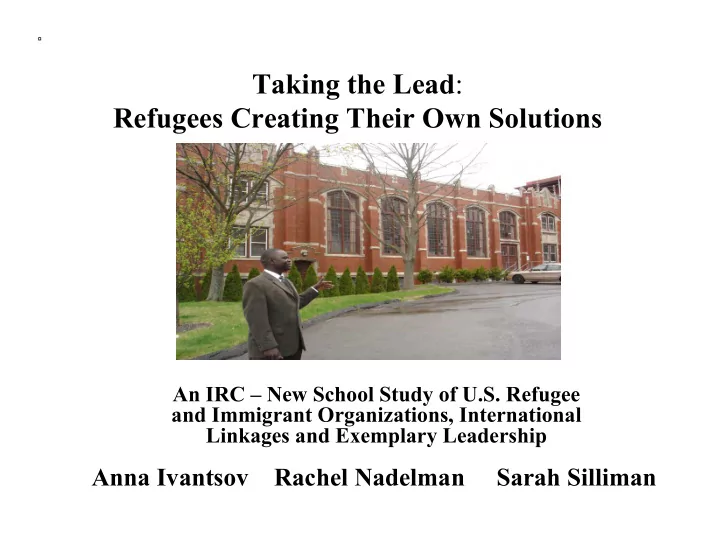
Taking the Lead : Refugees Creating Their Own Solutions An IRC New School Study of U.S. Refugee and Immigrant Organizations, International Linkages and Exemplary Leadership Anna Ivantsov Rachel Nadelman Sarah Silliman Project
Taking the Lead : Refugees Creating Their Own Solutions An IRC – New School Study of U.S. Refugee and Immigrant Organizations, International Linkages and Exemplary Leadership Anna Ivantsov Rachel Nadelman Sarah Silliman
Project Purpose • Create a community-based organization database of refugee focused service providers • Identify organizations that collaborate with or contribute to organizations in their home country • Identify outstanding refugee organizations and leaders for potential collaboration with IRC program departments
Focus Populations: Africa Southern Sudan** Sierra Leone Democratic Republic of Congo Liberia **Southern Sudan was the only country study focused on region rather than nation, because of nature of conflict and composition of U.S. refugee population.
Focus Populations: Asia Afghanistan Burma/Myanmar** ** Myanmar is official country name, but international bodies who do not recognize ruling military junta (such as U.S.) use the name “Burma.”
Research: Methodology • CBOs identified through: – Web-based research – Previous New School student study – CBO leadership/staff referrals • Findings based on: – Data collected through surveys and phone interviews – In-person organizational assessments – CBO-produced print and electronic materials – News reports about CBOs
Survey Design The Survey addressed: • Why established, scope, programs and focus • Leadership (board, staff and volunteers) • Member and beneficiary characteristics • Collaborations & linkages – U.S.-based – Home countries – Countries of first asylum
Organizational Assessment Tools Sigmoid Curve IRC Self-Assessment • Management (program, organizational & financial) • Leadership
Research: Scope • 97 CBOs identified as Refugee/Immigrant-run in 20 states • 43 CBOs interviewed • 8 CBOs visited: – Maine – Massachusetts – New York – Pennsylvania – Virginia
CBO Main Functions • Serve U.S.-based refugee/immigrant populations (locally, regionally and nationally) • Assist with development, reconstruction and social services in home countries/countries first asylum • Advocate on behalf of community and ensure information dissemination
Work in the U.S. • Education (after school programs, literacy, ESL, seminars/conferences, college prep, vocational training) • Health Service Provision (trauma counseling, health fairs, medical assistance) • Legal Assistance and Referrals • Community Outreach/Development • Art and Culture • Youth Leadership • Peer Networking
Linkages to Home Countries & Countries of First Asylum • Education (build/manage schools, provide volunteer teachers, scholarships and supplies) • Development and Reconstruction • Emergency Relief Aid • Medical and Mental Health Services • Exchange Programs (cultural, technical, development) • Leadership Support
Advocacy • Public Organizing (rallies, political demonstrations and festivals) • Lobbying Government (in U.S. and abroad) • Media Outreach (electronic and print) • Conferences and Lectures
Particular social, political, economic conditions… … directly shape each population’s CBO efforts
Common CBO Experiences • Funding Challenges • ‘Mission Creep’ • Focus on Education
Unique Characteristics of CBOs • Afghan – Financial and security issues, post 9-11 challenges in U.S; focus on immigrants, not refugees • Burmese – Prioritizes independence for Burma and assisting refugees in countries of 1 st asylum, offering only minimal social service for U.S.-based refugees • Congolese – Non-English speaking struggles, strong organization of the Diaspora (across U.S. – globally), significant advocacy work
Unique Characteristics of CBOs • Liberian – Colonial relationship with the U.S.; History of organizing U.S. population before the conflict, advocacy work • Sierra Leonean – Few organizations focus only in U.S., because regional nature of conflict many CBOs are Pan African service providers • Southern Sudanese – U.S. refugees primary focus (comprise majority of U.S. population), few and difficult linkages in Sudan
Organizational Assessments: CBOs Visited Afghan: Sierra Leonean: *Afghan Communicator – Queens, NY *Nah We Yone – Harlem, NY American Society of Afghan Southern Sudanese: Professionals – Alexandria, VA *Action for Self Reliance Congolese: Association – Portland. ME *Congolese Women’s Association of *Southern Sudanese New England – Jamaica Plain, MA Organization – Lynn, MA Fondation Shalupe – Braintree, MA Liberian: *African Cultural Alliance of North America – Philadelphia, PA
Action for Self Reliance Association (ASRELA) – Portland, ME • Built and manages a K-6 school in Kiryandongo refugee camp (Uganda) providing education and nutrition • Designed and implemented a youth leadership program • U.S.-based programs tackle issues such as tribalism, inter- family conflict and community building • Success in producing large-scale fundraising events for Uganda school which joins diverse communities in the U.S.
Afghan Communicator – Queens, NY • SLIDE INCOMPLETE • Strong connections with U.S.-based Afghan CBOs and maintains a Kabul office to distribute Western aid • Provides immigration assistance and referrals
African Cultural Alliance of North America (ACANA) – Philadelphia, PA • Provides job and health referrals, legal assistance, educational programs, cultural orientation, support to artists, and a food bank for the community • Partners with health care providers for trauma counseling, government agencies for cultural programs in the U.S. • Implementing educational program in Liberia • Working to become ‘one-stop’ social service provider for African immigrants and refugees
Congolese Women’s Association of New England (CWANE) – Jamaica Plain, MA • First group to conduct focus-groups of Congolese women throughout New England to identify their primary needs • Advocates for Congolese Women’s needs in the context of the wider Congolese refugee/asylee community • Partners with mainstream social service providers and Congolese CBOs to produce public events in the U.S. and subsequent workshops throughout New England • Raises funds for women’s projects in DRC
Nah We Yone – Harlem, NY • Provides support to refugees in detention centers and resources for resettlement including housing, job and legal referrals • Fosters sustainable service network here beneficiaries give back as eventual providers • Partners with high profile international human rights NGOs and local hospitals for advocacy and service provision • Creates a community of support for African immigrants and refugees through counseling services, cultural programs, and youth camps
Southern Sudanese Organization – Lynn, MA • Member of Massachusetts Mutual Assistance Coalition, an alliance of eleven immigrant/refugee groups that provides support programs, seeks funding and partners with mainstream social service agencies • frequent partner to NGOs such as the IRC Boston resettlement office and other refugee support agencies. • Creatively serves the community by utilizing skills and knowledge learned at home to overcome challenges such as unemployment [picture to come]
Thank you!
Recommend
More recommend
Explore More Topics
Stay informed with curated content and fresh updates.