Tautological Necessity and Tautological Validity With Quantifjers - - PowerPoint PPT Presentation

tautological necessity and tautological validity with
SMART_READER_LITE
LIVE PREVIEW

Tautological Necessity and Tautological Validity With Quantifjers - - PowerPoint PPT Presentation

Truth Table Necessity We will call the method we use to uncover this form: Boxing, Tagging, and Replacing Truth Table Validity of Arguments What we have to do is fjnd a way of feigning ignorance . We need to make sure that we ignore everything


slide-1
SLIDE 1 Truth Table Necessity Boxing, Tagging, and Replacing Truth Table Validity of Arguments

Tautological Necessity and Tautological Validity With Quantifjers

Mark Criley IWU 25 October 2017

Mark Criley IWU Tautological Necessity and Tautological Validity With Quantifjers Truth Table Necessity Boxing, Tagging, and Replacing Truth Table Validity of Arguments

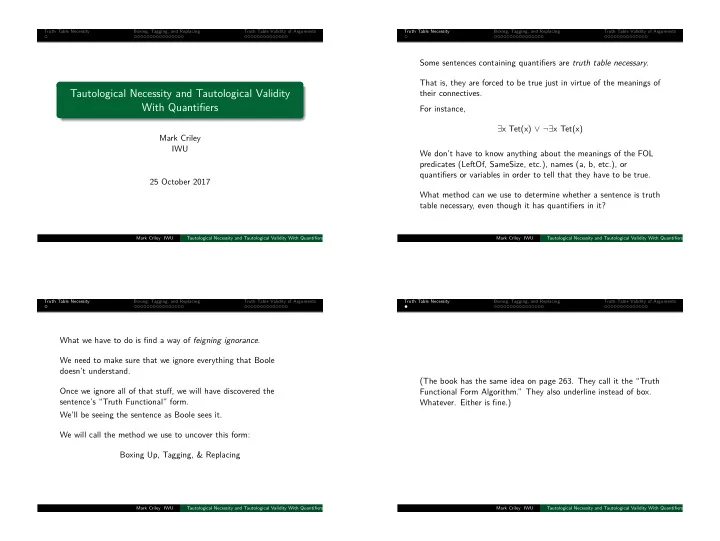
Some sentences containing quantifjers are truth table necessary. That is, they are forced to be true just in virtue of the meanings of their connectives. For instance, ∃x Tet(x) ∨ ¬∃x Tet(x) We don’t have to know anything about the meanings of the FOL predicates (LeftOf, SameSize, etc.), names (a, b, etc.), or quantifjers or variables in order to tell that they have to be true. What method can we use to determine whether a sentence is truth table necessary, even though it has quantifjers in it?

Mark Criley IWU Tautological Necessity and Tautological Validity With Quantifjers Truth Table Necessity Boxing, Tagging, and Replacing Truth Table Validity of Arguments

What we have to do is fjnd a way of feigning ignorance. We need to make sure that we ignore everything that Boole doesn’t understand. Once we ignore all of that stufg, we will have discovered the sentence’s “Truth Functional” form. We’ll be seeing the sentence as Boole sees it. We will call the method we use to uncover this form: Boxing Up, Tagging, & Replacing

Mark Criley IWU Tautological Necessity and Tautological Validity With Quantifjers Truth Table Necessity Boxing, Tagging, and Replacing Truth Table Validity of Arguments

(The book has the same idea on page 263. They call it the “Truth Functional Form Algorithm.” They also underline instead of box.

  • Whatever. Either is fjne.)
Mark Criley IWU Tautological Necessity and Tautological Validity With Quantifjers
slide-2
SLIDE 2 Truth Table Necessity Boxing, Tagging, and Replacing Truth Table Validity of Arguments

The Method

Here’s how the method works. Start at the beginning of the sentence you’re investigating. Apply the following recipe, moving your fjnger from left to right through your sentence and repeating until you reach the end of the sentence.

Mark Criley IWU Tautological Necessity and Tautological Validity With Quantifjers Truth Table Necessity Boxing, Tagging, and Replacing Truth Table Validity of Arguments

Apply the following recipe, moving your fjnger from left to right through your sentence and repeating until you reach the end of the sentence.

1 If your fjnger is on a connective or a parenthesis, leave it

unboxed and skip over it. Apply this recipe to the rest of the sentence.

2 If your fjnger is on the start of an atomic sentence, box up

that atomic sentence. Move your fjnger to the end of the box, apply this recipe to the rest of the sentence.

3 If your fjnger is on a quantifjer: Box up the entire quantifjer

statement, starting at the quantifjer and extending to the end

  • f its scope. Move your fjnger to the end of the box, and

continue applying this recipe to the rest of the sentence.

Mark Criley IWU Tautological Necessity and Tautological Validity With Quantifjers Truth Table Necessity Boxing, Tagging, and Replacing Truth Table Validity of Arguments

An Example: Boxing Exercise 10.1, sentence #4

From Exercise 10.1

4 ∀x (Cube(x) ∧ Small(x)) → ∀x (Small(x) ∧ Cube(x))

We start at the quantifjer: ∀. The scope of that quantifjer extends to the end of the fjrst complete wfg after it. That means that it extends this far:

4

∀x (Cube(x) ∧ Small(x)) → ∀x (Small(x) ∧ Cube(x))

Mark Criley IWU Tautological Necessity and Tautological Validity With Quantifjers Truth Table Necessity Boxing, Tagging, and Replacing Truth Table Validity of Arguments

Boxing Exercise 10.1, sentence #4

4

∀x (Cube(x) ∧ Small(x)) → ∀x (Small(x) ∧ Cube(x)) Now we move our fjnger to the end of that box, and keep moving right. What comes next is the →. That is a connective, so we leave it unboxed. But after that we come to another ∀. So we start boxing again, to the end of the scope of that quantifjer. In this case, that means to the end of the sentence.

4

∀x (Cube(x) ∧ Small(x)) → ∀x (Small(x) ∧ Cube(x))

Mark Criley IWU Tautological Necessity and Tautological Validity With Quantifjers
slide-3
SLIDE 3 Truth Table Necessity Boxing, Tagging, and Replacing Truth Table Validity of Arguments

Tagging 10.1.#4…

Now, we have to tag each unique boxed up sentence part with a unique capital letter sentence abbreviation (A, B, C, etc.)

  • Make sure that you use the same capital letter for two boxes

if they contain exactly the same string of symbols.

  • Make sure that you use the same capital letter sentence for

two boxes only if they contain the same string of symbols.

Mark Criley IWU Tautological Necessity and Tautological Validity With Quantifjers Truth Table Necessity Boxing, Tagging, and Replacing Truth Table Validity of Arguments

Tagging 10.1.#4…

4

∀x (Cube(x) ∧ Small(x)) → ∀x (Small(x) ∧ Cube(x)) The two boxes don’t have exactly the same string of symbols

  • inside. They are similar, but not identical.

It doesn’t matter that they mean the same thing. In order to be replaced with the same capital letters, the symbols themselves have to be identical, letter for letter. In these sentences, the order of “Cube(x)” and “Small(x)” is

  • switched. So they have to get difgerent sentence letter

abbreviations.

4

∀x (Cube(x) ∧ Small(x)) A → ∀x (Small(x) ∧ Cube(x)) B Note: When exercise 10.1 asks you to write an “Annotated Sentence” in your table, this is what it is looking for: The boxed up sentence with an appropriate assignment of capital letters.

Mark Criley IWU Tautological Necessity and Tautological Validity With Quantifjers Truth Table Necessity Boxing, Tagging, and Replacing Truth Table Validity of Arguments

…& Replacing (Exercise 10.4#4)

Now, to fjnish this ofg and get the truth functional form, just replace each box with its capital letter. So our example of sentence #4 from Exercise 10.1 before …

4

∀x (Cube(x) ∧ Small(x)) A → ∀x (Small(x) ∧ Cube(x)) B …becomes …

4 A → B

That is sentence 4’s truth functional form. That is what you should write in the second column of the table you have to write up for Exercise 10.1, under sentence 4.

Mark Criley IWU Tautological Necessity and Tautological Validity With Quantifjers Truth Table Necessity Boxing, Tagging, and Replacing Truth Table Validity of Arguments

Is 10.1#4 a Truth Table Necessity?

Is a sentence that has this form a tautology—a Truth Table Necessity? That is, is it true on every row of its truth table?

4 A → B
  • No. Clearly not. It will have a row on its truth table where A is

true and B is false. On that row, A → B will be false. So it isn’t a tautology. That means that we don’t want to write “a” in the third column of the table you are writing for Exercise 10.1.

Mark Criley IWU Tautological Necessity and Tautological Validity With Quantifjers
slide-4
SLIDE 4 Truth Table Necessity Boxing, Tagging, and Replacing Truth Table Validity of Arguments

Is 10.1.4 Logically Necessary?

Next question:

4 ∀x (Cube(x) ∧ Small(x)) → ∀x (Small(x) ∧ Cube(x))
  • Is this sentence logically necessary?
Mark Criley IWU Tautological Necessity and Tautological Validity With Quantifjers Truth Table Necessity Boxing, Tagging, and Replacing Truth Table Validity of Arguments

Is 10.1.4 Logically Necessary?

4 ∀x (Cube(x) ∧ Small(x)) → ∀x (Small(x) ∧ Cube(x))

Answer: Yes Why? Because: If the antecedent (∀x (Cube(x) ∧ Small(x))) is true, that means that everything is a cube and small. So the consequent (∀x (Small(x) ∧ Cube(x))) has to be true, too. Everything is a small cube. That means that we will want to write “b” in the last column of the chart we’re writing for Exercise 10.1.

Mark Criley IWU Tautological Necessity and Tautological Validity With Quantifjers Truth Table Necessity Boxing, Tagging, and Replacing Truth Table Validity of Arguments

Another Example: 10.1#1

1 ∀x (x=x)

How do we box it up?

Mark Criley IWU Tautological Necessity and Tautological Validity With Quantifjers Truth Table Necessity Boxing, Tagging, and Replacing Truth Table Validity of Arguments

Boxing Up 10.1#1

1 ∀x (x=x)

Start at the quantifjer ∀. Its scope goes to the end of the fjrst complete wfg after the quantifjer. Here, that takes us all the way to the end of the whole sentence. So here’s what we get:

1

∀x (x=x) Now assign a capital letter sentence abbreviation.

1

∀x (x=x) A (This is what we’ll want to write in the fjrst column of our chart for Exercise 10.1.1, under “Annotated sentence”)

Mark Criley IWU Tautological Necessity and Tautological Validity With Quantifjers
slide-5
SLIDE 5 Truth Table Necessity Boxing, Tagging, and Replacing Truth Table Validity of Arguments

10.1.1 Truth Functional form

1

∀x (x=x) A That means that the truth functional form of the sentence is just

1 A

(That’s what we’ll want to write in the second column of the chart we’re writing to hand in for Exercise 10.1, under “Truth-functional form” for sentence number 1.)

Mark Criley IWU Tautological Necessity and Tautological Validity With Quantifjers Truth Table Necessity Boxing, Tagging, and Replacing Truth Table Validity of Arguments

10.1.1 Truth Table Necessary?

Question: So is sentence 10.1.1 a tautology? To answer, we look at its truth table form again:

1 A

Answer: Heck, no. It’s just a single simple sentence, according to

  • Boole. So it will be true on some rows of the truth table, and false
  • n others.
Mark Criley IWU Tautological Necessity and Tautological Validity With Quantifjers Truth Table Necessity Boxing, Tagging, and Replacing Truth Table Validity of Arguments

10.1.1 Logically necessary???

But is 10.1.1 a logical necessity? That is, is it a sentence that is forced to be true when we pay attention to more than just the meanings of the connectives? Once we start paying attention to the meanings of the connectives and the quantifjers, identity, and then the rest of the predicates, then the sentence goes back to looking like this:

1 ∀x (x=x)

Question: Does that sentence have to be true?

Mark Criley IWU Tautological Necessity and Tautological Validity With Quantifjers Truth Table Necessity Boxing, Tagging, and Replacing Truth Table Validity of Arguments

10.1.1 Logically Necessary

Well, what does it say?

1 ∀x (x=x)
  • “Every object is one and the same object as itself.”

There is just no way that could be false. Everything must be identical to itself. So 10.1.1 is logically necessary. Once again, we’ll have to write “b” in the last column of our chart we’re submitting for Exercise 10.1.

Mark Criley IWU Tautological Necessity and Tautological Validity With Quantifjers
slide-6
SLIDE 6 Truth Table Necessity Boxing, Tagging, and Replacing Truth Table Validity of Arguments

TT-Validity of Arguments

The Boxing, Tagging & Replacing technique will also help us to determine whether an argument involving quantifjers is truth table (or “tautologically”) valid. This is what you would be asked to do if you were assigned Exercise 10.4.

Mark Criley IWU Tautological Necessity and Tautological Validity With Quantifjers Truth Table Necessity Boxing, Tagging, and Replacing Truth Table Validity of Arguments

Extending the BTR method to Arguments

The only new wrinkle concerns the way we tag boxes with capital letters:

  • When we are tagging our boxes with capital letter sentence

names, we have to make sure that we use unique capital letters for difgerent boxes across all the sentences in the argument.

  • Also, if we have the same box reappearing in difgerent places

in the argument, we need to make sure that we use the same capital letter for that box wherever it appears in the argument.

Mark Criley IWU Tautological Necessity and Tautological Validity With Quantifjers Truth Table Necessity Boxing, Tagging, and Replacing Truth Table Validity of Arguments

Exercise 10.4

Let’s Box, Tag, and Replace the argument in Exercise 10.4 ∀x Cube(x) → ∃y Small(y) ¬∃y Small(y) ¬∀x Cube(x) We just box this up the same way we boxed up sentences before. How does that go?

Mark Criley IWU Tautological Necessity and Tautological Validity With Quantifjers Truth Table Necessity Boxing, Tagging, and Replacing Truth Table Validity of Arguments

The Argument in Exercise 10.4

∀x Cube(x) → ∃y Small(y) ¬∃y Small(y) ¬∀x Cube(x)

Mark Criley IWU Tautological Necessity and Tautological Validity With Quantifjers
slide-7
SLIDE 7 Truth Table Necessity Boxing, Tagging, and Replacing Truth Table Validity of Arguments

Boxing Up the Argument in Exercise 10.4:

∀x Cube(x) → ∃y Small(y) ¬ ∃y Small(y) ¬ ∀x Cube(x) Notice that we skip over the beginning negations for the second premise and the conclusion. Boole can understand those, since they’re not inside of any quantifjers.

Mark Criley IWU Tautological Necessity and Tautological Validity With Quantifjers Truth Table Necessity Boxing, Tagging, and Replacing Truth Table Validity of Arguments

Tagging Exercise 10.4

Now we have to assign capital letter sentence abbreviations. Make sure that we use difgerent letters for difgerent boxes and the same letters for the repeating boxes! See any repeats we need to watch out for? ∀x Cube(x) → ∃y Small(y) ¬ ∃y Small(y) ¬ ∀x Cube(x)

Mark Criley IWU Tautological Necessity and Tautological Validity With Quantifjers Truth Table Necessity Boxing, Tagging, and Replacing Truth Table Validity of Arguments

Exercise 10.4:

∀x Cube(x) A → ∃y Small(y) B ¬ ∃y Small(y) B ¬ ∀x Cube(x) A Replace tagged boxes with their capital letter abbreviations … A → B ¬B ¬A …to reveal the truth-functional form of the argument.

Mark Criley IWU Tautological Necessity and Tautological Validity With Quantifjers Truth Table Necessity Boxing, Tagging, and Replacing Truth Table Validity of Arguments

Truth Functional Form and TT-Validity

This is what we would want to write out on paper if 10.4 were assigned as homework: Exercise 10.4: A → B ¬B ¬A And then we have to answer the question whether this argument is TT-valid. What do you think?

Mark Criley IWU Tautological Necessity and Tautological Validity With Quantifjers
slide-8
SLIDE 8 Truth Table Necessity Boxing, Tagging, and Replacing Truth Table Validity of Arguments

Assessing TT-Validity

It’s TT-Valid if and only if it doesn’t have any Truth Table counterexamples. A counterexample would be a row where the premises A → B and ¬B are true, but the conclusion ¬A is false. Would there be any rows like that?

Mark Criley IWU Tautological Necessity and Tautological Validity With Quantifjers Truth Table Necessity Boxing, Tagging, and Replacing Truth Table Validity of Arguments
  • Nope. There would not be any rows like that.

Wherever A → B and ¬B are true on the truth table, the conclusion ¬A has to be true, too. So there are no counterexample rows. So the argument from Exercise 10.4 is TT-valid. So we should write down (a) for our assessment of the argument: It is tautologically valid.

Mark Criley IWU Tautological Necessity and Tautological Validity With Quantifjers Truth Table Necessity Boxing, Tagging, and Replacing Truth Table Validity of Arguments

Assessing Logical Validity

Thus, it has to be Logically Valid, too. (All TT-valid arguments are logically valid.)

Mark Criley IWU Tautological Necessity and Tautological Validity With Quantifjers Truth Table Necessity Boxing, Tagging, and Replacing Truth Table Validity of Arguments

Using Other Programs to Check

Still not sure whether this is TT-valid? A → B ¬B ¬A You could check it by constructing a truth table in Boole. The book tells you that you can use the rule of Taut Con to check your answers.

Mark Criley IWU Tautological Necessity and Tautological Validity With Quantifjers
slide-9
SLIDE 9 Truth Table Necessity Boxing, Tagging, and Replacing Truth Table Validity of Arguments

Taut Con

Taut Con is a wildcard rule in Fitch. It is kind of like Ana Con,

  • nly less powerful. It tells you whether a step is a TT-Consequence
  • f other steps.

Ana Con tells us whether an argument is Logically Valid. It pays attention to the connectives, the quantifjers, identity, and meanings of all of the other predicates, too. Taut Con, like Boole, only pays attention to the meanings of the connectives.

Mark Criley IWU Tautological Necessity and Tautological Validity With Quantifjers Truth Table Necessity Boxing, Tagging, and Replacing Truth Table Validity of Arguments

One more Exercise …

Take a look at Exercise 10.2 It is not TT-valid. (Why?) But it is logically valid. (Why?) So if this Exercise were assigned, we would write (b) for our assessment.

Mark Criley IWU Tautological Necessity and Tautological Validity With Quantifjers