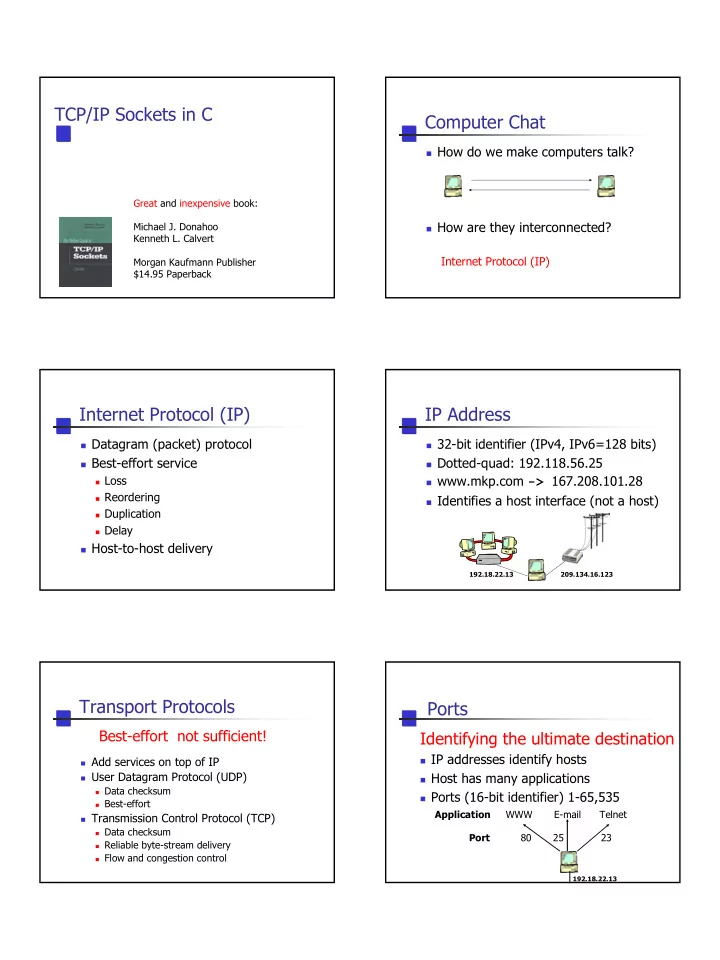
TCP/IP Sockets in C Computer Chat How do we make computers talk? - - PDF document

tcp ip sockets in c computer chat
SMART_READER_LITE
LIVE PREVIEW

TCP/IP Sockets in C Computer Chat How do we make computers talk? - - PDF document

TCP/IP Sockets in C Computer Chat How do we make computers talk? Great and inexpensive book: How are they interconnected? Michael J. Donahoo Kenneth L. Calvert Internet Protocol (IP) Morgan Kaufmann Publisher $14.95 Paperback


slide-1
SLIDE 1

1

TCP/IP Sockets in C

Great and inexpensive book: Michael J. Donahoo Kenneth L. Calvert Morgan Kaufmann Publisher $14.95 Paperback

Computer Chat

How do we make computers talk? How are they interconnected?

Internet Protocol (IP)

Internet Protocol (IP)

Datagram (packet) protocol Best-effort service

Loss Reordering Duplication Delay

Host-to-host delivery

IP Address

32-bit identifier (IPv4, IPv6=128 bits) Dotted-quad: 192.118.56.25 www.mkp.com -> 167.208.101.28 Identifies a host interface (not a host)

192.18.22.13 209.134.16.123

Transport Protocols

Best-effort not sufficient!

Add services on top of IP User Datagram Protocol (UDP)

Data checksum Best-effort

Transmission Control Protocol (TCP)

Data checksum Reliable byte-stream delivery Flow and congestion control

Ports

Identifying the ultimate destination

IP addresses identify hosts Host has many applications Ports (16-bit identifier) 1-65,535

192.18.22.13

Port 80 25 23 Application WWW E-mail Telnet

slide-2
SLIDE 2

2

Socket

How does one speak TCP/IP?

Sockets provides interface to TCP/IP Generic interface for many protocols

Sockets

Identified by protocol and local/remote

address/port

Applications may refer to many sockets Sockets accessed by many applications

TCP/IP Sockets

IPPROTO_UDP SOCK_DGRAM UDP IPPROTO_TCP SOCK_STREAM PF_INET TCP Protocol Type Family mySock = socket(family, type, protocol); TCP/IP-specific sockets Socket reference

File (socket) descriptor in UNIX

Specifying Addresses

  • struct sockaddr

{ unsigned short sa_family; /* Address family (e.g., AF_INET) */ char sa_data[14]; /* Protocol-specific address information */ };

  • struct sockaddr_in

{ unsigned short sin_family;/* Internet protocol (AF_INET) */ unsigned short sin_port; /* Port (16-bits) */ struct in_addr sin_addr; /* Internet address (32-bits) */ char sin_zero[8]; /* Not used */ }; struct in_addr { unsigned long s_addr; /* Internet address (32-bits) */ };

Generic IP Specific

Client: Initiates the connection Server: Passively waits to respond

Clients and Servers

Client: Bob “Hi. I’m Bob.” “Nice to meet you, Jane.” Server: Jane “Hi, Bob. I’m Jane”

TCP Client/Server Interaction

Client

1.

Create a TCP socket

2.

Establish connection

3.

Communicate

4.

Close the connection Server

1.

Create a TCP socket

2.

Assign a port to socket

3.

Set socket to listen

4.

Repeatedly:

a.

Accept new connection

b.

Communicate

c.

Close the connection

Server starts by getting ready to receive client connections…

slide-3
SLIDE 3

3

TCP Client/Server Interaction

Client

1.

Create a TCP socket

2.

Establish connection

3.

Communicate

4.

Close the connection Server

1.

Create a TCP socket

2.

Bind socket to a port

3.

Set socket to listen

4.

Repeatedly:

a.

Accept new connection

b.

Communicate

c.

Close the connection

/* Create socket for incoming connections */ if ((servSock = socket(PF_INET, SOCK_STREAM, IPPROTO_TCP)) < 0) DieWithError("socket() failed");

TCP Client/Server Interaction

Client

1.

Create a TCP socket

2.

Establish connection

3.

Communicate

4.

Close the connection Server

1.

Create a TCP socket

2.

Bind socket to a port

3.

Set socket to listen

4.

Repeatedly:

a.

Accept new connection

b.

Communicate

c.

Close the connection

echoServAddr.sin_family = AF_INET; /* Internet address family */ echoServAddr.sin_addr.s_addr = htonl(INADDR_ANY);/* Any incoming interface */ echoServAddr.sin_port = htons(echoServPort); /* Local port */ if (bind(servSock, (struct sockaddr *) &echoServAddr, sizeof(echoServAddr)) < 0) DieWithError("bind() failed");

TCP Client/Server Interaction

Client

1.

Create a TCP socket

2.

Establish connection

3.

Communicate

4.

Close the connection Server

1.

Create a TCP socket

2.

Bind socket to a port

3.

Set socket to listen

4.

Repeatedly:

a.

Accept new connection

b.

Communicate

c.

Close the connection

/* Mark the socket so it will listen for incoming connections */ if (listen(servSock, MAXPENDING) < 0) DieWithError("listen() failed");

TCP Client/Server Interaction

Client

1.

Create a TCP socket

2.

Establish connection

3.

Communicate

4.

Close the connection Server

1.

Create a TCP socket

2.

Bind socket to a port

3.

Set socket to listen

4.

Repeatedly:

a.

Accept new connection

b.

Communicate

c.

Close the connection

for (;;) /* Run forever */ { clntLen = sizeof(echoClntAddr); if ((clntSock=accept(servSock,(struct sockaddr *)&echoClntAddr,&clntLen)) < 0) DieWithError("accept() failed");

TCP Client/Server Interaction

Client

1.

Create a TCP socket

2.

Establish connection

3.

Communicate

4.

Close the connection Server

1.

Create a TCP socket

2.

Bind socket to a port

3.

Set socket to listen

4.

Repeatedly:

a.

Accept new connection

b.

Communicate

c.

Close the connection

Server is now blocked waiting for connection from a client

TCP Client/Server Interaction

Client

1.

Create a TCP socket

2.

Establish connection

3.

Communicate

4.

Close the connection Server

1.

Create a TCP socket

2.

Bind socket to a port

3.

Set socket to listen

4.

Repeatedly:

a.

Accept new connection

b.

Communicate

c.

Close the connection

Later, a client decides to talk to the server…

slide-4
SLIDE 4

4

TCP Client/Server Interaction

Client

1.

Create a TCP socket

2.

Establish connection

3.

Communicate

4.

Close the connection Server

1.

Create a TCP socket

2.

Bind socket to a port

3.

Set socket to listen

4.

Repeatedly:

a.

Accept new connection

b.

Communicate

c.

Close the connection

/* Create a reliable, stream socket using TCP */ if ((sock = socket(PF_INET, SOCK_STREAM, IPPROTO_TCP)) < 0) DieWithError("socket() failed");

TCP Client/Server Interaction

Client

1.

Create a TCP socket

2.

Establish connection

3.

Communicate

4.

Close the connection Server

1.

Create a TCP socket

2.

Bind socket to a port

3.

Set socket to listen

4.

Repeatedly:

a.

Accept new connection

b.

Communicate

c.

Close the connection

echoServAddr.sin_family = AF_INET; /* Internet address family */ echoServAddr.sin_addr.s_addr = inet_addr(servIP); /* Server IP address */ echoServAddr.sin_port = htons(echoServPort); /* Server port */ if (connect(sock, (struct sockaddr *) &echoServAddr, sizeof(echoServAddr)) < 0) DieWithError("connect() failed");

TCP Client/Server Interaction

Client

1.

Create a TCP socket

2.

Establish connection

3.

Communicate

4.

Close the connection Server

1.

Create a TCP socket

2.

Bind socket to a port

3.

Set socket to listen

4.

Repeatedly:

a.

Accept new connection

b.

Communicate

c.

Close the connection

echoStringLen = strlen(echoString); /* Determine input length */ /* Send the string to the server */ if (send(sock, echoString, echoStringLen, 0) != echoStringLen) DieWithError("send() sent a different number of bytes than expected");

TCP Client/Server Interaction

Client

1.

Create a TCP socket

2.

Establish connection

3.

Communicate

4.

Close the connection Server

1.

Create a TCP socket

2.

Bind socket to a port

3.

Set socket to listen

4.

Repeatedly:

a.

Accept new connection

b.

Communicate

c.

Close the connection

if ((clntSock=accept(servSock,(struct sockaddr *)&echoClntAddr,&clntLen)) < 0) DieWithError("accept() failed");

TCP Client/Server Interaction

Client

1.

Create a TCP socket

2.

Establish connection

3.

Communicate

4.

Close the connection Server

1.

Create a TCP socket

2.

Bind socket to a port

3.

Set socket to listen

4.

Repeatedly:

a.

Accept new connection

b.

Communicate

c.

Close the connection

/* Receive message from client */ if ((recvMsgSize = recv(clntSocket, echoBuffer, RCVBUFSIZE, 0)) < 0) DieWithError("recv() failed");

TCP Client/Server Interaction

Client

1.

Create a TCP socket

2.

Establish connection

3.

Communicate

4.

Close the connection Server

1.

Create a TCP socket

2.

Bind socket to a port

3.

Set socket to listen

4.

Repeatedly:

a.

Accept new connection

b.

Communicate

c.

Close the connection

close(sock); close(clntSocket)
slide-5
SLIDE 5

5

TCP Tidbits

Client

send(“Hello Bob”) recv() -> “Hi Jane”

Server

recv() -> “Hello ” recv() -> “Bob” send(“Hi ”) send(“Jane”)

Client knows server address and port No correlation between send() and recv()

Closing a Connection

close() used to delimit communication Analogous to EOF

Client

send(string) while (not received entire string) recv(buffer) send(buffer) close(socket)

Server

recv(buffer) while(client has not closed connection) send(buffer) recv(buffer) close(client socket)

Constructing Messages

…beyond simple strings

TCP/IP Byte Transport

TCP/IP protocols transports bytes Application protocol provides semantics

Application TCP/IP

byte stream

Application TCP/IP

byte stream Here are some

  • bytes. I don’t

know what they mean. I’ll pass these to the app. It knows what to do.

Application Protocol

Encode information in bytes Sender and receiver must agree on

semantics

Data encoding

Primitive types: strings, integers, and etc. Composed types: message with fields

Primitive Types

String

Character encoding: ASCII, Unicode, UTF Delimit: length vs. termination character

M

  • m

\n 3 77 111 109 77 111 109 10

slide-6
SLIDE 6

6

Integer

Strings of character encoded decimal digits

Advantage:

  • 1. Human readable
  • 2. Arbitrary size

Disadvantage:

  • 1. Inefficient
  • 2. Arithmetic manipulation

Primitive Types

49 55 57 57 56 55 48 10 ‘1’ ‘7’ ‘9’ ‘9’ ‘8’ ‘7’ ‘0’ \n

Primitive Types

Integer

Native representation Network byte order (Big

  • E

ndian)

Use for multi-byte, binary data exchange htonl(), htons(), ntohl(), ntohs()

92 246 4-byte two’s-complement integer 23,798 246 92 Big-Endian Little-Endian

Message Composition

Message composed of fields

Fixed

  • length fields

Variable

  • length fields

short short integer \n 1 2 e i k M

“Beware the bytes of padding”

  • - Julius Caesar, Shakespeare

Architecture alignment restrictions Compiler pads structs to accommodate Problem: Alignment restrictions vary Solution: 1) Rearrange struct members

2) Serialize struct by

  • m

e mber

struct tst { short x; int y; short z; };

x [pad] y z [pad]

TCPEchoClient.c #include <stdio.h> /* for printf() and fprintf() */ #include <sys/socket.h> /* for socket(), connect(), send(), and recv() */ #include <arpa/inet.h> /* for sockaddr_in and inet_addr() */ #include <stdlib.h> /* for atoi() */ #include <string.h> /* for memset() */ #include <unistd.h> /* for close() */ #define RCVBUFSIZE 32 /* Size of receive buffer */ void DieWithError(char *errorMessage); /* Error handling function */ int main(int argc, char *argv[]) { int sock; /* Socket descriptor */ struct sockaddr_in echoServAddr; /* Echo server address */ unsigned short echoServPort; /* Echo server port */ char *servIP; /* Server IP address (dotted quad) */ char *echoString; /* String to send to echo server */ char echoBuffer[RCVBUFSIZE]; /* Buffer for echo string */ unsigned int echoStringLen; /* Length of string to echo */ int bytesRcvd, totalBytesRcvd; /* Bytes read in single recv() and total bytes read */ if ((argc < 3) || (argc > 4)) /* Test for correct number of arguments */ { fprintf(stderr, "Usage: %s <Server IP> <Echo Word> [<Echo Port>]\n", argv[0]); exit(1); } servIP = argv[1]; /* First arg: server IP address (dotted quad) */ echoString = argv[2]; /* Second arg: string to echo */ if (argc == 4) echoServPort = atoi(argv[3]); /* Use given port, if any */ else echoServPort = 7; /* 7 is the well-known port for the echo service */ /* Create a reliable, stream socket using TCP */ if ((sock = socket(PF_INET, SOCK_STREAM, IPPROTO_TCP)) < 0) DieWithError("socket() failed"); /* Construct the server address structure */ memset(&echoServAddr, 0, sizeof(echoServAddr)); /* Zero out structure */ echoServAddr.sin_family = AF_INET; /* Internet address family */ echoServAddr.sin_addr.s_addr = inet_addr(servIP); /* Server IP address */ echoServAddr.sin_port = htons(echoServPort); /* Server port */ /* Establish the connection to the echo server */ if (connect(sock, (struct sockaddr *) &echoServAddr, sizeof(echoServAddr)) < 0) DieWithError("connect() failed"); echoStringLen = strlen(echoString); /* Determine input length */ /* Send the string to the server */ if (send(sock, echoString, echoStringLen, 0) != echoStringLen) DieWithError("send() sent a different number of bytes than expected");

slide-7
SLIDE 7

7

/* receive the same string back from the server */ totalBytesRcvd = 0; printf("Received: "); /* Setup to print the echoed string */ while (totalBytesRcvd < echoStringLen) { /* Receive up to the buffer size (minus 1 to leave space for a null terminator) bytes from the sender */ if ((bytesRcvd = recv(sock, echoBuffer, RCVBUFSIZE - 1, 0)) <= 0) DieWithError("recv() failed or connection closed prematurely"); totalBytesRcvd += bytesRcvd; /* Keep tally of total bytes */ echoBuffer[bytesRcvd] = '\0'; /* Terminate the string! */ printf(echoBuffer); /* Print the echo buffer */ } printf("\n"); /* Print a final linefeed */ close(sock); exit(0); } void DieWithError(char *errorMessage) { perror(errorMessage); exit(1); } TCPEchoServer.c #include <stdio.h> /* for printf() and fprintf() */ #include <sys/socket.h> /* for socket(), bind(), and connect() */ #include <arpa/inet.h> /* for sockaddr_in and inet_ntoa() */ #include <stdlib.h> /* for atoi() */ #include <string.h> /* for memset() */ #include <unistd.h> /* for close() */ #define MAXPENDING 5 /* Maximum outstanding connection requests */ void DieWithError(char *errorMessage); /* Error handling function */ void HandleTCPClient(int clntSocket); /* TCP client handling function */ int main(int argc, char *argv[]) { int servSock; /* Socket descriptor for server */ int clntSock; /* Socket descriptor for client */ struct sockaddr_in echoServAddr; /* Local address */ struct sockaddr_in echoClntAddr; /* Client address */ unsigned short echoServPort; /* Server port */ unsigned int clntLen; /* Length of client address data structure */ if (argc != 2) /* Test for correct number of arguments */ { fprintf(stderr, "Usage: %s <Server Port>\n", argv[0]); exit(1); } echoServPort = atoi(argv[1]); /* First arg: local port */ /* Create socket for incoming connections */ if ((servSock = socket(PF_INET, SOCK_STREAM, IPPROTO_TCP)) < 0) DieWithError("socket() failed"); /* Construct local address structure */ memset(&echoServAddr, 0, sizeof(echoServAddr)); /* Zero out structure */ echoServAddr.sin_family = AF_INET; /* Internet address family */ echoServAddr.sin_addr.s_addr = htonl(INADDR_ANY); /* Any incoming interface */ echoServAddr.sin_port = htons(echoServPort); /* Local port */ /* Bind to the local address */ if (bind(servSock, (struct sockaddr *) &echoServAddr, sizeof(echoServAddr)) < 0) DieWithError("bind() failed"); /* Mark the socket so it will listen for incoming connections */ if (listen(servSock, MAXPENDING) < 0) DieWithError("listen() failed"); for (;;) /* Run forever */ { /* Set the size of the in-out parameter */ clntLen = sizeof(echoClntAddr); /* Wait for a client to connect */ if ((clntSock = accept(servSock, (struct sockaddr *) &echoClntAddr, &clntLen)) < 0) DieWithError("accept() failed"); /* clntSock is connected to a client! */ printf("Handling client %s\n", inet_ntoa(echoClntAddr.sin_addr)); HandleTCPClient(clntSock); } /* NOT REACHED */ }

Transport Protocols

Best-effort, host-to-host insufficient Transport protocols add services to IP Ports make end-to-end protocols

192.18.22.13

Port 80 25 23 Application WWW E-mail Telnet

Transport Protocols

User Datagram Protocol (UDP)

Adds ports and data checksum to IP Best

  • e

ffort

Transmission Control Protocol (TCP)

Adds ports and data checksum to IP Reliable byte

  • s

t ream delivery

Flow and congestion control Etc.

slide-8
SLIDE 8

8

Socket Protocols

Protocol Family

PF_INET – Internet Protocol Family

Protocol Type

SOCK_STREAM – Reliable byte

  • stream

SOCK_DGRAM – Best

  • e

ffort datagram

Protocol

IPPROTO_TCP IPPROTO_UDP

TCP Client

1.

Create a TCP socket using socket()

2.

Establish a connection to the server using connect()

3.

Communicate using send() and recv()

4.

Close the connection with close()

TCP Server

1.

Create a TCP socket using socket()

2.

Assign a port number to the socket with bind()

3.

Tell the system to allow connections to be made to that port, using listen()

4.

Repeatedly do the following:

a.

Call accept() to get a new socket for each client connection.

b.

Communicate with the client via that new socket, using send() and recv()

c.

Close the client connection using close()

Protocols

We want to make computers “talk” Protocol: Agreement on exchange

Bob “Hi. I’m Bob.” “Nice to meet you, Jane.” Jane “Hi, Bob. I’m Jane”

TCPEchoServer-Fork.c #include "TCPEchoServer.h" /* TCP echo server includes */ #include <sys/wait.h> /* for waitpid() */ int main(int argc, char *argv[]) { int servSock; /* Socket descriptor for server */ int clntSock; /* Socket descriptor for client */ unsigned short echoServPort; /* Server port */ pid_t processID; /* Process ID from fork() */ unsigned int childProcCount = 0; /* Number of child processes */ if (argc != 2) /* Test for correct number of arguments */ { fprintf(stderr, "Usage: %s <Server Port>\n", argv[0]); exit(1); } echoServPort = atoi(argv[1]); /* First arg: local port */ servSock = CreateTCPServerSocket(echoServPort); for (;;) /* Run forever */ { clntSock = AcceptTCPConnection(servSock); /* Fork child process and report any errors */ if ((processID = fork()) < 0) DieWithError("fork() failed"); else if (processID == 0) /* If this is the child process */ { close(servSock); /* Child closes parent socket */ HandleTCPClient(clntSock); exit(0); /* Child process terminates */ } printf("with child process: %d\n", (int) processID); close(clntSock); /* Parent closes child socket descriptor */ childProcCount++; /* Increment number of outstanding child processes */ while (childProcCount) /* Clean up all zombies */ { processID = waitpid((pid_t) -1, NULL, WNOHANG); /* Non-blocking wait */ if (processID < 0) /* waitpid() error? */ DieWithError("waitpid() failed"); else if (processID == 0) /* No zombie to wait on */ break; else childProcCount--; /* Cleaned up after a child */ } } }

slide-9
SLIDE 9

9

#define MAXPENDING 5 /* Maximum outstanding connection requests */ void DieWithError(char *errorMessage); /* Error handling function */ int CreateTCPServerSocket(unsigned short port) { int sock; /* socket to create */ struct sockaddr_in echoServAddr; /* Local address */ /* Create socket for incoming connections */ if ((sock = socket(PF_INET, SOCK_STREAM, IPPROTO_TCP)) < 0) DieWithError("socket() failed"); /* Construct local address structure */ memset(&echoServAddr, 0, sizeof(echoServAddr)); /* Zero out structure */ echoServAddr.sin_family = AF_INET; /* Internet address family */ echoServAddr.sin_addr.s_addr = htonl(INADDR_ANY); /* Any incoming interface */ echoServAddr.sin_port = htons(port); /* Local port */ /* Bind to the local address */ if (bind(sock, (struct sockaddr *) &echoServAddr, sizeof(echoServAddr)) < 0) DieWithError("bind() failed"); /* Mark the socket so it will listen for incoming connections */ if (listen(sock, MAXPENDING) < 0) DieWithError("listen() failed"); return sock; } #include <stdio.h> /* for printf() */ #include <sys/socket.h> /* for accept() */ #include <arpa/inet.h> /* for sockaddr_in and inet_ntoa() */ void DieWithError(char *errorMessage); /* Error handling function */ int AcceptTCPConnection( int servSock ) { int clntSock; /* Socket descriptor for client */ struct sockaddr_in echoClntAddr; /* Client address */ unsigned int clntLen; /* Length of client address data structure */ /* Set the size of the in-out parameter */ clntLen = sizeof(echoClntAddr); /* Wait for a client to connect */ if ((clntSock = accept(servSock, (struct sockaddr *) &echoClntAddr, &clntLen)) < 0) DieWithError("accept() failed"); /* clntSock is connected to a client! */ printf("Handling client %s\n", inet_ntoa(echoClntAddr.sin_addr)); return clntSock; }

Resources/References

http://cs.ecs.baylor.edu/~donahoo/practical/C

Sockets

http://www.ecst.csuchico.edu/~beej/guide

Network programming Unix Interprocess communication