TDDE25 Computational Complexity Theory F 9 Chap 5: Algorithms - - PowerPoint PPT Presentation

tdde25 computational complexity theory
SMART_READER_LITE
LIVE PREVIEW

TDDE25 Computational Complexity Theory F 9 Chap 5: Algorithms - - PowerPoint PPT Presentation

https://liuonline.sharepoint.com/sites/Lisam_TDDE25_2020HT_FZ Algorithmics and Computability Part II TDDE25 Computational Complexity Theory F 9 Chap 5: Algorithms Chap 12: Theory of Computation Patrick Doherty Dept of Computer and


slide-1
SLIDE 1

TDDE25

Fö 9 Chap 5: Algorithms Chap 12: Theory of Computation

https://liuonline.sharepoint.com/sites/Lisam_TDDE25_2020HT_FZ

Algorithmics and Computability Part II

Patrick Doherty Dept of Computer and Information Science Artificial Intelligence and Integrated Computer Systems Division 1

Computational Complexity Theory

2

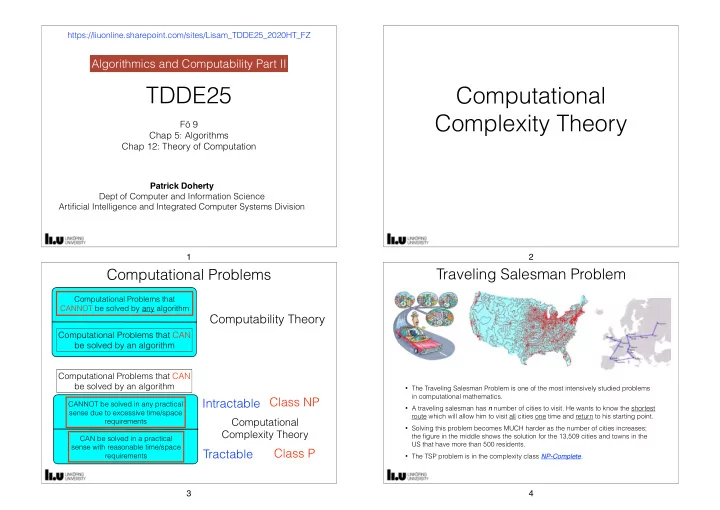
Computational Problems

Computational Problems that CAN be solved by an algorithm

Computational Problems that CANNOT be solved by any algorithm

Computability Theory

CANNOT be solved in any practical sense due to excessive time/space requirements

Computational Problems that CAN be solved by an algorithm

CAN be solved in a practical sense with reasonable time/space requirements

Computational Complexity Theory

Tractable Intractable Class NP Class P

3

Traveling Salesman Problem

  • The Traveling Salesman Problem is one of the most intensively studied problems

in computational mathematics.

  • A traveling salesman has n number of cities to visit. He wants to know the shortest

route which will allow him to visit all cities one time and return to his starting point.

  • Solving this problem becomes MUCH harder as the number of cities increases;

the figure in the middle shows the solution for the 13,509 cities and towns in the US that have more than 500 residents.

  • The TSP problem is in the complexity class NP-Complete.

4

slide-2
SLIDE 2

Traveling Salesman Problem

  • Suppose there are n cities to visit.
  • The number of possible itineraries is (n-1)!
  • For n=10 cities, there are 9!=362,880 itineraries.
  • What if n=40? For brute force methods:
  • There are now 39! itineraries to check which is greater then 1045
  • Examining 1015 tours per second, the required time would be several billion lifetimes of the

universe (universe is estimated to be 13.8 billion years old)

  • In fact, no supercomputer, existing or projected can run this fast.
  • There are other methods though (branch-bound, progressive improvement, heuristics) that can

compute up to 200 cities in “reasonable” time. Current record (?): 85,900 cities for a problem instance.

  • (n-1)! grows faster than 2n. So the time it takes to solve the problem grows exponentially with the size of

the input.

5

Sequential Search: Telephone Book

  • Suppose a telephone book has N=1000000 entries.
  • Given the name Y, search the telephone book sequentially for Y’s telephone

number

  • Entries <X1, T1>, <X2, T2>, ... X1000000, T1000000>
  • At each iteration Y is compared with Xi
  • Assume time increases relative to the number of comparisons, so we are

counting comparison instructions. (there may be other instructions...)

  • In the worst case, 1 000 000 comparisons may have to be made.
  • Call the algorithm A. We say it has a worst case running time which is on the
  • rder of N.
  • A runs in time O(N) in the worst case, where N is the number of entries in the

telephone book.

  • In other words, the time complexity of A is dependent on the size of the input.
  • A has worst case behavior which is linear in the size of the input to A.

6

Big- Notation

O

  • We do not care whether the algorithm takes time

, , , or even a fraction of :

  • The only thing that matters is that the running time of the algorithm

grows linearly with .

  • In other words, there is some constant such that the algorithm

runs in time that is no more than in the worst case

  • Let

be a function on (the size of the input to an algorithm) then is on the order of if:

N 3N 100N N N/6 N k k * N T(n) n T(n) f(n)

is if for some , for all

T(n) O(f(n)) T(n) < k * f(n) k n > n0

Asymptotic Analysis

characterizes the running time of the algorithm, i.e, lines of code, # of additions, etc. as a function of input n. usually characterizes worst case running time.

T(n) T(n)

7

Linear Family of Functions

Multiplicative constants only change the slope of the curve and not its shape.

8

slide-3
SLIDE 3

Binary Search: Telephone Book

A: Sorted List as content t: Number to be found n: size of list

n=7

0 1 2 3 4 5 6

9

Binary Search Example: Telephone Book

1 Allen 2 Baley 3 Boyer 4 Casy 5 Davis 6 Davison 7 Glen 8 Greer 9 Haley 10 Hanson 11Harrison 12 Listor 13 Mendel 14 Morgenstern 15 Patton 16 Perkins 17 Quinn 18 Reed 19 Schmidt 20 Woolf

Find Casy

Casy < Harrison

Start

Casy < Davison Casy > Boyer Casy < Davis

Eureka!

Length = 20 # Comparisons = 5

Size of the problem is reduced by half each comparison!

Round up on non whole numbers

10

Binary Search: 1 000 000 Entries

  • Each comparison reduces the length of the input list by half.
  • The process terminates when or before the list becomes empty
  • So, the worst case number of comparisons is obtained by figuring
  • ut how many times a number

can be repeatedly divided by two before it is reduced to 0 (ignoring fractions)

N

Length = # Comparisons =

20 5

Length = # Comparisons = ??

1000000

is about

1000000 220

is about

log2(1000000) 20

counts the number required to reduce to (not )

log2(N) N 1

In the worst case, # of comparisons required is ,

  • r

1 + log2(N) O(log2(N))

11

N 1+ log2 N

10 4 100 7 1000 10 1000000 20 1000000000 30 1000000000000000000 60

a billion billion a billion a million

Sequential search Binary search

Comparing Linear vs. Log

12

slide-4
SLIDE 4

Various Runtimes of different algorithms

Linear Quadratic Cubic Logarithmic Exponential Square Root

O(n) O(n2) O(n3)

O(log2(n))

O(2n)

O(sqrt(n)) 13

Quadratic Cubic

Family of Quadratic / Cubic Functions

O(n2) O(n3)

14

Some Values of some Representative Functions N= 10 50 100 300 1000

5N

50 250 500 1500 5000

N x log2 N

33 282 665 2469 9966

N2

100 2500 10000 90000 1 million (7 digits)

N3

1000 125000 1 million (7 digits) 27 million (8 digits) 1 billion (10 digits)

2N

1024 a 16 digit number a 31 digit number a 91 digit number a 302 digit number

N!

3.6 million (7 digits) a 65 digit number a 161 digit number a 623 digit number

unimaginably large

NN

10 billion (11 digits) an 85 digit number a 201 digit number a 744 digit number

unimaginably large

The number of microseconds since the Big Bang has 24 digits The number of protons in the known universe has 126 digits

Tractable Polynomial Intractable Super Polynomial

15

Polynomials

The basic shape of a polynomial function is determined by the highest valued exponent in the polynomial (called the order of the polynomial).

16

slide-5
SLIDE 5

Dominant Terms of a Polynomial ( O(p(n))

Only the dominant terms of a polynomial matter in the long run. Lower-order terms fade to insignificance as the problem size increases.

17

Dominant Terms of a Polynomial ( O(p(n)) As n grows

18

vs.

O(log2(n)) O(n3)

Polynomial curves will always overtake logarithmic curves eventually, when the problem size gets big enough, regardless of the multiplicative constants involved.

19

Sorting Algorithms

The best sorting algorithms (such as mergesort) run in time. Slower ones (such as bubble sort, selection sort, and insertion sort), take time.

O(n * log2(n)) O(n2)

20

slide-6
SLIDE 6

The Class of Computational Problems

P

  • A function

is said to be bounded from above by another function , if for all from a certain point on, is no greater than .

  • is bounded by
  • is bounded by
  • is bounded by
  • is bounded by
  • For our purposes a polynomial function of

is one that is bounded from above by

for

some fixed .

  • All other functions are super polynomial (exponential)
  • Recall definition of a polynomial function:
  • is an expression of finite length constructed from variables and constants, using only

the operations of addition, subtraction, multiplication, and non-negative integer exponents.

  • An algorithm whose order-of-magnitude time performance is bounded from above by a

polynomial function of , where is the size of its inputs, is called a polynomial time algorithm ( ), where is a polynomial function)

f(N) g(N) N f(N) g(N) log2 N N N * log2 N N2 2N N! N! NN N Nk k N N O(p(N)) p

21

The Class of Computational Problems

NP

  • Most exponential time algorithms are merely variations on exhaustive

search.

  • Generate and test
  • Incrementally generate partial solution and Backtrack
  • Some examples of problems:
  • Traveling salesman problem
  • find the shortest path passing through all nodes in a graph only
  • nce.
  • shortest path problem
  • 3-coloring map problem
  • Is there a Hamiltonian path in a graph?
  • is there a path passing through all nodes in a graph only once.
  • Satisfiability problem

22

The Satisfiability Problem

  • Satisfiability Problem
  • Find a truth assignment that satisfies a sentence in

the propositional calculus

  • Existing algorithms are exponential in the size of

the input formula.

  • But! ....
  • If one has a truth assignment for a formula,

certifying that it is in fact a valid truth assignment can be checked in polynomial time.

  • Let’s call such a solution a “short” certificate (it’s

size is bounded by a polynomial)

23

A:True A:False B:True B:False B:False B:True

C:True C:True C:True C:True C:False C:False C:False C:False

A:True B:True C:True A:True B:True C:False A:True B:False C:True A:True B:False C:False A:False B:True C:True A:False B:True C:False A:False B:False C:True A:False B:False C:False

A ∧ (¬B ∨ C) ∧ (¬C ∨ B)

Formula to satisfy: Models

23

Short Certificate

24

slide-7
SLIDE 7

The Class of Computational Problems

NP

  • Define the following non-deterministic algorithm:
  • Assume there is a magic coin that when flipped will always provide the right

choice for assigning T or F to one of the variables in the input formula.

  • If only one of two choices can be extended to a complete solution, the

magic coin will choose it (without looking ahead);

  • If both choices can be used, or neither can, it acts like a normal random

coin

  • Whenever there is a choice, use the magic coin.
  • It can be shown that for this class of problems, each has a polynomial time

nondeterministic algorithm!

  • It is proved by showing that the “short” certificates discussed previously

correspond to the polynomial time “magical” executions.

  • So simply follow the instructions of the magic coin and when there is a

complete candidate solution simply check whether it is legal.

  • Since the coin chooses the best possibility, a no is a no and a yes is a yes

and this can be checked in polynomial time.

25

P = NP?

  • stands for the class of problems that admit polynomial time solutions
  • stands for the class of problems that admit nondeterministic polynomial

time solutions

  • The
  • complete problems are the hardest problems in the class of NP

problems

  • If one of them turns out to be “easy”, that is it is in , then all

problems are in .

  • The SAT problem and the Traveling Saleman Problem are
  • complete

problems.

  • Since is already a part of

, an important unresolved question is whether ?

  • This has been an open problem since it was posed in 1971
  • It is one of the most difficult unresolved problems in computer science and

mathematics

  • Most computer scientists believe is not equal to

P NP NP P NP P NP P NP P = NP P NP 26

Complexity Classes

Complexity Zoo!

Over 500 classes to date!

Computational Problems

27

Prime Numbers

Fundamental Theorem of Arithmetic

Every integer greater than 1 is either a prime number

  • r the product of prime numbers.

also called the unique prime factorization theorem

Testing whether a number is Prime is now known to be in P Generating the prime factorization

  • f a composite number is currently in NP

28

slide-8
SLIDE 8

Primality Testing

The superiority of the Fermat prime test over the prime test becomes clear for really big integers.

O(log2(n)) O(sqrt(n))

Testing whether a number is Prime or not is in class P . Providing prime factors for a number is currently known to be in NP , but it is not known if it is NP-Complete.

29

Primality Testing

The superiority of the Fermat prime test over the prime test becomes clear for really big integers.

O(log2(n)) O(sqrt(n))

Testing whether a number is Prime or not is in class . Providing prime factors for a number is currently known to be in , but it is not known if it is

  • Complete (probably not)

P NP NP

30

Cryptography

  • Basic activities in cryptography are to
  • Encode (Encrypt) a message
  • Decode (Decrypt) a message
  • Done in such a way that the recipient can

decode it, but eavesdroppers can not.

  • Two procedures of interest:
  • M* = encode(M)

M = decode(M*)

31

Public-Key Cryptography

  • Proposed by Diffie and Hellman (1976)
  • Idea is basis for the RSA Algorithm (Rivest, Shamir,

Adelman)

  • Messages to be sent are assumed to be sequences of digits.
  • Given a particular Party ,
  • A’s encode procedure

is associated with a public key, known to anyone who wants to send a message to , and

  • ’s decode procedure

is associated with a private key only known to

  • Each party has its own Public and Private Keys.

A encodeA A A decodeA A

32

slide-9
SLIDE 9

The Process: decodeA(encodeA(M)) = M

Meet me tonight Meet me tonight (Meet me tonight)

encodeA

Bob encrypts using encodeA

Bob’s original message

Alice decrypts using decodeA

Bob’s original message

How can we make easy and hard?

encodeX decodeX

33

RSA Algorithm

  • The RSA system is based on the contrast

between testing a number for primality and factoring a number.

  • Generating and Testing for primality can be

done fast using probabilistic algorithms. Testing is in class

  • Prime Factoring of a number is conjectured

to be in class and there are no known algorithms to do this efficiently.

P NP

34

Basics of RSA

  • (Each) party , secretly and at random, chooses two large prime

numbers and , of length around 200 digits, and multiplies them: .

  • Party then chooses a relatively large random number

, say (public exponent)

  • should have no common factors with the product of

(except for 1)

  • Finally, party computes the number

(private exponent) to be the modular multiplicative inverse

  • f

:

  • Find

such that

  • This means that

yields a remainder of when divided by :

  • X

P Q N = P * Q X G 65537 = 216 + 1 G (P − 1) * (Q − 1) X K (G−1) G mod (P − 1) * (Q − 1) G−1 G × G−1 ≡ 1 mod ((P − 1) × (Q − 1)) G * K 1 (P − 1) * (Q − 1) G × K ≡ 1 mod ((P − 1) × (Q − 1)) (G × K) mod ((P − 1) × (Q − 1)) = 1

35

Basic Idea Party X

PX QX GX

NX = PX * QX

: KX GX × KX mod ((PX − 1) × (QX − 1)) = 1

digit Primes

300

Random Number

(Should be odd, preferably prime. Need not be too large. Ex: 65,537)

,

NXGX

Public Key Private Key

PX, QX, KX M

Party Y

Uses

encodeX

NX, GX

Party X

Uses

decodeX

PX, QX, KX M* M

61 53 17 3233 = 61 * 53

: 2753

(17 × 2753) mod ((61 − 1) × (53 − 1)) = 1

3233, 17

, ,

61 53 2753

3233, 17

61, 53, 2753

(17 × 2753) mod (60 × 52) = 1

36

slide-10
SLIDE 10

Encoding and Decoding

M

Party Y

Uses encodeX

NX, GX

Party X

Uses decodeX

PX, QX, KX

M* M

encodeX(M) = MGX mod NX = M* decodeX(M*) = M*KX mod NX = M

If an adversary could factor large numbers efficiently: Since

is public, it could be factored into

Since

is public, could be used to compute

the secret key!

Z NX PX, QX

GX

PX, QX, NX, GX KX

M17 mod 3233 = M* M*2753 mod 3233 = M 15 3031 15

1517 mod 3233 = 3031 30312753 mod 3233 = 15

37

Digital Signatures

  • Can a message be “signed” by the sender, so that:
  • the receiver can be sure that the sender alone would have

sent it

  • the sender can not later deny sending a message
  • and, the receiver having received the message, can not

sign any message in the sender’s name?

  • Digital signatures are important for money orders, electronic

contracts, business transactions, etc.

  • The Main idea: Make the

and functions commutative

encode decode

decodeX(encodeX(M)) = M encodeX(decodeX(M)) = M

M = MGX*KX(mod NX)

38

The Process: Signed Encrypted Message Meet me tonight

Meet me tonight

( (Meet me tonight))

encodeA decodeB

Bob’s original message

Bob’s original message Bob decrypts his message using decodeB

(Meet me tonight) decodeB

Bob encrypts his message using encodeA Alice decrypts his message using decodeA

(Meet me tonight)

decodeB

Alice decrypts his message using encodeB

( (Meet me tonight)

encodeB decodeB

Only Bob could have produced

(Meet me tonight)

decodeB

No message would result when subjected to

unless the message was

(Meet me tonight)

encodeB decodeB

Bob should also put Alice’s name and a date in the message before using , so Alice can’t encode it herself and send it to a 3rd party

decodeB

39

Conclusions on RSA

  • All approaches suggested so far in attempting to break the RSA system have

been shown to require fast solutions to the factoring problem too.

  • Since Factoring is strongly conjectured to have no fast algorithm, not even

a probabilistic algorithm, RSA is considered safe!

  • The size of the number (# of digits) should be large!
  • 1999: a 140 digit number was factored using several hundred computers

running for several months.

  • 2000: An optical device called Twinkle (not built but specified) would be

able to factor 160 digit numbers in a few days if 12 were used.

  • RSA uses 512 bit numbers (between 154 -155 digit numbers)
  • 512 bit numbers are no longer considered safe!
  • Slightly different version of the RSA system (Rabin) exists whose security is

provably equivalent to fast factoring.

  • good to have if there are other ways to break the system that do not appear

to require fast factoring. After analysis, they will be shown to require ff.

40

slide-11
SLIDE 11

Quantum Computing

  • If a computer could be built based on the the laws of quantum physics rather than

classical physics, one might get an exponential speedup for some types of computations

  • Quantum analog of a bit is a qubit
  • the direction of photon polarization (vertical or horizontal)
  • nuclear spin (a special two-valued quantum observable)
  • energy level of an atom (ground or excited)
  • Basis states of a qubit:
  • a qubit can be in both states simultaneously with certain probabilities (which can

even be negative or imaginary)

  • the resulting combination state is a superposition
  • two basis states at the same time.
  • but once we take a look, all probabilities disappear and it is in one state or

another.

  • Combination states of qubits:
  • Some can be entangled: observing one and fixing its state causes the other to

lock into its state simultaneously: instant communication!

∣ 0 > or ∣ 1 > ∣ 0101 >

41

Quantum Computing cont’d

  • Full, general purpose quantum computing subsumes

classical computation

  • can emulate any classical computation without loss of time
  • A classical computer can simulate any quantum computation
  • but it may result in an exponential loss of time
  • Church/Turing Thesis remains intact
  • Quantum computing can only compute computable

functions.

  • Is there a computational problem with exponential lower

bound in classical models of computation that has a polynomial-time quantum algorithm? 42

Big Surprise for the Future

  • SHOR’s Algorithm
  • Invented by Peter Shor in 1994
  • Quantum algorithm for integer factorization:
  • Given an integer N, find its prime factors.
  • Theoretically, Shor’s algorithm runs in polynomial time
  • n a quantum computer, (if one

can build a quantum computer!)

  • The algorithm requires a huge amount of quantum gates:
  • bit number requires roughly

(4,947,802,324,992) quantum gates.

  • Gates required increase with

as .

  • 2012: factorization of 21 succeeded ( 10 qubits required) on a quantum computer (simulator?)
  • needed prior knowledge of the solution
  • 2012: factorization of 143 succeeded (4 qubits required) using a new algorithm: minimization.
  • did not need prior knowledge of the solution. (simulator?)
  • 2020: factorisation of 1028171 using quantum annealing (D-Wave)
  • Algorithm is different from Shor’s algorithm
  • D-Wave’s is a “quantum annealer” which is more of a simulator than a computer. (2000Q: 2000 qubits)

O((log2(N))3) 4096 5 * 1012 N (log2(N))3

43