Teaching and Learning Fractions in the Middle Years (TQI program: - - PowerPoint PPT Presentation

teaching and learning
SMART_READER_LITE
LIVE PREVIEW

Teaching and Learning Fractions in the Middle Years (TQI program: - - PowerPoint PPT Presentation

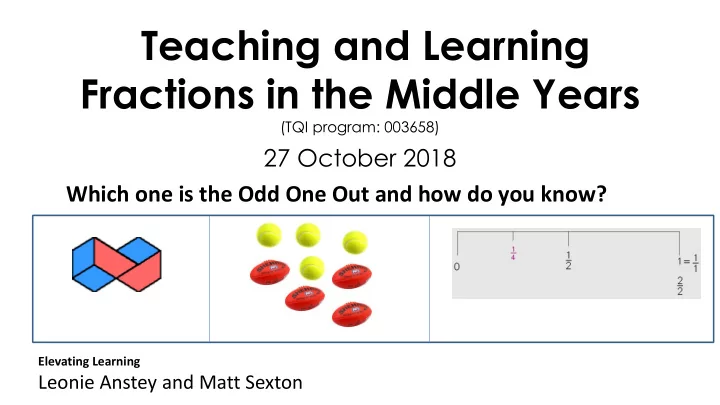
Teaching and Learning Fractions in the Middle Years (TQI program: 003658) 27 October 2018 Which one is the Odd One Out and how do you know? Elevating Learning Leonie Anstey and Matt Sexton Fraction constructs Todays professional learning

slide-1
SLIDE 1

Teaching and Learning Fractions in the Middle Years

(TQI program: 003658)

27 October 2018 Which one is the Odd One Out and how do you know?

Elevating Learning

Leonie Anstey and Matt Sexton

slide-2
SLIDE 2

Fraction constructs

(Clarke, 2006) Today’s professional learning focus

slide-3
SLIDE 3

Fraction key ideas

Quantity Number triad relationships Partitioning Equivalence Benchmarking

slide-4
SLIDE 4

Number triad

Students must connect the three pieces of information when understanding and interpreting numbers, especially rational numbers like fractions

WORD QUANTITY SYMBOL

(Fuson et al., 1997)

slide-5
SLIDE 5

‘nine- twelfths”

9 12

We also need to understand that the same quantity, can have different names. “nine-twelfths is also known as “three-quarters” (or three-fourths)” and also ….

slide-6
SLIDE 6

Year 5 NAPLAN (2008) Fractions

Percentage correct National

23

slide-7
SLIDE 7

Key ideas:

  • Fraction as part-whole (fraction of an area model)
  • Equivalence
  • Quantity
  • Partitioning

Pattern Block fractions

What are the blocks and what are they called?

slide-8
SLIDE 8

Pattern Block fractions

How many different congruent hexagons can you find? If the hexagon has a value of 1, how could you describe each of the parts? If two hexagon has a value of 1, how could you describe each of the parts? If ….has a value of 1, how could you describe each of the parts?

slide-9
SLIDE 9
slide-10
SLIDE 10
slide-11
SLIDE 11

Pattern block designs

Create a design using any of the pattern blocks where one-third is represented

  • Is there another way?
  • How many ways of representing

1 3 might you be able to find?

  • Is there a limit to how many ways you might be able to find?
slide-12
SLIDE 12

Pattern block fractions

Create a design using 2 different pieces.

  • If we call your whole design ‘1’, what is the value of each of the

pieces?

  • Can you convince the person beside you using reasoning.
  • What do you notice about the relationship between the

different pieces?

slide-13
SLIDE 13

Pattern block fractions

Create a design where one hexagon is

3 4

  • f the area.

How many different designs could you make? Create them and then draw and label on isometric paper Create a design where the hexagon is two-fifths of the area

Handfuls:

Take a large handful of pattern blocks and determine the value of the blocks:

  • If the hexagon is 1
  • If the trapezium is 1
  • If ….
slide-14
SLIDE 14

Using models and representations

slide-15
SLIDE 15

Exploring use of models

Encourage students to model their thinking through the use of concrete materials, pictorial representations and language (spoken and written)

slide-16
SLIDE 16

Models for fractions

(Van de Walle et al., 2015)

slide-17
SLIDE 17

Fraction length models

Length models are physical materials that are compared on the basis of length Number lines are subdivided.

slide-18
SLIDE 18

Using a modified ‘think board’ is an important strategy for developing quantity sense about fractions. Be sure that the students use a range of models (set and area models) when representing the quantity associated with the fraction

Helping students connect the information about number triad relationships

slide-19
SLIDE 19

Fraction set models

Set models, the whole is understood to be a set

  • f objects and the

subsets of the whole make up fractional parts.

slide-20
SLIDE 20

Conceptual focus on equivalence

Area models for equivalent fractions help students create understanding

slide-21
SLIDE 21

‘Cuisenaire fractions’

Race to 3

Game of NIM

slide-22
SLIDE 22

What fraction of the brown rod is the red rod?

1 4

slide-23
SLIDE 23

Cuisenaire questions

  • What fraction of the brown rod is the red rod?
  • If the pink (pink/purple) is two thirds, what is the whole?
  • If the brown rod is

4 3, what rod is one?

  • If the dark green is

1 2, what is 3 4?

  • If the blue rod is 1

1 2, what is 2 3?

  • What other questions might you have?
slide-24
SLIDE 24

If pink/purple is two-thirds, what is

  • ne (1)?

2/3 1/3 1/3 1/3 3/3

The dark green rod is 1

slide-25
SLIDE 25

If brown is four-thirds, what rod is one (1)?

4/3 1/3 1/3 1/3 1/3 3/3

The dark green rod is one

slide-26
SLIDE 26

If dark green is half, what is three- quarters?

½ ½ ½

1/4 1/4 1/4 1/4 3/4

The blue rod is 3

4

slide-27
SLIDE 27

If the blue rod is one and a half, what is two-thirds?

1 ½ ½ ½ ½ 1 1/3 1/3 1/3 2/3

The purple/pink rod is

2 3

slide-28
SLIDE 28

Cuisenaire fractions

Why might you use this learning assignment?

  • What concepts does it support students to experience?
  • What aspects might students find easier?
  • What aspects might be more challenging?
  • Why do you think this?
slide-29
SLIDE 29

Colour in Fractions (Clarke & Roche, 2010)

29

slide-30
SLIDE 30

Colour in fractions

  • Take turns in rolling both dice:

– Dice 1: 1, 2, 2, 3, 3 ,4 – Dice 2:

  • Each row represents one whole
  • Use the numbers rolled to create a fraction.

– For example 3 and ∗

6

– You can colour in 3

6 on one line.

  • What other options might there be?
  • Each player needs to convince the other that what is shading is

correct.

  • If players are unable to use their turn they must ‘pass’
  • The first player to colour their entire wall is the winner

30

slide-31
SLIDE 31

3/6 1/3 + 1/6 2/8 1/4 31

slide-32
SLIDE 32

Moving between parts and wholes Susan Lamon

  • Moving from the whole to the part

“Here is one chocolate block…show me a third of the block.”

  • Moving from the part to the whole

“Three-quarters of the brick wall has been built…show me the whole brick wall.”

  • Moving from the part to the part

“This is one-quarter of a pencil set…show me five-quarters of a set.”

slide-33
SLIDE 33

Robust definitions for the numerator and denominator

slide-34
SLIDE 34

A change from...

What do the numbers mean? The four is the number of parts you cut the whole into and the three is the number of parts you take from the whole

3 4

Can this explanation be generalised? How about if we had an improper fraction like ?

slide-35
SLIDE 35

What do the numbers mean?

The denominator (4) represents the name or size of the part (e.g., the four represents quarters and they have this name because 4 equal parts fill a whole) and numerator (3) is the number of parts of that name

  • r size. [three-quarters]

Four is the name or size of the parts (quarters) and seven is the number

  • f quarters. [seven-quarters]

3 4 7 4

slide-36
SLIDE 36

Fraction pair interview

(Clarke & Roche, ACU)

slide-37
SLIDE 37

Fractions Pair Interview (Clarke & Roche, ACU)

Interviewing as assessment

Using the fraction pair cards, you interview the student The teacher will ask the student to choose which of the two fractions in the pair is the largest and ask for an explanation The teacher asks each time: Please point and tell me which is the larger fraction...How did you decide? The teacher will record on the sheet the thinking strategy that was used by the student

slide-38
SLIDE 38

Strategies that are noted above the line in each rectangle are considered “preferred strategies” By preferred, we mean strategies which are built on conceptual understanding of fractions and their sizes

slide-39
SLIDE 39

Benchmarking

Benchmarking is a thinking strategy that can be used to compare the quantity or size of two fractions (Clarke & Roche, 2009) It involves the use of a third fraction or benchmark, usually 0,

1 2 or 1.

When a student uses benchmarking, he/she will decide that

4 5 is larger

than

3 7 because the latter fraction is closer to a half

slide-40
SLIDE 40
slide-41
SLIDE 41

Comparing fractions

Think about the two fractions Which is larger and why? Use two strategies to prove which is larger

slide-42
SLIDE 42

Residual thinking

slide-43
SLIDE 43

Residual thinking

1/8 is less than 1/6 therefore 7/8 is larger

Residual thinking relies on understanding the amount that is needed when building up to the whole

(Clarke & Roche, 2009)

slide-44
SLIDE 44

Gap thinking

(common misconception)

“Only one piece or

  • ne number between

5 and 6 or 7 and 8 so this means that they are the same”

This is an example of using whole number thinking with rational numbers

(Pearn & Stephens, 2004)

slide-45
SLIDE 45

Teaching considerations

  • 1. Emphasise number sense and meaning of fractions
  • 2. Emphasise that fractions are numbers and therefore quantities
  • 3. Provide a variety of models and contexts, including examples, non-

examples, and images that go beyond the prototype

  • 4. Dedicate time for understanding of equivalence (concretely,

symbolically)

  • 5. Teach “fraction families” to help students build connections between

fraction sizes, i.e., explore the “halving family” – half, quarter, eighths, sixteenths…explore the “thirding family” – third, ninths, twenty- sevenths…

  • 6. Link fractions to key benchmarks and encourage estimation
  • 7. Highlight comparison strategies that focus on conceptual

understanding of fraction sizes

slide-46
SLIDE 46

A change to....

Denominator represents the name or size of the parts (e.g., quarters) Numerator is the number of parts of that name or size (e.g., 3)

3 4

slide-47
SLIDE 47

Common misconceptions

  • Thinking of numerator and denominator as

separate and not as a single value

  • Not recognizing equal-sized parts--thinking ¾ green instead of ½ green
  • Thinking that fraction

1 5 is smaller than 1 10 because it has a smaller

denominator

  • Using the operation rules from whole numbers to compute with

fractions

  • Having only a limited number of images which are most likely the

prototypical ones and generally area models (circle or square)

(Van de Walle et al., 2015)

slide-48
SLIDE 48

Fraction Numberlines

Peg and Tape Fractions

slide-49
SLIDE 49

Fraction number lines

Materials: Number cards (0, 1, 2); fraction cards including improper fractions, rope, pegs

  • Hand out the fraction cards (1 per pair)
  • Ask students to talk about what they know about the

fraction, focusing on its quantity and the representations that they think about and visualise

  • Ask students to place the whole numbers on the

clothesline, explaining reasons for their placement

  • Invite pairs of students to place their fraction card on the

line using the peg

  • Encourage discussion about reasons for the placement of

the card along the line

49