Ten Years after the Global Financial Crisis: what have we learned and - - PowerPoint PPT Presentation

ten years after the global financial crisis what have we
SMART_READER_LITE
LIVE PREVIEW

Ten Years after the Global Financial Crisis: what have we learned and - - PowerPoint PPT Presentation

Ten Years after the Global Financial Crisis: what have we learned and what did we forget? #LSEfinance Lord ODonnell Professor Sir Charles Bean Gus ODonnell was Cabinet Secretary and Head of Civil Service 2005-11. Charles Bean is Professor


slide-1
SLIDE 1

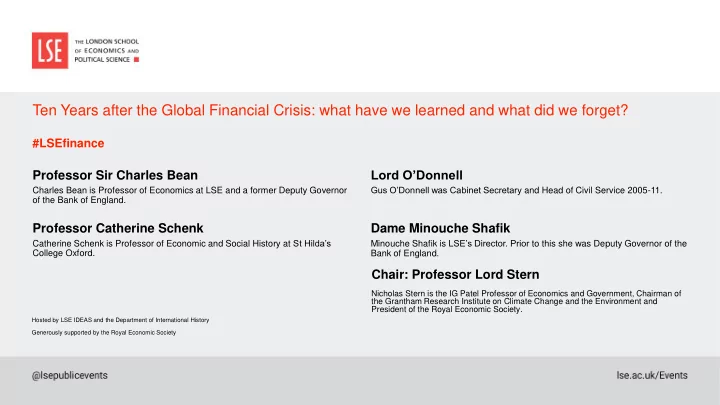
Ten Years after the Global Financial Crisis: what have we learned and what did we forget?

#LSEfinance

Professor Sir Charles Bean Professor Catherine Schenk Chair: Professor Lord Stern Lord O’Donnell Dame Minouche Shafik

Charles Bean is Professor of Economics at LSE and a former Deputy Governor

  • f the Bank of England.

Catherine Schenk is Professor of Economic and Social History at St Hilda’s College Oxford.

Nicholas Stern is the IG Patel Professor of Economics and Government, Chairman of the Grantham Research Institute on Climate Change and the Environment and President of the Royal Economic Society.

Gus O’Donnell was Cabinet Secretary and Head of Civil Service 2005-11. Minouche Shafik is LSE’s Director. Prior to this she was Deputy Governor of the Bank of England.

Hosted by LSE IDEAS and the Department of International History Generously supported by the Royal Economic Society

slide-2
SLIDE 2

Ten Years after the Glo lobal Fin inancial Cris isis: what have we le learned and what did we forget?

Professor Catherine R. Schenk University of Oxford

slide-3
SLIDE 3

What did we learn?

  • Many recent reviews of events 10 years ago
  • Hindsight – why were governments so complacent, regulators so blind, bankers so greedy, home-buyers so

irresponsible? Reinvigorated focus on (macro)-prudential supervision: but pro-cyclical policies Reinvigorated focus on micro-prudential supervision: less tractable

  • Key uses of the past based on 1930s (Bernanke, Kindleberger, Eichengreen et al)
  • 1930s Sovereign Debt/War Debt, Asset Market shock, Financial Crisis, Agricultural Slump
  • Lack of US leadership
  • European Financial Crisis: Ten years after = World War II
  • Fiscal expansion (short-lived and risky)
  • Monetary expansion (QE – now 10 years old)
  • Regulation: Basel III and Dodd Frank
  • International Cooperation
slide-4
SLIDE 4

20 40 60 80 100 120 140 12 24 36 48 60 72 84 96 108 120 Months since peak (June 1929 or April 2008) June 1929=100 April 2008 = 100 40 50 60 70 80 90 100 110 120 130 12 24 36 48 60 72 84 96 108 120 Months since peak (June 1929 or April 2008) June 1929 = 100 April 2008 = 100

World Industrial Production World Trade

20 40 60 80 100 120 1 7 13 19 25 31 37 43 49 55 61 67 73 79 85 91 97 103 109 115 121 June 1929=100 April 2008=100

Equity Markets Source: Eichengreen and O’Rourke VoxEU (2010) ‘A Tale of Two Depressions’ [O’Rourke: updated June 2018]

slide-5
SLIDE 5

Neglected Uses of the Past

  • ‘Currency wars’ of 1930s: competitive devaluation (currency

manipulation)

  • Governance of the Global Economy: 1930s crisis inspired the Bretton

Woods System and the International Monetary Fund/World Bank

  • Capital controls, pegged exchange rates, global source of liquidity for ST

deviations from equilibrium

  • Global Financial Safety Net: 1970s vs 2010s
  • 1930s trade shock/turn to protectionism not fulfilled (yet)
  • The ‘Great Reversal’ of globalization (Rajan and Zingales 2000-2004)
slide-6
SLIDE 6

Currency Wars today?

1930s: part of economic nationalism, leads to retaliatory trade barriers, dangers of floating exchange rates and short term capital flows

  • 2010s not the same as 1930s, BUT
  • Spillover effects from Unconventional Monetary Policy
  • Impact on Emerging Market Economies:
  • Capital inflow in 2009-12
  • Taper tantrum 2013
  • Capital outflow 2014-
  • Impact exacerbated by Dollar indebtedness
  • EMEs v USA; USA v China
  • Retreat from Floating Exchange rates
  • IMF Institutional View on Capital Flow Management (2012)
slide-7
SLIDE 7

Jay Powell – May 2018

  • ‘Monetary stimulus by the Fed and other advanced-

economy central banks played a relatively limited role in the surge of capital flows to EMEs in recent years. There is good reason to think that the normalization

  • f monetary policies in advanced economies should

continue to prove manageable for EMEs’ (Powell 2018).

slide-8
SLIDE 8

50 60 70 80 90 100 110 120 130 140 01-1994 07-1994 01-1995 07-1995 01-1996 07-1996 01-1997 07-1997 01-1998 07-1998 01-1999 07-1999 01-2000 07-2000 01-2001 07-2001 01-2002 07-2002 01-2003 07-2003 01-2004 07-2004 01-2005 07-2005 01-2006 07-2006 01-2007 07-2007 01-2008 07-2008 01-2009 07-2009 01-2010 07-2010 01-2011 07-2011 01-2012 07-2012 01-2013 07-2013 01-2014 07-2014 01-2015 07-2015 01-2016 07-2016 01-2017 07-2017 01-2018 07-2018

US Dollar Broad Effective Exchange Rate Index (2010 = 100)

March 2002 July 2008 Emerging Market Economy Crises 1990s Great Moderation Quantitative Easing November 2008- October 2014 End of Quantitative Easing October 2014-

slide-9
SLIDE 9

20 40 60 80 100 120 140 160 180 200 01-2003 06-2003 11-2003 04-2004 09-2004 02-2005 07-2005 12-2005 05-2006 10-2006 03-2007 08-2007 01-2008 06-2008 11-2008 04-2009 09-2009 02-2010 07-2010 12-2010 05-2011 10-2011 03-2012 08-2012 01-2013 06-2013 11-2013 04-2014 09-2014 02-2015 07-2015 12-2015 05-2016 10-2016 03-2017 08-2017 01-2018 06-2018

2010=100

Emerging Market Nominal Effective Exchange Rate Index 2003- August 2018

Brazil India South Africa Turkey Argentina

slide-10
SLIDE 10

BIS Quarterly Review | September 2018 | 23 September 2018

slide-11
SLIDE 11

Exchange Rate Regimes and Capital Flow Management

  • EMEs that have harder inflation targets tended to suffer less from

spillover effects (IMF 2018)

  • There has been no increase in the proportion of countries that float

their exchange rates and a slight drift toward de facto soft pegs

slide-12
SLIDE 12

10 20 30 40 50 60 70 80 90 100 2009 2010 2011 2012 2013 2014 2015 2016 2017

De Facto Exchange Rate Arrangments

Hard Peg Soft Peg Floating Other

slide-13
SLIDE 13

5 10 15 20 25 30 35 40 45 50 2009 2010 2011 2012 2013 2014 2015 2016 2017

Types of Soft Peg (as a percent of total)

Stabilized arrangement Crawling peg Crawl-like arrangement Pegged within bands Conventional Peg

slide-14
SLIDE 14

Governance of the Global Economy

  • Reinvigorated: G20 and FSB
  • Governance reform: International Monetary Fund, Bank for International

Settlements (esp. China)

  • Side-lined? World Trade Organisation, World Bank
  • Regional Trade Agreements, Chinese OBOR/BRI

Learning from 1970s

  • Coordination problems, is 20 too big to maintain momentum?
  • 1970s: CXX ineffective
  • Basel Process: long delays, backward looking, negotiated with banks,

implemented just in time for the next crisis

  • Basel III finalized December 2017, implementation expected in 2022-2027
  • Reforming the SDR
slide-15
SLIDE 15

Global Financial Safety Net

  • International Monetary Fund (core outcome of 1930s):
  • stigma and uncertainty about conditionality (new non-conditional schemes

expensive but not attractive)

  • bilateral focus of surveillance, advice
  • National Foreign Exchange Reserves – global imbalances
  • Regional Financial Arrangements: restricted, IMF Backstop
  • Central Bank Swaps: restricted (Fed Swaps v PBoC Swaps)
  • Compare to 1970s: Multilateral swaps negotiated through BIS, Bilateral Fed

Swaps

slide-16
SLIDE 16

5 10 15 20 25 30 35

Federal Reserve Reciprocal Currency Arrangements (USD billion)

slide-17
SLIDE 17

5 10 15 20 25 50 100 150 200 250 300

Federal Reserve Reciprocal Swap Arrangements

2017 $b (share GDP equiv LHS) Share of Global Reserves (RHS)

slide-18
SLIDE 18

20 40 60 80 100 120 140 12 24 36 48 60 72 84 96 108 120 Months since peak (June 1929 or April 2008) June 1929=100 April 2008 = 100 40 50 60 70 80 90 100 110 120 130 12 24 36 48 60 72 84 96 108 120 Months since peak (June 1929 or April 2008) June 1929 = 100 April 2008 = 100

World Industrial Production World Trade

20 40 60 80 100 120 1 7 13 19 25 31 37 43 49 55 61 67 73 79 85 91 97 103 109 115 121 June 1929=100 April 2008=100

Global Equity Markets Source: Eichengreen and O’Rourke VoxEU (2010) ‘A Tale of Two Depressions’ [O’Rourke: updated June 2018]

slide-19
SLIDE 19

Conclusions

  • Important lessons were learned
  • Sustain global liquidity
  • Confident leadership and cooperation
  • Maintaining open markets for goods and capital
  • Initial Success seemed to demonstrate distinctive nature of GFC2008

vs 1930s:

  • no currency wars or trade protectionism
  • success of G20
  • broader and more intense international financial architecture
  • Ten Years After: time to reassess?
  • Economic nationalism, trade wars, currency wars, global financial safety net
slide-20
SLIDE 20

Ten Years after the Global Financial Crisis: what have we learned and what did we forget?

#LSEfinance

Professor Sir Charles Bean Professor Catherine Schenk Chair: Professor Lord Stern Lord O’Donnell Dame Minouche Shafik

Charles Bean is Professor of Economics at LSE and a former Deputy Governor

  • f the Bank of England.

Catherine Schenk is Professor of Economic and Social History at St Hilda’s College Oxford.

Nicholas Stern is the IG Patel Professor of Economics and Government, Chairman of the Grantham Research Institute on Climate Change and the Environment and President of the Royal Economic Society.

Gus O’Donnell was Cabinet Secretary and Head of Civil Service 2005-11. Minouche Shafik is LSE’s Director. Prior to this she was Deputy Governor of the Bank of England.

Hosted by LSE IDEAS and the Department of International History Generously supported by the Royal Economic Society

slide-21
SLIDE 21