
SLIDE 1
AUTOMATED REASONING SLIDES 14: TERM REWRITING SYSTEMS Term rewriting Overview of Knuth Bendix completion Properties of rewrite systems Church-Rosser Confluence Termination Relation between the properties Using confluent rewrite systems KB - AR - 2009
14ai
- All sentences are unit equations (∀ is implicit).
- Problem is usually to show that two terms are equal modulo equations.
Although this could be done using paramodulation ....
- To cut down the search space the equations are used in one direction only,
called orienting the equations.
- A more general problem is to find bindings for variables such that two terms
are equal modulo equations. (See later.)
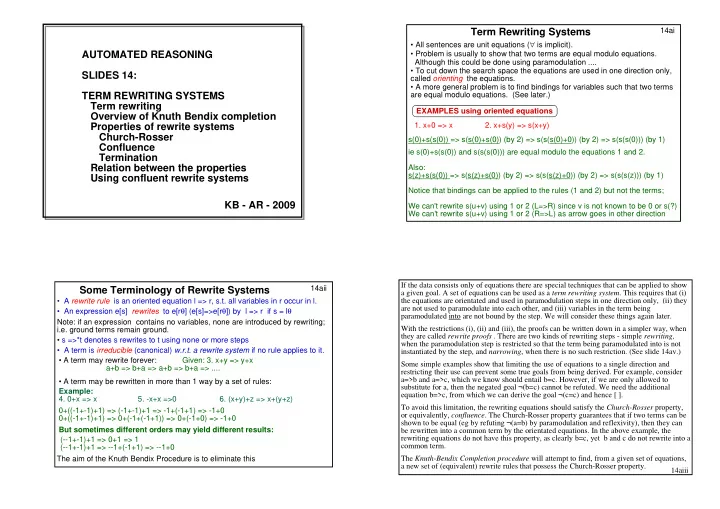
- 1. x+0 => x 2. x+s(y) => s(x+y)
Term Rewriting Systems
EXAMPLES using oriented equations s(0)+s(s(0)) => s(s(0)+s(0)) (by 2) => s(s(s(0)+0)) (by 2) => s(s(s(0))) (by 1) ie s(0)+s(s(0)) and s(s(s(0))) are equal modulo the equations 1 and 2. Also: s(z)+s(s(0)) => s(s(z)+s(0)) (by 2) => s(s(s(z)+0)) (by 2) => s(s(s(z))) (by 1) Notice that bindings can be applied to the rules (1 and 2) but not the terms; We can't rewrite s(u+v) using 1 or 2 (L=>R) since v is not known to be 0 or s(?) We can't rewrite s(u+v) using 1 or 2 (R=>L) as arrow goes in other direction 14aii
- A rewrite rule is an oriented equation l => r, s.t. all variables in r occur in l.
- An expression e[s] rewrites to e[rθ] (e[s]=>e[rθ]) by l => r if s = lθ
Note: if an expression contains no variables, none are introduced by rewriting; i.e. ground terms remain ground.
- s =>*t denotes s rewrites to t using none or more steps
- A term is irreducible (canonical) w.r.t. a rewrite system if no rule applies to it.
Some Terminology of Rewrite Systems
- A term may be rewritten in more than 1 way by a set of rules:
Example:
- 4. 0+x => x 5. -x+x =>0 6. (x+y)+z => x+(y+z)
0+((-1+-1)+1) => (-1+-1)+1 => -1+(-1+1) => -1+0 0+((-1+-1)+1) => 0+(-1+(-1+1)) => 0+(-1+0) => -1+0 But sometimes different orders may yield different results: (--1+-1)+1 => 0+1 => 1 (--1+-1)+1 => --1+(-1+1) => --1+0 The aim of the Knuth Bendix Procedure is to eliminate this
- A term may rewrite forever: Given: 3. x+y => y+x
a+b => b+a => a+b => b+a => .... 14aiii If the data consists only of equations there are special techniques that can be applied to show a given goal. A set of equations can be used as a term rewriting system. This requires that (i) the equations are orientated and used in paramodulation steps in one direction only, (ii) they are not used to paramodulate into each other, and (iii) variables in the term being paramodulated into are not bound by the step. We will consider these things again later. With the restrictions (i), (ii) and (iii), the proofs can be written down in a simpler way, when they are called rewrite proofs . There are two kinds of rewriting steps - simple rewriting, when the paramodulation step is restricted so that the term being paramodulated into is not instantiated by the step, and narrowing, when there is no such restriction. (See slide 14av.) Some simple examples show that limiting the use of equations to a single direction and restricting their use can prevent some true goals from being derived. For example, consider a=>b and a=>c, which we know should entail b=c. However, if we are only allowed to substitute for a, then the negated goal ¬(b=c) cannot be refuted. We need the additional equation b=>c, from which we can derive the goal ¬(c=c) and hence [ ]. To avoid this limitation, the rewriting equations should satisfy the Church-Rosser property,
- r equivalently, confluence. The Church-Rosser property guarantees that if two terms can be