Terms of Reference for Sub-Group II 1. To review the present status - - PowerPoint PPT Presentation

terms of reference for sub group ii
SMART_READER_LITE
LIVE PREVIEW

Terms of Reference for Sub-Group II 1. To review the present status - - PowerPoint PPT Presentation

Terms of Reference for Sub-Group II 1. To review the present status of Indian mining industry (excluding fuel minerals) and principal mineral based industries in the country and to assess its international context. 2. To assess demand for


slide-1
SLIDE 1

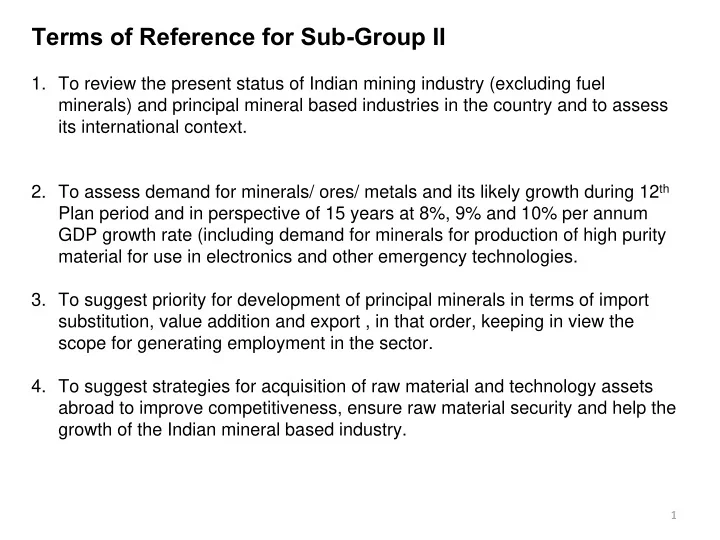
Terms of Reference for Sub-Group II

  • 1. To review the present status of Indian mining industry (excluding fuel

minerals) and principal mineral based industries in the country and to assess its international context.

  • 2. To assess demand for minerals/ ores/ metals and its likely growth during 12th

Plan period and in perspective of 15 years at 8%, 9% and 10% per annum GDP growth rate (including demand for minerals for production of high purity material for use in electronics and other emergency technologies.

  • 3. To suggest priority for development of principal minerals in terms of import

substitution, value addition and export , in that order, keeping in view the scope for generating employment in the sector.

  • 4. To suggest strategies for acquisition of raw material and technology assets

abroad to improve competitiveness, ensure raw material security and help the growth of the Indian mineral based industry.

1

slide-2
SLIDE 2

Core groups on Mineral Exploration and Development (other than coal and lignite) for the XIIth Five Year Plan

1.Aluminium 2.Copper 3.Lead and Zinc 4.Diamond and Precious Stones 5.Cement and Limestone 6.Industrial/ Non-metallic Minerals 7.Beach Sand Minerals 8.Strategic Minerals 9.Dimensional and Decorative Stones 10.Gold and Precious Metals

2

slide-3
SLIDE 3

Improvements from XIth Five Year Plan Report:

  • A new chapter on Strategic Minerals
  • A new chapter on Ferrous Minerals
  • Addition of Rare Earth Elements in Beach Sand Minerals
  • Enriched the contents on Platinum Group of Elements
  • Added a section on Precious Stones with diamonds
  • Focus on recycling particularly in metals and cement

3

slide-4
SLIDE 4

ALUMINIUM

GLOBAL SCENARIO

p – projected

China ‐ Imported about 50% of its Aluminium requirement as scrap, bauxite and alumina ‐ Exported about 15%

  • f

its production as primary Aluminium and semis will become a large importer of primary Aluminium by 2015 ‐ Significant increase in production from 9 million tonnes to 17 million tonnes

4

2006 2010 2015(p) World Production 33.9 42.3 57.4 Consumption 34.2 41.5 58.2 China Production 9.3 16.92 23.7 Consumption 8.79 16.6 28.0 (All figures in million tonnes)

slide-5
SLIDE 5

5

27

By 2030, Aluminium consumption growth will be By 2030, Aluminium consumption growth will be driven by China & India. driven by China & India.

2005 2030

Source: CRU June’ 07

World demand-31.9 Mn tonnes World demand-73.7 Mn tonnes China India India China

Aluminium demand in India to grow more than 5 fold by 2030

23% 22% 8% 5% 4% 8% 3% 22% 5%

North America EU/EEA Japan CIS & Other Europe Latin America SE Asia India China Others

14% 13% 4% 5% 5% 10% 8% 35% 6%

slide-6
SLIDE 6

6

Per Capita Consumption of Aluminium in the World

slide-7
SLIDE 7

7 25

48 8

2 8 6 28

52 11

6 6 6 19

37 21

7 8 6 21

34 22

8 11 8 17

35 21

10 10 6 18

39 17

15 9 4 16

9 29

18 18 8 18 1970-71 1980-81 1991-92 1995-96 1999-00 Current* Wo rld

E lectr ica l T r a nspor t Building Pa cka g ing Ma chiner y & E quipm ent Other s

(%)

Change in consumption pattern to accelerate Change in consumption pattern to accelerate growth growth

_______________________ Sourc e: Wo r ld - B arc lays & Alc o a I ndia – Co mpany Data

India Picture India Picture World World Electrical sector still the major aluminium consumer in India

slide-8
SLIDE 8

INDIAN SCENARIO

(in million tonnes)

8

Aluminium 2006 2010-11 2016-17 Production 0.94 1.63 (CAGR – 7.1%) 4.3 Consumption 0.93 1.53 2.8 (CAGR- 9.5%) Projected capacity 2010-11 2016-17 Smelting 1.71 4.675 Refining 4.6 13.375 Bauxite mining 12.5 28.0

  • Deficit of bauxite mining capacity: 2 MT in 2010‐11

12 MT in 2016‐17

  • No new Greenfield mines
  • Pending big projects – Vedanta 3mtpa (Orissa), Anrak 4.5mtpa (A.P), Aditya

Aluminium 4.5mtpa (Orissa) 4.5mtpa

(in million tonnes)

slide-9
SLIDE 9

9

Bauxite Reserves and Resources of India (Figs in Million Tonnes)

slide-10
SLIDE 10

10

  • Recycled Aluminium‐

estimated at about 20% of consumption ‐ global consumption 32% (expected to be 40% by 2025)

  • Currently India exports as well as imports alumina and aluminium
  • The semis and downstream, value‐added, alloy production sector is not well‐

developed in India, resulting in significant imports in these applications

  • The priority for India should be imports substitution followed

by value addition before exports

  • Technology for alloys and other value added products

INDIAN SCENARIO

slide-11
SLIDE 11

11

slide-12
SLIDE 12

12

1. Grant of ML, EC, FC are main constraints

  • Delays exist

2. Recycling to be promoted

  • No significant progress

3. Green field smelters to be planned for future

  • New smelter came up at

Jharsuguda

  • 4. Import of scrap to be increased with low

duty

  • Duty structure altered
  • 5. Utilisation of red mud disposal
  • No technical break through

REVIEW OF XI PLAN

slide-13
SLIDE 13
  • Faster clearance of big mining projects
  • Bauxite/ alumina imports to be facilitated through appropriate duty structure
  • Value addition in Al alloys and semis to be encouraged through removing inverted duty

structures and induction and promotion

  • f

appropriate technologies indigenously

  • r

through JVs

  • Domestic

recycling to be promoted by a mix

  • f

regulation and fiscal measures to ensure more

  • rganised

segregation/collection

  • f

scrap and more scientific melting/recycling to provide proper quality

  • Aluminium

smelting being energy‐intensive, allocation

  • f

captive coal blocks

  • r

linkages at par with IPPs for primary smelters

  • Development of appropriate technology through R & D for utilisation of Red Mud
  • Smelter can be established abroad to produce metal at low energy

cost

  • Efforts should be made to acquire mining assets abroad

13

RECOMMENDATIONS

slide-14
SLIDE 14

14

  • Strategic metal for economic development; Consumption growth strongly

linked to economic growth

  • Global consumption projected to rise from 19.4 mt in 2010 to 31.6 mt by 2025

(CAGR of 3.3%)

COPPER

Global Scenario

slide-15
SLIDE 15

15 15

Emerging markets with low per capita usage currently to drive future growth

slide-16
SLIDE 16

Distribution of Global demand for Refined Copper‐ Page 6

16

slide-17
SLIDE 17
  • Asia’s share: 53% in consumption,

43% in refined production – but <one- fifth in mine production

  • 49% of global refined copper

production through custom smelting route (vs. 33% in 1995)

  • Japan, Korea, China, India, Germany

completely dependent on custom smelters

  • Mine supply will continue to remain

tight due to falling grades and depths, keeping prices firm; more pressure on recycling and substitutes

COPPER

Global Scenario

Source: WBMS www.world-bureau.com Region % Asia 43 America 32 Europe 19 Africa 4 Oceania 2 Total 100

slide-18
SLIDE 18
  • Hindustan Copper Limited (HCL) is the only company in mining, producing

<5% of India’s requirement of concentrates; by the end of 12th Plan, will cater to ~8-9% based on mine expansion plans

  • Two Custom Smelters in private sector account for ~95% of production
  • One secondary smelter depending on imported scrap ~ Not in producction
  • Refined copper production is ~6.6 lakh tonnes against production capacity of

1 million tonnes(2010-11)

  • largely static during XI Plan
  • At present only ~65% capacity utilisation

18

COPPER Indian Scenario

slide-19
SLIDE 19

19

Indian Scenario (contd.)

(tonnes of Copper) 2006-07 2010-11 2016-17 (P) Consumption 4,14,887 5,66,261 9,50,000 Production Capacity 9,99,500 9,99,500 14,99,500 Production Actual 6,57,232 6,63,753 13,67,500 Concentrate Requirement 6,81,000 6,88,000 14,20,000 Concentrates Production (HCL) 30,231 31,683 1,18,000

  • Consumption grew in XI Plan by 8.5-9% CAGR, projected to grow

at the same rate in XII Plan

  • Custom smelters expected to add capacities in line with the

growth in demand, leaving sufficient surplus for continuing exports

slide-20
SLIDE 20

20

Sector wise copper consumption

ESTIMATED SECTORWISE COPPER CONSUMPTION IN INDIA

56% 8% 5% 6% 7% 7% 11%

Elec & Tel Transport Process Ind General Engg.

  • Cons. Durable

Bldg & Constn Others

Source : ICDC

slide-21
SLIDE 21

21

Indian Scenario (Contd.)

  • Ore resources :

1394.4 MT (11.4 MT contained Cu)

  • HCL holds

503.39 MT ( 6.09 MT of contained Cu)

  • Present mining capacity 3.21 MT, to be expanded to 12.71 MT

by 2016-17 (1,18,000 tonnes of Cu)

  • Sterlite applied for RP/ PLs during 2007, 2008;
  • KCC smelter/ refinery shut down since Dec. 2008; selling/

tolling surplus concentrate; precious metals plant at ICC closed – anode slimes being exported

  • In view of large dependence on imported concentrates, the key

focus for XII Plan should be raw material security.

slide-22
SLIDE 22

22

slide-23
SLIDE 23

23

  • Copper content of imported copper & copper alloy scrap

2006-07 – 78,484 tonnes 2008-09 – 70,335 tonnes *2010-11 – 75,356 tonnes *(prorata on 9 months’ basis)

  • No precise data available or indigenous scrap. Industry estimate – about 30-

35% on average of total copper consumption

  • Only one 50,000 tpa secondary refined copper manufacturing facility; currently

non-operational

  • Thus, all scrap is processed through direct melt route

COPPER Copper Recycling in India

slide-24
SLIDE 24

COPPER

Review of XIth Plan

1 .

Introduction of robotic mining

  • Not relevant, may be dropped

2 .

High volume and multi- metal extraction

  • No significant progress

3 .

Adoption of Solvent extraction- electro winning (SX-EW) technology

  • To explore potential investors willing

to invest in this technology based on small deposits.

4 .

Strategic approach of PSUs

  • Private investment to be encouraged

in exploration

5 .

R & D activities in mining

  • Focus on beneficiation

6 .

Re-opening of closed mines

  • HCL has opened new mines

24

slide-25
SLIDE 25

25

  • Addition of resources by encouraging exploration
  • Development of existing resources through both Private and Public investment
  • Government support (incl. Government-to-Government coordination) for overseas mine

acquisition / tie-ups

  • Maintain viability of custom smelters – a business model inevitable for India
  • Reduce basic customs duty on concentrate imports from 2.5% to NIL, at least until CST

is phased out

  • Leverage FTAs / PTAs to improve access to copper concentrate
  • Encourage efficient recycling of scrap through appropriate technology
  • Encourage smelters to recover gold and silver from slimes indigenously by removing

excise duty and import duty

  • Incentive scheme for copper based product export
  • Create a nodal centre or help relevant existing organisations for regular data collection &

analysis

COPPER

Recommendations

slide-26
SLIDE 26

Global Scenario

(million tonnes) metal

2005 2010 2015 F

Zinc Mine production 9.88 12.19 14.55 Zinc conc. consumption 9.92 12.34 14.56 Zinc Metal (incl. secondaries/losses) 10.13 12.52 14.80 Zinc consumption‐ Global Zinc consumption‐ China 10.61 2.85 11.64 (CAGR 3.5%) 4.70 15.1 6.91 Lead mine prod. 3.34 4.04 4.73 Primary refined prod. 4.18 4.68 5.59 Secondary refined prod. 3.53 4.64 6.25 Total refined prod. 7.71 9.33 11.84 Lead consumption‐ Global Lead consumption‐ China 7.80 1.85 9.06 (CAGR 4%) 3.96 11.90 6.21

26

LEAD AND ZINC

slide-27
SLIDE 27
  • 50%
  • f

zinc is consumed in galvanising, balance in alloys, brass/bronze, semis , chemicals.

  • 80%
  • f

lead is consumed in batteries, balance in rolled / extruded products, pigments, ammunitions.

  • Prices
  • f

zinc and lead normally move together, but lead prices are expected to move faster than zinc, going forward

  • World

resources

  • f

Zinc at 480 million tonnes and lead at 180 million tonnes (contained metal)), Australia, China and USA being the leaders

  • In lead, secondary is a larger source than mine supply.
  • Currently,

zinc is an

  • versupplied

market, while lead in deficit; trends to continue in future, thus reflecting on prices accordingly.

27

LEAD AND ZINC

slide-28
SLIDE 28

28

Resources

(in Million Tonnes) Reserves + Resources Contained Zinc Metal Contained Lead Metal India’s Position as on 1st April 2005 (IBM) 522.58 24.26 7.21 Net addition during 2005-2011 (HZL) 148.38 12.92 3.84 All India Net Position as on 1st April 2011 (Provisional) 670.96 37.18 11.05

Source: HZL

LEAD AND ZINC INDIAN SCENARIO

slide-29
SLIDE 29

29

2007-08 2010-11 2016-17 (F) 1. Zinc Conc. (MIC) 5,51,295 7,52,125 9,30,000 Lead Conc. (MIC) 77,724 87,928 1,60,000 2. Refined Zinc 4,58,226 7,12,471 8,79,000 3. Zinc Consumption 4,28,226 5,18,133 8,80,000 4. Zinc (Export-Import) 40,000 2,41,000 Marginal 5. Refined Lead (Primary) 58,247 57,294 1,85,000 6. Refined Lead (Secondary) 1,52,000 2,00,000 3,50,000 7. Lead Consumption 2,95,000 3,80,000 5,68,000 8. Lead (Export-Import) (-) 65,000 (-) 65,000 (-) 30,000

LEAD AND ZINC Production and Consumption

─ Resources of both lead and zinc have increased significantly during XI Plan Due to intensive exploration efforts by HZL – both greenfield and brownfield, spending USD 8-10 million every year. ─ Production of zinc and lead, both mine/ smelters, has also increased substantially over XI Plan period

slide-30
SLIDE 30

Review of XI Plan

clearance for grant of RP/PL/ML; process simplification for all clearances including environment and forest clearances ‐ Ongoing Inadequate exploration; lack

  • f infrastructure

and enabling environment ‐ Significant progress in Pb/Zn despite constraints continuing Framework

  • f

commitment to active exploration by mining companies ‐ More efforts by mining

  • cos. towards exploration

Improved regulatory regime ‐ MMDR Bill 2010 in progress No EC for PLs ‐ Exempted Simplify land acquisiton, R&R, particularly in forest areas ‐ New R&R policies and PSP proposed in MMDR Bill Rationalise royalty rates ‐ Ongoing Part of royalty for peripheral/infrastructure development and for funding exploration ‐ Provision in new MMDR bill Royalty deferment to support investment in mineral/metal sector ‐ Ongoing

30

LEAD AND ZINC

slide-31
SLIDE 31

31

LEAD AND ZINC

Recommendations

  • Further efforts on exploration – to increase resources and to convert resources into reserves
  • 50% of Indian resources are low-grade, not feasible to exploit. Special incentives/ reliefs to exploit such

deposits

  • Concessional duties on exploration equipment/ tools and geophysical/ chemical survey instruments
  • Simplification of Aerial survey procedures/ approvals
  • Protection of duty regime during FTAs to protect exports
  • Supportive tariff regime to enable concentrate imports etc.
  • Development of downstream alloy industry to replace imports and add value indigenously.
slide-32
SLIDE 32
  • The world diamond production -

140 Million carats estimated at USD 11.75 billion

  • The main producers are Russia

(24%), Botswana, Angola , DRC South Africa, Australia and Canada

  • ~92% uncut diamonds land in

India for cutting & polishing ()

  • Jewellery is major value addition;

major portion of the finished products is exported- industry worth 31 billion- 10 lakh employees- China 25,000

32

DIAMONDS AND PRECIOUS STONES Global Scenario

slide-33
SLIDE 33
  • Favorable geology indicating

high potential for economic discoveries- 0..04% production at present.

  • Total 302,062 km2 have been

explored in 10 states; which is about one third of total cratonic

  • area. (Potential target areas)
  • Major exploration entities are

De Beers, Rio Tinto, BHP, Jindal Steel and NMDC.

  • Over

100 Kimberlites discovered in last decade

  • Bunder

the

  • nly

minable deposit

DIAMONDS AND PRECIOUS STONES Indian Scenario

New Delhi Bangalore

Dharwar Craton Bastar Craton Bundelkhand

slide-34
SLIDE 34

State Total Area RP Granted Total Area RP Relinquished Total Area PL Applied Total Area PL Granted Total Area ML Applied Total Area ML Granted Andhra Pradesh 67768.3 53265 1012.6 811 Nil Nil Chhattisgarh 44615.5 36113 628.9 Nil Nil Nil Jharkhand 7080 5070 Nil Nil Nil Nil Karnataka 51883.4 37973.7 61.5 Nil Nil Nil Madhya Pradesh 68880.6 39650.8 195.5 70 Nil Nil Maharashtra 16741 8590 Nil Nil Nil Nil Orissa 18227.8 18227.8 201 Nil Nil Nil Rajasthan 9683.1 Nil Nil Nil Nil Nil Uttar Pradesh 16685.3 12001.3 Nil Nil Nil Nil West Bengal 497 Nil Nil Nil Nil Nil Total 302,062 210,892 2100 881

DIAMONDS AND PRECIOUS STONES RP and PL status

Conversion from RP/PL to ML is low

slide-35
SLIDE 35

DIAMONDS AND PRECIOUS STONES Review of XIth Plan

To continuously review the diamond export/ import policy; to make continuous availability

  • f

roughs to the industry and facilitate exports of finished products. ‐Imports and exports both have increased at a very good rate during XI Plan. Value addition surged to USD 16.32 from 3 billion. ‐Threat now coming due to desire of China and South Africa to polish diamonds within their countries. Efforts to increase production

  • f

rough diamonds to partly meet the requirement

  • f Indian diamond industry.

‐ No new mines added Exploration efforts may result in discovery

  • f

a new mine, production may be expected only by 2015. ‐ Bunder deposits discovered; first production expected by 2016 Exploration activity required to be boosted ‐ Reasonably increased activity but requires further boost Relaxation for PL to be > 25 sq km within MMDR Act 1957 as per NMP. ‐ Revised provision under the draft MMDR bill‐ area limit 500 sq km

slide-36
SLIDE 36
  • Thrust on Diamond Exploration to match Indian gems and jewellery industry
  • Aim to achieve 5-7% of domestic production to add the current 156mct of

import supply

  • Investor-friendly Policies to attract junior and other players in exploration
  • Simplify permitting Procedure for Airborne Survey- Procedure1-2 year time

line

  • Reducing the permitting approval timeline to keep the interest of existing

players and attract new Indian and foreign MNC’s

  • Upgrade of Diamond Industry to counter China the future threat to cutting

and polishing industry.

  • Regional Surveys and Technology Upgradation by GSI like Regional

Airborne Geophysical Surveys, Magneto-Telluric (MT) Survey, Lithoprobe Project and Teleseismics (Seismic Tomography) Project

36

DIAMONDS AND PRECIOUS STONES Suggestions and Recom m endations

slide-37
SLIDE 37
  • The

top three producers

  • f

Emerald are Columbia, Brazil and Zambia

  • The top three producers of Ruby

are Myanmar, Madagascar and India

  • The

top three producers

  • f

Sapphires are India, Myanmar, Sri Lanka

  • Semi precious stone the top three

producers are Tanzania, Brazil and Australia

  • Major cutting and polishing centres

are India, Thailand, China and Sri Lanka

37

DIAMONDS AND PRECIOUS STONES Precious stones Global Scenario

Emerald Ruby Yellow Sapphire Blue Sapphire

slide-38
SLIDE 38
slide-39
SLIDE 39

DIAMONDS AND PRECIOUS STONES

Indian Scenario

  • We have producing mines in Andhra Pradesh, Chhattisgarh, Karnataka,

Rajasthan, Orissa, Jammu and Kashmir and Tamilnadu- little data on reserves resources.

  • The country polishes the entire gamut of gems of virtually every hue
  • India is known as the leading centre for cutting and polishing emeralds
  • India is the chief source of polished tanzanite
  • Jaipur - India’s major hub for cutting and polishing of coloured gemstones
  • India’s Import of Coloured Gemstones US$ 146 million
  • Exports of coloured gemstones were US$ 315 million in 2010-11
slide-40
SLIDE 40
  • Illegal mining- Need for appropriate regulatory framework
  • Regional surveys and technology up gradation to ascertain availability of coloured

gemstones

  • Focus attention to diamonds and coloured stone security
  • Facilitate with direct procurement of coloured gemstones rough through Government

support

  • Facilitating market access for Indian exports
  • Negotiate favorable trade regimes and agreements with countries which currently

impose high tariffs on imports from India (e.g. Brazil, Mexico, China)

40

DIAMONDS AND PRECIOUS STONES Recommendations

slide-41
SLIDE 41

WORLD CEMENT PRODUCTION (2010)

Country Cement Production (Mn.t) % of Total Per Capita Cement Consumption (Kg.) China 1800 54.5 1218.4 India 220 6.7 170.0 World 3300 100 447.4

41

Source:USGS, 2011 ‐ Resources of Limestone – widespread and abundant ‐ Concrete substitutes like aluminium, asphalt, clay bricks, etc but not significant ‐ Use of supplementary cementation materials (SCMs) like fly ash and ground granulated blast furnace slag significant; both in cement and concretes.

CEMENT AND LIMESTONE Global Scenario

slide-42
SLIDE 42

42

Performance of Cement industry during XIth Plan

  • The cement capacity increased from 178.89 MT in 2006‐07 to 313 MT in 2010‐11
  • The cement production increased from 161.64 MT in 2006‐07 to 231 MT in

2010‐11

  • The cement demand increased from 149.34 MT in 2006‐07 to 226 MT in 2010‐11
  • The cement/clinker exports decreased from 9 MT in 2006‐07 to 5 MT in 2010‐11
  • Capacity utilisation decreased from 90% to 74%
  • Production of PPC and PSC (blended cements) further increased
  • Cement demand expected to reach 388 MT by end of 12th

Plan, based on 10% CAGR; capacities will continue to get built

slide-43
SLIDE 43

CEMENT AND LIMESTONE Availability Of Limestone Reserves and Resources

43 A: State-wise status of cement grade limestone reserves & resources (Provisional) as on 01.04.2010 (in MT) Zone / State Reserves Remaining Resources Total Resources Arunachal Pradesh

  • 151.500

151.500 Assam 213.024 756.783 969.807 Bihar 11.472 438.282 449.754 Jharkhand 116.055 199.986 316.041 Manipur

  • 38.423

38.423 Meghalaya 146.637 13797.798 13944.435 Nagaland 0.825 20.000 20.825 Orissa 534.993 426.627 961.620 West Bengal

  • 4.417

4.417 Andhra Pradesh 2564.219 31717.544 34281.763 Karnataka 717.732 24896.708 25614.440 Kerala 143.392 2.231 145.623 Pondicherry

  • 15.732

15.732 Tamil Nadu 465.288 230.698 695.986 Chhattisgarh 852.056 7051.152 7903.208 Gujarat 670.897 8287.222 8958.119 Madhya Pradesh 391.644 3934.656 4326.300 Maharashtra 199.608 1161.636 1361.244 Daman

  • 48.840

48.840 Haryana 9.675 48.538 58.213 Himachal Pradesh 162.927 3454.293 3617.220 Jammu & Kashmir 90.743 511.189 601.932 Rajasthan 1533.257 17004.643 18537.900 Uttaranchal 1.136 1011.581 1012.717 Uttar Pradesh 123.346 380.146 503.492

Grand Total 8948.926 115590.625 124539.551

slide-44
SLIDE 44

Demand and Constraints For Limestone

  • Reserves of cement grade limestone reduced from 9.4 billion to 8.9

billion tonnes during the 12th Plan while remaining resources increased from 90 billion tonnes to 115.6 billion tonnes

  • Limestone

reserves requirement is 669 MT by 2016‐17 based

  • n

100% OPC and 490 MT considering about 25% OPC

  • Geological

Constraints ‐ Non Uniform Distribution, low‐ grade resources

  • Lack of Infrastructure and Inaccessible Deposits
  • Forest and Human Settlements
  • Environmental Constraints including Coastal Regulation Zone
  • 30% resources are in forest/ coastal areas

44

slide-45
SLIDE 45

45

CEMENT AND LIMESTONE Review of XIth Plan No substantial increase in total reserves. Need to identify deposits ‐ Total resources increased from 97 BT in 2006 to 124 BT in 2010; however, reserves have marginally come down Review of the provisions of the CRZ is essential to enable eco‐friendly use of reserves blocked along Gujarat coast ‐ Amended CRZ Notification – with respect to High Tide and Low Tide ‐ issued making it even tougher Efforts have to be intensified to utilise 27% of marginal grade limestone ‐Some industries have begun using low‐grade limestone for blending but no major efforts yet. Periodic re‐assessment of captive limestone reserves need to be made mandatory. ‐ Rule 27(3) of MCR – all lease holders to submit exploration details as a part of mining plan process Royalty rates of limestone are abnormally high ‐ To be taken up

slide-46
SLIDE 46

Recommendations

  • Development
  • f

Infrastructural and Communication Network to Exploit Inaccessible Deposits

  • Intensify Exploration Activities to convert resources into reserves
  • Increase the Depth of Exploration
  • Integration of Small Quarries to Improve the Workability of Mines
  • Periodic Reassessment of Captive Limestone Mines
  • Deep Drilling, Geophysical Exploration for Concealed / Deep Seated Deposits
  • Incentive for Adoption of Mineral Beneficiation Techniques for Utilizing Low and

Marginal Grade Limestone

  • Adoption of Eco Friendly Mining Methodologies and Relaxation in Environmental

Rules and Regulations

  • Use of higher proportions of SCMs (fly ash, slag, etc)
  • Optimisation
  • f

raw mix design for clinkerisation to reduce dependence

  • n

high CaO in raw meal, but will require low ash coal or natural gas, etc

46

slide-47
SLIDE 47

Industrial Minerals

  • Fertiliser Minerals‐

Apatite & Rock phosphate, potash and sulphur & pyrites;

  • Flux & Construction Minerals‐

Asbestos, dolomite, fluorspar, gypsum, wollastonite and non‐cement grade limestone;

  • Ceramic

& Refractory Minerals‐ Quartz &

  • ther

silica minerals, fireclay, ball clay, kaolin(china clay), magnesite, graphite, pyrophyllite, kyanite, sillimanite, vermiculite and non‐metallurgical grade bauxite and

  • Export

Oriented Minerals‐ Barytes, bentonite, fullers earth, mica and talc/ steatite/ soapstone are. Value of production of Industrial Minerals during 2009‐10 was Rs. 1,399 crores.

47

slide-48
SLIDE 48

48

A. Fertiliser Minerals:

(in Million Tonnes) Mineral World reserves Indian Resources Present production 2009-10 Estimated demand Actual demand- supply Gap (09-10) 2011-12 2016-17 Rock Phosphate 65,000 305 1.547 8.434 12.393 5.679 Potash 9,500 21,815 Nil

  • Sulphur &

Pyrites Large 1,674 0.263 1.896 2.787 1.366

Industrial Minerals

slide-49
SLIDE 49

49

Mineral Recommendations

Rock Phosphate

  • Open for Pvt. Sector.
  • Cluster Mining.
  • Technology for extraction of low grade ores may be adopted.
  • Further exploration is needed in various parts of the country.

Acquisition abroad Potash

  • Open for Pvt. Sector
  • Glauconitic sand stone as substitute.
  • State Govt. for further development. Acquisition abroad

Sulphur & Pyrites

  • Deposits may be re-opened for Private Sector.
  • Incentives for Refinery & Petro-Chemicals.
slide-50
SLIDE 50

50

  • B. Flux and Construction Minerals:

(in Million Tonnes) Mineral World reserves Indian Resources Present production 2009-10 Estimated demand Actual demand- supply Gap (09-10) 2011-12 2016-17 Asbestos (Th. Tonnes) 200,000 21,740 0.233 386 567 .33 Dolomite Large 7,533 5.200 6.030 8.870 Fluorspar 23 20.166 0.014 0.182 0.267 .146 Gypsum Large 1,237 3.423 5.554 8.167 1.34 Wollastonite NA 20.240 0.132 0.130 0.191

  • .021

Non-cement grade Limestone NA 70,765 14 19 28

Industrial Minerals

slide-51
SLIDE 51
  • C. Ceramic and Refractory Minerals:

(in Million Tonnes) Mineral World reserves Indian Resources Present production 2009-10 Estimated demand Actual demand- supply Gap (09-10) Recommendations 2011-12 2016-17 Quartz & Silica Sand Large 3,238 2.898 3.090 4.540

  • .245
  • Environmental

constraints may be cleared for mining in Haryana. Fireclay Large 705 0.410 0.471 0.692

  • .058

Attention for quality improvement Kaolin Large 2,596 2.578 2.939 4.319 .099 Attention for quality improvement Ball Clay Large 79.290 0.898 1.162 1.708

  • .006

Attention for quality improvement Magnesite 2,400 338 0.286 0.397 0.583 .054

  • Discourage imports

Industrial Minerals

slide-52
SLIDE 52

Mineral World reserves Indian Resources Present production 2009-10 Estimated demand Actual demand- supply Gap (09-10) Recommendations 2011-12 2016-17 Graphite 71 169 0.109 0.133 0.195 .005

  • Incentives for

beneficiation of low grade. Pyrophyllite Large 33.690 0.242 0.282 0.415

  • More exploration

Kyanite (Th. Tonnes) Large 103,000 6 6 9

  • 0.02
  • Detailed exploration for

grade analysis. Sillimanite (Th. Tonnes) Large 74,000 31 37 54

  • Exports may be

encouraged. Vermiculite (Th. Tonnes)

  • 2400

13 14 21

  • .001
  • Exports may be

encouraged. Non- metallurgical grade bauxite NA 157.3 3066 2.52 4

  • Exports to be

discouraged.

  • Substitutes to be

explored.

Industrial Minerals

slide-53
SLIDE 53
  • D. Export Potential Minerals:

(in Million tonnes) Mineral World reserves Indian Resources Present production 2009‐10 Estimated demand Actual demand‐ supply Gap (09‐10) Recommendations 2011‐12 2016‐17 Barytes 240 74.200 2.138 1.330 1.960 ‐.997 Exploration required. Bentonite Large 530 NA NA NA NA ‐Exports may be encouraged. Fullers earth Large 256 NA NA NA NA ‐Exports may be encouraged. Mica (Th. Tonnes) Very large 394 1 NA NA .090 ‐Process know how for extraction of lithium & rubidium ‐ To establish wet ground mica plants. Talc/steatite Large 312 0.835 0.863 1.270 ‐.095 ‐Exports may be increased.

Industrial Minerals

slide-54
SLIDE 54

Mineral Composition Applications

# Ilmenite* (50‐60% TiO2 ) Oxide of titanium & iron.

  • Sp. Gr.:4.2‐4.8
  • Non‐toxic, high RI paints, pigments
  • Cosmetics, pharmaceuticals, foodstuffs to

improve brightness

  • Titanium metal / alloys find applications and

hi‐tech planes, missiles, space vehicles, surgical implants

# Leucoxene* (75‐82% TiO2 ) # Rutile * (> 92% TiO2 ) # Zircon (64‐66% ZrO2 ) Zirconium Sillicate

  • Sp. Gr.:4.7
  • Ceramics, refractory tiles, armour plating on

military aircraft, heat shield in space shuttles, solid

  • xide, fuels cells in hydrogen powered vehicles

# Monazite (58% RE2 O3, 9% ThO2 & 27% P2 O5 ) Phosphate of Rare earths & Thorium

  • Sp. Gr.:5.2
  • Rare earths, thorium, uranium

# Sillimanite (56‐58% Al2 O3 ) Aluminium Silicate

  • Sp. Gr.:3.2
  • Refractories, ceramics in steel, glass, other

furnaces

# Garnet (43% FeO, 21% Al2 O3, 36% SiO2 ) Iron Aluminium Silicate

  • Sp. Gr.:4.1
  • Abrasive, water jet cutting, water filtration,

sand blasting media, anti skid agent for roads/ air strips

# ASSOCIATE MINERALS * TITANIUM FEEDSTOCK

54

Beach Sand Minerals

slide-55
SLIDE 55

MAJOR SOURCES

World India

slide-56
SLIDE 56
slide-57
SLIDE 57

RESOURCES AND PRODUCTI ON OF I LMENI TE I N THE WORLD

Resource in contained TiO2; Production in mineral concentrate Source : Mineral Commodity Summaries, 2005

Resources Production / Resources ratio

slide-58
SLIDE 58
slide-59
SLIDE 59

* Including Leucoxene

slide-60
SLIDE 60

60

(QTY IN MT) SURPLUS SHORTAGE

60

Minerals Wise Demand Supply Gap –India (2010‐11) Beach Sand Minerals

slide-61
SLIDE 61

Rare earth oxide Demand Applications Lanthanum 59,250 Fluid cracking catalyst in refineries Cerium 69,425 Polishing powders in CRT, LCD, TFT monitors Praseodymium 9,750 NiMH rechargeable batteries for portable electronics, hybrid cars Neodymium 37,000 Permanent magnets (wind turbines, defence) Samarium 1,350 Permanent magnets (wind turbines, defence) Europium 925 Phosphors in mobile phones, plasma TVs Gadolinium 2,575 Terbium 480 Dysprosium 2,450 Erbium 1,075 High speed communications Yttrium 12,500 Lasers Ho‐Tm‐Yb‐L 220 Total 197,000 RARE EARTH METALS Forecast For Global Demand For Individual Rare Earths In 2015 Beach Sand Minerals

61

(QTY MTs REO)

slide-62
SLIDE 62

62

Beach Sand Minerals Review of XIth Plan 1. Exploration for Xenotime, Bastnesite (containing naturally occurring rare earth elements) ‐ Could not be realised 2. India’s share 2.6% in RE production ‐ Could not be realised 3. Exploration/ survey of complete coastline ‐50% so far; 350 sq. km during Xi Plan 4. Value‐addition in Titanium and REs ‐ Little progress 5.a. Shifting of Ilmenite, Rutile and Leocoxene from Part B to Part C ‐ Proposed in MMDR Bill 2010 b. Unified window for clearance and permission ‐ No progress c. Doing away with the requirement of obtaining license from AERB for ilmenite tailings ‐ Not required (monazite in tailings) d. Export license from DGFT for ilmenite ‐ Not required now e. Value‐addition industry ‐ No progress

slide-63
SLIDE 63

RECOMMENDATIONS Beach Sand Minerals

63

  • Value addition to be promoted –

technology for Ti sponge, Rare earths production and usage; policy on value addition in FDI needs review.

  • Grant of concessions and land acquisition to be simplified and

facilitated (environmental concerns, habitation and tourism activities

  • n mineral bearing areas)
  • Mineral Exclusion Certificates (MECs) before allotting land for other

purposes

  • Better synergy amongst AMD, IBM and State DGMs
  • Prevention of illegal mining
slide-64
SLIDE 64

64

STRATEGIC METALS AND MINERALS Following metals are covered here

Tin, Cobalt, Lithium, Germanium, Gallium, Indium, Niobium, Beryllium, Tantalum, Tungsten, Bismuth and Selenium

30% 25% 25% 15% 5%

Germanium consumption (2009)

Fiber optic systems Infra red optics

slide-65
SLIDE 65

65

slide-66
SLIDE 66

66

Why these metals/minerals are strategic?

  • Hi-tech defence applications, hybrid cars, wind turbine magnets,

electronics, LCD screens etc- strategic minerals need for advances in technology development

  • Substitutes are limited
  • Production volume is limited when compared with bulk commodities and
  • ften produced as a by-product
  • Concentration in few geographies, mainly China. India production

practically NIL.

  • Resource nationalism is an increasing threat to global strategic mineral

flow.

slide-67
SLIDE 67

Mineral Source User Industry/Sectors Major Producers India’s Production (TPY) India’s Import (TPY) Global Demand(2030 estimates) (TPY) Tin Cassiterite Solder, Tin Plate, Alloys, ICs China, Indonesia, Peru 60 (IBM, 08-09) NA Cobalt Produced as a by-product of Copper and Nickel mining Batteries & Chemicals, Carbides, Super alloys & Magnets Congo, US, China 1560 (IBM) 9953 (IBM,07-08) 240,000 Lithium Electrolysis of a mixture of lithium Chloride and Potassium Chloride Batteries, Ceramics & glass, Grease Chile, Australia, China, NA NA 340,000 Germanium Sphalerite, zinc and copper smelting process Solar Cells, Defense, Optical fiber China, USA, Russia NA NA 220 Gallium By-product of Alumina Production process LEDs, Mobile Communications, solar cells, medical imaging China, Germany, Kazakhstan

  • NA

603

67

STRATEGIC METALS AND MINERALS Brief Summary

slide-68
SLIDE 68

Indium By-product of Zinc, lead, copper and tin Flat panel displays, lead-free solder, IR detectors China, Korea, Japan NA NA 1911 Niobium Pyrochlore Special steels, alloys for jets and rockets, super magnets for MRI scanners Brazil, Canada NA NA NA Beryllium Electrolysis of a mixture of Beryllium Fluoride and Sodium Fluoride Military and Aerospace, Nuclear Energy, Electronics USA, China NA NA NA Tantalum Columbite- tantalite

  • res, Tin slags

Stitching of bones, camera/ mobile lens, Capacitors for laptops/ phones batteries, etc Brazil, Australia, Mozambique, China NA NA 1410 Tungsten Wolframite and Scheelite bearing ores Light Bulbs, Defense, Drills China, Russia, Canada, Bolivia 0 (IBM) 20 (IBM) 500,000 Bismuth By-product of extraction process of lead, tin, zinc Pharmaceutical, Solder, Electronic Circuits China, Mexico, Peru NA NA NA Selenium Sulphide Deposits Glass Industry, Agriculture and Dairy, Manufacture

  • f Alloys

Japan, Germany, Belgium, Canada 36.810 (IBM) 164 (IBM) NA

68

STRATEGIC METALS AND MINERALS Brief Summary

slide-69
SLIDE 69

European Union (EU)

  • Published a report ‘Critical raw materials for EU’ which mentions critical raw material and

minerals that EU must address.

  • Adopted Geo-political approach to secure contracts at Government level
  • Investing heavily in R&D to find alternatives

USA

  • Has developed a strategy which focuses on four core technologies- batteries, photovoltaic thin

films, permanent magnets and phosphors.

  • Intends to develop domestic resources for production and refining of these minerals
  • Intends to develop technology to recycle these metals thus reducing dependence
  • Considering the re-starting of previous strategic stockpile.

Japan

  • Companies such as Sojitz, Sumitomo and Mitsubishi are securing alternative supplies, supported

by state financing.

  • The government earmarked $1 billion from a stimulus package in November to secure supplies,

including funding university research and projects such as robotic deep-sea mining.

  • It intends to create a national stockpile of these metals.

69

STRATEGIC METALS AND MINERALS The Global Response

slide-70
SLIDE 70
  • Access to raw materials in world markets-

Entering into bilatera l agreements to secure supply, both for long term and short term requirements. Creation of a national body responsible for the national sourcing of raw materials

  • The right framework to foster sustainable supply of raw materials from

Indian sources- Encouraging domestic producers by incentivizing by-product recovery to start with.

  • Increase resource efficiency and promoting recycling- Investing into R&D

so that viable alternatives could be unearthed. Also encouraging industries and stakeholders for recycling as it can turn out to be a very viable alternative.

  • Build a national stockpile-

Creating a national stockpile which can be used in times of emergencies ( e.g. spike in price and/or demand).

70

STRATEGIC METALS AND MINERALS Potential approach for India

slide-71
SLIDE 71

Recommend a comprehensive study on

  • Potential market size and demand; potential influence of substitution and price levels.
  • Study regarding current exploration, production and availability of these minerals.
  • Assessment of potential resource base and evaluation of economic feasibility of the

development of the resources.

  • Ways to incentivize Base Metal producers to produce these strategic metals
  • Strategy to address supply chain disruptions and ways to build a national stock pile, for

strategically critical input materials

  • Areas of competitive advantage India may have (in case of surplus availability) and how

best to leverage it for country’s long term advantage

  • Establishment of an Indian Competence Network on strategic minerals with all relevant

stakeholders including recyclers, manufacturers, public authorities, government and researchers is essential for a successful implementation

71

STRATEGIC METALS AND MINERALS

The way forward…

slide-72
SLIDE 72

Global Scenario

  • India is largest producer having 27.4% share followed by China

(24.7%), Turkey (6.7%) and Italy (6%)

  • Global Stone production for 2009 is over 125 million tons
  • Total world stone imports during 2009 was US $ 14081 million
  • The major importers of stones in the world are USA, China, South

Korea, Japan, Germany, France, Italy etc.

  • The major exporters of stones and stone products in the world are

China, Italy, India, Turkey, Spain, Brazil

72

DIMENSIONAL AND DECORATIVE STONES

slide-73
SLIDE 73

73

  • Largest producer of stones in the world (40.2 Million tons in 2010)

endowed with vast resources of granite, marble, sandstone, flaggy limestone (kotastone), slate and quartzite

  • Karnataka, Tamil Nadu, Andhra Pradesh and Rajasthan are major

producers of granite

  • Rajasthan is the major producer of marble, sandstone, slate and flaggy

limestone

  • Andhra Pradesh and Haryana are major producers of slate
  • Reserves and resources of granite are 42916 Million cubic meters and

Marble 2216 MT. However, most of the deposits are in forest areas

INDIAN SCENARIO

DIMENSIONAL AND DECORATIVE STONES

slide-74
SLIDE 74

Mineral 2005-06 2006-07 2007-08 2008-09 2009-10 Granite 5246.70 4679.50 4850.30 5362.10 4909.10 Limestone (Dimni.) 4685.49 5383.56 9085.35 6858.01 6904.90 Marble 8147.29 7572.71 8719.81 9511.50 11634.26 Sandstone 7799.05 8674.53 9661.33 11630.11 15385.02 Serpentine 1252.57 827.30 905.75 1009.56 1300.44 Slate & Quartzite Stone 30.87 22.67 20.92 40.15 117.98 Total 27161.97 27160.27 33243.46 34411.43 40251.69

Production Trends

74

DIMENSIONAL AND DECORATIVE STONES

slide-75
SLIDE 75

Projections for domestic consumption and exports

  • Demand for dimensional stones and stone products is steadily

increasing in India and abroad as a green building construction material.

  • The- anticipated annual growth in consumption would be around

15%.

  • The- anticipated annual growth in exports would be around 10-15%

per annum.

  • Detailed study to be undertaken to measure actual consumption in

India.

  • No updated report/ study available as regards mapping of Indian

dimensional stone industry.

75

DIMENSIONAL AND DECORATIVE STONES

slide-76
SLIDE 76

76

  • State Governments may earmark at least 10% of the revenue from royalty

towards infrastructure development in mining areas, power, road, water network.

  • Rationalization of central excise for Marble and Granite.
  • Ensure adequate financial flows to this sector.
  • To provide status of small-scale industry to stone quarries at par with other

SME’s

  • CDOS to extend its activities to other stone producing state including north

eastern states.

DIMENSIONAL AND DECORATIVE STONES Recommendations

slide-77
SLIDE 77

The major demand is for Jewellery & investment GOLD AND PRECIOUS METALS

GOLD – GLOBAL SCENARIO

77

slide-78
SLIDE 78

GOLD AND PRECIOUS METALS

GOLD – GLOBAL SCENARIO

Where does the Gold come from? World resources of Gold are 100,000 tonnes and reserves are 51,000 tonnes

78

slide-79
SLIDE 79

Gold - Indian Scenario Production & Consumption 2006‐07 2010‐11 2016‐17 (P) Production‐ Mine By‐ product Total 2.33 12.82 15.16 2.22 7.0 9.22 29 16 45 Consumption 800 1000 1200

  • Consumption continuing to increase rapidly due to high GDP

growth and availability of disposable incomes.

  • Significant reduction in domestic production – both mined and

by‐product; increasing imports.

Unit‐ Metric tonnes 79

slide-80
SLIDE 80

Reserves Resources Total

As on Ore Gold Ore Gold Ore Gold 01.04.2000 10 59 174 128 184 187 01.04.2005 19 85 371 406 390 491 01.04.2011 ‐ 95 ‐ 474 ‐ 569

Ore – in million tonnes Gold – in metric tonnes

  • Reserves mostly attributable to HGML
  • States having major reserves/ resources are – Karnataka (90% of reserves,

35%

  • f

resources), AP (10%

  • f

reserves, 20%

  • f

resources) and Rajasthan (25% of resources)

  • Significant

addition to resources due to increased exploration activity in last 10 years after entry of private players & FDI

  • However,

poor conversion rate

  • f

resources to reserves and exploitation

  • f identified reserves
  • Large

areas still remain underexplored, having good potential for gold

  • ccurrences (7,15,030 sq. km.)

Reserves and Resources

80

slide-81
SLIDE 81

Geographic Area of Archaean greenstone belts and Proterozoic Fold Belts important for Precious metals Exploration

BELTS

Area In Sq Km

Dharwar Craton 227,700 Singhbum Belt 34130 Mahakoshal Belt 56710 Sakoli Fold Belt 4219 Kotri belt including Bailadila, Abujmahar & Sonakhan (Bastar Craton) 11431 Ophiolite Belt + Precambrian of the NE India ) Rajasthan Proterozic Belts: 17,940 200,000 Total area available for precious metals exploration : 715,030

DC

81

slide-82
SLIDE 82

45 T/annum gold by 2017

1. Target of ~ 45 Tonnes gold production by 12th Plan with 16 Tonnes as by product 2. ~29 Tonnes/annum of gold production from mines by 12 th Plan 3. HGML to augment the Production to 8 tonnes/annum by 2016‐17 from current 2.2 T/annum 4. Recovery of gold from the abondoned KGF Tailings [ 30 MT @ 0.55 g/t recoverable gold] – 2TPA 5. Ramghad mineral {MSPL] to touch 1 tonne /annum by 2017 6. Geomysore to produce 7 tonnes from 6 of the Gold mines by 2017 7. BGML to produce 4.75 T by 2017 from their 30MT tailings+ Chigargunta+Bisannattam + Ramgiri gold mines

Projections GOLD AND PRECIOUS METALS

GOLD – INDIAN SCENARIO

82

slide-83
SLIDE 83

WHERE ARE THE NEW GOLD MINES

Bhukia

Hutti Gold Field & Satellite Mines Maski_Buddini

Mangalur_Jainapur Kolar_Surapalle

Kolar_Chigargunta_Bisanattam_Mkonda Kolar Tailings Kolar North_Manigatta Ganajur_Karajgi Mangalgatti_Bhavihal Ajjanhalli Group Gadag_Sangli & Hosur & Satellites Hanni_Ajjampura Kempinkote Jonnagiri GoldField Ramagiri_it’s extensions to N & S Bhiwapur_Pular‐Parsori_Marupar & Co Sonakhan GoldField Chhattisgarh Pathalgaon Goldfield in Chhattisgarh Gurharpahar and it’s extensions Bhukia GoldField Gold Mines in Jharkhand including Kunderkocha

slide-84
SLIDE 84

RECOMMENDATIONS

1. Exploration has gained momentum in the last 10 years, needs further acceleration to tap the immense potential and cover larger area − faster grants, seamless transition, no reservation after exploration etc. Separate Act for Mineral Exploration to be drafted to facilitate this. 2. Exploitation of explored resources needs to be supported − speedier approvals/ clearances, supporting PSUs, reopening mines, etc. 3. Enhancing by‐product gold − correcting taxation regime for producing by‐product gold by copper smelters to encourage them to produce more 4. Centralised R&D institute/centre for process development of precious metals 5. Ensuring availability of skilled/ trained manpower − in geology, mining, processing of precious metals:‐ engineers as well as tradesman − partnership between industry, academic institutions and research labs facilitated by Government.

GOLD AND PRECIOUS METALS

GOLD – INDIAN SCENARIO

84

slide-85
SLIDE 85
  • Platinum, Palladium, Ruthenium, Rhodium, Osmium and Iridium are the 6 PGE metals
  • Applications include jewellery, automotive (catalytic converters), electrical and electronics,

dental, petrochemical. Osmium is used in medical field – chemotherapy and pacemakers (alloy

  • f Pt/Os)

GOLD AND PRECIOUS METALS

PGM – GLOBAL SCENARIO

Annual Total Platinum supply

85

slide-86
SLIDE 86

Palladium Demand Palladium Supply GOLD AND PRECIOUS METALS

PGM – GLOBAL SCENARIO

86

slide-87
SLIDE 87

Rhodium Demand Rhodium Supply GOLD AND PRECIOUS METALS

PGM – GLOBAL SCENARIO

87

slide-88
SLIDE 88

Demand Production Pt 6.7 (208) 7 (215) Pd 7.4 (230) 7.6 (235) Rh 0.95 (29.2) 0.9 (28) (Million ounces/ tonnes)

  • Global PGE production in 2010 was 180 tonnes, S. Africa (138) and Russia (24) being the leading
  • producers. These are the two countries also with most of the resources – S. Africa 88% and

Canada 9% of all the mining resources (80,000 tonnes)

  • Prices of PGMs have increased considerably in recent years due to increase demand from

China, India and E. Asia (jewellery, automobiles) Global demand/ production

GOLD AND PRECIOUS METALS

PGM – GLOBAL SCENARIO

88

slide-89
SLIDE 89

INDIAN PGEs SCENARIO

  • India does not produce any PG Metals from mines & imports all its

requirements

  • India has not found any major PGEs bearing mine yet but many PGEs
  • ccurrences have been noticed
  • Some of these identified PGE occurrences have good potential but

need further detailed investigations for deposit evaluation and recoverability. GOLD AND PRECIOUS METALS

89

slide-90
SLIDE 90

PGE occurrences under investigation in India

GOLD AND PRECIOUS METALS

PGM – INDIAN SCENARIO

90

slide-91
SLIDE 91

Sl.No. States Ultramafic‐mafic complex Organisations involved in exploration 1. ORISSA i) Baula‐Nausahi G.S.I & B.R.G.M. 2. KARNATAKA i) Hanumalapura ii) Nuggihalli G.S.I., DGM,Karnataka HGML & Geomysore Ltd. 3. TAMIL NADU i) Sittampundi ii) Mettuppalaiyam iii) Sathyamangalam G.S.I. G.S.I. G.S.I. 4. KERALA i) Attappadi & Wayanad G.S.I. 5. UTTAR PRADESH i) Ikona D.G.M (U.P) 6. MADHYA PRADESH i)Sonaghat‐Betul Block (Betul Dist.) ii) Sidhi Block (Sidhi Dt) Geomysore Services Ltd. Geomysore Services Ltd. 7. MANIPUR‐ NAGALAND i) Ophiolite suite D.G.M (M&N) & NGRI G.S.I. Details of PGE deposits and the Organizations involved in exploration

GOLD AND PRECIOUS METALS

PGM – INDIAN SCENARIO

91

slide-92
SLIDE 92

1. BNUC having 11 tonnes to 15 tonnes

  • f PGEs

at 1 g/t

  • f Pt+Pd

should be accorded priority in developing it into economically viable deposit by Identifying National Institutes to carry out detailed feasibility studies & to set up 2 t/annum PGE recovery plant by end of 12th Plan 2. Feasibility studies on Sittampundi & Hanumal pura deposits to be initiated simultaneously RECOMMENDATIONS

  • 3. Detailed exploration in the 10‐12 areas identified by GSI needs a major thrust

during 12th plan to identify more resources

  • 4. Since no major PGE deposits could be identified till date,

There is a need to develop expertise to produce PG meetals By recycling the catalytic converters,E‐waste and other PG bearing wastes

GOLD AND PRECIOUS METALS

PGM – INDIAN SCENARIO

92

slide-93
SLIDE 93

World Scenario Of Silver

  • Silver reserves are 50,000 T
  • Mine production is around 22,000 T/annum
  • 70% of Silver supply comes from mines & 20% from Scrap
  • India produces only 300 tonnes
  • f silver against the import of ~ 5700 tpa

in 2008‐09.

  • Silver is mostly recovered as byproduct from Lead, Pb‐Zn ,Copper ores

in addition to its recovery as a co‐product with gold, since no stand alone silver ores are available in the country. INDIAN SCENARIO OF SILVER

  • By end of XIIth

Plan, silver production expected to reach about 800 TPA

  • As on 1‐4‐2005 the Resources of Silver are 244.63 Million Tonnes

GOLD AND PRECIOUS METALS

SILVER

93