ternary system fo an sio 2 with intermediate compound

Ternary system (Fo-An-SiO 2 ) with intermediate compound - PowerPoint PPT Presentation

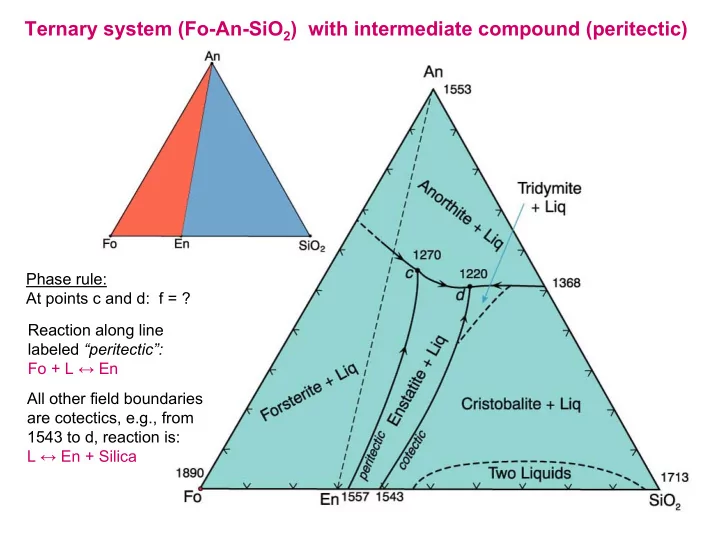
Ternary system (Fo-An-SiO 2 ) with intermediate compound (peritectic) Phase rule: At points c and d: f = ? Reaction along line labeled peritectic: Fo + L En All other field boundaries are cotectics, e.g., from 1543 to d, reaction


  1. Ternary system (Fo-An-SiO 2 ) with intermediate compound (peritectic) Phase rule: At points c and d: f = ? Reaction along line labeled “peritectic”: Fo + L ↔ En All other field boundaries are cotectics, e.g., from 1543 to d, reaction is: L ↔ En + Silica

  2. Ternary system (Fo-An-SiO 2 ) with intermediate compound (peritectic) Note: Fields of crystallization Eq m Xtl n of comp n a: of An, Fo, En and silica Eq m Xtl n of comp n d: a-b: Fo d-e: Fo b-c: Fo + L ↔ En e-f: Fo + L ↔ En c: Fo + L ↔ En + An f-g: En g-d': En + An at d': En + An + Silica: (at d': L ↔ En + An + Silica) g d' f Recall: tangent rule and how to determine nature of reactions along univariant boundaries d e and at invariant points

  3. Ternary system (Fo-An-SiO 2 ) with intermediate compound (peritectic) Fractional crystallization of composition a: a - b: Forsterite b - e: Enstatite e - d: En + An For melting of a solid assemblage of bulk composition a , what would be the first liquid produced? What differences are there between equilibrium melting and fractional melting of composition a ?

  4. Important systems with more than 3 components 1. “Granite” system (Ab-Or-Qz-H 2 O) This 4 component (Quaternary) system has been studied extensively since the publication of the classic memoir in 1958 by Tuttle and Bowen (GSA Memoir 74). There are 4 ternary sub-systems (Ab-Or-Qz; Ab-Or-H 2 O; Ab-Qz-H 2 O; Or-Qz-H 2 O) and 6 binary sub-systems. We have discussed the phase equilibria in the Ab-Or-H 2 O system. Time does not permit an extensive discussion of all the ternary systems so we will just focus on some of the key results at P = 5 kbars Qz H 2 O H 2 O V M: minimum on V a: L(Ab,Qz,V) b: L(Or,Qz,V) liquidus Qz+L 1065 1130 L+V L + V m(~1000) 1100 Afs+L a (690) 756 1100 875 b (730) Qz+L Ab+L Qz+L Or+L Ab Or Ab 1130 Qz Or Qz 1065 H 2 O To represent the phase equilibria in the quaternary (“granite”) system, the phase relations obtained under water-saturated conditions are a Qz projected from the water apex on to the triangular base of the tetrahedron, e.g., point a within the tetrahedron projects to a' on the base a' Ab Or

  5. “Granite” System at 5 kb Heavy lines show the location H 2 O of liquid compositions in Schematic perspective projection of V equlilibrium with various the H 2 0-saturated liquidus surface in crystalline assemblages the Ab-Or-Qz-H 2 O system at 5 kb Light lines (below the V-sat d This surface is labeled a-b-c-d-e-f-g surface are water present but V- and the numbers correspond to the undersat d equilibria, e.g., 690ºC- temperatures in ºC at each point 1130ºC line represents L(Ab,Qz) b(730ºC) – g(645ºC): L(Or ss ,Ab ss ,V) Fluid compositions lie f(690ºC) – g(645ºC): L(Ab ss ,Qz,V) L+V L+V close to H 2 O apex f(730 ºC ) – g(645ºC): L(Or ss ,Qz,V) e g(645ºC): L(Ab ss ,Or ss ,Qz,V) Qz At 5 kb, H 2 O-sat d liquids 730 690 d 645 contain ~10 wt% H 2 O f g L(Or ss ,Ab ss ,Qz,V) c a 1065 1130 701 b Ab Or

  6. “Granite” [Ab-Or-Qz-H 2 O] System at 2 kb and 10 kb (water saturated) Note: There is no ternary eutectic at P H2O = At P H2O = 10 kb, there is a ternary eutectic at 2kb. Instead, there is a minimum at 680ºC in T = 635ºC and the fields of Ab ss , Or ss and the field boundary separating the fields of quartz are distinct. Basically, the solvus and quartz and alkali feldspar. Recall the Ab-Or the solidus have intersected. system which shows that the solidus has not Phase Rule: variance at the eutectic? intersected the solvus at low P. Crystallization and melting behavior?

  7. Solidus in “Granite” [Ab-Or-Qz-H 2 O] System to 20kb (water saturated) Note: Curve shows the water saturated solidus in the “granite” system as a function of P. The diagonal line shows the one feldspar—two feldspar boundary (in effect the P and T of the crest of the solvus) The inset diagram shows the composition of the minima (at 1 and 2 kb) and the eutectic (at 5, 10 and 20 kb). At pressures above ~16 kb, albite is unstable and breaks down to jadeite + quartz. This produces an invariant point. What phases at present at the invariant point? The shaded area show the composition of most natural granites plotted on this diagram.

Recommend


More recommend


Explore More Topics

Stay informed with curated content and fresh updates.