SLIDE 1
1
100 Years of Voting: Women’s Rights and Responsibilities Text by Corinne Porter, curator of the National Archives, as presented at the online event of the ACWA, The U.S. Consulate General in Amsterdam and the John Adams Institute (Aug 27th, 2020) “Thank you, Pam. And thank you to the US Mission Amsterdam, US Consulate General Amsterdam, the American Women’s Club of Amsterdam and the John Adams Institute for putting together this exciting program to commemorate the 100th anniversary of the ratification of the 19th Amendment. [Slide of Rotunda] First, I’d like to begin with a bit about the National Archives or as I like to say “the nation’s record keeper.” Most people know the National Archives as the home of the Declaration of Independence, the Constitution and the Bill of Rights, but we preserve, protect and provide access to all the permanent records of the federal government. They document many of the most important milestones in American history, including the 19th Amendment. However, when I began to develop Rightfully Hers, I quickly realized that many people had never heard of the 19th Amendment or woman suffrage. Some people weren’t even aware that women only won the vote 100 years ago. Those who did know something about woman suffrage tend to picture images like this: [Slide of marching/picketing] And a narrative that goes:
SLIDE 2 2
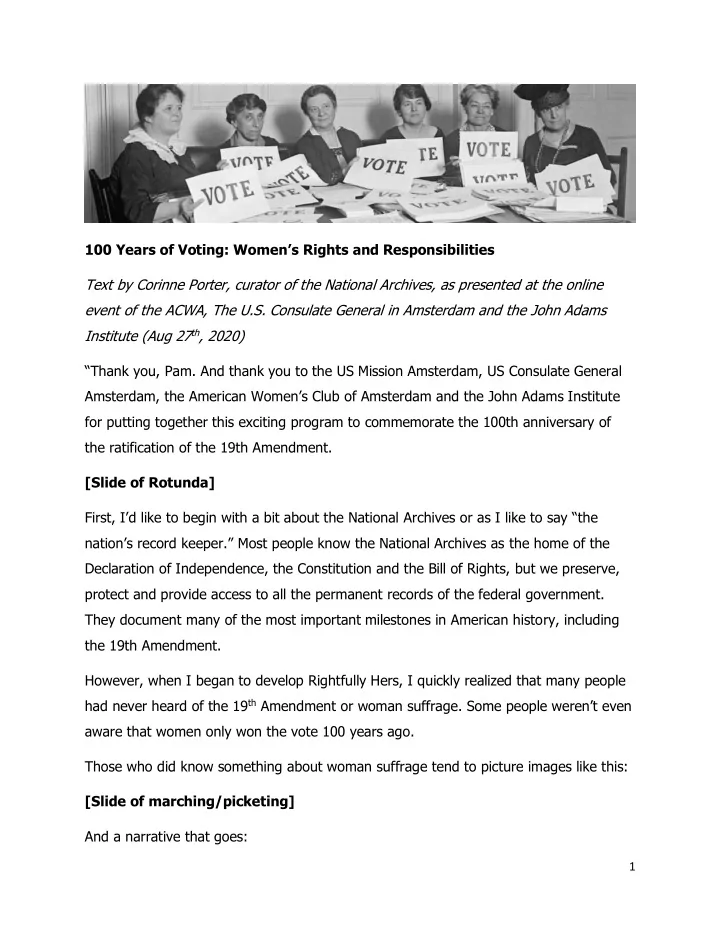
With Susan B. Anthony, Elizabeth Cady Stanton and Alice Paul leading the charge, women took to the streets to demand their rights. They marched down city boulevards and picketed the White House gates. For the “crime” of peacefully protesting for their rights, these heroines were arrested, and jailed where they endured horrific conditions and abuse. Nevertheless, they persisted until women finally received justice on August 18, 1920 when the 19th Amendment was ratified and women won the vote. There is truth in this, but as is so often the case, the story that we think we know about major historical events is not the full story. And, images like this with all white, mostly upper middle class women, don’t give us the full picture of who was fighting for women’s voting rights and what it took for them to succeed. A bigger issue, however, is the broad misunderstanding that the 19th Amendment gave all women the vote. In fact, millions of women across the country were already voters when the 19th Amendment passed. Many women, however, also remained unable to vote after 1920. Evidently, there is more to the story than this picture can tell us. In order to do justice to the legacy of the 19th Amendment and the generations of women who fought for their right to vote, Rightfully Hers offers a much more inclusive retelling of women’s struggle for the vote that reflects that diversity of women and strategies engaged in the struggle to win the vote for one half of the American people. But, in order to understand the story of women’s fight for the vote, we have to understand where the right to vote comes from in the United States. First, there is not a citizen’s right to vote in the Constitution. Not even today. The Constitution, when originally drafted in 1787, made no mention of qualifications for
- voting. And powers not reserved to the federal government by the Constitution, were
left to the states. [Berryman cartoon slide]
SLIDE 3 3
Over time, the Constitution has been amended to limit states’ power to exclude certain groups of Americans from voting, but the power that state governments have to determine voting qualifications for their residents dramatically shaped women’s struggle for the vote. It also continues to be a major factor in voting rights today. One other thing about the Constitution is that by design is REALLY HARD to change it. To give you a sense of this, the first time the 19th Amendment was proposed in Congress was in 1878 but it never even went for a vote. For 42 years, that same amendment was introduced at every session of Congress and either ignored or voted down before it finally passed and ultimately became the 19th Amendment. So what did it take for the 19th Amendment to finally pass? First, it took more than 70
- years. The received wisdom has traditionally been that the birth of the woman suffrage
movement happened in 1848 at the first women’s rights convention in American History in Seneca Falls, New York. Some historians argue that the origins of the suffrage movement are much earlier and much more dispersed. However, I’m going to pick up with the end of the Civil War, when woman suffragists, many who were also abolitionists hoped that they might secure their right to vote as Congress considered what the rights of newly emancipated slaves should be. [Slide Universal Suffrage] Unfortunately, the suffragists were left disappointed when the 14th and 15th Amendment prohibited states from denying the vote on the basis of race, color, or previous condition of servitude, but extended no voting protections to women of any race. This defeat really divided woman suffragists. Some refused to support the ratification of the 15th Amendment if “women” - and by this they meant white women - were denied the vote. It got so ugly that it split the woman suffrage movement into two factions. So for a time, the woman suffrage movement was composed of two separate national
- rganizations pursuing two separate strategies – one focused on the states, the other
SLIDE 4 4
- n winning the vote nationally. Neither was very successful on its own at winning new
voting rights for women. Eventually the two factions merged together after a couple of decades into the largest national woman suffrage organization in the country - which ultimately numbered more than 2 million women strong. Some suffragists, in the meantime, didn’t let the fact that they didn’t have the vote, keep them from showing up at the polls and trying to vote anyway. Susan B. Anthony was one such woman. She was famously arrested along with 14 other women for illegal voting in 1872. [Slide of Anthony arrest records – order to US Marshall to Arrest Anthony] Anthony wasn’t the only woman who did this, nor was she the first. Hundreds of women from California to Maine attempted the same strategy--not because they thought they could trick their way into the polls, but because they wanted to force a legal ruling on whether the 14th Amendment—which provides citizens equal protection under the law—granted them the right to vote. The question did make it to the Supreme Court, but the Court ruled unanimously that the Constitution did not guarantee a citizen’s right to vote and that states could restrict voting rights to men. So a legal path to the vote wasn’t a success. So, why was this so hard? Why did it take so long for women to gain traction in their fight for the vote? Clearly, male politicians did not support enfranchising women. But lot of women didn’t as well. [woman suffrage is a curse slide] In fact, anti-suffragists organized and lobbied politicians just as vigorously NOT to give women the vote as suffragists did to press for their place at the polls.
SLIDE 5 5
Of course that begs the question: Why on earth would women oppose their own enfranchisement? To start, the more than 70 year fight for the vote also marked a period of dramatic social change, when some women became increasingly active outside of the home and traditional ideas of gender roles began to shift. To some the very notion that women belonged in the public sphere was perceived as dangerous and frightening. They feared that women’s political participation would corrupt their moral virtue and disrupt the social order. But there’s more to it than that. While women hadn’t been very successful at gaining ground in their fight for the vote, after the end of Reconstruction in the South in the late 1800’s, former Confederate states had been very effective at suppressing the voting rights of African American men. [Postcard] Southern politicians feared that if women got the vote, it would include black women. If that happened, they believed it would be impossible sustain black men’s disfranchisement. Debates over woman suffrage were driven at least in-part by racial attitudes. This was not just limited to the anti-suffrage movement either. Suffragists made the same argument in this post card. Race-based arguments were made not only in support of or in opposition to giving women the vote, but also over whether or not women should get the vote by federal amendment or through state action. Despite fierce opposition to women’s enfranchisement, women were slowly gaining
- ground. Women actually lost ground, before they began to gain voting rights. After New
Jersey women lost the vote in 1807, it wasn’t until 1869 that Wyoming Territory gave women equal voting rights with men. Wyoming also became the first state after New Jersey to give women the vote when it achieved statehood in 1890. In fact, only states
SLIDE 6 6
west of the Mississippi passed woman suffrage until Illinois gave women partial voting rights in 1913. Many states, when they made women voters, gave women equal voting rights with men, but in other instances, women only got “limited” or “partial” suffrage, like Illinois. Meaning only certain women could vote, in certain elections. But if you have two separate ballots for women and men, you’ve kind of got a logistical mess on your hands on Election Day right? [Voting Machine] As states slowly began to pass woman suffrage, suffragists intensified their lobbying efforts on all fronts. State-level campaigns to win women full or partial voting rights were stepped up where success looked promising. Enfranchised women pressured their elected representatives to vote for a Federal amendment, and suffrage leaders fervently lobbied the President and Congress to do the same. [March photo] So let’s return to our marchers. As greater numbers of women join the fight for the vote, suffragists begin to stage large and dramatic parades and processions in cities and towns across the country that brought unprecedented visibility to their cause and helped gain tremendous public support. One of the most consequential marches, pictured here, was held in Washington, DC in 1913. Although they’re not pictured in any
- f the photographs from the march, we also know that women of color participated too.
[Marie Baldwin] One woman who was there was Marie Bottineau Baldwin. A member of the Turtle Mountain Band of Chippewa Indians, Baldwin, who was in law school at the time marched with other female lawyers. Alice Paul, who organized the DC march attempted to discourage black women from participating, however. Ultimately, Paul was overruled and black women joined the
SLIDE 7 7
procession, though they marched mostly in segregated units. One woman that refused to do so, was Ida B. Wells-Barnett. [Ida B spotlight slide] Wells-Barnett traveled to Washington, DC, from Chicago to participate in a suffrage march as a delegate from the state of Illinois. She famously refused to comply when she was ordered to march at the back of the parade with other African Americans, and marched with the Illinois delegation as she intended. [Black Women Voters photo] African American women and men played a really crucial role in the struggle for woman suffrage. They formed a robust network of black women’s clubs that actively worked to win women the vote and promote other reforms. However, as racial tensions mounted in the movement, some white women suffrage leaders increasingly discouraged or excluded black women from their activities. Some did so because they feared that including black women in their cause endangered their chances of winning the vote. Other suffragists held racist beliefs and preferred a segregated movement. But African American woman suffragists refused to accept this discriminatory treatment, no matter the reason. [SPOTLIGHT SLIDE] Wells-Barnett is one of 6 “Suffragist Spotlights” that are scattered throughout the
- exhibit. And I wanted to quickly mention the other women who are featured:
SLIDE 8
8
Mable Lee - A Chinese immigrant who marched for women’s enfranchisement even though she was barred from becoming a U.S. citizen because U.S. law at the time banned Asian-descended immigrants from naturalizing. Therefore, she remained unable to vote when New York adopted woman suffrage in 1917 and after the 19th Amendment was ratified in 1920. Rose Schneiderman - was a major force in New York’s labor community who used her powerful oratory and skills as a union organizer to rally working class support for woman suffrage that proved critical in turning women's fight for the vote into a mass movement. Adelina Otero Warren - was an influential Mexican American suffragist in the state of New Mexico. She was especially effective at engaging with Spanish-speaking men and women to gain critical support for women’s voting rights and she led a relentless campaign to keep pressure on New Mexican state legislators until they voted to ratify the 19th amendment. [Spotlight Slide 2] Fannie Lou Hamer - was a sharecropper in Mississippi when she began her struggle to register to vote. She persisted until she was successful, and then devoted herself to facilitating voter registration among other African Americans for which she received repeated threats on her life. In 1964, Hamer challenged the all-white political establishment in the state of Mississippi in nationally televised testimony that proved pivotal in the struggle for African American voting rights in the U.S. South. Vilma Martinez - was a leader in the Mexican American civil rights movement during the 1970s and played a critical role in expanding voting rights for Spanish-speaking citizens and other language minorities from discrimination at the polls.
SLIDE 9
9
Hamer and Martinez were voting rights activists who fought for the vote after 1920, but any woman who fights for the vote is a suffragist. But, let’s return to the struggle for the 19th Amendment. So women are marching by the thousands, petitioning by the millions, and women are voting too. Finally, suffragists have some real momentum behind their cause and then the country declares war against Germany and enters World War I. And just like the conclusion of the Civil War, woman suffragists are once again divided over what to do. Most suffragists feared that fighting for the vote while U.S. soldiers fought abroad would be seen as unpatriotic, and so they stopped publicly agitating for the vote and directed their energy to supporting the war effort. [Silent Sentinels] The militant branch of the suffrage movement, a small minority, however, who were led by Alice Paul, persisted in their public protest. They were the first Americans to picket the White House – and they openly criticized the president for fighting a war to “make the world safe for democracy” while women at home lacked full citizenship rights. The Wilson Administration did not respond kindly. The picketers were arrested, jailed and subjected to deplorable treatment. Although their protest activities were not popular with many suffrage leaders or the public, Americans were nevertheless shocked that government authorities would jail women for demonstrating peacefully for their rights. Collectively, women’s contributions to the war effort, sustained political pressure and numerous state suffrage victories that had significantly increased the number of congressional seats representing women voters, was finally enough to turn the political tide in favor of women’s enfranchisement. [Slide of Joint Resolution] And on June 4, 1919, Congress passed a joint resolution proposing a woman suffrage Amendment be added to the Constitution. However--I said that amending the
SLIDE 10 10
constitution is really hard—and suffragists’ fight for that long-sought amendment was not quite over. For the proposed amendment to become the 19th Amendment to the Constitution it not
- nly had to pass both the House and the Senate by a two-thirds majority, it also had to
be ratified by legislators in three-fourths of the states. It was a grueling process to secure enough state ratifications which culminated in Tennessee. Tennessee’s ratification of the 19th Amendment came down to a single vote cast by Harry T. Burn, a 24-year-old freshman legislator. Burn had intended to vote against the measure. However, he promised his mother, Febb E. Burn, that he would vote for ratification should his vote be needed for it to pass. When it came time to vote on the 19th Amendment on August 18, 1920, he kept his promise to his mother and the measure passed by a single vote. [Slide TN Rat] With Tennessee’s ratification, the 19th Amendment had received the requisite number
- f state ratifications to become the law of the land. It took three generations of
relentless political pressure to win this landmark voting rights victory and resulted in arguably the most dramatic expansion of the electorate in American history. But, I’d like you to take a closer look at what the 19th Amendment says: [Quote slide] “The right of citizens of the United States to vote shall not be denied or abridged by the United States or by any state on account of sex. In effect, the 19th Amendment won women the vote. But it is not an affirmative statement that women have the right to vote. It just says that a citizen’s vote cannot be denied by because of sex. There’s nothing in the amendment that prevents states from denying women the vote for other reasons. And for that reason the ratification of the
SLIDE 11 11
19th Amendment was not a victory universally enjoyed by all women. So before I close, I’d like to touch on a few of the voting right struggles that exhibit tells beyond 1920. First, the 19th Amendment did not apply to citizens that lived in U.S. territories like Puerto Rico, or the federal District of Columbia. So Puerto Rican women, had to fight for another 15 years before the Puerto Rican territorial legislatures gave all adult women the right to vote in 1935. Residents in the District of Columbia also have never enjoyed the same voting rights as those in the states. And it has been through piecemeal legislation throughout the 20th Century that District residents gained some voting rights, including the right to vote for President. Today, residents of Puerto Rico and DC still lack voting rights and voting representation in Congress that is equal with U.S. citizens that live in the States. The 19th Amendment also did not extend the vote to women who were not yet recognized as U.S. Citizens, including some Native American and Asian immigrant
- women. It wasn’t until 1924 that all Native Americans were granted U.S. citizenship.
And Asian immigrants were largely prohibited from naturalizing until changes to immigration laws in the mid-20th century lifted those restrictions. Even as citizens, Native, Asian, and other minority Americans often faced discriminatory barriers to voting that were similar to those experienced by African Americans in the Jim Crow South. As I already mentioned, after Reconstruction Southern states had effectively disfranchised most black men. The discriminatory laws and practices also kept many black men from voting in South also kept many black women from the polls after the 19th Amendment was ratified. While targeted at African Americans, these measures also kept many poor and poorly educated people of all races from the polls. A disproportionate number of who were women.
SLIDE 12 12
African American women and men risked their lives fighting for their civil rights. They finally secured a landmark voting rights victory with the passage of the Voting Rights Act in 1965, which outlawed many of the discriminatory practices that had disfranchised black voters for decades. The Voting Rights Act included a provision that required federal oversight of changes to voting laws in states with a history of voter suppression. However in Shelby County v. Holder in 2013, the Supreme Court in a 5-4 decision struck down the formula that was used to determine which states were required to clear changes to their election laws with the Federal government. The provision is currently unenforceable until Congress passes a new formula, which it has not done to date. [Fredshal slide] The question of what Americans citizenship rights should be, and who should be entitled to them has been an ongoing national conversation since our nation’s founding. It is a debate that continues today. But, like Mrs. Fresdhal, I hope you will all honor the legacy and sacrifice of the generations of Americans who fought to open the polls for themselves and millions of
- ther Americans by casting your ballot every election day.
[RH Info Slide] Thank you all for your time and attention and I look forward to answering any questions you have.”